



















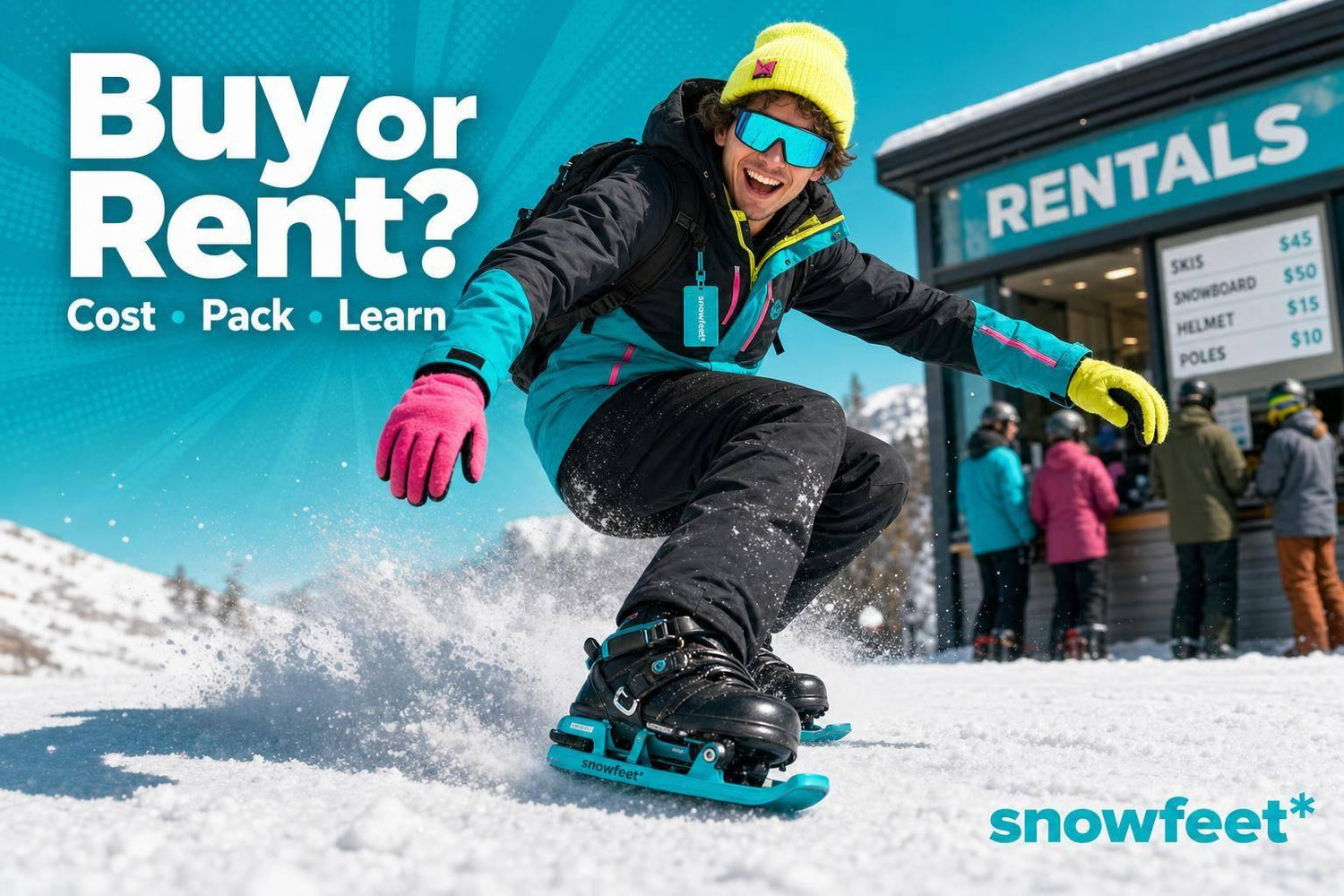
If you ski a few days a year, Snowfeet can cost less than rentals after about 4 to 10 days of use. If you’re taking one short trip, renting is still the lower-cost start.
Here’s the short answer: I’d pick Snowfeet for casual trips, easy packing, and skipping the rental line. I’d pick rentals for full-size skis, deep powder, formal lessons, or high-speed carving.
What stands out right away:
- Resort rentals often cost $60–$80 per day
- Big-name resorts can hit $90–$120+ per day
- Rental add-ons can add $3–$30 per day
- Some Snowfeet models can pay off in about 4 to 5 days
- Snowfeet are much easier to pack than skis that run 150–195 cm
- Rental lines can eat up 30–90 minutes on busy mornings
So, if you want the plain-English version:
- Buy Snowfeet PRO 50 cm if you want the easiest entry point
- Buy Skiskates 44 cm if you travel a lot or like a skate-like feel
- Buy Skiblades 65 cm if you want a middle ground
- Rent if you want the closest feel to full-size skis or a snowboard
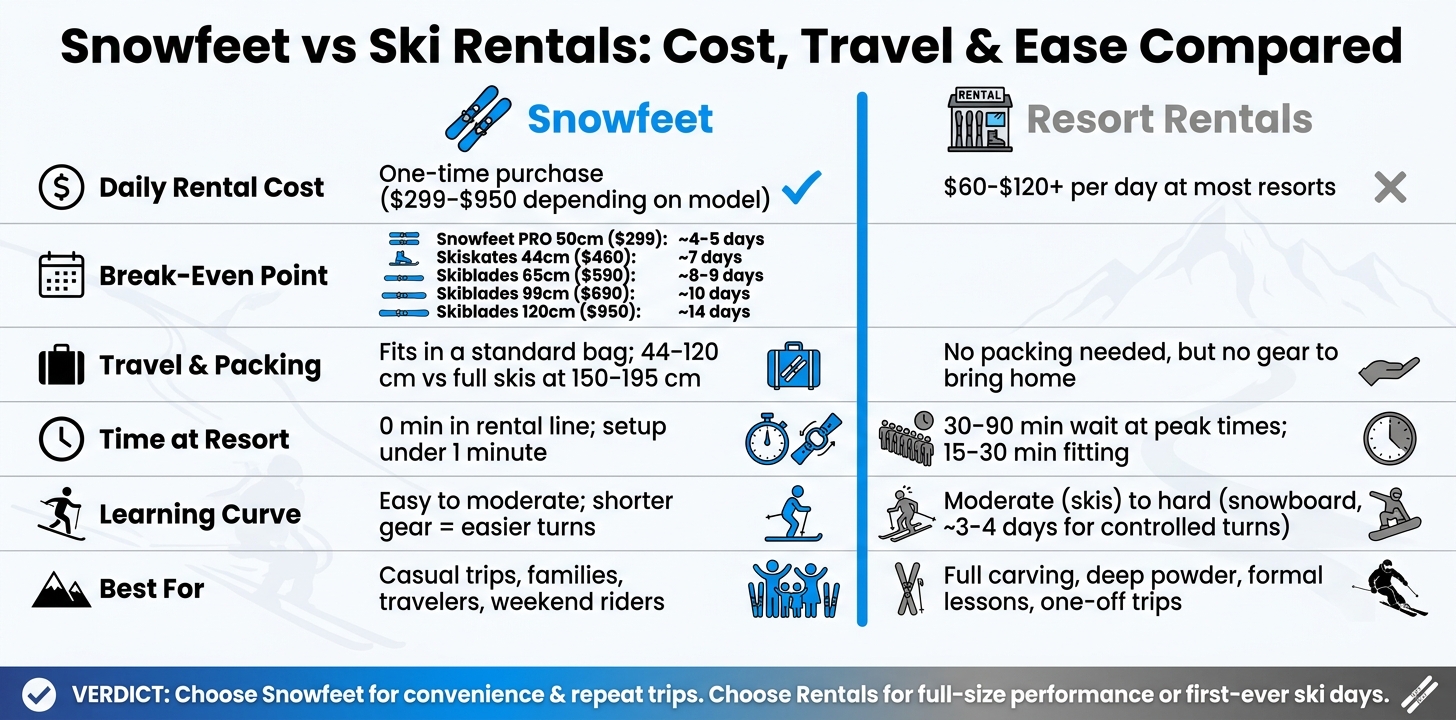
Snowfeet vs Ski Rentals: Cost, Travel & Ease Compared
Snowboarder tries Snowfeet* | Which Snowfeet* Short Ski is the Best? | Snowblades 44, 65, 99 Review
Quick Comparison
| Option | Upfront Cost | Trip Cost Over Time | Travel Ease | Learning Curve | Best For |
|---|---|---|---|---|---|
| Snowfeet PRO 50 cm | From $299 | Lower after about 4–5 days | Very easy | Easy | Casual riders, first-time buyers |
| Skiskates 44 cm | From $460 | Lower after about 7 days | Very easy | Medium | Travelers, skaters, park laps |
| Skiblades 65 cm | From $590 | Lower after about 8–9 days | Easy | Easy | Resort laps, more balance |
| Skiblades 99 cm | From $690 | Lower after about 10 days | Easier than skis | Medium | Riders who want more ski feel |
| Skiblades 120 cm | $950 | Lower after about 14 days | Easier than skis | Medium | More stability, closer to skis |
| Resort Rentals | Low day-one cost | Adds up fast | No packing needed | Depends on gear | One-off trips, lessons, powder days |
My take: Snowfeet make the most sense when convenience matters as much as performance. That means weekend trips, family trips, and fly-in resort days where you don’t want to drag a giant ski bag through the airport like it owes you money.
If that sounds like your trip, this comparison will help you make the call fast.
Cost Per Trip vs. One-Time Purchase
Rental fees at U.S. resorts stack up fast. Faster than most people think, honestly. A standard adult ski or snowboard package usually costs about $60–$80 per day at a midrange resort and can hit $90–$120+ per day at major destination resorts during peak periods.
For a family of four, that gets expensive in a hurry. A long weekend of rentals can land at $500–$800 before you even touch lift tickets or food. In many cases, that’s already more than the price of entry-level Snowfeet* models.
And the sticker price isn’t always the full story. Rental shops often tack on extra charges:
- Damage waivers: $3–$10 per day
- Demo upgrades: $10–$30 per day
On a 3-day trip, those add-ons can pile another $40–$120 onto the bill. That shifts the break-even point toward ownership sooner than a lot of people expect. So the real question isn’t just what costs less today. It’s how fast each option pays for itself based on the trips you take.
The table below uses a $70/day midrange adult rental reference to show how Snowfeet* models compare:
| Snowfeet* Model | Approx. Price | Break-Even (at $70/day rental) | Best Use Case |
|---|---|---|---|
| MINI KIDS | From $250 | ~4 days | Best for repeat use across seasons |
| PRO 50 cm | From $299 | ~4–5 days | A long weekend plus an extra day or two |
| Skiskates 44 cm | From $460 | ~7 days | Multiple trips or a full week on snow |
| Skiblades 65 cm | From $590 | ~8–9 days | Frequent weekend trips or longer stays |
| Skiblades 99 cm | From $690 | ~10 days | Several trips per season |
| Skiblades 120 cm | $950 | ~14 days | Frequent riders who want the closest feel to traditional skis |
That said, low upfront cost still matters. If you're heading out for a one-off trip, just starting, or buying for kids who’ll outgrow gear in no time, renting can still be the easier move.
When Renting Costs Less Up Front
Renting still wins in a few cases. If you’re planning one beginner trip and don’t know if you’ll come back for another, paying for a day or two of rentals is the lower-risk play than buying a $250+ Snowfeet* model right away.
The same goes for first-timers who want to test traditional skis or a snowboard before buying anything. Sometimes you just want to try it and see if it clicks. Fair enough.
For families with very young kids, growth is the big thing. Boot size can change fast, sometimes within the same season. In that case, short-term or seasonal rental packages can cost less than buying gear that may not fit for long.
Which Snowfeet* Model Offers the Best Value
Each model makes sense for a different kind of rider.
MINI KIDS is the best pick for families. The main win isn’t only the price math. It’s skipping the rental shop routine each season, which, let’s be honest, can feel like its own side quest.
PRO 50 cm is the lowest-cost entry point for casual adult riders. If you want a simple option instead of full rentals and expect even a couple of return trips, this is where the numbers start to look good.
Skiskates 44 cm make a lot of sense for travelers. They’re compact enough to fit in a carry-on and small enough to help you dodge oversized sports-equipment fees at the airport. That’s a nice little bonus.
Skiblades 65 cm work well for casual resort riders who want more stability without dragging around full-size skis. They fit the sweet spot for multiple weekend trips or use across more than one season.
Skiblades 99 cm and Skiblades 120 cm are better for riders who want more ski-like stability and a feel closer to traditional skis, while still keeping the portability edge over a full rental setup.
Once the cost side makes sense, the next thing that stands out is how much easier Snowfeet* is to pack, carry, and use at the mountain.
sbb-itb-17ade95
Packing, Travel, and On-Mountain Convenience
If the price gap is small, travel ease often becomes the tie-breaker. And honestly, packing can shape the whole trip before you even see the mountain.
Why Snowfeet* Is Easier to Travel With
Adult skis are usually 150–195 cm long, and snowboards tend to land in the 140–170 cm range. That’s a lot of gear to haul around. Snowfeet* flips that idea on its head.
The Skiskates at 44 cm are the smallest adult-size option. The Snowfeet PRO 50 cm is another very compact pick. Even the 120 cm Skiblades are far easier to handle than full-length skis or a snowboard.
For casual riders, smaller gear means less headache and more time on snow. Snowfeet* fit into much smaller bags than 150–195 cm skis or 140–170 cm snowboards. That makes car packing, hotel storage, and airport travel a lot simpler. For flights, Snowfeet* are far more likely to fit inside a standard checked bag or other compact luggage, which helps you avoid oversize-baggage trouble. Airlines often make room for ski gear that goes past normal size limits, but the usual 62 linear inches (158 cm) rule still causes plenty of confusion, and full-size skis often exceed it.
Renting at the resort does wipe out the airport issue. If you’re flying with tight baggage rules and only taking one trip, picking up gear on-site may still be the easiest path. But for a road trip, a winter trip with a few stops, or a stay in a small hotel room or condo, Snowfeet* cut down a lot of the packing and storage mess that comes with relying on rentals.
Boot Compatibility, Rental Lines, and Setup at the Mountain
This is where the ease gap gets more obvious. On busy weekend mornings, rental shops can eat up 30–90 minutes before you even touch the snow. With Snowfeet*, you bring your gear, step into the right boots, and head out. For riders who already own boots that fit the model, that’s a big time saver.
Boot fit depends on the model, so check that before you buy. The Snowfeet PRO 50 cm and original Snowfeet* models work with standard waterproof winter boots or snowboard boots. Skiskates come in two versions: one for winter or snowboard boots, and one for hard-shell ski boots. Skiblades use ski boot bindings. If you already have the right boots, setup takes less than a minute. If not, rentals may still be the simpler call.
| Feature | Snowfeet* | Rental Gear |
|---|---|---|
| Luggage Size | Fits in a compact bag; larger models may need a small ski bag | N/A - picked up at resort |
| Air Travel | Low oversize risk - standard bag in most cases | None - no gear to transport |
| Time at Resort | 0 minutes in rental line | 30–90 minutes at peak times |
| Setup Speed | Under 1 minute | 15–30 minutes (fitting + adjustments) |
| Post-Trip Storage | Shelf, drawer, or small closet | N/A - returned to shop |
| Boot Compatibility | Winter boots, snowboard boots, or ski boots depending on model | Rental boots included |
| Walking Ease | High on boot-compatible models; lower on ski-boot models | Low - stiff rental boots |
There’s another small win here too: Snowfeet* can make walking around the resort much easier when you’re using a model that works with winter boots.
Once the gear is packed and on your feet, the next step is simple: how each option feels once it hits the snow.
Learning Curve and How Each Option Feels on Snow
Learning Snowfeet* is often faster. The reason is pretty simple: shorter gear is easier to turn, easier to pull back under you, and less likely to catch a tip. That alone makes the first few runs feel less sketchy.
From there, the big question is which Snowfeet* model fits your skill level and the kind of ride you want.
Best Snowfeet* Model by Skill Level
Snowfeet PRO 50 cm is the easiest place to start. Skiskates 44 cm fit best if you already skate. Skiblades 65 cm sit in that sweet spot between balance and quick movement. And Skiblades 99 cm plus 120 cm lean more toward a ski-like ride.
| Model | Length | Beginner Friendliness | Turning Speed | Stability | First-Timer Confidence |
|---|---|---|---|---|---|
| Skiskates | 44 cm | Moderate (best for skaters) | Very fast | Low | Moderate |
| Snowfeet PRO | 50 cm | Very high | Fast | Medium-low | Very high |
| Skiblades | 65 cm | High | Fast | Medium | High |
| Skiblades | 99 cm | Moderate | Medium-fast | High | Moderate |
| Skiblades | 120 cm | Moderate | Standard | Very high | Moderate |
So, what’s the best pick?
- Want the easiest learning curve? Go with Snowfeet PRO 50 cm.
- Want a mix of balance and quick turns? Skiblades 65 cm make a lot of sense.
- Want something that feels closer to skis? Look at Skiblades 99 cm or 120 cm.
That playful-to-ski-like range sets up the bigger slope comparison with rental skis and snowboards.
Snowfeet* vs. Rental Skis and Snowboards on the Slope
Rental skis do a great job with stability at speed and edge hold on hard snow. If you're planning long groomer runs or want to carve faster, that's their lane.
But there’s a trade-off. More length gives you more stability, sure, yet it also gives you more gear to manage. And when things get messy, uh, that extra length can be harder to recover.
Snowboards are tougher on day one. Many beginners don’t get controlled turns down until around day 3 or 4, because a sideways stance, toe-side and heel-side transitions, and stopping all hit at once. That’s a lot for one brain and two legs.
Snowfeet* skip much of that headache. Your feet stay forward. The movement feels closer to walking or skating. And the fun part tends to show up a lot sooner :)
Rental skis and snowboards still make more sense for riders who care most about speed. But for casual trips, park laps, and first-timer confidence, Snowfeet* are often the easier bet. That matters when you're picking gear for your trip length, your group, and how you want to ride.
Which Option Fits Your Trip and Riding Style
After cost, packing, and the time it takes to get used to the gear, trip fit is what usually settles it.
Best Picks for Beginners, Families, Travelers, and Snowboarders
Here’s the simple version. If you want gear that’s easy to pack, easy to use, and a good match for laid-back resort days, Snowfeet* often make a lot of sense. If you want the feel of full-size skis or a snowboard, rentals can still be the better call.
| Rider Type | Best Snowfeet* Option | When Renting Is the Better Choice | Terrain Suitability |
|---|---|---|---|
| Young children | MINI KIDS | Kids are growing quickly and need regular refitting | Bunny slopes, gentle learning areas |
| Beginners / casual riders | Snowfeet PRO 50 cm | First-ever ski day with formal lessons planned | Groomed resort laps, easy groomers |
| Skaters / compact travelers | Skiskates 44 cm | You want full-size carving and higher-speed stability | Terrain parks, groomed hardpack |
| Casual resort users | Skiblades 65 cm | You want full-size skis or a snowboard | All-mountain groomed runs |
| Intermediate riders | Skiblades 99 cm | You want full-length ski performance or powder days | Mixed groomed terrain, light powder |
| Traditional ski feel | Skiblades 120 cm | You want full-length ski performance for carving or deep snow | Groomed runs, more control at speed |
| Snowboarders | Skiskates 44 cm or Skiblades 65 cm | You want a standard snowboard stance and progression | Groomed laps, park-style terrain |
A quick way to think about it: shorter options feel more playful and travel-friendly. Longer options move closer to the feel of regular skis. So if you like quick turns, simple packing, and mellow resort laps, the shorter Snowfeet* setups are hard to beat. If you want more speed control and a ride that feels closer to skis, the longer Skiblades options will feel more familiar.
When Renting Still Makes More Sense
Rentals still win when the trip calls for full-size gear. Go with rentals when you need:
- Full-length ski carving
- Deep powder performance
- A true snowboard experience
That’s the plain truth. If your day is all about charging hard, laying into big carved turns, or riding deep snow, full-size rentals are still the safer bet.
Conclusion: The Better Choice for Most Casual Ski Trips
Rent when you need full-size performance. Choose Snowfeet* when you want the easiest, most flexible setup for a casual resort trip.
FAQs
Do I need special boots?
No - most Snowfeet products don’t need special ski boots.
Many models, including Skiskates and smaller Skiblades, work with regular winter boots or snowboard boots. That means you can skip stiff ski boots and stay more comfortable, both on the slopes and when you’re walking around.
For 120 cm models and longer, ski boots are required. Those longer models need more support and a more secure fit, especially at higher speeds. So, always check the details for your exact model.
Are Snowfeet good for beginners?
Yes - Snowfeet are a great pick for beginners.
Their shorter length makes them feel a lot less intimidating than standard skis. They’re also easier to turn and control, which helps new riders get the hang of things fast. In many cases, people can learn the basics in as little as five minutes to one day.
Another big plus: you can use them with comfy winter boots or snowboard boots. That means beginners can skip those stiff, specialized ski boots that, let’s be honest, can feel like walking around in plastic buckets.
For extra ease and safety, look for models with ski-release bindings. Those bindings can detach during a fall, which makes them an even better fit for first-time riders.
When is renting still better?
Renting traditional gear still makes more sense if your trip is all about high-speed downhill racing, hard charging carves, or deep, untouched powder.
That’s where traditional alpine skis still win. They give you better edge grip, more stability, and more float when conditions get steep, fast, and demanding. Snowfeet* products stand out for convenience, agility, and easy carry, but long skis are still the go-to for tough terrain where power and surface area make a big difference.











Lasă un comentariu
Acest site este protejat de hCaptcha și hCaptcha. Se aplică Politica de confidențialitate și Condițiile de furnizare a serviciului.