




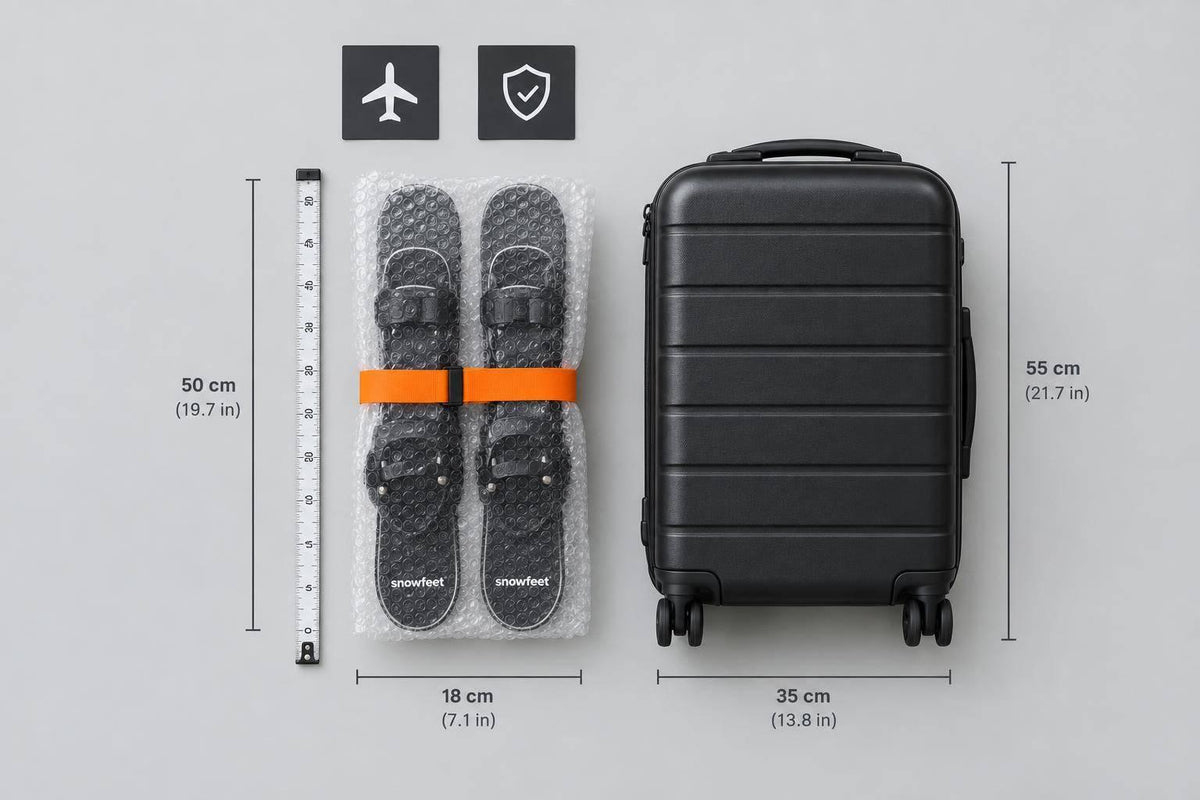
Snowfeet are easier to pack than long skis - but fitting in your bag doesn’t mean they can fly carry-on. My advice: measure your gear with boots and padding, then check your airline’s baggage fees and security rules before you buy.
Here’s how I’d narrow down the options:
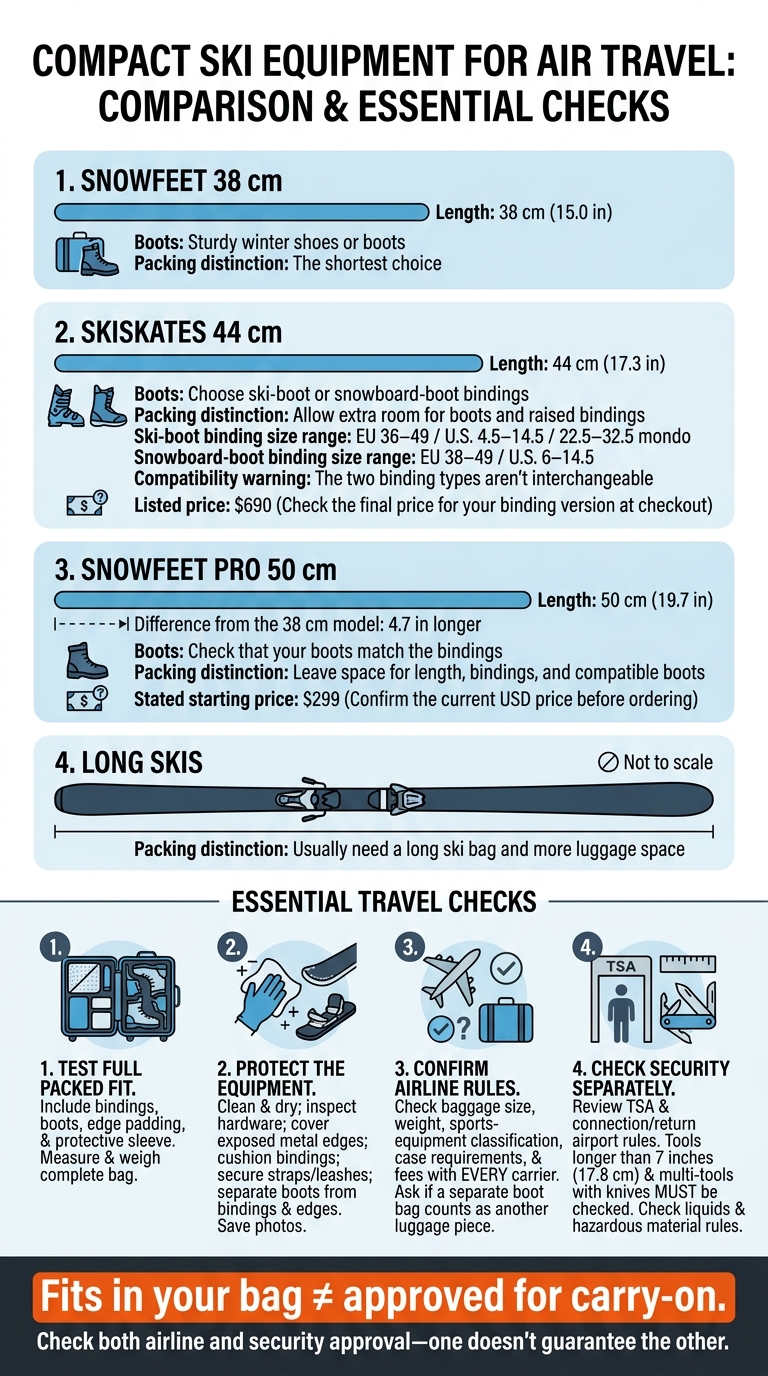
- Snowfeet 38 cm (15.0 in): The shortest choice, used with sturdy winter shoes or boots.
- Snowfeet PRO 50 cm (19.7 in): More length to pack. Check that your boots match the bindings.
- Skiskates 44 cm (17.3 in): Choose ski-boot or snowboard-boot bindings, and leave room for those boots.
- Long skis: Usually need a long ski bag and more luggage space.
Before I zip up, I’d cover the edges, cushion the bindings, and weigh the whole bag. Then I’d confirm current prices, check tool restrictions, and ask each operating airline how it treats the gear.
Small skis. Still a few travel rules. <u>Check both airline and security approval</u> - one doesn’t guarantee the other.
Flying With Snowfeet: Size, Boots, and Packing
Snowfeet* & Skiskates Complete Guide | All you need to know about Skiskating
Snowfeet PRO 50 cm: A Longer Compact Option
The PRO measures 50 cm (19.7 in) - 4.7 in longer than the 38 cm model, but still much easier to pack than long skis. Snowfeet calls it backpack-friendly, though airline rules determine whether it can go in your carry-on. Leave enough bag space for its length, bindings, and compatible boots.
Check Suitcase Fit and Boot Requirements
Check the fit with the bindings, edge padding, and any protective sleeve in place. If the PRO won’t fit lengthwise, try placing it diagonally. Don’t force it against the case walls or beneath the zipper. Pack boots beside the PRO, not on top of its bindings.
Before packing, check that your boots match your chosen binding setup. Secure straps and adjustable parts as Snowfeet directs, then weigh the packed case with the boots inside.
Check the Snowfeet PRO 50 cm Setup and Price
Review binding options through the official Snowfeet PRO 50 cm product search. The stated starting price is $299. Before ordering, check the current USD price, confirm boot compatibility, and check the total packed weight.
If you travel with ski boots, compare the 44 cm Skiskates next.
Skiskates 44 cm: Allow Space for Boots
If you already travel with ski or snowboard boots, Skiskates 44 cm are a compact step up from the PRO 50 cm.
Snowfeet* Skiskates measure 44 cm (17.3 in). They’re easier to pack than conventional skis, but the boots and raised bindings still need extra room.
Choose Ski-Boot or Snowboard-Boot Bindings
Pick the version made for your boots. Each binding has its own listed size range:
- Ski-boot binding: EU 36–49 / U.S. 4.5–14.5 / 22.5–32.5 mondo
- Snowboard-boot binding: EU 38–49 / U.S. 6–14.5
The two binding types aren’t interchangeable. Test your boots in your chosen binding before you leave. Make sure the mechanism closes securely and that no sole, buckle, or boot edge gets in the way.
Skiskates are best suited to travelers who already plan to bring ski or snowboard boots.
Compare Model Prices and Trip Fit
Select your binding version on the official Skiskates 44 cm product page. Listed price: $690. Check the final price for your binding version at checkout.
Their small size doesn’t guarantee airline carry-on approval or travel without extra fees.
Before packing them, pad the edges and bindings to protect them in your bag.
sbb-itb-17ade95
Pack Snowfeet to Prevent Damage
Once you know the model fits your bag, protect its edges and bindings. Snowfeet’s short length makes them much easier to pack safely in a suitcase than full-length skis.
Clean and dry the skis, bindings, and hardware before packing. Wear gloves when handling metal edges - they can cut. Check binding screws and connections for loose parts or damage.
Cushion Edges, Bindings, and Boots
Cover all exposed edges with foam, thick cardboard, or purpose-made guards. Secure the covers so they won’t shift. Wrap bindings and buckles in a towel or fleece, then place the padded skis in a sleeve at the center of a hard-shell suitcase, surrounded by soft clothing.
A storage bag helps prevent scratches. Padding protects against impacts. Use hook-and-loop ties to secure straps and leashes without folding them sharply. Put small parts in a closed pouch.
Pack heavy boots near the suitcase wheels. Use thick clothing or a divider to keep them apart from bindings and edges.
Take photos of the equipment’s condition and how you packed it. Then weigh and measure the full bag, including boots, padding, and tools.
Use a Final Packing Checklist
Run through this checklist before closing your bag. Then compare the packed bag’s size and weight with your airline’s limits.
| Check | Before closing the bag |
|---|---|
| Snowfeet | Clean, dry, and inspect hardware |
| Edge protection | Cover every exposed metal edge |
| Binding protection | Cushion buckles; secure straps and leashes |
| Compatible boots | Pack apart from bindings and edges |
| Tools and liquids | Check TSA rules for each item; pack securely |
| Total luggage weight and size | Include all contents |
| Condition record | Save photos until the trip is over |
Check TSA rules for wax, liquids, screwdrivers, and sharp tools. Tools longer than 7 inches (17.8 cm) must go in checked baggage. Multi-tools with knives must also be checked. Sheath or securely wrap sharp items, and keep restricted accessories out of cabin baggage.
Before each trip, review the liquids and hazardous-material rules for your maintenance products. The TSA officer makes the final decision at the checkpoint.
Check Airline and Security Rules
Once you’ve picked a model that fits your bag, check the airline’s rules. Fitting in a suitcase doesn’t mean it’s approved for carry-on travel. Airlines may treat Snowfeet as sports equipment and require you to check them in a protective case.
Confirm Baggage Limits and Equipment Fees
Check cabin size and weight limits, checked-bag allowances, oversize charges, sports-equipment fees, and case rules. Start with the sports-equipment policies for American, United, and Delta. Don’t assume standard ski rules apply to Snowfeet.
Then confirm which airline operates your flight and ask how it will classify your specific model. For codeshare flights, check with each operating carrier, including the one handling your return flight. Ask whether a separate boot bag counts as another piece of luggage. Save written confirmation of the fees and rules that apply.
Check Security Rules for Every Flight
Airline approval doesn’t guarantee your gear will pass security. Check even the smallest Snowfeet setup in the TSA “What Can I Bring?” database. Also check the rules in any country where you connect and at your return airport. Passing security in the United States doesn’t guarantee approval elsewhere.
Conclusion: Choose Snowfeet That Fit Your Luggage
For most casual travelers, Snowfeet 38 cm, Snowfeet PRO 50 cm, and Skiskates 44 cm are easier to pack than long skis. Pick the model that fits your luggage and protect it for travel. Before buying, check baggage rules, security rules, and the current price.
FAQs
What if security won’t allow my Snowfeet in my carry-on?
If security won’t let you take your Snowfeet in your carry-on, you’ll need to check them. Their compact size makes them easier to fit in a standard suitcase or duffel bag than full-length skis. That may help you avoid oversized baggage handling.
Wrap them in soft clothing or pack them in a padded case to protect the edges and bindings. Before you travel, check your airline’s baggage size and weight limits so you don’t get hit with surprise fees.
Which Snowfeet setup takes up the least space with boots?
The Snowfeet 38 cm Mini Ski Skates take up the least room when you factor in boots. They strap onto regular winter or snowboard boots, so you can leave specialized ski boots off your packing list.
The 44 cm Skiskates and 50 cm PRO models also fit in suitcases or backpacks. But the 38 cm model’s shorter length and fit with everyday footwear make it the most portable choice.
Does travel insurance cover damaged Snowfeet?
The available information doesn’t confirm whether travel insurance covers damaged Snowfeet. Check your policy or contact your insurance provider to ask if it covers damage to sports equipment or personal belongings during transit.












Lasă un comentariu
Acest site este protejat de hCaptcha și hCaptcha. Se aplică Politica de confidențialitate și Condițiile de furnizare a serviciului.