



















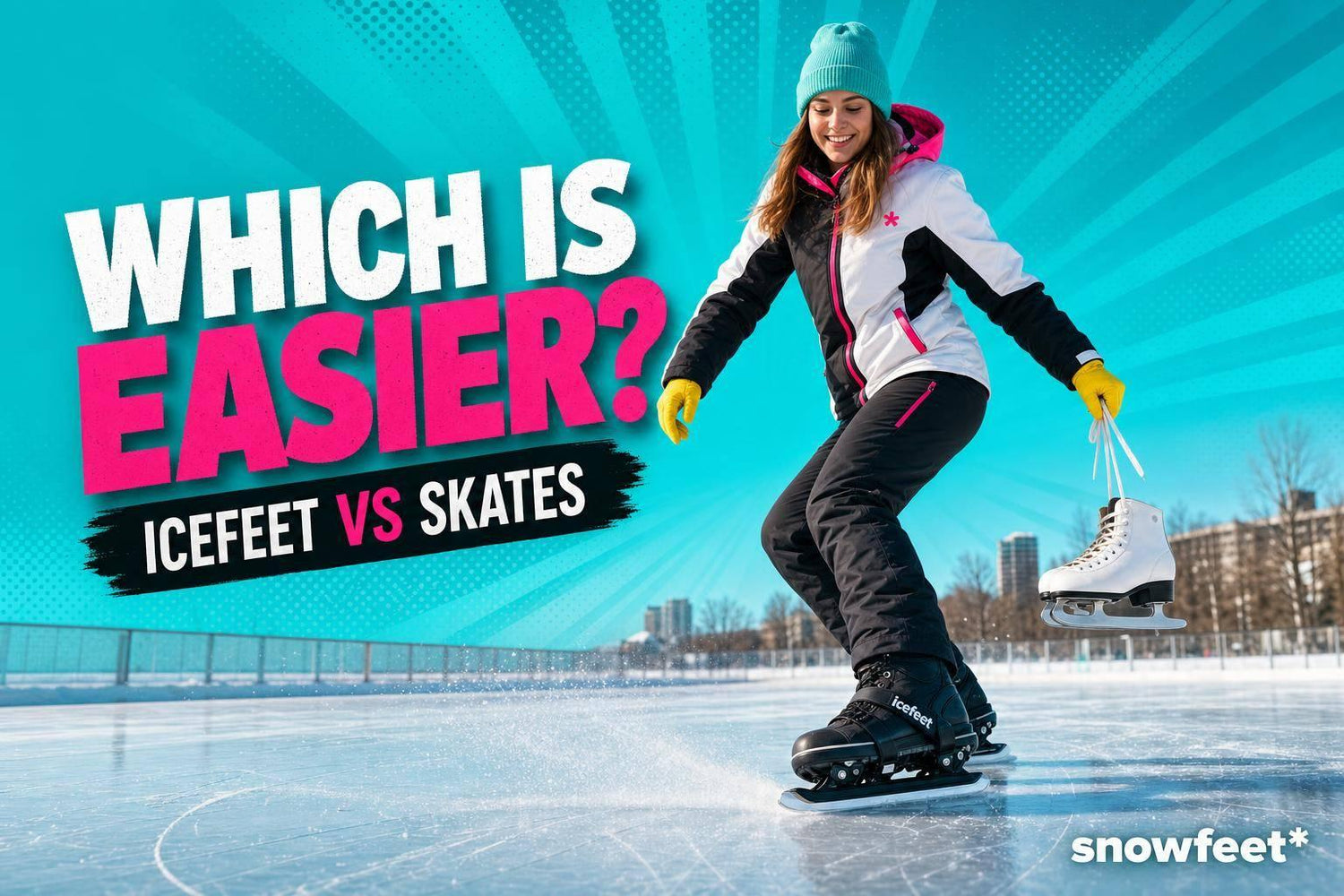
For most first-timers, Icefeet are easier to start with. They clip onto your winter boots, feel more stable at low speed, and take less effort to get used to on day one.
If I had to sum it up fast, here’s the call:
- Pick Icefeet if you want an easy first ride, less wobble, and simple setup
- Pick ice skates if you want better long-term skating form
- Icefeet help most with standing, slow gliding, easy turns, and comfort
- Ice skates help most with hockey, figure skating, lessons, and sharper control later on
A lot of beginners quit early because the first 10 minutes feel awkward. That’s the whole game here. If your first session feels calmer, there’s a better chance you’ll keep going.
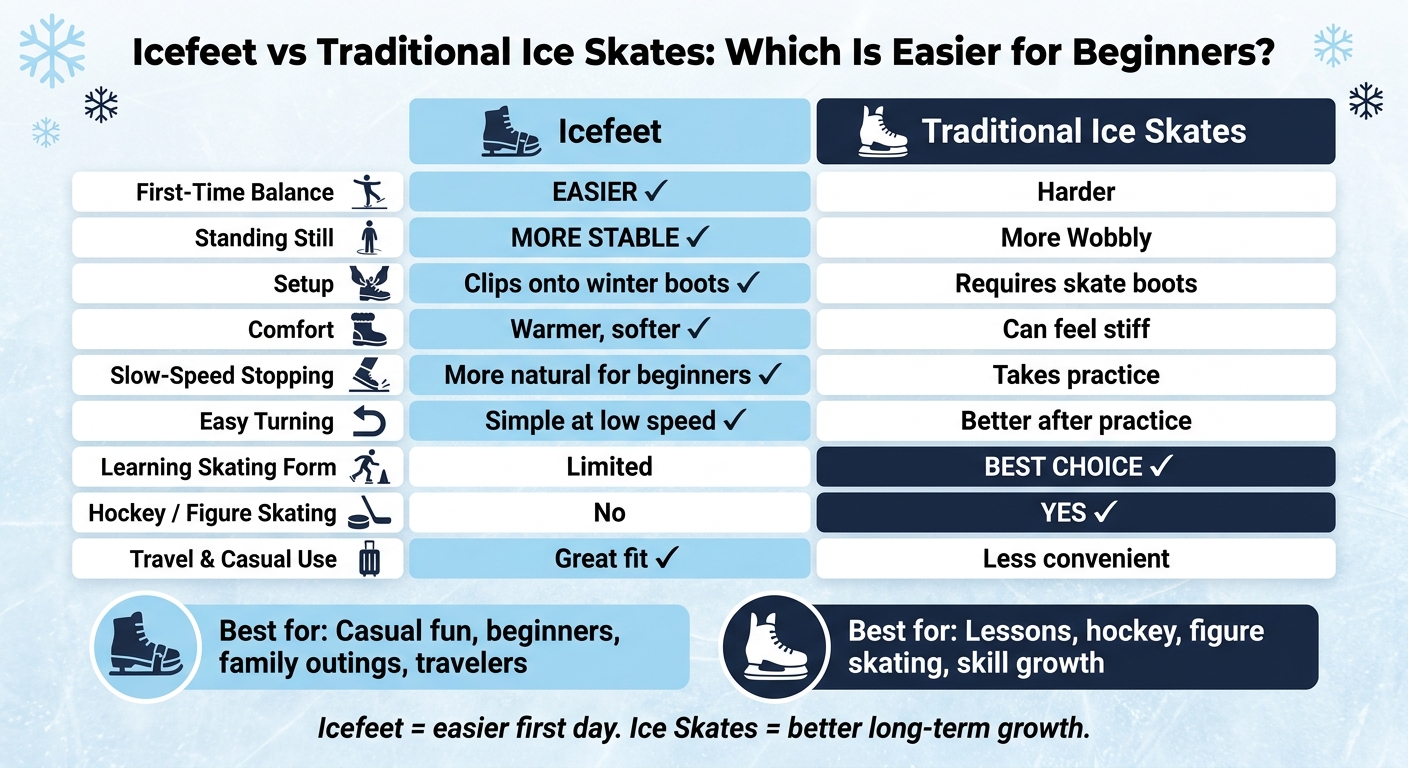
Icefeet vs Traditional Ice Skates: Beginner Comparison Chart
Finally… Ice Skates Anyone Can Use!
Quick Comparison
| Criteria | Icefeet | Ice Skates |
|---|---|---|
| First-time balance | Easier | Harder |
| Standing still | More stable | More wobbly |
| Setup | Strap onto your boots | Need skate boots |
| Comfort | Often warmer and softer | Can feel stiff |
| Slow-speed stopping | More natural for beginners | Takes practice |
| Easy turning | Simple at low speed | Better after practice |
| Learning skating form | Limited | Best choice |
| Hockey / figure use | No | Yes |
| Travel and casual use | Great fit | Less convenient |
I’d put it this way: Icefeet are the easier first date. Ice skates are the long-term relationship. One feels simpler right away. The other asks more from you, but gives more back if you stick with it :)
A few key facts from the article stand out:
- Double blades usually feel steadier than a single blade
- Boot-based setups can cut down on fit issues and cold feet
- New skaters often struggle most with balance, stopping, and turning
- The “best” choice depends more on your goal than on raw skill
If you just want casual laps, family fun, or a one-off rink trip, I’d steer you to Icefeet. If you want lessons, crossovers, or hockey stops, go with ice skates.
If you want to watch the motion side by side, YouTube can help:
So, the short answer is simple: Icefeet are easier for most beginners. Ice skates are better for skill growth.
Learning Curve and Balance: Icefeet vs Traditional Ice Skates
First-Day Stability and Standing Still
The first gap shows up before you even glide an inch. Standing still tends to feel easier on Icefeet because the double-blade setup gives new skaters a steadier base. If someone’s tense or a bit scared on day one, that extra stability can calm the nerves.
Traditional ice skates are a different story. They ask for more balance and body control right away. You step on the ice and, well, your body knows fast that it has work to do.
Starting to Move and Building Confidence
When beginners take those first small steps, Icefeet often feel more forgiving. That can help new users build confidence faster, which is a big deal for kids and nervous adults who just want to feel okay on the ice without getting overwhelmed.
Traditional skates are still very learnable. They just tend to feel less stable early on because they need more precise balance and a more upright stance. That’s not bad - it’s just part of the deal.
Where Traditional Skates Catch Up
As soon as a skater starts working on edge control, posture, and stride technique, traditional skates start to click. The single-blade design fits full skating technique better and gives more control as skills grow.
That early stability matters most during the jump from simple balancing to stopping and turning. That’s where beginners start to notice the trade-off: Icefeet may feel easier at first, but traditional skates start to make more sense once technique enters the picture.
sbb-itb-17ade95
Stopping, Control, and Comfort in Real Use
Once beginners can stand and glide, the next hurdle is pretty simple: how do you stop, turn, and stay comfortable without fighting the gear?
Which Is Easier to Stop With at Slow Speeds
At slow speeds, Icefeet tend to feel easier to read. Beginners can slow down with small, natural movements instead of using a formal stopping move right away. On Snowfeet* Icefeet, you can widen your stance, take short steps, or shift your weight back to slow down in a way that feels more instinctive. It’s closer to how you’d move in winter boots, which helps a lot in those first shaky minutes.
Traditional skates ask for more control from the start. The classic snowplow stop works well, but it takes practice to do it cleanly without wobbling. A basic T-stop asks for even more edge control and balance. So yeah, a lot of beginners end up hanging onto the boards or reaching for the railing.
Turning and Control for Casual Riders
That same simple feel carries over to basic turning. The shorter blade feels less locked in, so small direction changes come more easily. Stepping around a slow-moving skater or making a gentle arc feels a lot more like walking and sliding than full-on skating.
Traditional skates pay off once your control gets better. Turns can feel smoother and more fluid after some practice. But most beginners won’t feel that in the first session or two. And if you only skate a few times each winter, that early learning curve matters a lot.
Boot Comfort and Setup
Comfort plays a big part too. Gear that feels easy from minute one usually makes the whole session less stressful. Icefeet strap onto winter boots, so beginners can skip rental boots, break-in time, and most fit problems. Your feet stay warmer, pressure points are fewer, and setup takes only a few minutes.
Who Finds Each Option Easier?
The easier pick depends on what you want to do on the ice. Once balance and control are out of the way, it comes down to who's skating and why.
Complete Beginners, Nervous Adults, and Kids
If you've never skated before, or you just want a low-stress first try, Snowfeet* Icefeet are usually the easier place to start. They can make that first session feel less intimidating, which helps nervous adults settle in faster and feel more sure of themselves.
They also make sense for kids on laid-back family rink trips. A child who's just there to have fun may enjoy a simple, playful setup more than a narrow-bladed pair of old-school skates.
Skiers, Snowboarders, and Casual Winter Athletes
If you already like compact winter gear, Icefeet can feel familiar right away. They're easy to pack for casual outings, so they're a nice match for someone who skis a few weekends a year and wants a simple ice option too.
The same goes for travelers and people on winter trips who just want to get on the ice once. No big plan. No deep learning curve. Just some fun and a few laps :)
Frequent Skaters and Skill-Focused Riders
Old-school skates make more sense for structured skating. If your goal is hockey, figure skating, or rink lessons, old-school skates work better for edge control, stopping, crossovers, and lessons. For those goals, they're the right tool.
| Your Situation | Easier Option |
|---|---|
| First time on ice, nervous about falling | Snowfeet* Icefeet |
| Family outing with mixed skill levels | Snowfeet* Icefeet |
| Skier or snowboarder wanting ice fun | Snowfeet* Icefeet |
| Traveler wanting a one-time ice experience | Snowfeet* Icefeet |
| Taking regular skating lessons | Traditional ice skates |
| Playing hockey or figure skating | Traditional ice skates |
Final Verdict: Snowfeet* Icefeet for Easy Fun, Traditional Ice Skates for Full Technique
After looking at balance, stopping, and comfort, it comes down to one simple choice: do you want an easier first day, or do you want more technical range over time?
Snowfeet* Icefeet are easier to start with. Traditional ice skates give you more room to build skating technique. That’s the trade-off.
Snowfeet* Icefeet feel less intimidating for first-time use. You can get up and start having fun without the same learning curve many people feel with standard skates. Traditional ice skates, on the other hand, often take more time before basic gliding, stopping, and turning start to feel smooth and natural.
So, for most casual riders, Snowfeet* Icefeet are the easier pick. If you're more focused on skating form and skill, traditional ice skates make more sense.
FAQs
Are Icefeet good for adults who are afraid of falling?
Yes. Snowfeet are a solid pick for adults who are afraid of falling. Unlike ice skates, they give you a wider, more stable platform and use a motion that feels more natural and easy to pick up. That can help new riders find their balance faster and stay upright with less stress.
They’re also much shorter than skis, which helps in two big ways:
- There’s less chance of crossing the tips
- You get faster feedback, so control feels easier
For a lot of people, that means they start to feel more at ease within five minutes. It’s a bit like swapping a wobbly ladder for a step stool - same idea, much less drama :)
Can I use Icefeet at any ice rink?
Yes - you can use Snowfeet Skiskates at ice rinks.
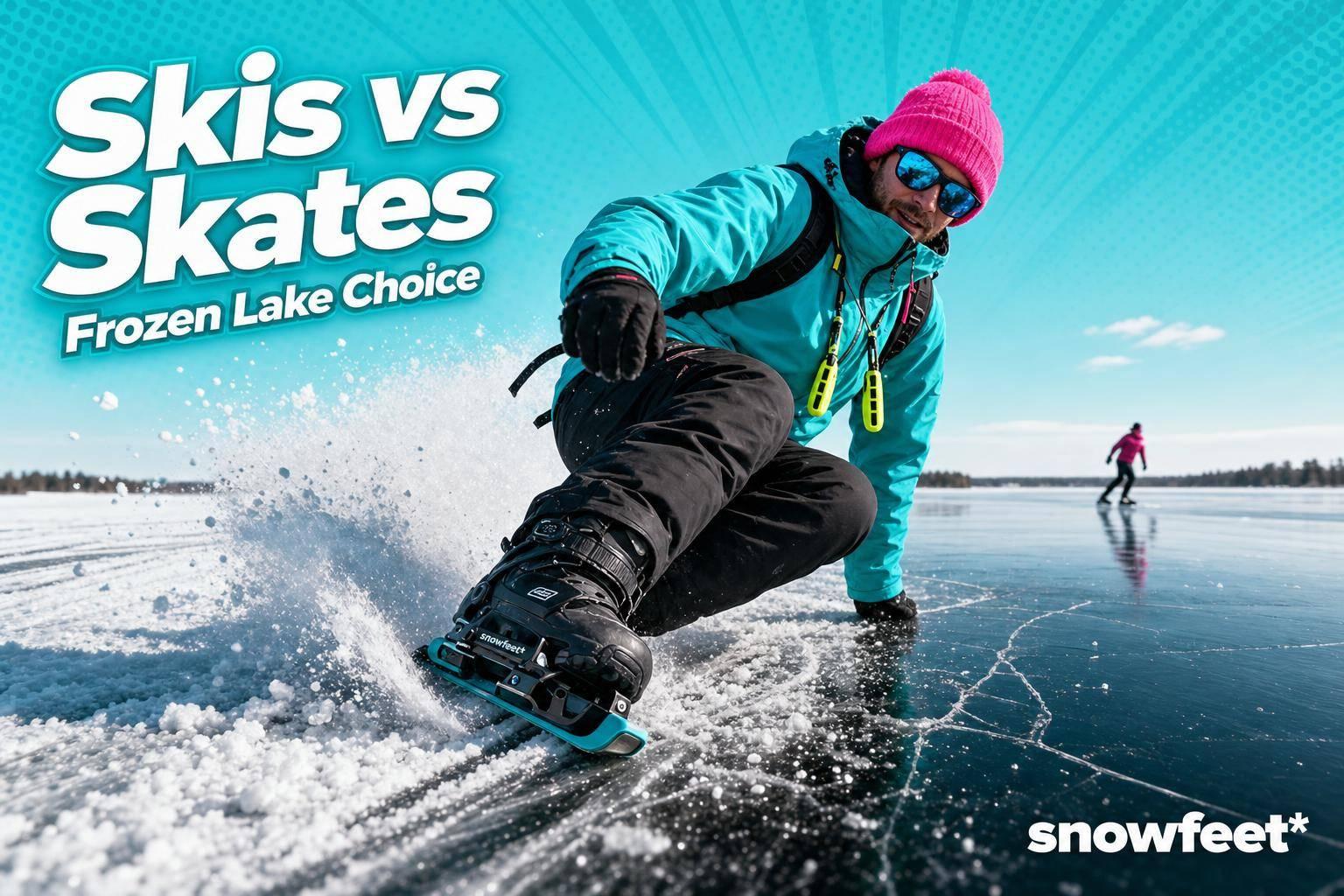
Their double-blade design gives you solid stability on groomed ice rinks, frozen ponds, and natural lake ice.
Compared with single-blade skates, the wider base deals with small surface flaws better. That can make it easier for both beginners and more experienced skaters to keep their balance and feel more confident on the ice.
When should I switch from Icefeet to traditional skates?
Consider switching if your goal is advanced figure skating techniques or high-speed hockey moves.
For casual riders, Snowfeet* is usually the easier pick. It’s portable, works with standard winter boots, and feels stable on natural ice and snow. Traditional single-blade skates are better for technical, sport-specific performance.











Lasă un comentariu
Acest site este protejat de hCaptcha și hCaptcha. Se aplică Politica de confidențialitate și Condițiile de furnizare a serviciului.