



















If you want the short answer: I’d pick the Snowfeet* WALKSKI 100 cm for most casual touring days. It’s the one short-ski option here with uphill tools built in, it packs small, and it costs far less than a full touring kit that can run about $2,200.
Here’s the simple breakdown:
- WALKSKI 100 cm: best for short tours, local laps, and people who want uphill + downhill in one small setup
- Skiblades 99 cm: best if you care more about the ride down and don’t plan to skin uphill
- Skiblades POWDER 99 cm: best for soft snow and short off-piste outings
- 95–105 mm touring skis: best for long days, deeper snow, and faster descents
So, if you tour in tight terrain, travel a lot, or just don’t want to haul a giant setup, short skis make a lot of sense. If you ski big lines in deep snow, full-length touring skis still win.
Snowfeet* WALKSKI Backcountry Touring Skis | 100 CM
Quick Comparison
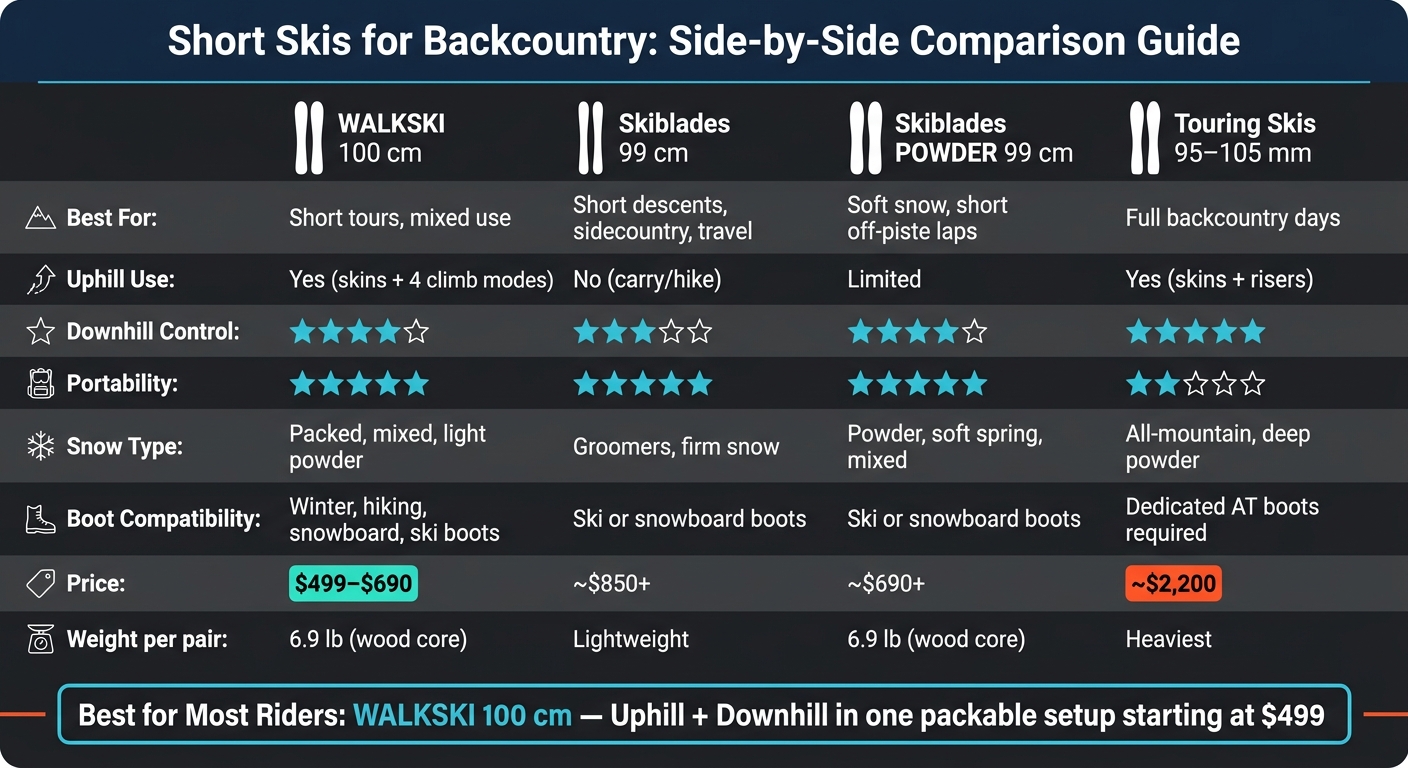
Short Skis for Backcountry: Side-by-Side Comparison Guide
| Option | Best For | Uphill Use | Snow | Price |
|---|---|---|---|---|
| Snowfeet* WALKSKI 100 cm | Short tours, mixed use | Yes, with skins and climb modes | Packed snow, mixed snow, light powder | $499–$690 |
| Snowfeet* Skiblades 99 cm | Short descents, sidecountry, travel | No, mostly carry/hike | Groomers, firm snow, narrow trails | About $850+ |
| Snowfeet* Skiblades POWDER 99 cm | Soft snow, short off-piste laps | Limited for long tours | Powder, soft spring snow, mixed backcountry snow | About $690+ |
| Touring skis 95–105 mm | Full backcountry days | Yes | Best all-around range | About $2,200 |
What stood out to me most is simple: short skis trade float and top-end stability for low weight, easy packing, and less gear hassle. And for a lot of skiers, that’s a very fair trade.
If you want a quick visual before you buy, these YouTube searches can help:
My takeaway: for most casual backcountry riders, WALKSKI is the smartest middle ground. For deep snow and bigger missions, go with full touring skis. Nice and simple :)
1. Snowfeet* WALKSKI Backcountry Touring 100 cm
WALKSKI is Snowfeet*’s touring-focused model. It’s built around removable climbing skins and a patented 4-mode binding system that the Skiblades 99 cm and POWDER 99 cm don’t have. Starting at $595, it costs far less than a standard AT setup. The big difference shows up on the climb.
Uphill Efficiency
The four modes handle flat travel, moderate climbs, steep pitches, and descents. That’s the whole point of this model. The Skiblades 99 cm and POWDER 99 cm use fixed bindings, so they’re not made for uphill travel.
Weight matters here too. The wood-core version comes in at 6.9 lb per pair (3,116 g), while the fiberglass-core version weighs 8.8 lb per pair (3,980 g). If your main goal is getting uphill with less effort, go with the lighter wood-core build. It keeps the climb easier without giving up too much on the way down.
Downhill Control
In Ski mode, the heel locks down and the risers tuck away, which gives you a stable feel on descents. The 100 cm length also helps a lot in tight spots. It turns fast, changes direction with little fuss, and feels less like wrestling a long ski through a narrow chute.
If you care most about hard carving or faster downhill runs, the 99 cm Wood Core Skiblades are the better fit.
Snow Suitability
The WALKSKI does well on packed snow, groomed trails, and light powder. It works best in powder up to about 4 in (10 cm). Past that point, float starts to drop off. So, if you’re heading into deeper, untracked snow, the Skiblades POWDER 99 cm make more sense.
Best fit:
- Packed trails
- Groomers
- Light powder
Portability
At 100 cm, the WALKSKI is easy to strap to a pack and carry around. That alone makes travel and quick tours much less of a headache. The universal binding also fits a wide range of footwear: winter boots, hiking or trekking boots, snowboard boots, and ski boots in MP 22.5–32.5 / EU 36–49.
That means you don’t need a full touring boot setup just to get out there. For people who want a simple, pack-friendly option, that’s a big plus.
The trade-off is pretty clear: you get better climbing function, but less downhill range than the skiblades. If downhill riding is the main event, the 99 cm skiblades are the next one to look at.
2. Snowfeet* Skiblades 99 cm
The Snowfeet* Skiblades 99 cm are the go-to short skis for short approaches, sidecountry laps, and fast descents where downhill control is the main event. Pricing starts at about $690. They use a wood core, metal edges, and a graphite base, which makes them the most balanced all-around short ski in the lineup. If you're heading into deeper snow, the POWDER 99 cm is the better short-ski fit.
Uphill Efficiency
These aren't built for long uphill missions. They don't come with the WALKSKI's free-heel binding or climbing skins, so getting uphill usually means hiking or carrying them to your drop-in.
That said, they're a good match when:
- the climb is short
- the descent is the whole point
- you want less fuss and a simple setup
For long skin tracks, the WALKSKI 100 cm is the better pick.
Downhill Control
This is where the Skiblades 99 cm shine. The deep sidecut and camber help them turn fast and hold an edge well on groomers, packed snow, and mixed terrain. They also do well in moguls and on narrow trails. And thanks to the twin-tip shape, you can ride forward or switch.
The trade-off is pretty simple: you give up some top-speed calm for quick turns and easy control. If you like a nimble, playful feel, that's a fun deal to make.
Snow Suitability
These are not made for deep powder. If your backcountry days are more about untouched snow than packed lines, the Skiblades POWDER 99 cm make more sense.
Portability
At 99 cm, they're easy to carry, stash in a car, or pack for a short mission. They're also sold with simple ski boot, pro ski boot, or snowboard boot bindings. That keeps the setup light, simple, and easy to handle.
For softer snow and more float, the POWDER 99 cm is the next move.
3. Snowfeet* Skiblades POWDER 99 cm
The Snowfeet* Skiblades POWDER 99 cm are made for soft snow and off-piste days. Pricing starts at $690. They keep the same 99 cm length as the standard Skiblades, but the shape is wider, which gives you more float when the snow is deep and soft.
Uphill Efficiency
Think of the standard Skiblades 99 cm as the fast-turn pick. The POWDER 99 cm leans more toward soft-snow touring with short approaches. It uses the same free-heel touring binding and climbing skins, so you can skin uphill without hauling full AT gear.
That makes it a nice middle ground for riders who want to get out into the snow without going all-in on a full touring setup.
Downhill Control
That wider shape helps a lot once the snow gets soft, chopped up, or uneven. The parabolic sidecut keeps the skis easy to steer, and the locked-heel mode gives you more support on the descent.
Longer skis still feel calmer at higher speeds. No shock there. But the POWDER 99 cm shines when space gets tight, like in trees, mellow off-piste lines, and bumpy soft snow. It’s the kind of ski that likes to wiggle through messy terrain instead of bulldozing over it.
Snow Suitability
These work best in:
- Fresh powder
- Soft spring corn
- Mixed backcountry snow
They can handle hardpack, but that’s not their sweet spot. If you spend more time on groomers or firm snow, the standard Skiblades 99 cm are the better match.
Portability
The wood-core version weighs 6.9 lb per pair. The fiberglass version comes in at 8.8 lb per pair. Either way, both are easy to strap to a pack.
The universal binding fits boot sole lengths from 9.5 in to 15 in, which is a big plus. You can use winter boots, hiking boots, or snowboard boots, so there’s no need for special touring boots.
For long skin tracks and big alpine missions, full-length touring skis still do a better job. That gap gets easier to spot when you put the POWDER 99 cm next to a standard touring setup.
sbb-itb-17ade95
4. Standard Touring Skis (95–105 mm class)
This is the full-length baseline for the short-ski setups covered above. In the 95–105 mm range, standard touring skis are the go-to pick for all-around backcountry use: stable, versatile, and common for skiers who want one setup that can handle a lot.
For quick laps, travel days, and short climbs, though, this is also the setup Snowfeet is built to beat on pure convenience.
Uphill Efficiency
Narrower skis usually climb with less effort. That said, 95–105 mm touring skis still hit a nice middle ground between uphill ease and better downhill support.
The catch? They still need specialized AT boots and bindings. That means more bulk and more cost than a short ski setup. So yeah, you get more ski under you, but you also carry more gear.
Downhill Control
This is where full-length touring skis pull ahead in a clear way. They feel calmer at speed and more secure on bigger descents.
If the slope opens up and the snow gets a bit rowdy, that extra length starts to pay off.
Snow Suitability
This width class handles the broadest mix of conditions. Skis around 95 mm tend to grip firmer snow better. Skis closer to 105 mm float more easily in fresh powder.
That range is a big reason 95–105 mm skis remain the default pick for many all-around backcountry setups. They’re kind of the Swiss Army knife of touring skis - without the tiny scissors nobody uses.
Portability
Here’s the plain trade-off: full-length skis are longer, tougher to carry, and tied to dedicated boots and bindings.
For many casual riders, that extra size and gear are the main reasons Snowfeet feels like the easier, more practical option. And that’s exactly what the side-by-side breakdown below helps show.
Head-to-Head Performance Breakdown
Here’s how the four options compare for backcountry and touring use, side by side:
| Criterion | WALKSKI 100 cm | Skiblades 99 cm | Skiblades POWDER 99 cm | Standard Touring Skis (95–105 mm) |
|---|---|---|---|---|
| Uphill Efficiency | ★★★★★ (4 modes + skins) | ★★☆☆☆ (carry or hike) | ★★☆☆☆ (carry or hike) | ★★★★☆ (skins + risers) |
| Downhill Control | ★★★★☆ (agile, moderate speed) | ★★★☆☆ (groomed, mellow) | ★★★★☆ (soft snow) | ★★★★★ (high-speed, open lines) |
| Snow Suitability | Backcountry, powder, mixed | Groomed slopes, parks, narrow trails | Soft snow, powder, mellow off-piste | All-mountain, deep powder |
| Portability | ★★★★★ (~39 in, packable) | ★★★★★ (lightweight) | ★★★★★ (lightweight) | ★★☆☆☆ (bulky) |
| Boot Compatibility | Winter, hiking, snowboard boots | Ski or snowboard boots | Ski or snowboard boots | Dedicated AT boots required |
| Avg. Cost | $499–$690 | ~$850+ | ~$690+ | ~$2,200 |
Uphill Efficiency
The WALKSKI 100 cm stands out among the short-ski picks. Its four-mode binding system - Walk, Climb 1, Climb 2, and Ski - is built for skintrack use. You get low and high heel risers for moderate and steep climbs, plus a free-heel walk mode that keeps movement natural on flat sections.
The short length helps too. At about 39 inches, kick turns feel much less awkward on tight switchbacks. That matters when the trail gets narrow and steep and you don’t want to fight your gear every few minutes.
Standard touring skis also climb well, no doubt. On long, steady ascents, the longer platform gives better skin grip and glide. The catch? You need dedicated AT boots and bindings, which adds cost and bulk before the tour even starts.
The Skiblades 99 cm and Skiblades POWDER 99 cm are a different story. They’re not made for skinning, so they make more sense on terrain where you can hike up or carry them without much fuss.
Downhill Control
This is where standard touring skis still have the upper hand. On long, open lines and steep descents, the extra length gives better stability and edge hold. That’s the big payoff when speeds climb and the terrain gets more serious.
As Brad Tolin put it:
"Only trade-off is at higher speeds, where longer skis still feel more stable - but for overall fun and maneuverability, these are hard to beat."
That quote sums it up well. Short skis can be a blast. They turn fast, feel playful, and stay easy to manage. But if your idea of fun is charging a big alpine face, standard touring skis still make more sense.
The WALKSKI does well on moderate descents thanks to its locked-heel ski mode, and the Skiblades POWDER 99 cm brings more float in soft snow than the standard Skiblades. Still, none of these short-ski options are meant for full-send, high-speed lines. And honestly, they’re not trying to be.
Snow Suitability and Portability
The Skiblades POWDER 99 cm does best in soft snow among the blade-style options, while the WALKSKI handles the broadest mix of backcountry conditions. If you’re out in deep mid-winter snow in places like the Wasatch or Sierra backcountry, standard touring skis still float better and more predictably. They also grip better on firm morning skintracks and icy refrozen slopes.
Where the Snowfeet lineup pulls ahead is portability. The wood-core WALKSKI pair weighs just 6.9 lb, and the short length makes all three Snowfeet options easy to strap to a daypack or toss in a car trunk. That’s a big deal if you like quick outings, travel often, or just don’t want your gear to feel like a garage full of stuff.
The WALKSKI also gets extra points for boot flexibility. Its universal bindings work with winter boots, hiking boots, or snowboard boots. That kind of setup keeps things simple, which is nice. Less gear drama, more time on snow :)
Pros and Cons
Here’s the quick breakdown. Each option has a clear lane, and the right pick depends on how you plan to use it.
| Model | Pros | Cons | Best Fit |
|---|---|---|---|
| WALKSKI 100 cm | 4-mode binding for Walk, Ski, and Climb modes; works with hiking, winter, snowboard, or ski boots; compact 100 cm length makes it easy to strap to a pack or toss in a car; wood-core version weighs just 6.9 lb; priced from $499–$690 | Less float in deep powder than full-length skis; less stable at speed on open descents | Hikers and casual backcountry explorers who want one light setup for both up and down |
| Skiblades 99 cm | Very easy to turn; short learning curve; compact and easy to travel with; great for quick turns and short, travel-friendly descents; about $850+ | No uphill climbing features; best on groomed slopes and firm snow | Riders who want a compact ski for short approaches, travel, and easy descents |
| Skiblades POWDER 99 cm | Better float in soft snow than standard Skiblades; responsive in narrow terrain; same compact size | Limited stability on icy or hard-packed runs at speed; not a touring tool | Intermediate riders heading into mellow off-piste or side-country terrain in soft snow |
| Standard Touring Skis (95–105 mm) | Best stability at high speeds; better float in deep powder; efficient on long approaches with skins | About $2,200; bulky and hard to transport; needs dedicated AT boots; steep gear buy-in | Experienced tourers taking on long, steep, or deep-snow days |
The trade-off is pretty simple. WALKSKI leans hard into easy uphill travel and boot freedom. You can use everyday boots, keep your setup light, and move through casual backcountry terrain without turning your garage into a gear lab.
Standard touring skis still take the prize on big mountain days. They give you more float, more speed control, and a better ride when the terrain opens up. But that comes with more gear, more bulk, and a much higher price tag.
So, if your goal is simple uphill access, easy transport, and a setup that doesn’t demand a full AT kit, WALKSKI has the edge for most casual backcountry days.
Conclusion
Once you stack up climbing, descending, and packability, it comes down to how you plan to use them.
For short tours and quick-access days, the Snowfeet* WALKSKI 100 cm is the most practical pick. You get flexible boot options, easy packing, and legit uphill ability without dragging along a full AT setup. If your main goal is soft snow performance, go with the Skiblades POWDER 99 cm. That makes the call pretty simple: hard-snow convenience on one side, soft-snow float on the other.
For bigger tours, standard touring skis still have the edge. Their added length helps on long, steep, mixed-condition days. But there’s a tradeoff. You’ll deal with more gear, more bulk, and a much higher price tag.
For most casual backcountry riders, Snowfeet* is the simpler, lighter, and more useful option.
FAQs
Are short skis good for beginners in the backcountry?
Yes. Short skis like the Snowfeet WALKSKI are a great pick for backcountry beginners.
At 100 cm, they’re much easier to control and turn than standard touring skis. That shorter length helps a lot when you’re still getting used to uneven snow, tight spots, or mellow downhill sections. They also feel light and responsive, which means less leg burn and a less scary learning curve.
Another nice perk: you can use your own winter boots or snowboard boots. That can make your first few tours feel a lot more comfortable, especially if stiff ski boots sound like a bad time.
For big alpine lines and fast descents, standard skis still make more sense. But for casual backcountry outings, Snowfeet products feel far more beginner-friendly and easier to enjoy from day one.
How much powder can 100 cm short skis handle?
The 100 cm Snowfeet WALKSKI is built for powder and ungroomed trails. It works well in up to 4 inches of powder, thanks to its wide shape and rockered tip. Those two features help it float better, which matters most on moderate slopes and in denser snow.
If you're heading into very deep powder, longer skis will usually do a better job. That said, for most backcountry riders, the WALKSKI hits a sweet spot. It’s easier to carry, easier to turn, and a lot handier in tight, technical terrain where long skis can feel like a pain :)
Do I need special boots for Snowfeet* WALKSKI?
No. Snowfeet* WALKSKI uses a patented universal free-heel binding that works with boots you may already own, like regular winter boots, snowboard boots, or ski boots.
That means you can skip alpine touring boots. Nice, right? Snowboard boots tend to give you more control on the way down, while winter boots are a good fit for easy, mellow terrain.











Lasă un comentariu
Acest site este protejat de hCaptcha și hCaptcha. Se aplică Politica de confidențialitate și Condițiile de furnizare a serviciului.