



















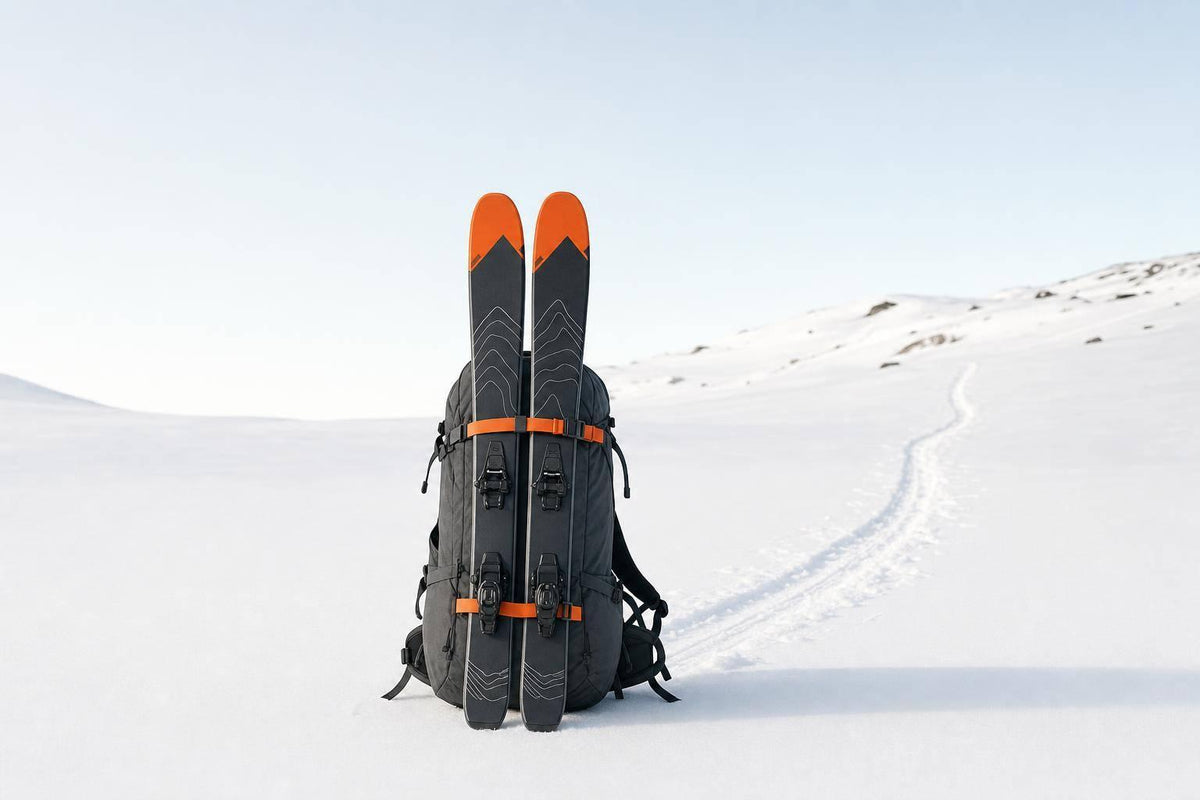
My take after a full winter: if you want a small touring ski for mellow backcountry days, travel, and tight trees, the WALKSKI 100 cm makes sense. If you want speed, float in deep powder, and more hold on steep open slopes, stick with full-length touring skis.
I used it 1–2 times most weeks through a full Colorado season, plus a few longer tours and one fly-to-ski trip. After that much snow time, the pattern was clear: easy to pack, easy to turn, and lower cost at about $595. But there’s a trade-off: less glide on flats, less float, and less stability once things get steep or fast.
Here’s the short version:
- Best for: beginners, casual riders, hikers, families, and travelers
- Works best on: rolling terrain, packed trails, forest routes, and lower-angle backcountry
- Main upsides: short length, simple setup, no AT-only boot need, easy storage
- Main downsides: shorter glide, more work on long flats, less edge hold and calm feel at speed
- Season result: held up well with normal scratches, one edge tune, and a couple hot waxes
| What I found | WALKSKI 100 cm |
|---|---|
| Price | About $595 |
| Length | 100 cm / 39 in |
| Weight | About 6.9 lb per pair |
| Boot fit | Winter, snowboard, and ski boots |
| Best use | Short to mid tours on mellow terrain |
| Weak spot | Fast descents, deep snow, open alpine lines |
So, if your goal is fun, low-fuss winter travel, this ski does the job. If your goal is big mountain days, uh, go longer.
Snowfeet* WALKSKI Backcountry Touring Skis | 100 CM
What the WALKSKI 100 cm Is Designed to Do
The WALKSKI 100 cm isn’t trying to replace a full alpine touring setup. That’s not the pitch here. It’s a compact touring ski for riders who want uphill travel and solid downhill control without going all-in on a full AT kit.
At 100 cm long, with a 13.5 / 12 / 13 cm tip/waist/tail profile, the wood-core version weighs about 6.9 lb per pair and uses adhesive-and-clip skins. That short, compact shape is what gives the ski its on-snow feel. You notice it right away: it’s built to stay light, simple, and easy to handle.
Setup, Bindings, and Boot Compatibility
This is where the system gets pretty appealing. The bindings work with winter boots, snowboard boots, and alpine ski boots, so you don’t need AT-specific boots to get out there. For a lot of riders, that takes a big hassle off the table.
You also get four modes:
- Walk for flats
- Ski for descents
- Climb 1 for moderate climbs
- Climb 2 for steeper climbs
Those modes help cut setup friction and make the whole system easier to use. In plain terms, you spend less time fiddling and more time moving. That’s a nice trade.
Where This Design Works Best
The WALKSKI 100 cm works best on rolling terrain, packed forest trails, and lower-angle backcountry routes. That’s the sweet spot. The short length made the ski easy to turn and control in tight terrain, which is exactly where a compact ski like this starts to shine.
Of course, there’s no free lunch in ski design. Its limits show up in deep powder, open alpine terrain, and faster descents, where longer skis still feel more stable and float better. Once the ski is on snow - especially on climbs and descents - those tradeoffs become pretty clear.
How It Performed Going Up and Coming Down
Uphill Travel: Grip, Stride, Kick Turns, and Fatigue
Once the setup was dialed in, the big test was the climb in mixed touring conditions.
On moderate climbs, like mellow forest roads and rolling backcountry approaches, the WALKSKI 100 cm felt efficient. The skins gripped well on packed snow, and the highest heel riser in Climb Mode 2 took some strain off the calves on steeper pitches.
Kick turns were the big win here. They felt fast, took little effort, and worked well on narrow switchbacks. That’s where the short length starts to make a lot of sense.
On long, flat approaches, though, you notice the tradeoff. Glide is shorter, and your pace feels slower. For half-day tours, that’s usually fine. On bigger days with lots of flat mileage, your legs will clock the extra work.
Compared with full-length touring skis, the WALKSKI gives up some glide on long approaches but makes up for it with easier kick turns and better portability.
Climbing felt pretty straightforward. The bigger test was the way the short platform handled on the way down.
Downhill Control: Turning, Braking, and Confidence
Locked into Ski Mode, the WALKSKI 100 cm handled mellow backcountry descents and tracked forest runs with more confidence than you’d guess at first glance. Turns felt quick and responsive, which made it easy to change direction in tight glades and narrow chutes. Speed control was simple with short turns, and most casual riders will likely find the ski forgiving, not nervous, at moderate speeds.
"I found these so easy to turn and control. I have recreational Nordic experience but was able to manage these great." - Lynn
The limit shows up in open terrain and at higher speed. On steeper open faces, or on refrozen tracks and ruts, the short running surface gives you less edge hold than a standard touring ski. Once speed picks up, the difference in stability becomes plain. The WALKSKI can feel less planted when the snow turns firm or mixed. It does best on rolling terrain and tracked runs. Steep, open faces still lean in favor of full-length skis.
"Only trade-off is at higher speeds, where longer skis still feel more stable - but for overall fun and maneuverability, these are hard to beat." - Brad Tolin
That mix of easy handling and clear speed limits shows up again in day-to-day use and durability.
sbb-itb-17ade95
Durability, Portability, and Day-to-Day Use After One Season
Wear and Reliability After Repeated Use
Once snow performance was clear, the next thing to check was simple: was the WALKSKI easy to own and use week after week?
After a full season, the WALKSKI 100 cm held up well. The bases picked up the usual cosmetic scratches from mixed snow and a few hidden rocks, but nothing out of the ordinary. It needed one mid-season edge tune and a couple of hot waxes. That’s pretty light upkeep.
The topsheets got a few chips near the tips from ski-on-ski contact during kick turns. That’s normal in the backcountry. The binding hardware stayed tight too, with monthly screw checks and a quick wipe-down after slushy days.
Because the ski is only 100 cm (39 in) long, edge damage matters more than it does on a longer ski. So, it’s smart to check edges often. The nice part? Shorter edges are faster to sharpen and wax. By the end of the season, the wood-core build still felt solid, with no clear loss in torsional stiffness.
That easy upkeep carried over to portability too.
Packing, Travel, and Storage in Practice
The 100 cm length is the big win here.
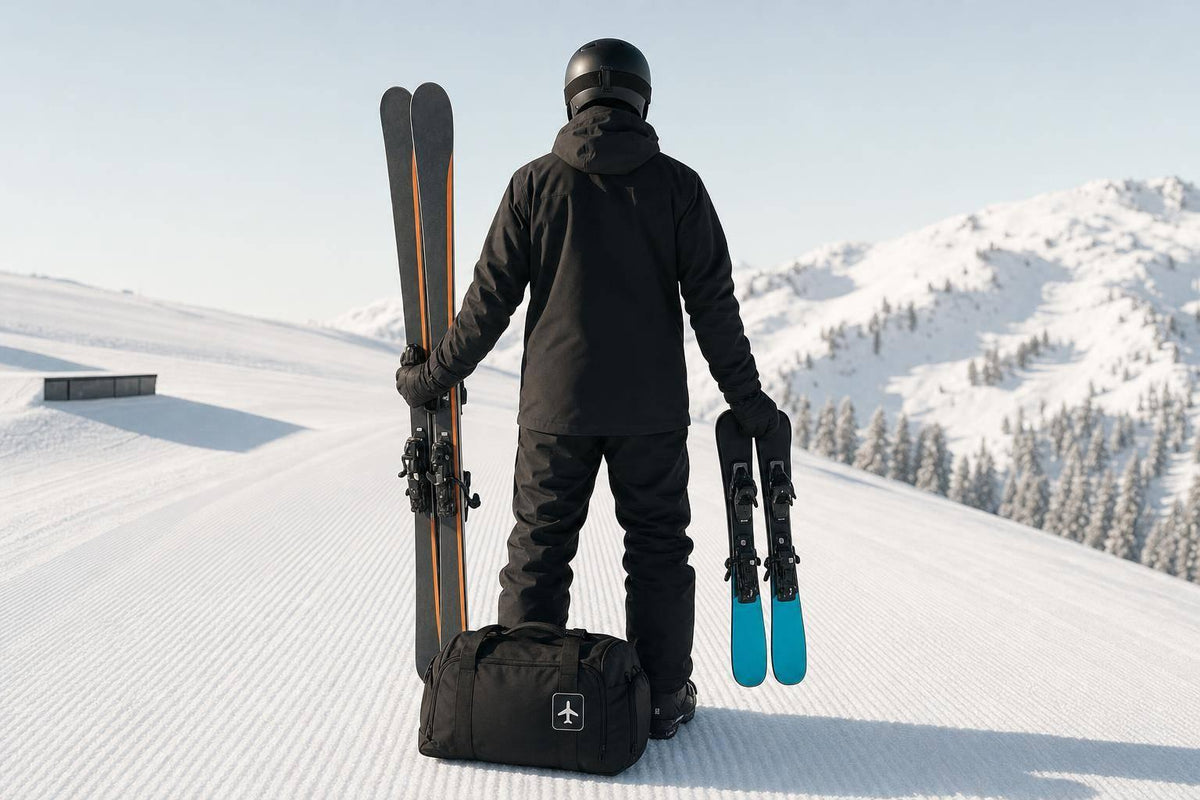
The WALKSKI fit in the trunk of a compact sedan with boots, a pack, and avalanche gear. No roof rack. No need to fold down the rear seats. In a four-person car share, that size edge showed up fast. It also made the skis easier to carry across a parking lot or on foot, which sounds small until you’re juggling poles, boots, and coffee :)
At home, they fit behind a closet door without eating up much space. If you live in an apartment, that’s a big deal.
"They're lightweight and much easier to carry around than full-size skis." - Brad Tolin
Price vs. Value After Long-Term Testing
Value here isn’t just about the ski’s sticker price. It’s about the cost of the whole setup.
At about $595, the WALKSKI costs less than most touring setups. Its universal binding can also cut out the need for AT boots, which changes the math quite a bit. After one full season with no structural failures and upkeep costs that stayed in check, the value story still makes sense for the right rider.
| WALKSKI 100 cm | Traditional Touring Setup | |
|---|---|---|
| Starting Price | From about $595 | Around $2,200 |
| Boot Requirement | Universal binding for winter, hiking, snowboard, or ski boots | Specialized AT boots |
| Portability | Fits in a car trunk, closet, backpack | Usually needs a ski bag or roof rack |
| Best Terrain | Rolling trails, forests, moderate slopes | Open bowls, steep faces, higher speeds |
| Maintenance | Fast tuning, shorter edges | Longer tune time |
For riders who get out for 10–20 mellow backcountry days per season, the mix of durability, convenience, and lower total cost makes a solid case for the price.
Who Should Buy It and the Final Take
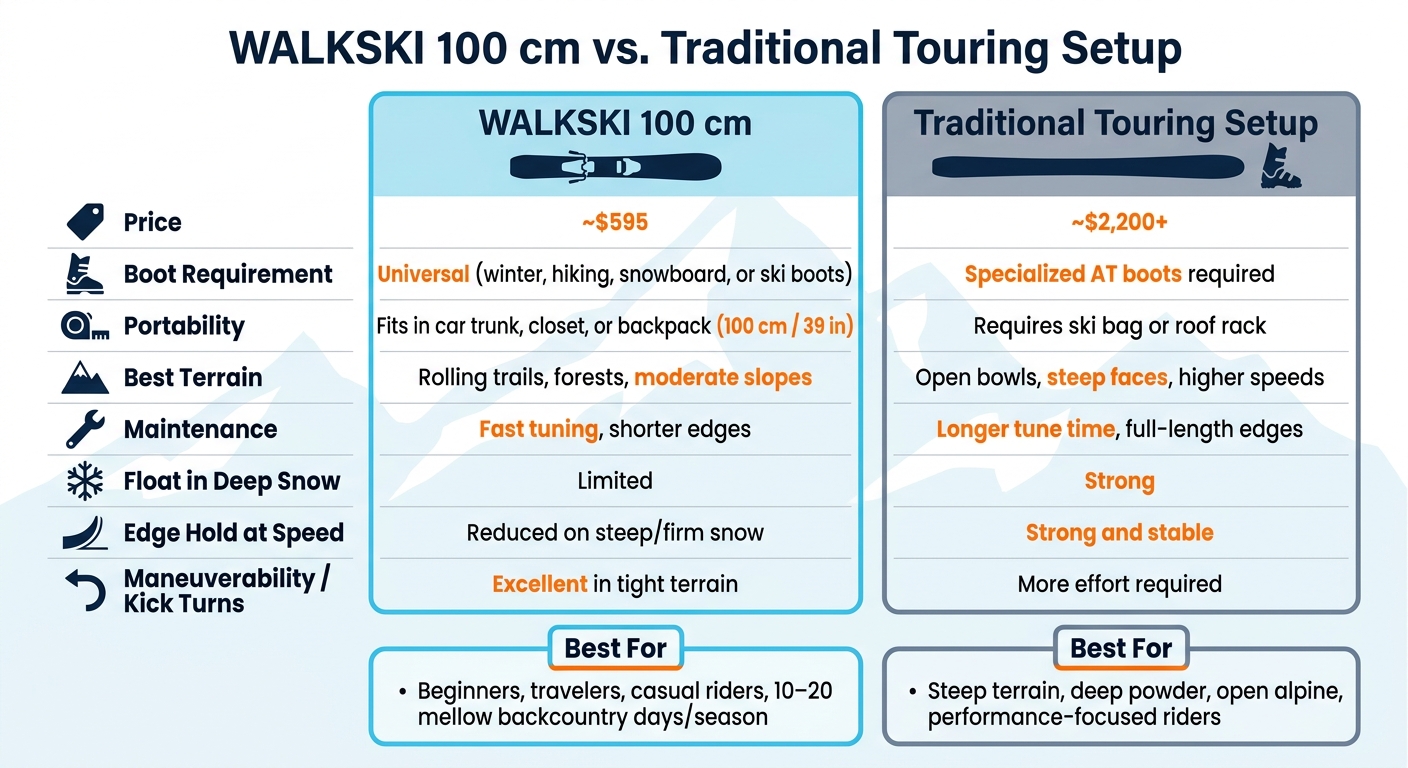
WALKSKI 100 cm vs. Traditional Touring Setup: Full Comparison
Best Fit: Beginners, Travelers, and Casual Backcountry Riders
After a full season on snow, the choice is pretty simple: the WALKSKI 100 cm makes the most sense for riders who care more about ease than top-end performance.
It’s a good match for beginners and casual riders who want simple winter touring without going all-in on a full AT setup.
Travelers and hikers will get the most out of it. The compact size makes it easy to pack and easy to carry, which is a big plus for winter hikes and mellow backcountry days. If you want something low-fuss that still gets you out there, this fits the bill.
Who Should Choose Full-Length Touring Skis Instead
That easy carry is the big win. But, yeah, it also comes with clear terrain limits.
Go with full-length touring skis if you spend a lot of time on steep, deep, or fast terrain. They still do a better job with float, edge hold, and stability when your speed picks up.
"Only trade-off is at higher speeds, where longer skis still feel more stable - but for overall fun and maneuverability, these are hard to beat." - Brad Tolin
Final Verdict After One Full Season
Over a full season, the WALKSKI 100 cm earned its place. It kept coming out on packed and mixed snow, short approaches, and rolling forest routes. And honestly, that repeat use says a lot. Gear that keeps making it out of the garage is usually gear worth owning.
For most casual riders, the trade-off is simple: easier transport, lower total cost, no specialized boot requirement, and a fun ride on moderate terrain.
So the short version is this: WALKSKI for portability and easy use, full-length skis for demanding mountain objectives.
FAQs
Can beginners use the WALKSKI 100 cm safely?
Yes - the WALKSKI 100 cm is a safe, beginner-friendly pick.
Its short length makes it easier to turn and control than standard touring skis. That gives new riders more confidence right away and helps them learn the basics without feeling like they're wrestling with a long ski.
It also works with familiar footwear, like standard winter boots or snowboard boots. So beginners can skip specialized touring gear and start with a setup that feels simpler and less intimidating. That’s a nice bonus when you’re just getting your snow legs :)
How does it handle icy or uneven snow?
The WALKSKI 100 cm does a good job on icy, uneven snow if you set it up right.
For more grip on slick surfaces, trim the climbing skins so 5 to 7 mm of metal edge stays exposed on each side. That small tweak can make a big difference when the snow gets firm and sketchy. On steep, icy slopes, nylon skins also tend to hold better.
Now, let’s be honest. Traditional full-length skis usually feel more stable when conditions get harsh. That’s just the nature of a longer platform.
But the WALKSKI has its own edge. With solid technique, it stays nimble, responsive, and easy to control on mixed terrain. So while it won’t feel quite the same as a full-length ski in rough conditions, it still handles a lot better than you might expect.
Is it worth buying for occasional touring?
Yes - the Snowfeet WALKSKI 100 cm is a smart pick if you go touring once in a while, not every weekend.
It’s a good fit for casual riders, travelers, and beginners who want something simple and lower cost. One of the big perks is that it works with your existing winter, snowboard, or ski boots. So you don’t need to buy a whole extra setup. That alone can save time, money, and a bit of a headache :)
Its compact 100 cm design also makes it easy to pack, carry, and control. On narrow trails or rolling terrain, that shorter length can feel a lot less awkward than full-size skis. You’re not wrestling with a long setup, which is nice when the goal is just to get out and enjoy a short tour.
That said, there’s a clear tradeoff. Traditional long skis still make more sense for steep alpine lines, deep powder, and high-speed runs. They’re built for bigger terrain and more demanding descents. But for short, mellow outings, the WALKSKI gives you a simpler, lower-fuss way to get moving in the snow.











Zostaw komentarz
Ta strona jest chroniona przez hCaptcha i obowiązują na niej Polityka prywatności i Warunki korzystania z usługi serwisu hCaptcha.