



















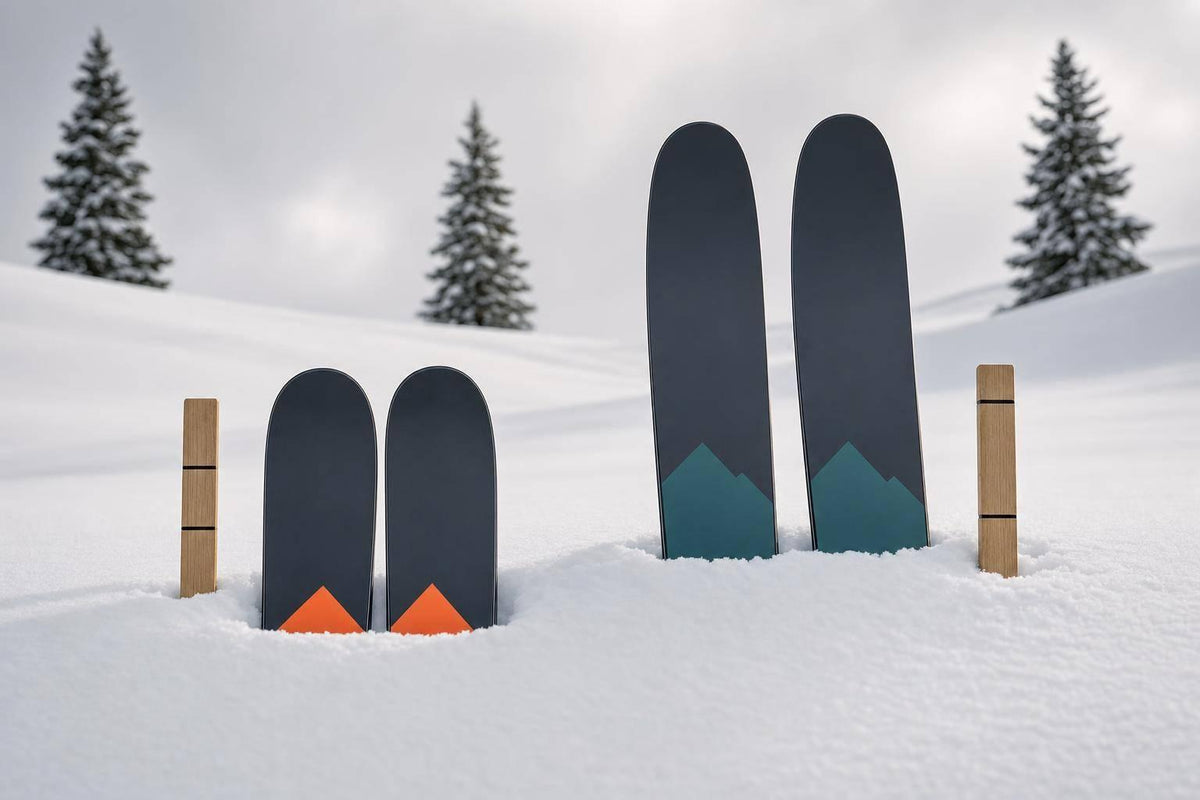
Yes - short skis can float in powder. But there’s a catch. From what I see, the Snowfeet* POWDER 99 works best in 4–8 inches of resort snow, where its 99 cm length, 120 mm waist, and short 6 m turn radius make it easy to slash, pivot, and control. Once snow gets to 12+ inches, a full-length powder ski still wins on float, calm at speed, and chop control.
If you want the short version, here it is:
- POWDER 99: best for resort powder laps, trees, side hits, and mixed snow
- Fat powder skis: best for deep days, open bowls, and faster lines
- Short skis do float: just not like a 170–190 cm powder ski
- Best use case: think of the POWDER 99 as a powder day sidekick, not your one-and-only ski
So, if you ski soft resort snow more than chest-deep storm days, the POWDER 99 makes a lot more sense than most people think. If your dream day is 15 inches in a big bowl with no tracks, grab the fat skis and thank me later :)
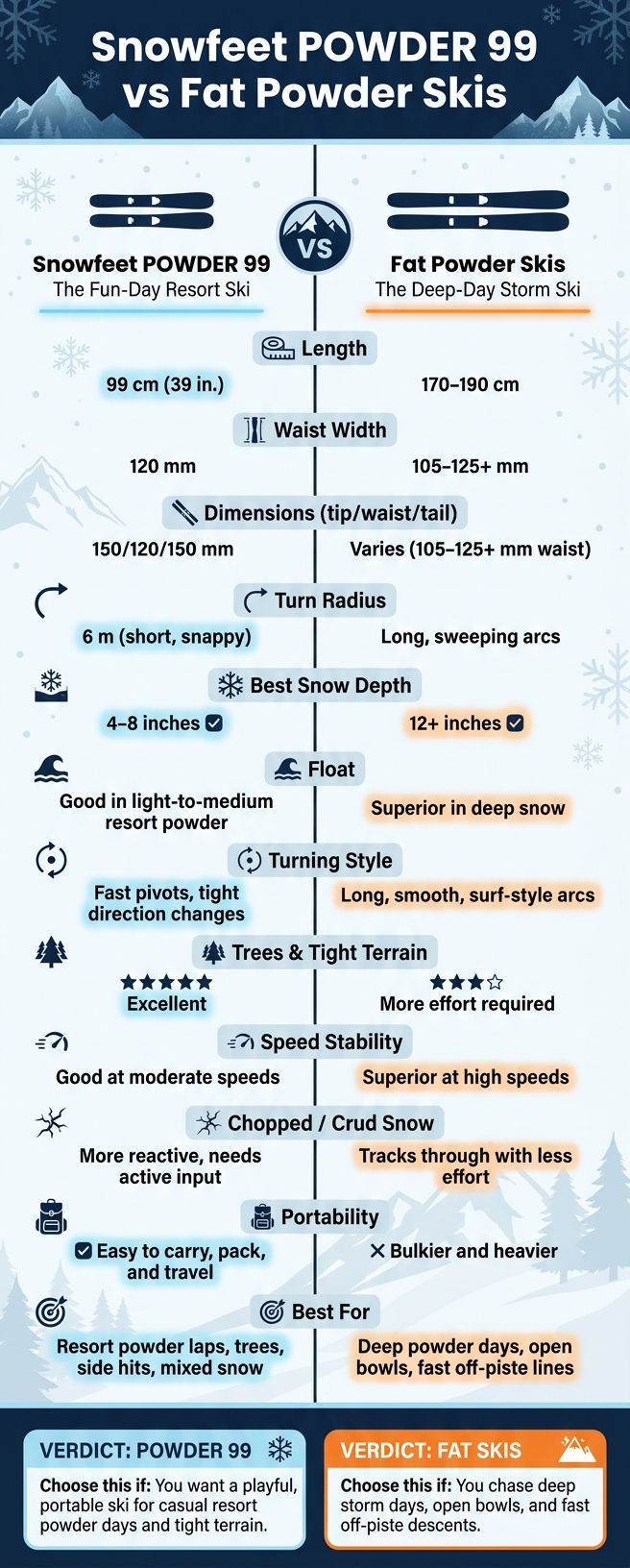
Snowfeet POWDER 99 vs Fat Powder Skis: Side-by-Side Comparison
ULTIMATE SHORT SKIS 🔥 Snowfeet Skiblades 99 cm | Unboxing & First Look
Quick Comparison
| Criteria | Snowfeet* POWDER 99 | Fat Powder Skis |
|---|---|---|
| Best snow depth | 4–8 in. | 12+ in. |
| Float | Good in light to medium resort powder | Better in deep snow |
| Turning | Short, tight, easy pivots | Longer, smoother arcs |
| Trees & tight spots | Very good | More work |
| Speed stability | Good at moderate speed | Better at high speed |
| Chopped powder | Can feel busy | More planted |
| Portability | Easy to carry and pack | Bulkier |
| Best for | Fun resort days | Deep powder days |
What stands out to me is simple: the article isn’t saying the POWDER 99 beats a fat powder ski at its own game. It’s saying it solves a different problem.
Here’s the main takeaway in plain English:
- If you ski resort powder, not bottomless backcountry snow, the POWDER 99 gives you enough float with less hassle.
- If you like tight turns, fast direction changes, and easy speed control, short skis feel like cheating in a good way.
- If you ski deep, heavy, or cut-up snow a lot, full-length powder skis still give you more support.
I’d frame it like this: a fat powder ski is your storm-day tool. The POWDER 99 is your fun-day tool. And for many riders in the U.S., there are a lot more fun days than face-shot days.
A few numbers help tell the story:
- POWDER 99 dimensions: about 150/120/150 mm
- Standard short ski version: about 115/85/110 mm
- Fat powder skis: often 105–125+ mm underfoot
- Typical fat ski length: often 170–190 cm
- POWDER 99 turn radius: 6 m
That means the POWDER 99 gets its soft-snow support from width, not length. Fat powder skis use both. That’s why each one feels so different on snow.
What I like most in this comparison is that it stays honest. The POWDER 99 isn’t pitched as some magic powder missile. It’s shown for what it is: a playful, short powder ski for resort riders who want easy turns and less work. That’s a fair point, and it lines up with how short, wide skis tend to ski in the real world.
If you want a deeper look at powder ski shape and rocker, these videos help:
- Blister Gear Review YouTube Channel
- SkiEssentials.com YouTube Channel
- SnowboardProCamp / ski gear discussions
So, my quick read is this: short skis can float, yes. But they float best when the snow is soft, the terrain is tight, and the day is about fun more than speed. That’s where the POWDER 99 earns its spot.
Snowfeet* POWDER 99 vs fat powder skis: design and purpose
The big split comes down to how each ski floats.
The POWDER 99 gets there with a short, wide shape. Fat powder skis do it with more length, more width, and more rocker. That one design choice changes a lot on snow, especially float, turning, and how calm the ski feels when you pick up speed.
Where POWDER 99 fits in the Snowfeet* lineup
At 99 cm, the POWDER 99 stays short enough for fast pivots, but it gives you more surface area for powder than the standard 99 cm short ski. Its platform is much wider too: about 15/12/15 cm tip/waist/tail versus roughly 11.5/8.5/11 cm on the standard version.
That extra width helps it stay up in soft snow without giving up the tight, quick feel Snowfeet* skis are known for. It still keeps a 6 m turn radius, so turns feel fast, snappy, and easy to link.
The short length and wider shape also help in tight spots. You can pivot fast, change direction in a hurry, and still feel steady in soft snow. Its camber profile adds a more planted feel on firmer resort runs and keeps carving simple, which gives it a lively feel when you move from powder into packed snow.
Another nice touch: you can get it with ski boot or snowboard boot binding options. That makes the setup feel simple and easier for more riders to jump into.
What fat powder skis are built to do
Fat powder skis are built for one main job: deep snow.
They usually get there with:
- More length
- More width
- More rocker
Most powder skis have waists around 105 to 125+ mm, and many run longer than an all-mountain ski so they can add planing surface and stay calmer in deep snow. They also tend to use a lot of tip rocker, and often tail rocker too, which helps lift the ski, cut tip dive, and make surf-style turns easier in soft snow.
That setup works great in deep conditions. The catch? You gain stability in powder, but you give up some agility when the terrain gets tighter or the snow gets less forgiving.
| Feature | Snowfeet* POWDER 99 | Fat Powder Ski |
|---|---|---|
| Length | 99 cm (39 in.) | Usually around skier height to about 6 in. longer |
| Width | 15/12/15 cm tip/waist/tail | About 105–125+ mm waist |
| Turn feel | 6 m radius, quick and playful | Long, smooth turns |
| Profile | Camber with powder-focused width | Pronounced tip and often tail rocker |
| Best use | Resort powder laps and tight terrain | Deeper snow and open terrain |
So, if you strip it down, fat powder skis lean toward deep-snow stability. The POWDER 99 leans toward easy handling and fast direction changes. And yeah, that gap gets pretty obvious once you take both into soft snow.
sbb-itb-17ade95
Float, turning, and speed: how each ski performs
Float in 4–6 in. powder vs 12+ in. storm snow
Float isn't only about waist width. It comes from surface area, rocker shape, snow density, and your speed too. The Snowfeet* POWDER 99 uses a wide, short platform, which gives it enough support to stay up in 4–6 in. of resort powder, mainly when there's a soft groomed base underneath. For lighter or intermediate riders who make lots of turns at medium speed, that’s usually plenty. It feels loose and fun instead of grabby or sinky.
Once the snow gets past 12 in., things change. Fat powder skis - often 170–190 cm long with 105–120+ mm waists - spread your weight across a much bigger platform. They also use more tip rocker to help keep the shovel from diving. That gives them a clear edge in deep snow. The POWDER 99 just can’t keep up there, mainly for heavier riders or anyone skiing hard and carrying more speed. In blower snow, both setups float more easily. In dense coastal snow or heavy spring snow, the gap gets bigger fast.
Tight trees, side hits, and quick resort laps
This is where the POWDER 99 starts to shine. Its short length makes pivots fast, direction changes snappy, and speed checks easy - which is exactly what you want in tight trees or when someone suddenly cuts across your line. It’s also easier to recover from little mistakes because there’s less ski in front of you and behind you to hook on stuff.
On side hits, rollers, and banked turns, the POWDER 99 feels playful right away. It’s easy to pop, slash, and snap from one edge to the other without much effort. On those mixed days with powder on the sides and firmer snow in the middle, it moves between both without feeling stuck in one mode. Fat powder skis can do this too, sure, but the extra length and swing weight make fast slashes and tight pivots more work, mainly if you don’t have a strong freestyle background.
Open bowls, chopped powder, and higher speeds
Fat powder skis are made for this kind of terrain. Their added length and mass help them track through crud, chopped powder, and wind-affected snow with fewer sharp deflections. That means less work for the rider over a full day. In open bowls at higher speeds, they stay calmer and hold a steadier line, which helps a lot when you want to make big, sweeping turns.
The POWDER 99 can still handle open terrain at moderate speed, but the short length makes it more reactive as speed goes up. Small movements turn into direction changes fast, which can feel twitchy on long fall-line runs or in heavy afternoon chop. Still, most casual riders won’t hit speeds where that becomes a big issue. And, honestly, the easy speed control can be a lifesaver when you run into a surprise wind drift or a weird pitch change.
| Category | Snowfeet* POWDER 99 | Fat Powder Skis |
|---|---|---|
| Float (4–6 in. powder) | Good for most casual riders | Better float, mainly as powder gets deeper |
| Float (12+ in. storm snow) | Limited, mainly for heavier riders | Clear edge in deep snow |
| Turn quickness | Very fast, short-radius pivots | Slower to pivot, likes longer arcs |
| Stability at speed | Lower - can feel twitchy when pushed | High - smooth and calm at speed |
| Chopped snow / crud | More reactive, needs active input | Tracks through with less effort |
| Rider effort | Less demanding, easier for intermediates | More physical input needed |
| Portability | Much easier to carry, pack, and travel with | Bulkier and heavier |
Which ski fits your conditions and riding style
Now that the performance difference is on the table, here’s the simple version: the right ski depends on snow depth and how you like to ski.
If your days are a mix of soft groomers, quick powder laps, trees, and side hits, one choice makes life easy. If you live for deep storm totals, open faces, and heavier snow, the other starts to pull away.
| Condition | Snowfeet* POWDER 99 | Fat Powder Skis |
|---|---|---|
| Light resort powder | Nimble, playful, and enough float for most | More ski than most casual riders need |
| Mixed groomer and powder days | Handles both without feeling awkward | Can feel less versatile on firm snow |
| Deep storm days | Manageable at moderate speeds for lighter riders | Clear advantage in deep, heavy snow |
| Chopped / late-day powder | Easy to redirect with playful surf-style turns | More composed as chop gets deeper |
| Tight trees and technical terrain | Short length makes quick pivots and recovery easy | More work to maneuver in confined spaces |
| Deep sidecountry days | Good for short laps on mellow terrain | Stronger choice for deep, demanding descents |
Best for casual resort powder days
If your usual powder day means a few fast laps, a soft groomer, a dip into the trees, and maybe a side hit or two, the POWDER 99 is a good match. Snowfeet describes the POWDER 99 as a strong option for moderate deep snow, with excellent flotation and stability. That shorter length also helps on repeat laps. It keeps tight terrain fun instead of turning every run into a leg workout.
When fat powder skis make more sense
If you hunt for open bowls or ski deep powder on a regular basis, fat powder skis are the better tool. Their wider platforms - typically 105–120 mm underfoot - help them stay higher in deep, heavy snow and feel steadier when conditions get weird.
The POWDER 99 can still work for short sidecountry laps. But when the day gets deep, steep, or far from the lift, fat powder skis have the edge.
That tradeoff sets up the final verdict.
Final verdict: Snowfeet* POWDER 99 or fat powder skis?
After looking at float, turning, and speed, the pick comes down to snow depth and how you like to ride.
The good news? Short skis can float in powder. The POWDER 99 stays playful in soft snow and shines on resort days with trees, side hits, and fast laps.
Fat powder skis still take the lead once you get into 12+ inches of unconsolidated snow, open bowls, and faster descents. The extra length and width give them more float and a steadier feel in chopped-up snow.
That’s the trade-off, plain and simple: fat powder skis give you more float; the POWDER 99 gives you more agility. On mixed resort days, the POWDER 99 is usually the more fun ski and asks less from the rider.
In heavier or deeper snow, the POWDER 99 works best when you stay centered and keep your speed moderate. If you like to charge hard through deep chop, fat skis are the better tool.
Choose the POWDER 99 if you want a portable, playful ski for casual powder days, trees, bumps, and resort terrain. Go with fat powder skis if deep snow, open bowls, and fast off-piste lines are part of your normal routine. For most resort riders, the POWDER 99 fits more actual mountain days with less hassle.
FAQs
Are short powder skis enough for most resort days?
Yes. For most U.S. resort powder days, short skis like the Snowfeet POWDER 99 cm* are often enough.
Their 135–140 mm waist gives them plenty of float in 4–12 inches of fresh snow. That makes them a great fit for:
- trees
- short laps
- side hits
Long powder skis still win when the snow gets deeper than 12 inches or when you're skiing fast in wide-open terrain. But for the kind of resort laps most people take, the POWDER 99 cm feels more playful, lighter, and easier to handle.
It’s a bit like choosing between a nimble trail bike and a full downhill rig. Both have their place. But on a normal powder day at a U.S. resort, the shorter setup is often more fun and less work :)
Who should choose the POWDER 99 over fat powder skis?
Choose the Snowfeet* POWDER 99 cm if you care more about playfulness, quick turns, and easy carry than top-end speed in deep powder. It’s a good match for casual resort skiers, travelers who want gear that packs small, and snowboarders making the jump to skis.
It does its best work in tight trees, side hits, and resort powder laps with 4–12 inches of fresh snow. Long skis still have the edge in open bowls and steady 12-inch-plus powder.
How do heavier riders affect float on the POWDER 99?
Weight matters because the POWDER 99 sits on a short 99 cm platform. That means it has less surface area than a full-size powder ski, so rider weight plays a bigger role.
Here’s the simple version: heavier riders will sink more and hit the ski’s float limit sooner than lighter riders.
In powder deeper than 10 inches, those riders need to stay more centered and make more active fore-aft moves to keep the tips from diving. If you’re over 200 lb, the 120 cm model may feel more stable and more dependable in deep snow.











Zostaw komentarz
Ta strona jest chroniona przez hCaptcha i obowiązują na niej Polityka prywatności i Warunki korzystania z usługi serwisu hCaptcha.