




















If you weigh 200+ lb, the short answer is simple: go with the Snowfeet* Short Skis 120 cm if you want the most control. The 99 cm models can still work, but they make more sense for slower skiing, softer snow, or a more playful feel.
Here’s the whole call in plain English:
- Best for most heavier riders: Snowfeet* Short Skis 120 cm - more stable, better grip, calmer when speed picks up
- Best for groomers and easy laps: Snowfeet* Skiblades 99 cm - fun, light feel, but less planted once things get fast or rough
- Best for soft snow: Snowfeet* Skiblades POWDER 99 cm - more float in slush, crud, and powder than the standard 99 cm
A few things matter more when you’re a heavier rider:
- Length helps on firm snow
- More surface area helps in soft snow
- Short skis get less forgiving as speed goes up
- Edge tune matters more under heavier loads - the article calls out tuning every 3–5 ski days
So, if you’re around 180–220 lb, the 99 cm options can make sense based on terrain. If you’re 220 lb and up, the 120 cm is the safer bet in almost every case.
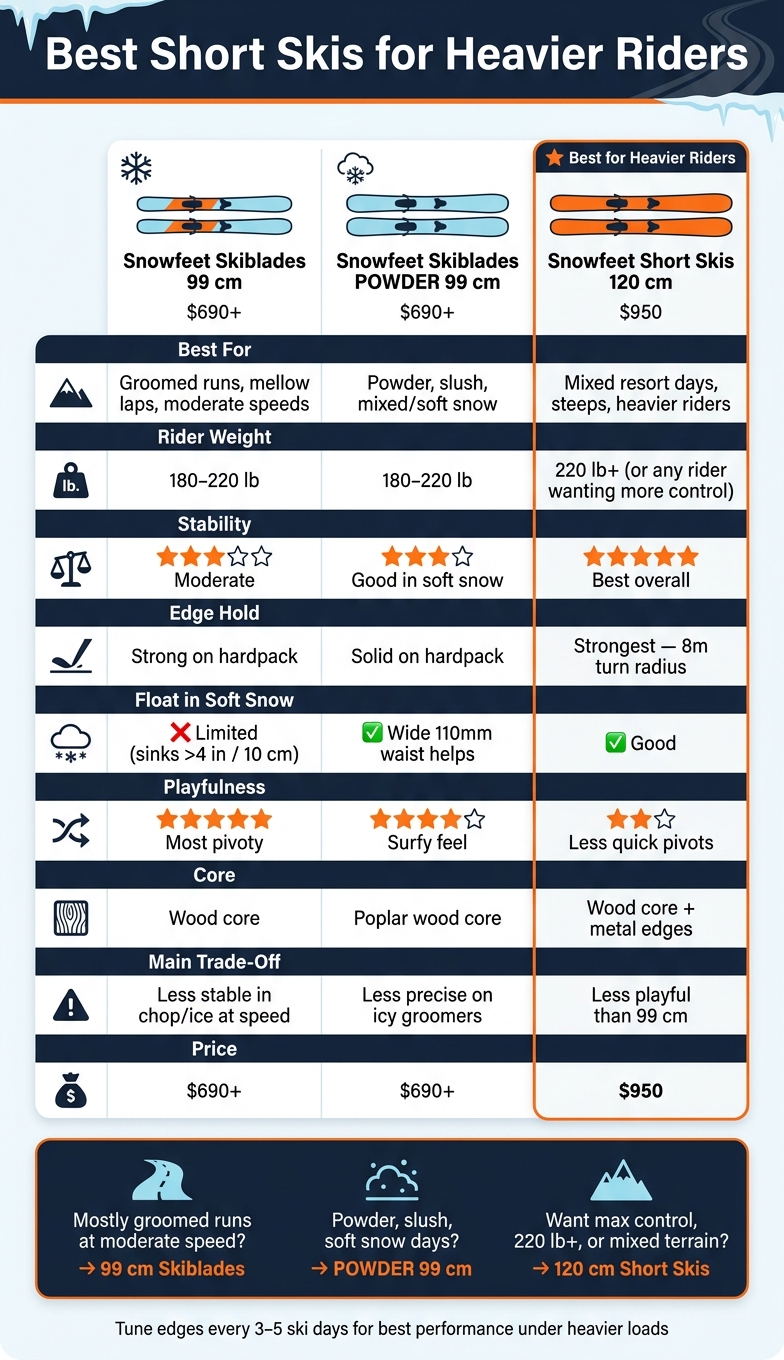
Best Short Skis for Heavier Riders: Side-by-Side Comparison
Snowfeet* Short Skis | Snowblades Skiboards 120 cm
Quick Comparison
| Model | Best For | Main Trade-Off | Price |
|---|---|---|---|
| Snowfeet* Skiblades 99 cm | Groomed runs, mellow park laps, slower to moderate speeds | Less stable in chop, ice, and at higher speed | $690+ |
| Snowfeet* Skiblades POWDER 99 cm | Powder, slush, mixed snow, soft off-groomer laps | Less locked-in on firm, icy groomers | $690+ |
| Snowfeet* Short Skis 120 cm | Mixed resort days, steeper groomers, heavier riders who want more control | Less loose and playful than 99 cm | $950 |
My quick take? If you’re between two models, pick the 120 cm. It gives you more margin for rough snow, firmer runs, and those “uh, this got steep fast” moments :)
And if soft snow is your whole thing, the POWDER 99 cm is the better 99 cm pick.
If you want a feel check before buying, these ski videos can help:
- Short skis / skiblades riding examples on YouTube
- Powder skiblades videos on YouTube
- Short skis vs skiblades comparisons on YouTube
That’s the main point of the article: for heavier riders, more ski usually means more control. The 99 cm models are fun tools. The 120 cm is the safer all-around pick.
1. Snowfeet* Skiblades 99 cm
The 99 cm Skiblades are the most nimble option in the Snowfeet* lineup. They’re a blast on groomers. But for heavier riders, they work best at lower speeds and in more settled snow.
Stability
For heavier riders, the big issue isn’t turning. The 99 cm turns fast and feels snappy. The real limit shows up when you start skiing harder.
On groomed resort runs at moderate speeds, these skiblades feel planted and easy to control. A heavier rider can load the full edge and carve clean turns without that sketchy, loose feeling. That’s the good news.
The catch? Once you go past that comfort zone - or roll into chopped-up afternoon snow - the short length starts to push back. There’s just less ski on the snow. That means less support when speed climbs or the surface gets rough. In plain English: fun and stable on smooth runs, less forgiving when things get bumpy.
Weight Support
The 99 cm Skiblades use a wood core, which helps a lot for heavier riders. It keeps the ski from feeling soft or soggy under pressure.
Still, length matters. Because the platform is short, your weight gets packed into a smaller contact area. You’ll notice that most in softer snow or uneven conditions, where the ski has less room to spread that pressure out.
Edge Hold
On groomed hardpack, extra rider weight can actually help. It drives the edge deeper into the snow, which gives the ski a solid bite.
The trade-off shows up on steep icy terrain. Since the running length is short, you get less room for mistakes. If the edges aren’t dialed in, you’ll feel it fast.
For heavier riders, tune matters a lot. A 1° base / 2° side bevel and burr-free edges are extra important because more pressure on the ski makes small tuning issues stand out more. Tune every 3–5 ski days.
Terrain Fit
These skiblades are made for groomed runs, moguls, and park features - boxes, small jumps, and rails. The low swing weight makes spins and butters feel easy, and the fast edge-to-edge response is great in tight spots.
Where they struggle is pretty simple:
- Deep powder
- Steep icy terrain
In powder deeper than about 4 inches (10 cm), a heavier rider will notice the tips sinking more. If soft snow is part of the plan, the POWDER 99 cm is a better fit. If you want more calm at speed or more support on steeper runs, go with the 120 cm instead.
| Skiblades 99 cm | Short Skis 120 cm | |
|---|---|---|
| Stability at Speed | Solid at moderate speeds | More stable under heavier loads |
| Weight Support | Wood core, supportive under load | Larger surface area, better distribution |
| Edge Hold | Strong on hardpack, limited on ice | Better grip on steeps |
If powder matters more than groomer performance, the POWDER 99 cm gives you more width without losing that short-ski feel.
2. Snowfeet* Skiblades POWDER 99 cm
The POWDER 99 cm is the wider take on the 99 cm Skiblade, made for powder and mixed snow. For heavier riders, that matters a lot. A short ski can feel twitchy if it gets pushed too hard, but this one fights back with a much wider shape: 135–110–130 mm (5.3–4.3–5.1 in). That extra width gives heavier riders more float and a steadier ride.
Stability
The wider platform helps this model feel calmer in chopped snow and slush. That’s a big plus if you want more confidence at moderate speeds. More width also helps the ski keep its shape when extra weight goes through the edge.
For heavier riders, this makes the POWDER 99 cm a good match for powder and mixed terrain. On ice, though, there’s still a limit. If you like hard, aggressive carving on firm snow, the 120 cm is still the better pick.
Weight Support
The POWDER 99 cm uses a poplar wood core, which helps with damping and support under load. The 110 mm waist spreads pressure better than the standard 99 cm, and that helps most in soft snow and crud.
The wider tip and tail make turning easier in heavy snow too. You don’t have to muscle the skis around as much, which is nice when the snow feels like mashed potatoes.
Edge Hold
On groomed hardpack, the POWDER 99 cm still gives you solid grip thanks to its steel edges and wood core. But the usual short-ski trade-off is still here: on steep or icy terrain, heavier riders need to stay centered and link smooth, controlled turns instead of trying to force hard carves.
If you want the strongest edge stability at higher speeds, the 120 cm still comes out ahead.
Terrain Fit
This model works best for powder days, tree runs, slush, crud, and mixed resort conditions. It also handles groomed runs and small-to-medium park features just fine.
If your days often include powder or chopped-up snow, this is the better 99 cm option. If you want more calm at speed and better grip on firm snow, the 120 cm is the next move. For heavier riders who care more about stability than super-fast pivots, the 120 cm is worth a close look.
| Feature | POWDER 99 cm | Standard 99 cm |
|---|---|---|
| Waist Width | 110 mm | Narrower |
| Best Conditions | Powder, slush, crud, mixed terrain | Groomed trails, park |
| Weight Support | Better flotation | Less support on soft snow |
| Edge Hold | Solid on hardpack | Stronger on firm snow at speed |
sbb-itb-17ade95
3. Snowfeet* Short Skis 120 cm
If the 99 cm skiblades feel a bit twitchy for heavier riders, the 120 cm Short Skis make more sense. That extra length brings more calm, better grip on edge, and more support when speed picks up. In plain English: they feel less jumpy and more planted.
Stability
The 120 cm model uses a camber profile with tip and tail rocker. That setup helps the ski stay smoother as you go faster. Next to the 99 cm skis, the 120 cm feels less nervous on hardpack and more settled underfoot.
That smoother ride is the big reason heavier riders should look at this model first instead of jumping straight to the 99 cm versions. It’s a bit like moving from a tiny sports car to something with a longer wheelbase. You still get fun, but with less chatter.
Weight Support
This ski is built with a wood core, metal edges, graphite base, and parabolic sidecut. Its dimensions are 4.3 / 3.1 / 3.9 in at the tip, waist, and tail.
That construction spreads pressure more evenly, which helps heavier riders get better support and less sink-in than either 99 cm option. When you lean into turns or hit firmer snow, the ski has more to stand on. That matters.
Edge Hold
With an 8-meter turn radius, the 120 cm gives you a longer effective edge, which helps it hold a carve with more confidence on groomed and hard-packed snow.
On very icy or steep terrain, full-length race or freeride skis still have the edge. No surprise there. But for normal resort days, this is the strongest all-around Snowfeet option for heavier riders. It strikes a nice middle ground between short-ski fun and the extra grip you want when the hill gets firm.
Terrain Fit
This model works well on groomed runs, steeper blue and black trails, and mixed resort conditions. It has enough stability for stronger skiing, but it still keeps that short-ski feel that makes Snowfeet gear fun.
Its limits show up in very high-speed charging on wide, steep, icy faces or big-mountain terrain with large drops. That’s where longer freeride skis are still the better pick. So, the trade-off is pretty simple: more stability than the 99 cm options, with a touch less of that super-quick, playful feel.
| Feature | 120 cm Short Skis |
|---|---|
| Length | 120 cm / 47 in |
| Tip / Waist / Tail | 4.3 / 3.1 / 3.9 in |
| Turn Radius | 8 m |
| Profile | Camber + tip/tail rocker |
| Core | Certified sustainable wood core |
| Best For | Groomed runs, steeper blue and black trails, mixed resort conditions |
| Price | $950 |
Pros and Cons of Each Model for Heavier Riders
Side by side, the trade-off is simple: agility, float, or stability. That’s the whole game here. If you’re a heavier rider, ski length, width, and edge hold will matter a lot more once the snow changes or your speed picks up.
Here’s the side-by-side view:
| Skiblades 99 cm | Skiblades POWDER 99 cm | Short Skis 120 cm | |
|---|---|---|---|
| Pros | Most pivoty; easiest at slow speeds | Wider base gives better float in soft snow and slush | Best stability and edge hold of the three |
| Cons | Less grip on ice or firm hardpack once speed climbs | Less precise edge hold on icy groomers; tails may wash out with your weight too far back | Rotations and quick pivots take more effort |
| Ideal Use Case | Beginners who want easy turning on groomed green and easy blue runs at moderate speeds | Intermediate riders who want a surfy feel on powder days, spring slush, and soft off-groomer snow | Intermediate to advanced heavier riders who want all-day resort skiing with real edge hold on groomers, mixed snow, and moderate steeps |
| Who Should Skip It | Heavier riders who want to charge steep blues and blacks or carve aggressively on icy mornings | Heavier skiers who spend most days on firm, icy groomers and want locked-in, high-speed carving | Complete beginners who want the easiest pivot; heavier park riders focused on spins and quick switch landings |
A simple way to think about it:
- Width helps in soft snow
- Length helps on firm snow
So, if you mostly ski groomers and want more confidence when things get fast or firm, the Short Skis 120 cm make the most sense. If your days are more about mellow runs, slush, or that loose, surfy feel, one of the 99 cm options may fit better.
For heavier riders, terrain and speed matter more than any single cutoff. That’s where the right pick starts to feel less like guesswork and more like common sense :)
Final Verdict: Which Model Should You Buy?
Short version: heavier riders need more ski underfoot as speed goes up.
After looking at stability, float, and edge hold, the pick gets pretty simple once you match the ski to the rider.
Go with the Skiblades 99 cm ($690+) if you weigh 180–220 lb, stick to groomed runs, ski at a moderate pace, and want the most playful ride. It’s the fun one. But on firm snow, once you start pushing speed, it won’t feel as calm.
Pick the Skiblades POWDER 99 cm ($690+) if you’re 180–220 lb and spend more time in soft snow, slush, or hitting small features off groomed runs. It handles mixed, softer conditions better. That said, on icy groomers at speed, you’ll still run into its limits.
Choose the Short Skis 120 cm ($950) if you weigh 220 lb or more, or if you want more confidence when skiing fast. This is the best pick for stability, edge hold, and steady performance across mixed conditions.
Here’s the quick guide:
| Your Profile | Best Pick |
|---|---|
| 180–220 lb, beginner/casual, groomed runs | Skiblades 99 cm |
| 180–220 lb, intermediate, soft snow or mixed terrain | Skiblades POWDER 99 cm |
| 180–220 lb, intermediate-advanced, speed and steeps | Short Skis 120 cm |
| 220 lb and up, any skill level | Short Skis 120 cm |
If you’re stuck between the POWDER 99 cm and the 120 cm, go with the 120 cm.
FAQs
How should I choose between the 99 cm and 120 cm models?
Choose based on agility vs. stability.
The 99 cm Skiblades are the best all-around pick. They hit a nice middle ground between easy turning and control. That makes them a strong fit for carving, park laps, and light powder.
If you’re a heavier rider, or you want more confidence at higher speeds, go with the 120 cm model. It gives you more surface area, better float in moderate powder, and a steadier feel on tougher terrain.
Will short skis still feel stable if I weigh over 220 lb?
Yes. If you weigh over 220 lb, short skis can still feel stable if you pick the right model.
For heavier riders, the longer Snowfeet* options - 99 cm and 120 cm - are the best picks. They give you more support, spread your weight more evenly, help keep the tips from sinking in soft snow, and make the ride feel more stable with better edge control.
Which model is best for powder versus icy groomers?
On icy groomers, the Snowfeet* Skiblades lineup does a nice job. You get quick edge engagement and solid control on hard-packed snow, which is exactly what you want when the surface feels slick and unforgiving. The 65 cm Skiblades stand out here because they feel extra nimble and make sharp, precise turns with ease.
For powder, the Snowfeet Skiblades POWDER 99 cm* is the top pick. If you're heading into deeper snow, go with the 99 cm POWDER or 120 cm models. They give you more float and better stability, so you won't feel like you're fighting the mountain the whole way down.











Zostaw komentarz
Ta strona jest chroniona przez hCaptcha i obowiązują na niej Polityka prywatności i Warunki korzystania z usługi serwisu hCaptcha.