



















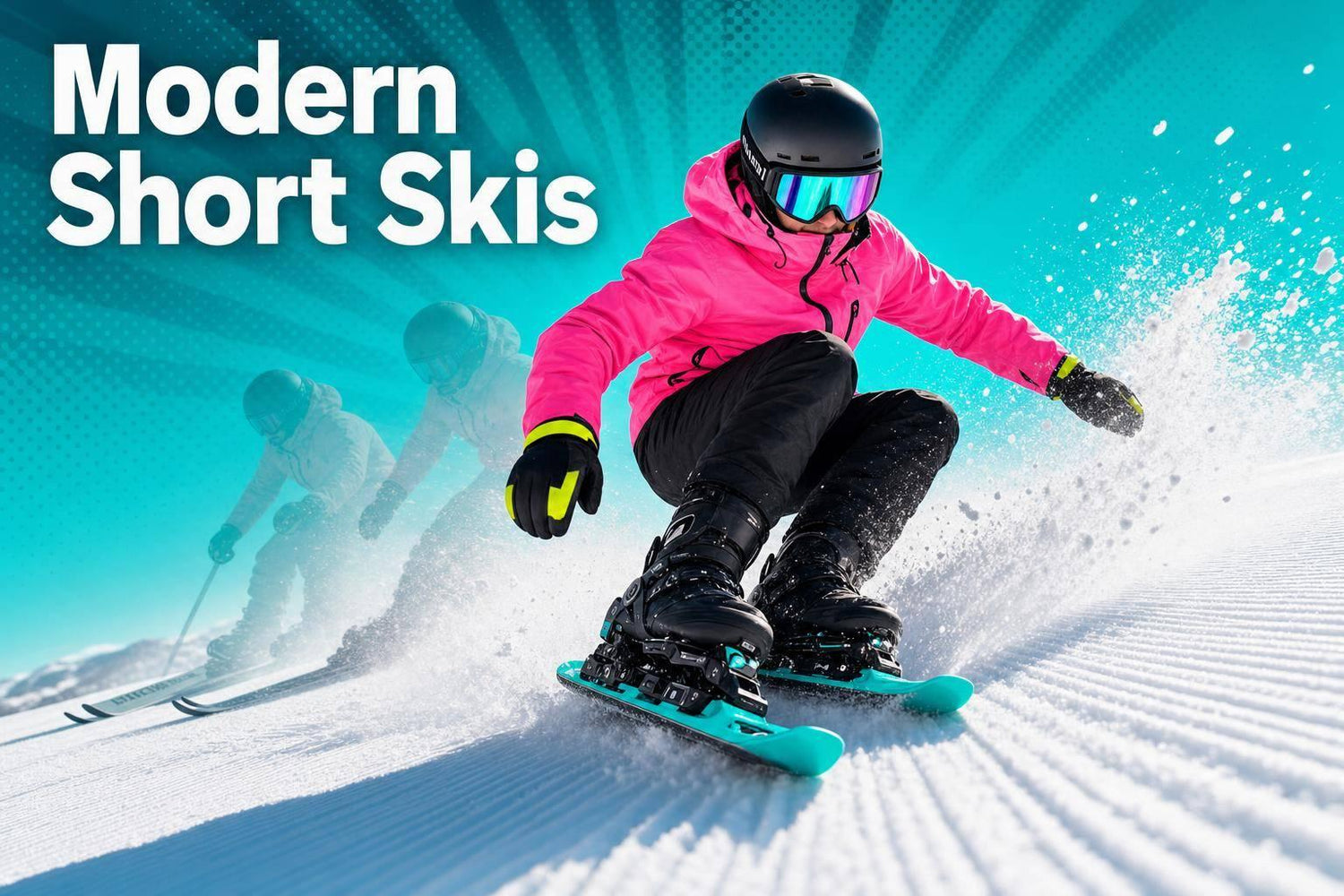
Short answer: Salomon Snowblades are gone, and most people are better off with modern short skis instead of chasing a used pair.
If you want the fast take, here it is:
- Salomon stopped making Snowblades in the mid-2000s
- Used pairs often sell for $80–$150
- Older pairs can have non-release bindings, which is a big thing to check
- Old models were fun on green and easy blue groomers
- They were less steady in chopped snow, powder, and at higher speed
- Today’s main options are 65 cm, 99 cm, 120 cm short skis, plus 44 cm skiskates
So if you’re trying to choose, I’d break it down like this:
- Want the closest old Snowblade vibe? Go with a 99 cm short ski
- Want the smallest and easiest to carry setup? Look at 44 cm skiskates or 65 cm skiblades
- Want more edge hold and a calmer ride? A 120 cm short ski makes more sense
- Found a cheap used Snowblade online? Check the bindings first. No joke.
I also think boot setup changes the whole deal. Old Snowblades were mostly tied to alpine ski boots. New short-ski setups can come in versions for ski boots, snowboard boots, and sometimes winter boots, which can cut cost and hassle.
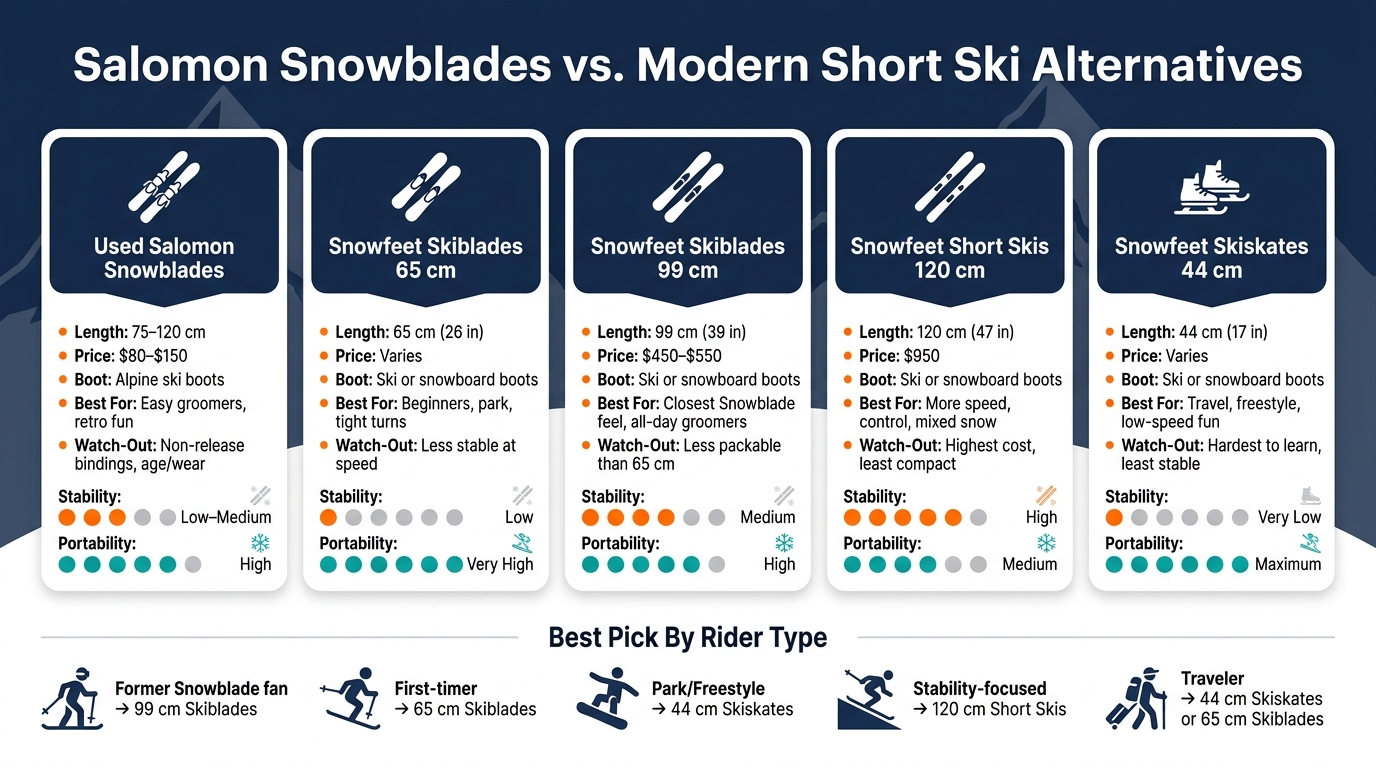
Salomon Snowblades vs. Modern Short Ski Alternatives: Full Comparison
Snowboarder tries Snowfeet* | Which Snowfeet* Short Ski is the Best? | Snowblades 44, 65, 99 Review
Quick Comparison
| Option | Length | Best Use | Boot Setup | Main Watch-Out | Price |
|---|---|---|---|---|---|
| Used Salomon Snowblades | 75–120 cm | Easy groomers, retro fun | Mostly alpine ski boots | Age, wear, binding safety | $80–$150 |
| Short skiblades | 65 cm | Beginners, park, tight turns | Ski or snowboard boots | Less steady at speed | Varies |
| Mid-length skiblades | 99 cm | Closest Snowblade feel, all-day groomers | Ski or snowboard boots | Less packable than 65 cm | $450–$550 |
| Short skis | 120 cm | More speed, more control, mixed resort snow | Ski or snowboard boots | Higher cost, more length | $950 |
| Skiskates | 44 cm | Travel, low-speed fun, freestyle laps | Ski or snowboard boots | Harder to learn, least steady | Varies |
What stands out to me is simple: used Snowblades are mostly a nostalgia buy now. They can still be fun, sure. But for day-to-day resort use, modern short skis give you a better mix of control, setup choices, and less used-gear roulette.
And yeah, used-gear roulette is fun only until you’re staring at a binding from 2003 in a parking lot :)
1. Used Salomon Snowblades
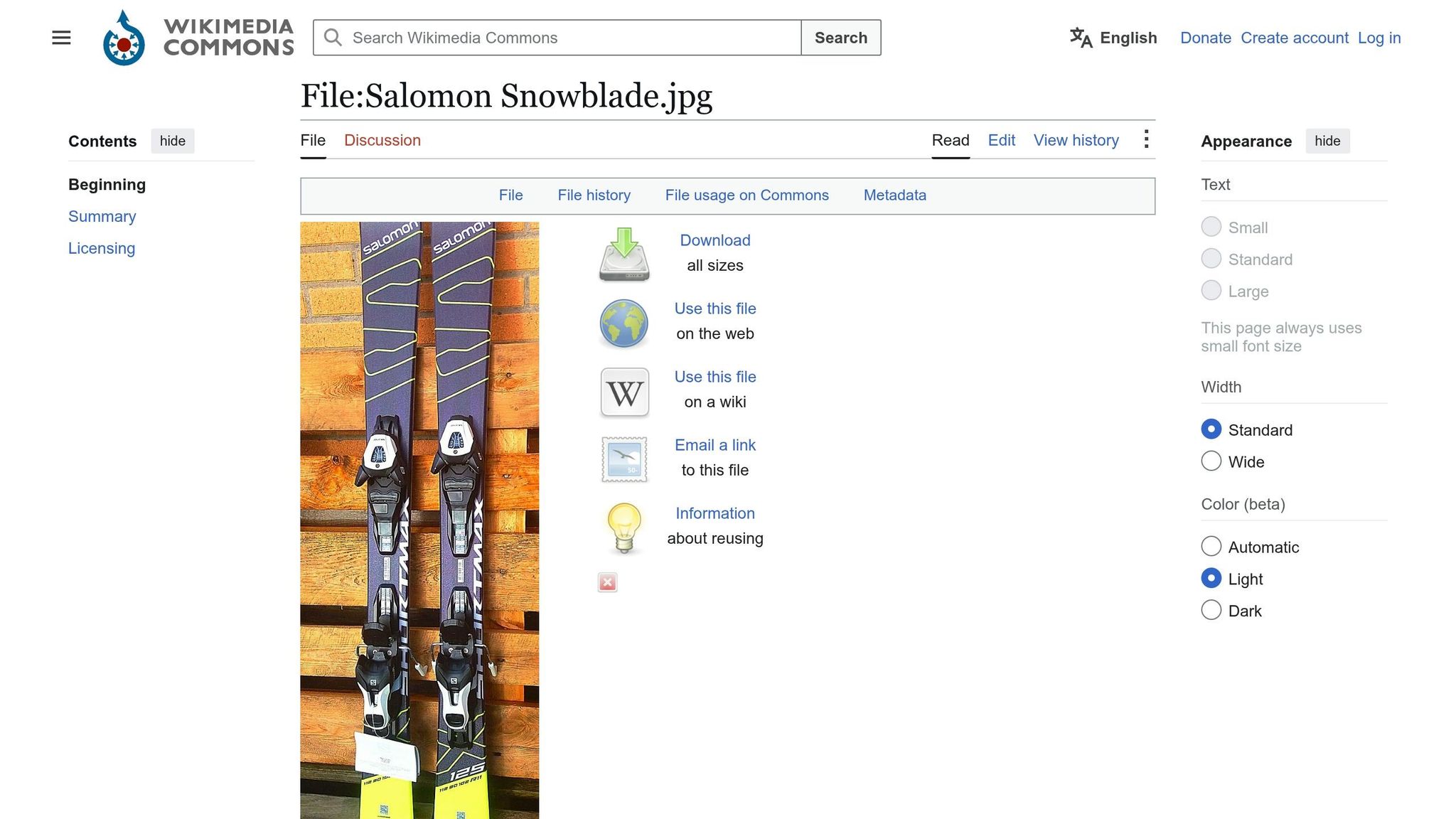
Used Salomon Snowblades usually list for $80 to $150. But don’t let the price tag make the call for you. Age, binding type, and condition matter more. In plain English: a cheap pair with sketchy bindings can be a bad deal, while a clean pair with the right setup may still be worth a look.
Stability
Short 75–99 cm models feel playful and turn with almost no effort. That’s the fun part. The tradeoff shows up fast once you pick up speed or hit uneven snow - they can get wobbly in a hurry.
The 99 cm and 120 cm versions do better here. They feel more planted and work better for easy cruising. Still, these older Snowblades used foam-core, narrow builds. That kept them light, but it also hurt edge hold and gave them a softer feel than modern short skis. So if you used to ride Snowblades and are coming back after trying newer gear, you may notice that older models give up some of the stability that newer short skis now offer by default.
Portability
At about 90–99 cm (35–39 in), Snowblades are easy to live with. They’re simpler to carry through the parking lot, easier to stash at home, and way less awkward to fit in a car than full-length skis. That part still rules :)
The catch is age. Older foam-core skis can feel flat or soft underfoot after years of use or poor storage. So yes, they’re compact and convenient - but some used pairs may have lost a lot of their snap.
Boot Compatibility
This is the big one.
Later Snowblade models, especially the 99 cm and 120 cm versions, came with integrated adjustable release bindings for standard alpine ski boots. That’s the setup most people should want.
Earlier or shorter models often used bindings that do not release in a fall, which have been widely criticized as a safety concern, especially for kids and lighter riders. If you’re shopping used, check this first. No joke. A fun parking-lot find stops being fun if the binding setup is wrong.
That binding issue is a big reason modern short-ski options are easier to recommend.
Terrain Fit
Snowblades work best on green and easy blue groomers at moderate speeds. That’s their sweet spot. Smooth runs, mellow pace, quick turns - good times.
They struggle in:
- Powder
- Chopped snow
- Steep icy terrain
Their narrow width gives them little float in soft snow, and edge grip on hardpack is limited. So if your mountain gets mixed conditions through the day, a used pair can start to feel limiting pretty fast. Modern short skis do a much better job closing that gap.
That makes used Snowblades more of a nostalgia buy. For most riders, the stronger next step is a modern short-ski option like Snowfeet*. Next, compare that used-gear gamble with current short-ski options built for the way most riders actually ski today.
2. Snowfeet* Skiblades 65 cm
At 65 cm (26 in), these are Snowfeet*'s shortest skiblades. If you're looking at used Salomon Snowblades, this gives you a newer build and a cleaner binding setup. Nice little upgrade, honestly.
Stability
Snowfeet* builds these with a wood core, metal edges, and a graphite base. The 4-meter turn radius makes them fast to turn and easy to control, but they’re not made for bombing down the hill or laying out big carving turns.
The deep sidecut and camber help the edges bite well on groomed snow. So, they feel best when you want a playful ride and quick moves, not top-end speed.
Portability
This is where the 65 cm model shines.
At only 26 in long, it’s easy to carry, stash in a car, or pack for a trip. If you want something small, simple, and not a pain to deal with, this size is tough to beat.
Boot Compatibility
Snowfeet* offers the 65 cm model with either ski-boot bindings or snowboard-boot bindings.
- Ski boots give you more precise edge control
- Snowboard boots feel warmer and are easier to walk in, but you’ll usually want to ride a bit more carefully
That choice comes down to how you like to ride and how much control you want underfoot.
Terrain Fit
These work best on groomed green and blue runs, park features, and natural hits. They can handle light powder up to 4 in (10 cm), but once the snow gets deeper, longer skiblades make life easier.
The twin tips help with both forward and switch riding. If your mountain is mostly groomers, the 65 cm model is the easiest and most playful pick for beginners, kids, lighter riders, and freestyle riders.
If you want a bit more stability but still want that short-ski feel, move up to the 99 cm version.
3. Snowfeet* Skiblades 99 cm
If the 65 cm model feels a little too loose, this is the sweet spot. At 99 cm (39 in), it sits right in the middle of the Snowfeet* lineup. It’s longer and steadier than the 65 cm, but still shorter and easier to throw around than the 120 cm. For former Snowblade riders, this is probably the closest thing out there today. You get that quick-turn feel, but with better stability and cleaner bindings.
Stability
The 6-meter turning radius, along with the 11.5–8.5–11 cm tip/waist/tail shape and deep sidecut, helps these skis feel smoother and more settled on groomed snow. The wood core and metal edges also give them a more solid feel underfoot.
You can still pivot fast, which is half the fun, but the ride feels calmer once you pick up speed. If you liked the playful feel of old Salomon-style snowblades but thought super-short gear got twitchy, this length lands in a nice middle lane.
Portability
At 39 inches, these are still easy to carry, store, and toss in the car compared with standard skis. They’re not as tiny as the 65 cm version, of course, but they balance convenience with a more planted ride.
Boot Compatibility
The 99 cm model comes with two binding options:
- Bindings for ski boots: EU 36–49 / US 4.5–14.5
- Bindings for snowboard boots: EU 38–49 / US 6–14.5
Snowboard boots can cut the cost of getting started and make it easier to walk around the resort. Ski boots, on the other hand, give you sharper edge control.
Terrain Fit
This model works best on groomed runs and easy resort laps. It also handles mixed snow with more confidence than the 65 cm version. That said, it’s still a daily resort ski, not a replacement for a full-length carving ski.
Price usually lands around $450–$550 for the standard model and $850 for the POWDER version. If you want more speed and a steadier feel, but still want to stay in the short-ski camp, the 120 cm model is the next step.
4. Snowfeet* Short Skis 120 cm
At 120 cm (about 47 in), this is the longest Snowfeet* model. If you want the most stability without jumping to full-length skis, this is the one to look at. It’s also the closest fit for riders who liked the quick feel of old Snowblades but want a calmer ride when speed picks up.
Stability
The 120 cm skis use a camber profile with tip and tail rocker. That setup helps them hold an edge on hardpack while still making turns feel easier and smoother in ungroomed snow.
The longer platform gives you the firmest edge hold and the smoothest ride in mixed snow. Put simply, this is the most stable model in the Snowfeet* line. The trade-off is simple too: you get more control, but you give up some packability.
Portability
These still travel and store more easily than full-length skis. That said, they’re the least compact Snowfeet* option.
Boot Compatibility
This model works only with:
- ski boots
- snowboard boots
Terrain Fit
It keeps that playful short-ski feel, but it handles mixed snow better than older Snowblade-style skis. That makes it a strong pick for groomed runs and days when conditions aren’t all neat and tidy.
At $950, it’s the most expensive Snowfeet* option. If you want something smaller and more skate-like, the 44 cm Skiskates are the next step.
sbb-itb-17ade95
5. Snowfeet* Skiskates 44 cm
If the 65 cm and 99 cm models still feel a bit too much like skis, Skiskates are the next step down. At 44 cm (17.3 in), they’re the smallest option in this lineup.
These are for riders who want max portability and quick, low-speed fun. They’re not a direct Snowblades copy. Think of them more like the pocket-size version of the idea: easy to bring along, easy to toss in a bag, and fast to get on snow.
The trade-off? Stability. The tiny platform makes them the least stable model here. But that same small size is what makes them so handy for travel, storage, and casual resort use. If you hate lugging gear around, this setup will feel like a breath of fresh air :)
Boot Compatibility
They come in ski-boot and snowboard-boot versions, with fixed, non-release bindings.
Terrain Fit
They work best on groomed resort runs and handle only about 4 in (10 cm) of light powder.
Compared with used Salomon Snowblades, Skiskates are smaller and more simple, but they’re also less of an all-around resort ski. They make more sense for riders who care most about size and ease of use, not the usual Snowblade mix of playful feel and control.
If you want a ride that feels more like skiing and gives you more stability, the next section looks at other short skis and skiboards.
6. Other Short Skis and Skiboards
Beyond Snowfeet*, a few other brands still make short skis and skiboards that are worth a look. Most lean more heavily on specific boot setups or take up more space than Snowfeet*. So the big thing to weigh is simple: which option gives you the best mix of fun, control, and ease of use?
RVL8 Skiboards
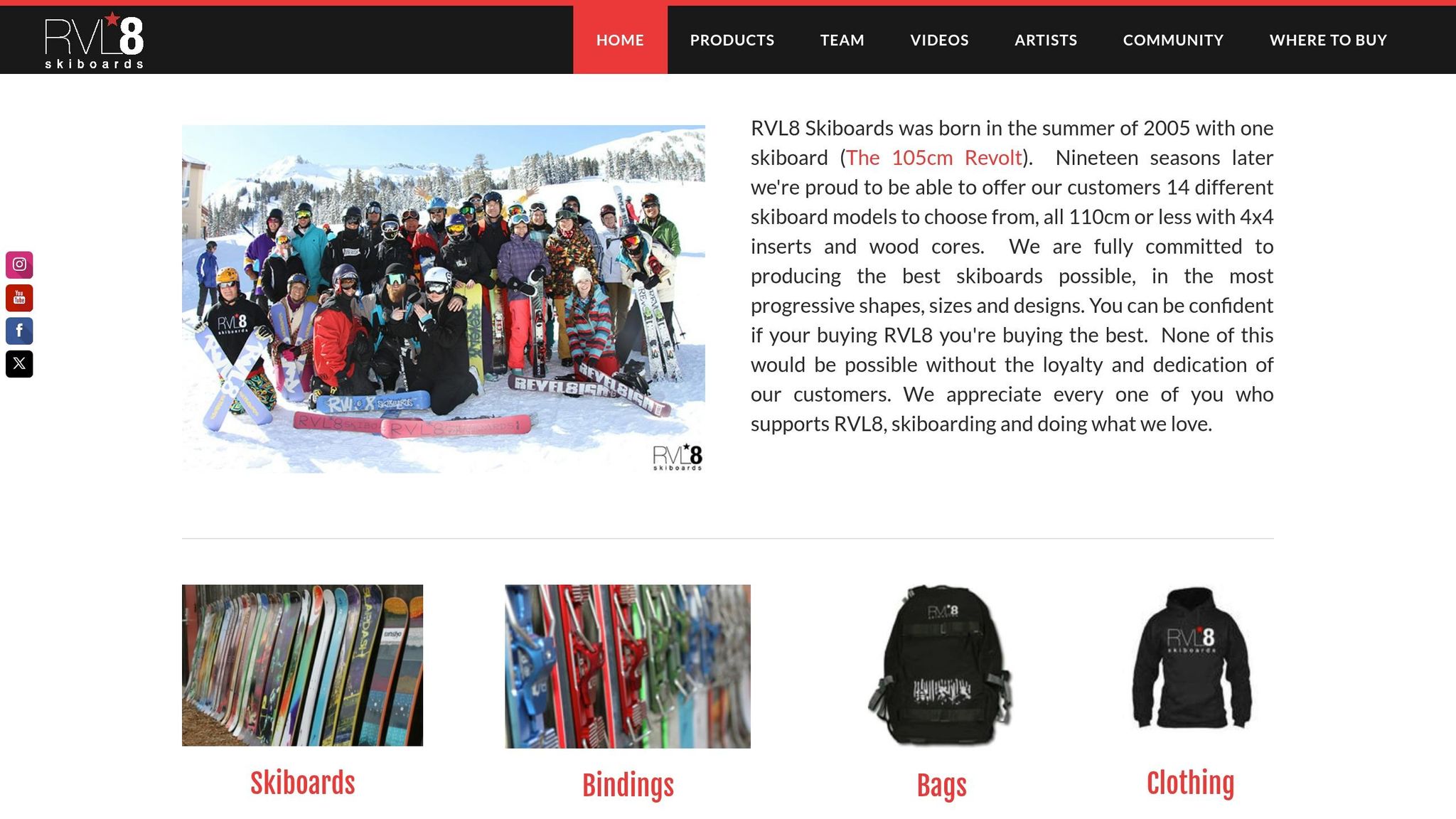
RVL8 sticks to dedicated skiboards, most often in the 75–110 cm range. Most models come flat, which means riders can mount either ski boots or snowboard boots. That makes them a nice fit for park laps and playful all-mountain riding. On icy groomers, though, they still give up some security.
SnowJam Skiboards
SnowJam makes skiboards in 75 cm, 90 cm, and 99 cm lengths, with wood cores, twin tips, and standard 4-hole mounts. They sit in the lower-price part of the market, which makes them a decent pick for casual riders who want that short-ski feel without spending a ton. The catch? SnowJam gives you less range and less boot freedom than Snowfeet*.
Head, Elan, Atomic, and Fischer Short Skis
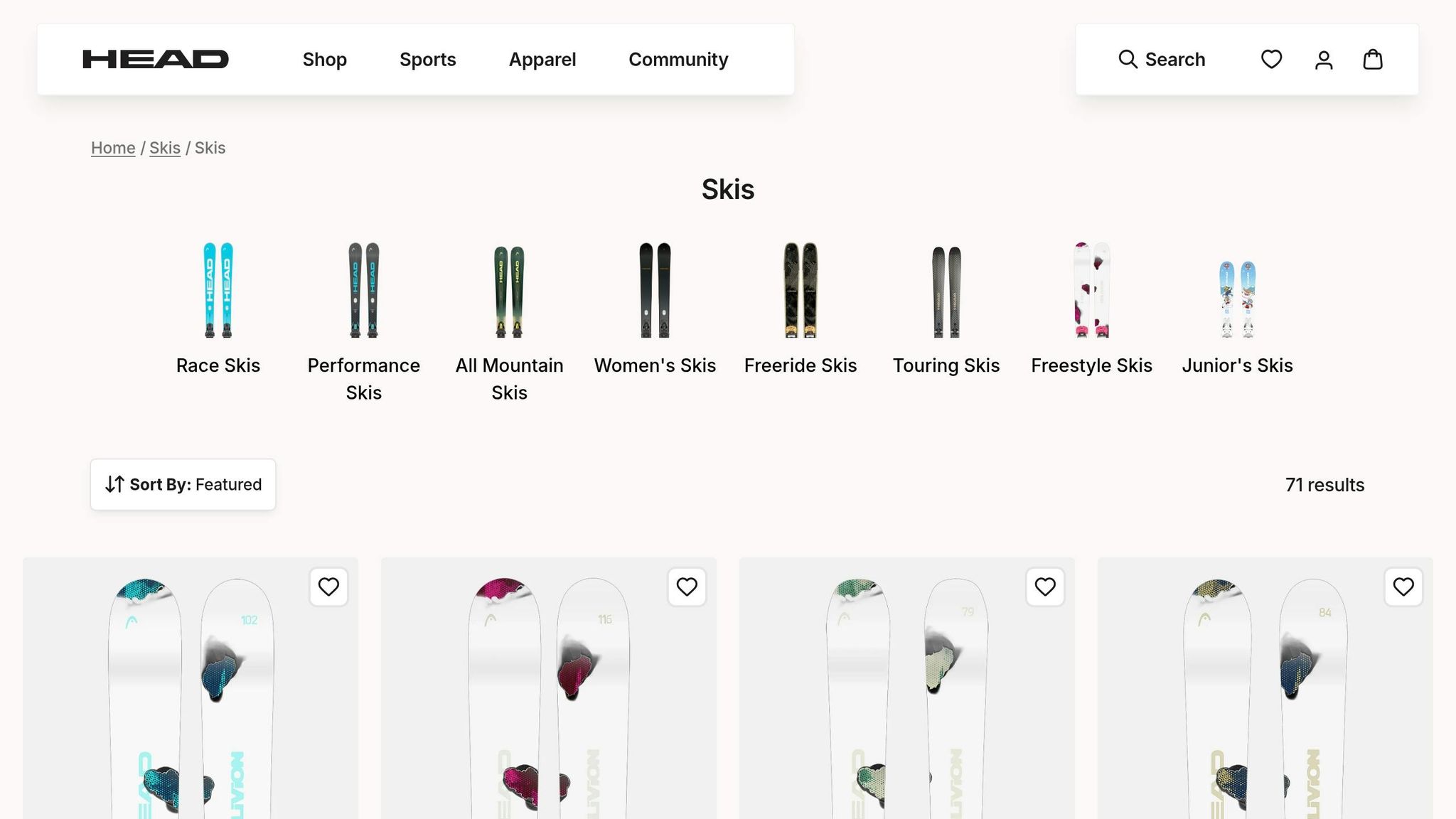
Big ski brands like Head, Elan, Atomic, and Fischer have also made shorter fun-carver-style skis, usually around 90–120 cm. These are built more like regular skis, with proper sidecut and camber. On groomed runs, that setup works well. You get strong edge hold and fast, tight turns that feel clean and planted.
The downside is pretty clear: they usually need standard alpine ski boots. So if you don't already own ski boots, you're looking at a rental or a new gear buy.
| Brand/Type | Typical Length | Boot Compatibility | Best For |
|---|---|---|---|
| RVL8 Skiboards | 75–110 cm (30–43 in) | Ski or snowboard boots | Park, playful all-mountain |
| SnowJam Skiboards | 75–99 cm (30–39 in) | Standard 4-hole mounts | Casual resort, budget riders |
| Head / Elan / Atomic / Fischer | 90–120 cm (35–47 in) | Alpine ski boots only | Groomed runs, carving |
| Snowfeet* Skiblades | 65–120 cm (26–47 in) | Winter shoes, ski boots, or snowboard boots | Resort, park, versatile |
| Snowfeet* Skiskates | 44 cm (17 in) | Winter shoes, ski boots, or snowboard boots | Casual resort, travel |
Boot compatibility is the main line between these options. And yeah, that one detail changes a lot: how much fun they are, how hard they are to learn, and how easy they are to own day to day.
Fun, Learning Curve, and Practical Ownership: What to Expect
Used Snowblades are getting old. So the big question isn’t just, “Can I still find a pair?” It’s which modern short-ski setup makes the most sense now.
The main difference comes down to fit. And that fit changes the whole ride.
44 cm Skiskates feel the most like skating. 65 cm Skiblades are the easiest for most people to pick up. 99 cm Skiblades come closest to that old Snowblade feel. And 120 cm Short Skis give you the most stability.
So, this isn’t only about raw performance. It’s more about what kind of rider you are and what kind of day you want on the mountain.
| Rider Type | Best-Fit Option | Why |
|---|---|---|
| Former Snowblade fan | Snowfeet* Skiblades 99 cm | Closest to Snowblade feel |
| First-timer | Skiblades 65 cm or Skiskates 44 cm | Easiest to learn |
| Park / freestyle rider | Skiskates 44 cm or Skiblades 65 cm | Most agile |
| Casual groomer skier | Skiblades 99 cm or Short Skis 120 cm | All-day groomer use |
| Traveler / frequent flier | Skiskates 44 cm or Skiblades 65 cm | Most portable |
| Stability-focused skier | Short Skis 120 cm | Most stable |
That’s only part of the story, though. Owning the gear over time matters too. And this is where older Salomon Snowblades can get a bit messy.
Used Snowblades are harder to maintain, harder to service, and less predictable to own. A lot of U.S. ski shops won’t work on them. That can turn a fun thrift-store score into a headache fast.
Snowfeet*, on the other hand, is easier to buy, easier to maintain, and easier to get on snow without a bunch of guesswork. That matters more than people think. Gear is a lot more fun when you can just use it instead of hunting for parts or calling three shops to ask the same question.
Boot choice is the last practical piece. It gives you some room to shape the setup around comfort or control:
- Ski boots give you the most precision.
- Snowboard boots lean more toward comfort.
- Winter boots make walking easiest and feel best off the snow.
With rider fit and ownership clear, the next step is a direct pros-and-cons comparison.
Pros and Cons of Each Option
Each option fits a different type of rider. The table below lays out the trade-offs in plain English. If you're comparing them with old Salomon Snowblades, the main gaps today come down to binding safety, boot choice, and how much stability you want.
| Option | Pros | Cons |
|---|---|---|
| Used Salomon Snowblades | Nostalgic retro feel; low used-market price; very maneuverable and playful on groomers | Older foam-core construction can wear out over time; many models used non-release bindings that are harder to service |
| Snowfeet* Skiblades 65 cm | Easiest substitute for new riders; highly portable; works with regular winter boots, snowboard boots, or ski boots | Less stable at higher speeds; not ideal for long groomer runs |
| Snowfeet* Skiblades 99 cm | Closest modern Snowblade feel; good all-day groomer choice; balanced short-ski option | Slightly less portable than the 65 cm version; not as agile as shorter options |
| Snowfeet* Short Skis 120 cm ($950) | Best for riders who want more speed and control; most stable Snowfeet* option | Least portable; highest price in the lineup; less nimble than shorter options |
| Snowfeet* Skiskates 44 cm | Ultra-portable; backpack-friendly; most agile; great for park and freestyle | Hardest to learn; less suited to long groomer runs or high-speed carving |
| Other short skis / skiboards | Standard ski-boot setup; good choice if you already own ski boots | Typically require alpine ski boots; fewer rental or lesson options at U.S. resorts |
Used Snowblades are mostly a nostalgia play. They're cheap, fun, and full of retro charm. But age matters here. Older construction can break down, and binding risk makes them a shaky pick for day-in, day-out riding.
Snowfeet* solves the biggest headache for a lot of casual riders: boot hassle. If you don't want to buy ski boots just to try short skis, that's a big deal. Being able to use regular winter boots or snowboard boots lowers the barrier by a lot.
Other modern skiboards make more sense if you already own ski boots and like that standard setup. That's the cleaner path for skiers who want short skis without changing how they gear up.
The short version is simple: old Snowblades are for retro fans, standard skiboards fit ski-boot users, and Snowfeet* is the easiest modern switch for most casual riders.
Conclusion
Salomon Snowblades had a strong run before Salomon stopped making them around 2007. Then the cracks started to show. Foam-core builds, narrow platforms, and riskier bindings held them back on stability and safety. The short-ski idea didn’t die, though. It just got better gear, better builds, and safer bindings. That’s why Snowfeet* stands out as the practical modern replacement.
So the choice is pretty simple: go with used vintage gear or get a modern Snowfeet* setup.
Here’s the quick breakdown:
- For the closest Snowblade-style feel, go with the 99 cm Skiblades
- For max agility, pick the 65 cm Skiblades or 44 cm Skiskates
- For the most stability, choose the 120 cm Short Skis
One more thing matters a lot: all Snowfeet* models work with winter boots, snowboard boots, or ski boots. That kind of flexibility is a big deal, and it’s something the original Snowblades never had.
For most casual riders, Snowfeet* is the better pick.
FAQs
Are used Snowblades still safe to ride?
Used snowblades can come with serious safety issues. Older pairs may not have strong metal edges for solid grip, and the bindings might not hold or release the way they should. Some vintage models were also made with older materials that wear down over time, which can lead to cracks or even failure on snow.
Modern options like Snowfeet Skiblades* use high-quality, fiberglass-reinforced materials and purpose-built bindings. That means better control, better precision, and a safer ride.
If you want peace of mind on the mountain, new, dependable gear is the safer pick.
Which Snowfeet* option feels most like old Snowblades?
The 99 cm Snowfeet Skiblades feel the closest to old-school snowblades. If you want that classic short-ski ride, this is the one that nails it best.
They hit the sweet spot between stability, carving, and easy turning. That’s the mix that made snowblades fun in the first place.
The 65 cm model is more playful. It’s better for fast direction changes, spins, and tricks. But the 99 cm version gives you more of that classic short-ski feel, just with newer build quality and bindings that work with comfy snowboard boots instead of stiff ski boots.
That last part matters more than people think. Snowboard boots feel a lot less harsh, so you get a setup that’s easier on your feet without losing that short, nimble ride.
Can I use snowboard or winter boots with Snowfeet*?
Yes. Most Snowfeet* models work with snowboard boots, which gives you a more comfortable, flexible ride than standard ski gear.
Here’s the simple breakdown:
- Under 100 cm: the 44 cm Skiskates and 65 cm and 99 cm Skiblades work with snowboard boots.
- Over 100 cm: models like the 120 cm versions need ski boots for support and safety.
So, if you want that more laid-back snowboard-boot feel, stick with the shorter models. Once you get into the longer options, ski boots are part of the deal.











Laat een reactie achter
Deze site wordt beschermd door hCaptcha en het privacybeleid en de servicevoorwaarden van hCaptcha zijn van toepassing.