



















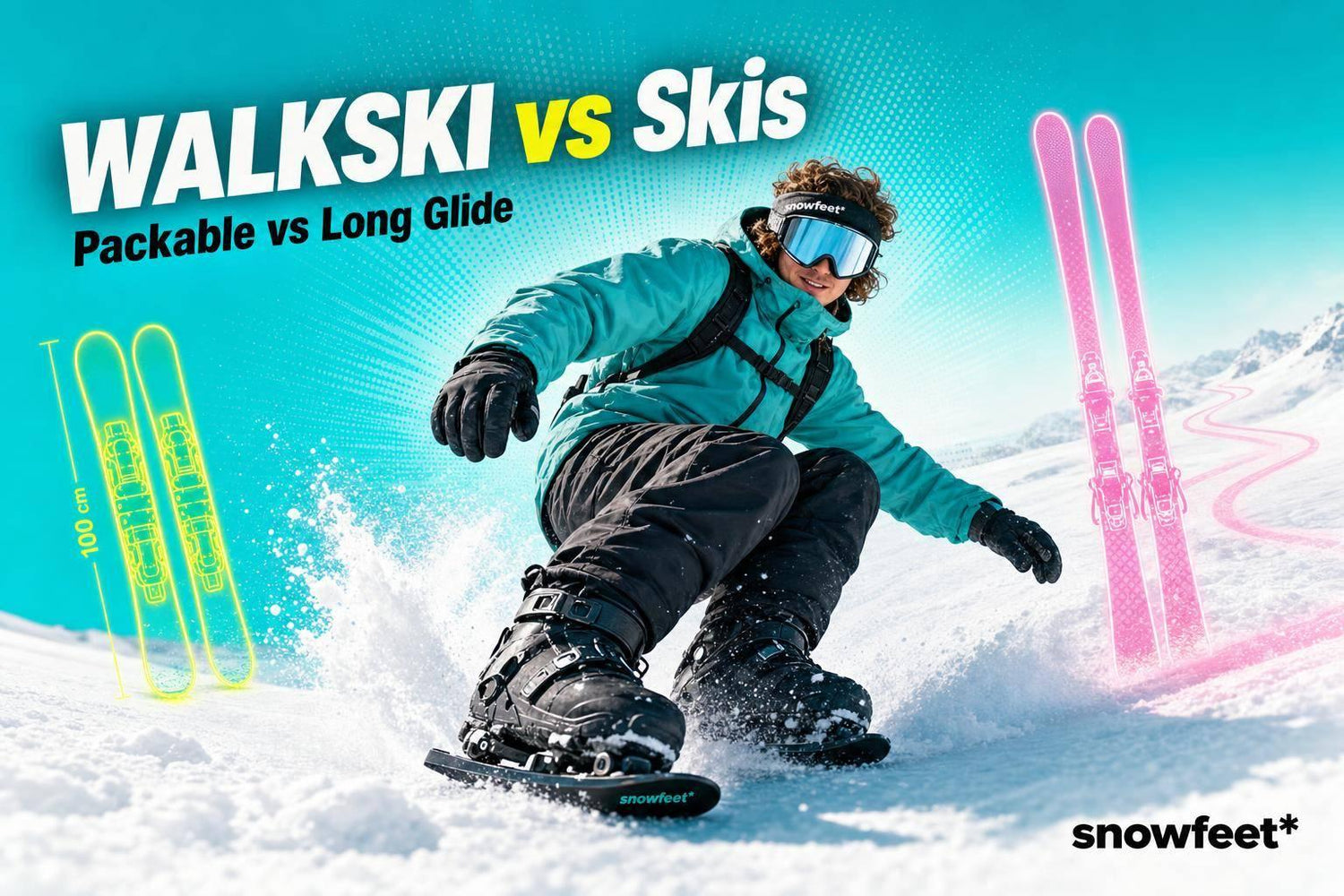
If you want short, low-hassle tours, I’d pick WALKSKI. If you want long backcountry days, I’d go with full touring skis. That’s the whole call in one line.
Here’s the short version:
- WALKSKI is 100 cm / 39.4 in long and about 8.8 lb per pair
- It works with winter boots, hiking boots, snowboard boots, or ski boots in US sizes 6 to 14.5
- It includes climbing skins and uses a strap-in binding
- Full touring skis are usually 160 to 190 cm long and about 3.1 to 4.0 lb per ski
- Full touring setups need touring boots + tech or frame bindings
- WALKSKI fits travel, beginners, and 1–3 hour laps
- Full touring skis fit long climbs, higher speeds, and mixed snow
So, if you care most about packing light, simple setup, and tight-tree handling, WALKSKI makes more sense. If you care most about glide, float, and downhill control on big days, full touring skis still win.
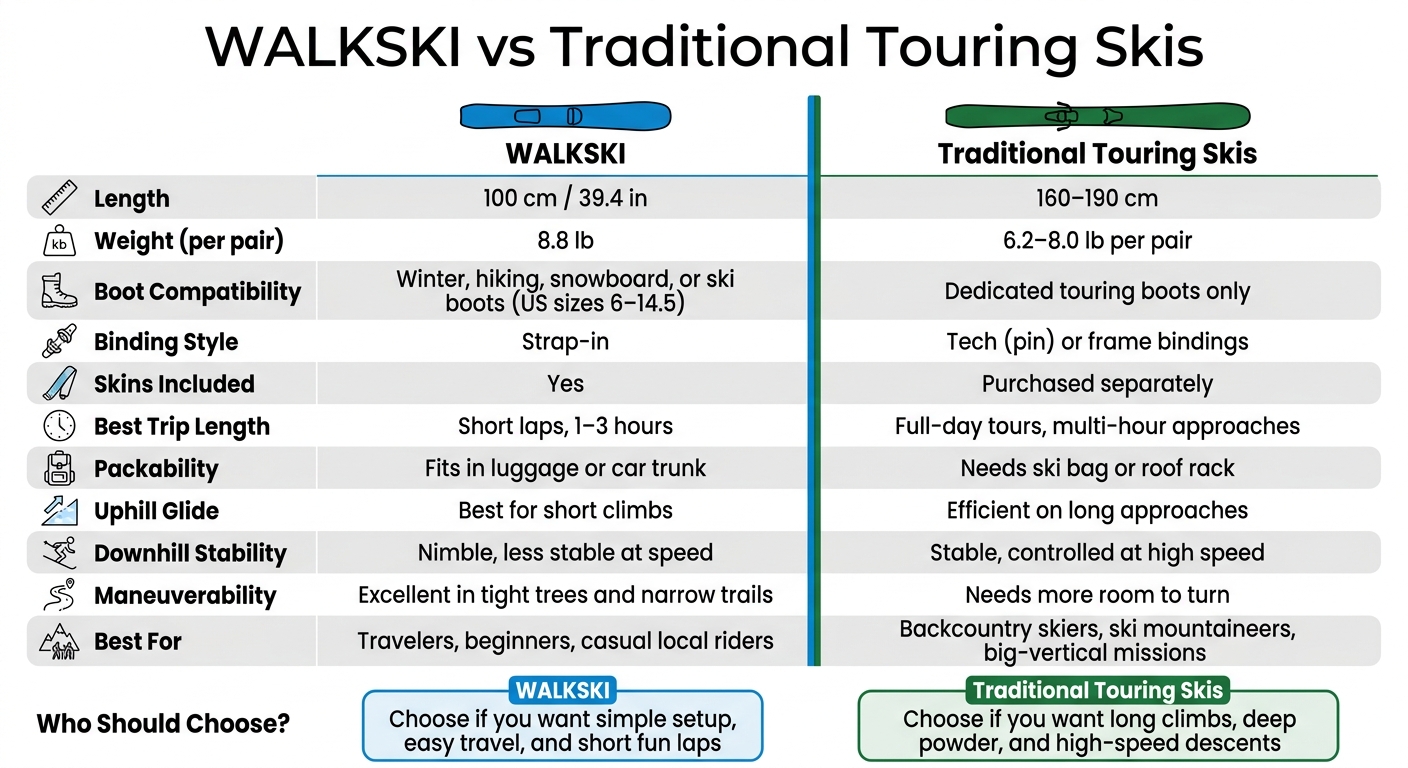
WALKSKI vs Traditional Touring Skis: Side-by-Side Comparison
Snowfeet* WALKSKI Backcountry Touring Skis | 100 CM
Quick Comparison
| Criteria | WALKSKI | Full Touring Skis |
|---|---|---|
| Length | 100 cm / 39.4 in | 160–190 cm |
| Weight | 8.8 lb per pair | 6.2–8.0 lb per pair |
| Boots | Winter, hiking, snowboard, or ski boots | Touring boots only |
| Binding style | Strap-in | Tech or frame |
| Best trip length | Short laps | Full-day tours |
| Travel | Fits in luggage or trunk | Often needs ski bag |
| Uphill glide | Short climbs | Better on long climbs |
| Downhill feel | Nimble, less stable at speed | More stable, more float |
I see it like this: WALKSKI lowers the hassle. Full touring skis lift your ceiling on big mountain days. Pick the one that matches how you’ll ski most of the time, not your dream day once a year :)
Snowfeet* WALKSKI: Short-Tour Skiing Made Simple
Snowfeet* WALKSKI Backcountry Touring 100 cm is made for people who want to go uphill and ski back down without dragging around a big touring setup. It stays small, light, and easy to deal with. That’s the whole appeal of a short touring ski. It makes the most sense on short tours, neighborhood hills, travel days, and quick laps when you don’t want gear to become a project.
| Feature | Snowfeet* WALKSKI Backcountry Touring 100 cm |
|---|---|
| Length | ~100 cm / 39 in |
| Weight (pair) | ~8.8 lb (3,980 g) - fiberglass core |
| Binding / Boot Setup | Strap-in binding; works with winter boots, waterproof hiking boots, or snowboard boots |
| Touring Modes | Walk, Ski, Climb 1, Climb 2 |
| Skins Included | Yes |
| Packability | High - fits in car trunks, large suitcases, small closets |
| Best Use Cases | Short tours, local hills, forest trails, travel skiing, beginner backcountry |
The binding has four modes: Walk, Climb 1, Climb 2, and Ski. That means you can move through the day without swapping gear in the middle of a tour or dealing with a more involved boot-and-binding system. Nice and simple. Supportive waterproof hiking boots or snowboard boots tend to work best.
How the 100 cm length changes things on snow
At 100 cm, WALKSKI is much shorter than standard touring skis, and you feel that right away in tight spaces. On narrow forest trails, kick turns are easier. In brush, trees, or awkward side paths, the skis take less effort to manage. For short laps, that can make a big difference.
If you’re new to touring, the shorter length can also feel less awkward. The skis stay closer under your feet, so balance shifts may feel more natural. It can also help cut down on crossed tips, which is a common headache on longer skis.
Why WALKSKI works for travelers, beginners, and casual tourers
WALKSKI keeps the gear list short. You can use supportive waterproof hiking boots or snowboard boots instead of dedicated alpine touring boots. That lowers the barrier to getting started and makes the whole thing feel less like you need a garage full of gear just to enjoy snow.
The 100 cm size also helps a lot with travel and storage. It fits in a car trunk or a suitcase, and it won’t hog space in a small closet. For casual riders and beginners, that makes it a handy way to get out on snow without turning every outing into a full-on expedition.
Traditional touring skis deal with those tradeoffs by giving you more glide, more stability, and better efficiency on longer missions.
sbb-itb-17ade95
Traditional Touring Skis: Built for Long Approaches and Fast Descents
Compared with WALKSKI's short, strap-in setup, traditional touring skis give up convenience and lean hard into efficiency. They make more sense on longer tours, where glide, stability, and downhill control matter more than packability. Most models run about 160–190 cm long and pair with dedicated touring boots, pin/tech or frame bindings, and climbing skins. The goal is simple: climb well and descend with more control. You feel that trade-off most on long climbs and fast descents.
| Feature | Traditional Touring Skis |
|---|---|
| Typical Length | About 160–190 cm |
| Waist Width | About 80–105 mm underfoot; wider 95–115 mm models also common |
| Bindings Required | Pin/tech or frame bindings |
| Boots Required | Dedicated touring boots with walk mode |
| Strengths | Long approaches, flotation, stability at speed, mixed terrain |
| Limitations | More gear, more cost, harder to pack, more setup time |
| Best For | Advanced tourers, ski mountaineers, big-vertical backcountry missions |
Where traditional touring skis have a clear edge
On big backcountry days, the gap gets obvious fast. On a full-day alpine tour with several thousand feet of vertical gain, traditional touring skis can do things a 100 cm ski just can't. The longer edge helps you hold better on firm snow and stay calmer at speed. That means descents feel more controlled when the snow turns icy, choppy, or wind-packed.
Wider models in the 95–115 mm range also give you more float in deeper or mixed snow. And on the skin track, a longer ski glides farther with each stride. That may sound small, but over a long approach or a multi-hour mission, it saves real energy. It's the ski version of taking long, smooth pedal strokes instead of grinding in the wrong gear.
That said, all that performance comes with more gear and less simplicity. For casual use, that matters.
Why the full touring setup can feel impractical for casual use
The big catch is the full system. A complete traditional touring setup - skis, AT bindings, touring boots, skins, and often avalanche safety gear plus a 25–35 L touring backpack - is a bigger buy for someone who only tours a few times each season, sticks to short local laps, or is heading out for a long weekend.
It’s also harder to travel with. Traditional touring skis are awkward to pack, often need roof racks or a dedicated ski bag, and make last-minute trips less easy. Then there’s the learning curve. Managing skins and getting comfortable with the setup takes time, and not everyone wants homework before a snow day :)
For travelers, beginners, and casual riders, it can feel like a lot to deal with just to get a few hours on snow.
Traditional skis win on long, demanding tours. WALKSKI wins when convenience matters more.
Head-to-Head: Key Differences on Real Tours
Here’s what this looks like on snow: WALKSKI keeps travel and setup simple, while traditional touring skis make more sense for long days out. You feel that split fast once you get past the parking lot and start moving uphill.
| Feature | WALKSKI (100 cm) | Traditional Touring Skis |
|---|---|---|
| Travel/Packability | Fits in a car trunk, closet, or standard luggage | Usually needs roof racks or a large ski bag |
| Weight on Foot | Very light on foot; simpler boot and binding setup | Heavier overall; dedicated touring boots and bindings add weight and bulk |
| Simpler Setup | High; intuitive for beginners | Moderate; skin management and kick turns take practice |
| Climbing Efficiency | Best for short tours and local hills | Best for long, multi-hour approaches |
| Descending Stability | Quick to turn; less stable at higher speeds | Stable and controlled at higher speeds and in variable snow |
| Maneuverability | Excellent in tight trees and narrow trails | Needs more room to turn |
| Boot Compatibility | Works with winter boots, snowboard boots, or ski boots | Requires dedicated touring boots with walk mode and tech fittings |
Portability, packability, and boot setup
WALKSKI’s 100 cm length is a big deal if you hate hauling gear around. It fits in a car trunk, a closet, or standard luggage, so you can skip roof racks and those giant ski bags that always seem to fight back at the worst time.
The boot setup is simpler too. WALKSKI works with winter boots, snowboard boots, or ski boots. Traditional touring skis, by contrast, need dedicated touring boots with walk mode and tech fittings. For travelers and beginners, that easier setup is the main draw. Less gear. Less fuss. More “let’s just go.”
Climbing, descending, and performance limits
On short climbs and local tours, WALKSKI feels straightforward and light on foot. The short length also helps in switchbacks and narrow tracks. If you’ve ever tried to wrestle long skis through tight trees, you know why that matters.
Traditional touring skis pull ahead on long approaches. Their glide pays off more and more as the tour gets longer, which makes a difference on multi-hour climbs.
On the way down, WALKSKI turns fast and feels nimble, but there’s a catch: it gives up some stability and float once speed picks up. Traditional touring skis track better when the slope gets faster or the snow gets choppy, crusty, or mixed. That’s the trade-off in plain terms - easy, casual touring versus longer, harder backcountry days.
Which One Should You Choose? Final Verdict
The choice comes down to three things: how far you tour, what kind of terrain you ride, and how much gear you want to haul around.
Here’s the quick match-up:
| User Profile | Terrain & Tour Style | Recommended Setup |
|---|---|---|
| Traveler | Short trips, resort-adjacent hills | WALKSKI |
| Beginner | Mellow slopes, learning basics | WALKSKI |
| Casual local rider | After-work laps, 1–3 hour sessions | WALKSKI |
| Backcountry skier | Full-day tours, steep terrain, deep powder | Traditional touring skis |
Best for travelers, beginners, and local riders
If you travel a lot, tour now and then, or you’re still getting your ski legs under you, WALKSKI cuts out a lot of hassle.
For travelers, that matters right away. WALKSKI fits in standard luggage, so you can skip dragging around a big touring setup. For beginners, the shorter platform feels less intimidating and is easier to learn on. It also works with boots many new skiers already have. And for local riders squeezing in a few quick laps on a Saturday or after work, the compact size and simple setup make a big difference. Less fuss usually means you’ll get out more. That’s half the battle, honestly :)
Best for full-day tours and performance-focused backcountry skiers
If you spend long days in the backcountry and care most about uphill travel, traditional touring skis still come out on top.
On long approaches, steep lines, and mixed snow, full-length touring skis give you better glide on the skin track. You also get stronger edge hold, plus more stability and flotation on the way down. If your tours are big, your snow is all over the place, and your descents matter as much as the climb, that extra ski pays off.
So, for travelers, beginners, and casual riders, WALKSKI is the better default. For long, demanding backcountry days, traditional touring skis still make more sense.
FAQs
Can WALKSKI handle powder?
Yes. WALKSKI Backcountry Touring 100 cm handles powder and ungroomed trails well, especially in up to 4 inches of powder.
It’s a fun, reliable pick for backcountry routes, packed trails, and light powder. If you’re heading into deep alpine powder, longer skis will usually give you better float.
Do I need special boots for WALKSKI?
No. Snowfeet WALKSKI* works with regular winter boots or snowboard boots you likely already own.
That means you can skip pricey alpine touring boots. Its adjustable, universal bindings fit a wide range of footwear, which makes things a lot simpler.
Any solid waterproof winter boot can work. That said, Snowfeet* recommends boots with good ankle support for better control and comfort. Think of it like this: the more stable your boots feel, the smoother your ride tends to be.
Is WALKSKI good for beginners?
Yes - WALKSKI is a great pick for beginners.
Its compact 100 cm length makes it much easier to handle and control than long touring skis, which can feel like a lot when you're just starting out.
It also makes touring a lot simpler. You can use regular winter boots instead of heavy alpine touring boots and special bindings. That lighter, more intuitive setup helps new users build confidence and have more fun in the backcountry.











Laat een reactie achter
Deze site wordt beschermd door hCaptcha en het privacybeleid en de servicevoorwaarden van hCaptcha zijn van toepassing.