



















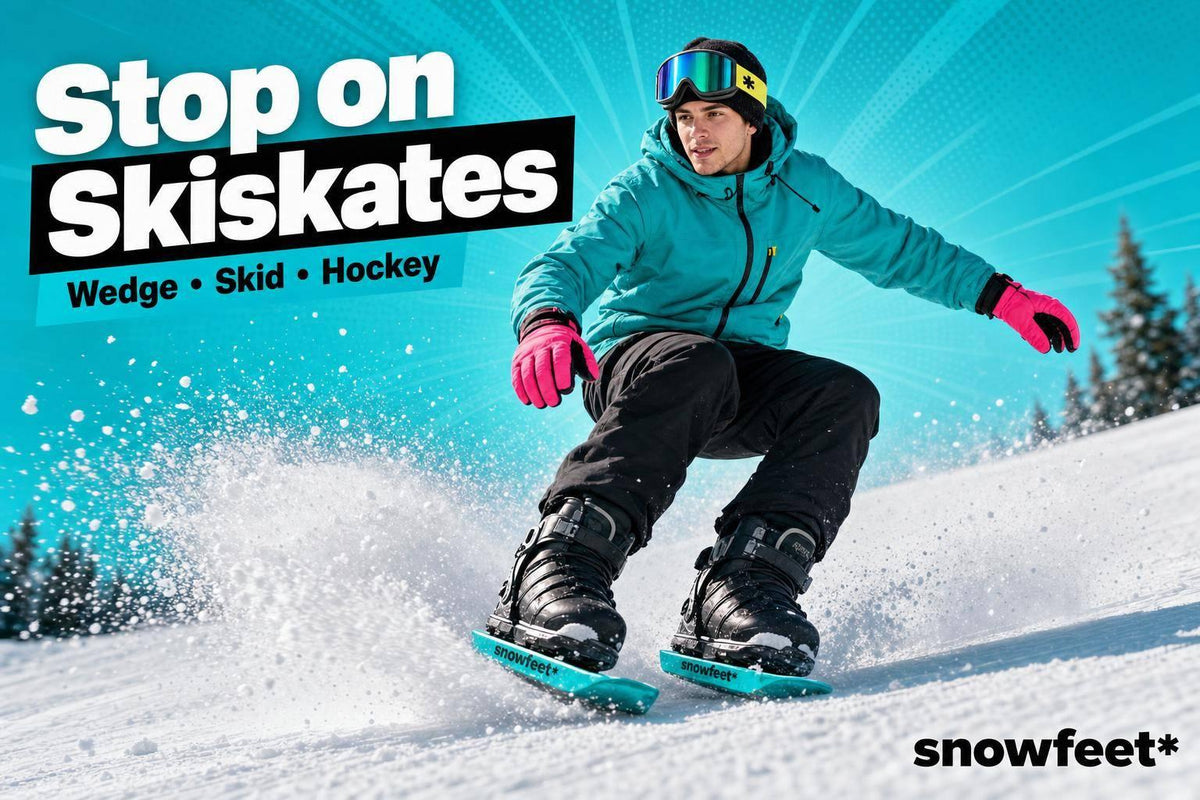
Yes - you can stop on skiskates, and the short answer is this: use a wedge at low speed, move to a controlled skid next, and learn a hockey stop for faster runs.
If I were teaching a friend on 44 cm skiskates, I’d keep it simple:
- Start on a gentle groomed slope
- Keep knees bent and weight centered
- Don’t lean onto your toes
- Use the wedge first
- Practice the skid before the hockey stop
- Use uphill turns or soft snow if you need extra help
Because skiskates are only 44 cm (about 17.3 in.) long, they turn much faster than full-length skis. That means stopping can feel a little twitchy at first. The upside? Once I find my balance, they’re often easier to slow down on than long skis.
A good rule: if I can’t stop cleanly on a slope, the slope is too steep for me right now. No shame there. Green run, reset, try again :)
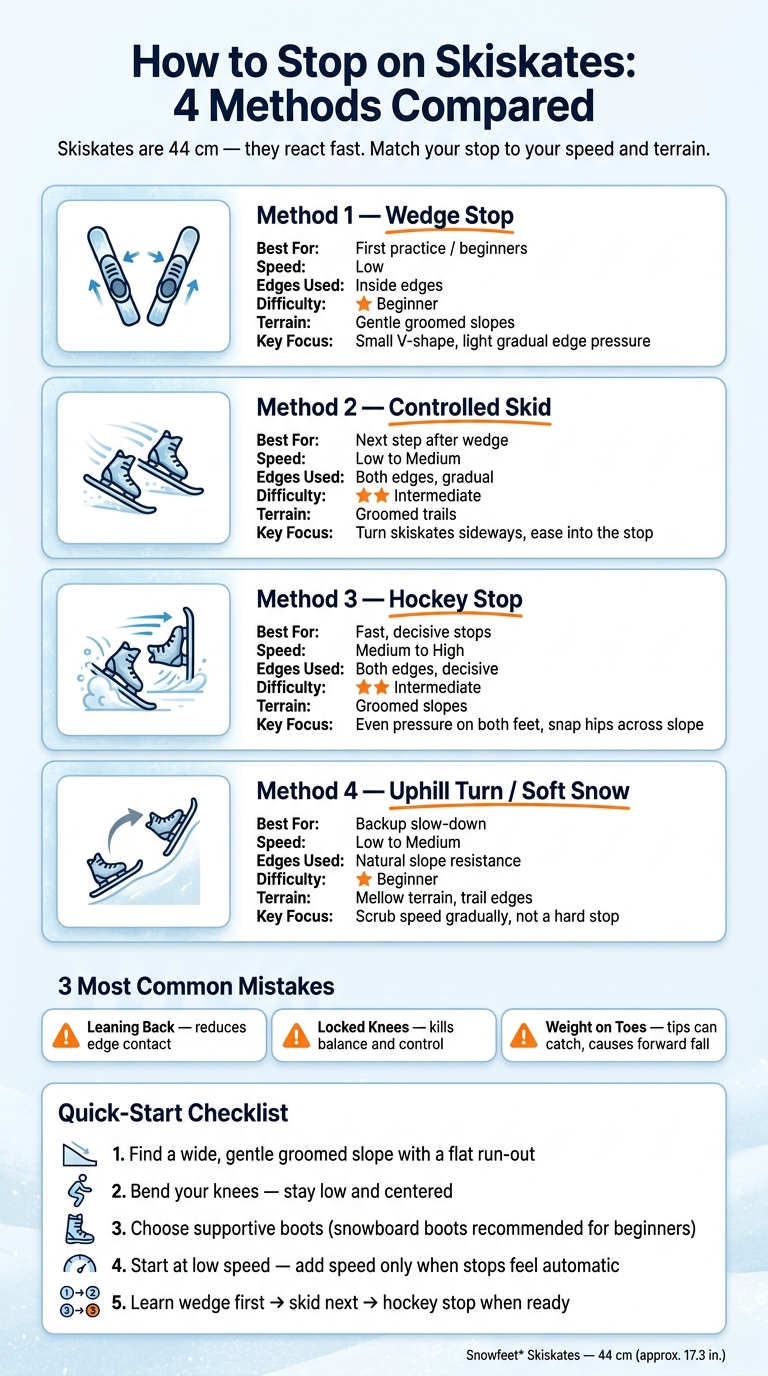
Quick comparison
| Stop method | Best for | Speed | What I focus on |
|---|---|---|---|
| Wedge stop | First practice | Low | Small V-shape, light edge pressure |
| Controlled skid | Next step | Low to medium | Turn skiskates across the slope |
| Hockey stop | Fast stop | Medium to high | Even pressure on both feet |
| Uphill turn / soft snow | Backup slow-down | Low to medium | Scrub speed, not a hard stop |
A few facts that matter most:
- 2 main things control your stop: edge pressure and body position
- 3 common problems: leaning back, locked knees, and too much toe pressure
- 1 smart place to learn: a wide, mellow slope with a flat run-out
If you keep your stance low, your feet under you, and your speed in check, stopping on skiskates gets a lot less sketchy and a lot more fun.
Skiskate Stopping Methods: Which One Should You Use?
How to Stop with Skiskates and Snowfeet? 🛑 Check out our video!
Set Up Your Stance, Boots, and Practice Slope Before You Start
Before you work on stopping, get three things dialed in first: your stance, your boots, and the slope you’re on.
That prep matters. Skiskates react fast, so even small shifts in balance or gear can change how your stop feels.
Keep your weight centered with knees bent
Stay low and centered, with your knees bent. That helps your edges stay in contact with the snow.
The Snowfeet Team says it best:
"Keep your center of gravity low, especially when going downhill."
Try not to sit in the back seat. Leaning back makes it harder for your edges to bite, and your stop can get sketchy fast.
Pick boots that match your level of control
Snowfeet* Skiskates work with a few boot types, which is great for casual riders. You can pick the amount of support that fits your skill level.
Here’s the short version:
- Snowboard boots are the best all-around pick for most beginners. They offer good support, comfort, and enough response for clean edge control.
- Ski boots give you the most precise control, but they’re stiffer and less forgiving.
- Regular winter shoes are only okay for slow practice on flat ground.
Once your boots give you enough edge feel, head to a mellow slope and start working on the stop.
Start on wide, gentle snow before adding speed
The slope matters just as much as your form. Look for wide, gentle groomed snow with a flat run-out.
Because skiskates respond so fast, easy terrain gives you more time to fix mistakes before you need a full stop. Keep your speed low and repeat each stop until it starts to feel automatic.
Method 1: The Wedge Stop
The wedge stop is the first stopping move most beginners learn, and it works well on Snowfeet* Skiskates. Since the 44 cm skiskates are short and easy to turn, this move feels simple to manage. But there’s a catch: they react fast. So instead of stomping hard, use light, quick movements. The goal is simple: make a small V, let the edges dig in, and slow down bit by bit.
How to do a wedge stop step by step
Start with a slow, controlled glide on flat snow or a gentle slope. Then go through these steps:
- Start from a balanced glide and stay low and centered.
- Set the skiskates into a small V-shape.
- Rotate your heels outward bit by bit while keeping your stance around shoulder-width.
- Tip the skiskates onto their edges a little more as friction starts to build.
The big thing here is gradual movement. Smooth, steady pressure works much better than trying to force the stop in one shot. Keep your legs loose the whole time. Stiff legs make this much harder to control.
When the wedge works best on Snowfeet* Skiskates
This method works best at low speed: mellow green slopes, wide groomed trails, and those moments when you want to slow down in a steady way instead of stopping all at once. It gives you time to feel how the edges work and get more comfortable before moving on to a stronger stop.
Skip steep or bumpy terrain while you’re still learning. Once you start picking up speed, or the slope gets steeper, the wedge won’t do as much. That’s when a hockey stop becomes the better choice.
Mistakes that make the wedge fail
Most wedge mistakes are pretty easy to fix:
| Mistake | Why it causes problems | Fix |
|---|---|---|
| Weight on toes | The tips can catch in the snow and cause a forward fall | Shift weight to the middle or back of your feet |
| Locked knees | Reduces balance and makes smooth edge pressure hard | Keep knees bent, legs flexible |
| Heels pushed too far apart | Hurts stability and makes control harder | Use gradual outward rotation, shoulder-width apart |
| Leaning backward | Throws off balance and reduces edge contact | Keep weight centered; don't sit back |
One more thing: dull edges can make the wedge slide instead of grip. If the wedge stops biting into the snow, switch to a controlled skid or hockey stop.
sbb-itb-17ade95
Method 2: The Controlled Skid and Hockey Stop
Once the wedge feels comfortable, move to the controlled skid and hockey stop.
How to do a controlled skid stop
The controlled skid is the bridge between a wedge and a hockey stop. You’re not snapping into a full stop here. You’re easing into it.
Turn both skiskates sideways to the slope and let the edges bite little by little. Keep your weight centered over your midfoot, with a slight lean toward your heels. If your weight drifts onto your toes, those short tips can catch and pitch you forward. Not fun.
As you rotate, tip the skiskates a bit more until they scrub off speed and bring you to a stop.
How to do a hockey stop on skiskates
A hockey stop is sharper and more direct, but the basics stay simple: keep pressure even on both feet so the stop stays smooth.
Build up to a moderate speed on a groomed slope. Bend your knees, then turn your hips and legs across the slope. At the same time, roll both skiskates onto their edges until they bite and stop you.
Start on wide, groomed terrain before you try this on steeper runs. That gives you room to work out the timing without feeling rushed.
Wedge vs. skid vs. hockey stop: a side-by-side look
| Method | Speed | Edge Use | Difficulty | Terrain |
|---|---|---|---|---|
| Wedge Stop | Low | Inside edges | Beginner | Gentle slopes |
| Controlled Skid | Moderate | Both edges, gradual | Intermediate | Groomed trails |
| Hockey Stop | Moderate–high | Both edges, decisive | Intermediate | Groomed slopes |
If you still need gentler speed control on mellow terrain, use the backup slow-down options below.
Emergency Slow-Down Options, Common Errors, and Key Takeaways
Use heel drag and uphill turns on gentle terrain
If wedge and hockey stops still feel a bit fast, don’t force it. Use backup moves that help you stay in control on gentle terrain.
If you still need to trim speed, use heel drag, slight uphill turns, or the soft snow near the edge of a groomed trail.
"If you just need to slow down, use the heel brake." - Snowfeet Team
Use the heel brake to scrub speed, not to make a full stop.
You can also turn a little uphill. That small change in direction works like a natural brake because the slope pushes against your forward motion. Another simple move is drifting toward soft snow along the side of the trail. That softer patch can help slow you down without much effort.
If you already have a partial wedge, make the V a bit wider and press harder into the inside edges to slow down more.
As a last resort, crouch low and sit toward the uphill side. Keep your hands up and forward so you don’t throw them back and hurt your wrists.
If none of those moves work, it’s time to look at the usual mistakes.
Fix the most common stopping problems
When a stop keeps sliding out or feels shaky, the issue is often your stance or the slope you’re on.
- Terrain is too steep. If the hill is making you move faster than you can react, step back to a flatter green run. Spend your first runs on near-flat terrain before you add more slope.
- Your stance fell apart. Go back to the basics: bent knees, feet about shoulder-width apart, and eyes forward.
- Too much weight on your toes. That can tip you forward. Keep your pressure centered or a little toward your heels.
"Do not put your weight over your toes while skating, otherwise, you might catch the tips in the snow and fall." - Snowfeet Team
And yeah, one more thing: don’t try to jam a ski pole into the snow to stop yourself. It won’t hold your body weight, and it can hurt your shoulder.
What to remember before your next run
Start on easy terrain. Add speed only when your stop feels automatic.
Learn the wedge first. Then work toward a hockey stop when you’re ready. Keep your edges sharp and your base waxed so you get the grip you need on hard-packed snow or ice.
Snowfeet* Skiskates pivot faster than long skis, which can make stopping easier for many beginners. For many casual riders, Snowfeet Skiskates 44 cm* are easier to handle than long skis.
So, keep it simple: match your speed to the terrain, keep your weight centered, and use the stop that fits the slope.
FAQs
Can beginners learn to stop on skiskates quickly?
Yes. Many beginners learn to stop on skiskates pretty fast. Since Snowfeet Skiskates are short at 44 cm and easy to turn, they often feel simpler to control than long skis.
Most first-timers can pick up a basic snowplow stop in about 30 to 60 minutes on gentle slopes. After a few hours, or a handful of outings, a lot of people start to feel pretty confident.
If you’ve done ice skating, hockey, or inline skating, you may learn even faster. It’s a bit like stepping onto snow with skills your body already knows. :)
What should I do if my skiskates keep sliding instead of stopping?
If your skiskates keep sliding instead of stopping, your weight is probably too far back. When you lean back, the front of the skiskates lifts up. That cuts down edge contact and can make you pick up speed instead of slow down. Yeah, the exact opposite of what you want.
Keep your weight centered or a bit forward, with your shins pressing into your boot tongues. Keep your feet about hip-width apart, and steer with your knees and ankles, not your shoulders.
Which boots give the best control for stopping on Snowfeet* Skiskates?
Snowboard boots give you the best control when stopping on Snowfeet* Skiskates. They support your ankles, fit snug, and have a supportive cuff that helps keep your feet steady when you brake or put pressure on the edges.
Other boots can work too, but they need to be stiff enough so your foot doesn’t slide around inside. For 44 cm models, a medium-stiff freestyle boot is a good match. If you want more stability at higher speeds, go with a stiffer freeride boot.












Laat een reactie achter
Deze site wordt beschermd door hCaptcha en het privacybeleid en de servicevoorwaarden van hCaptcha zijn van toepassing.