
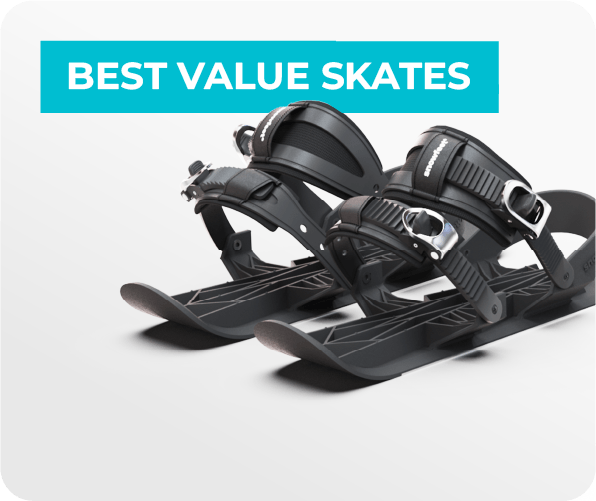
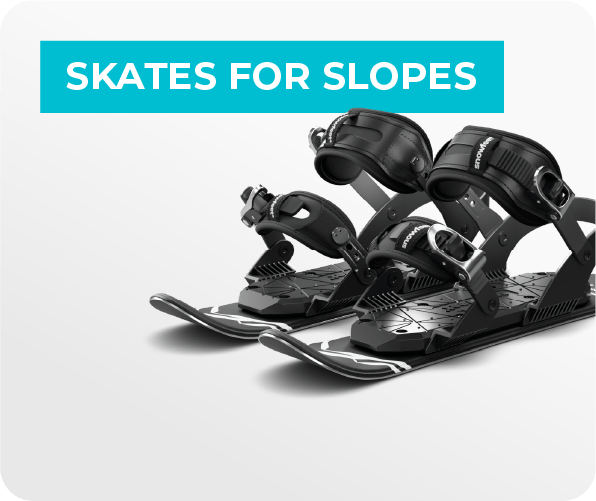
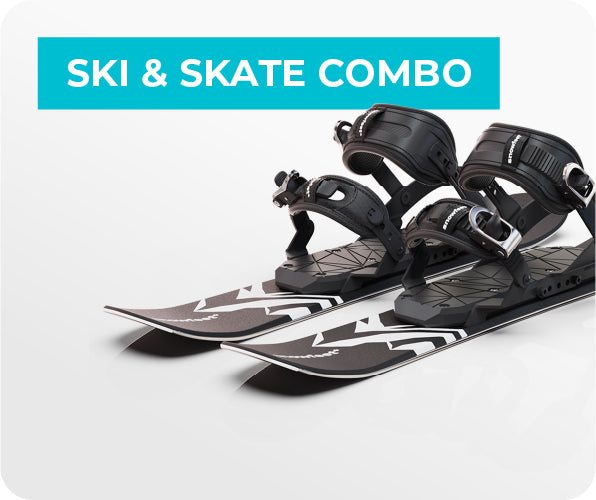
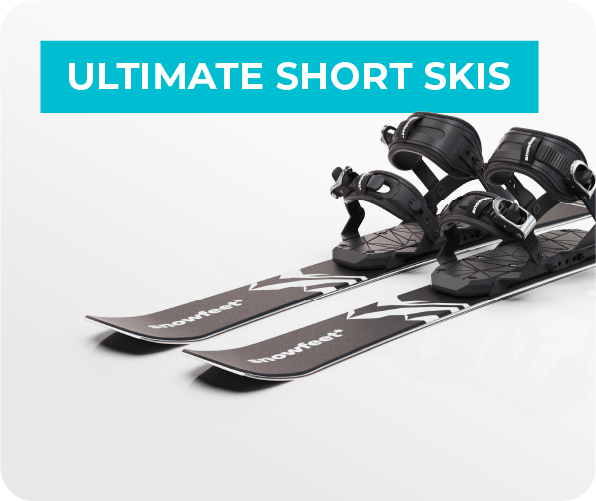
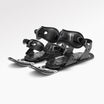
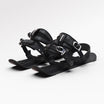
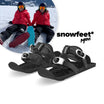
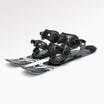
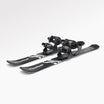
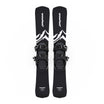
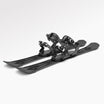
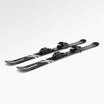
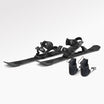
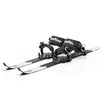
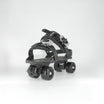
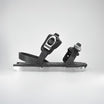
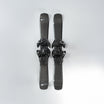

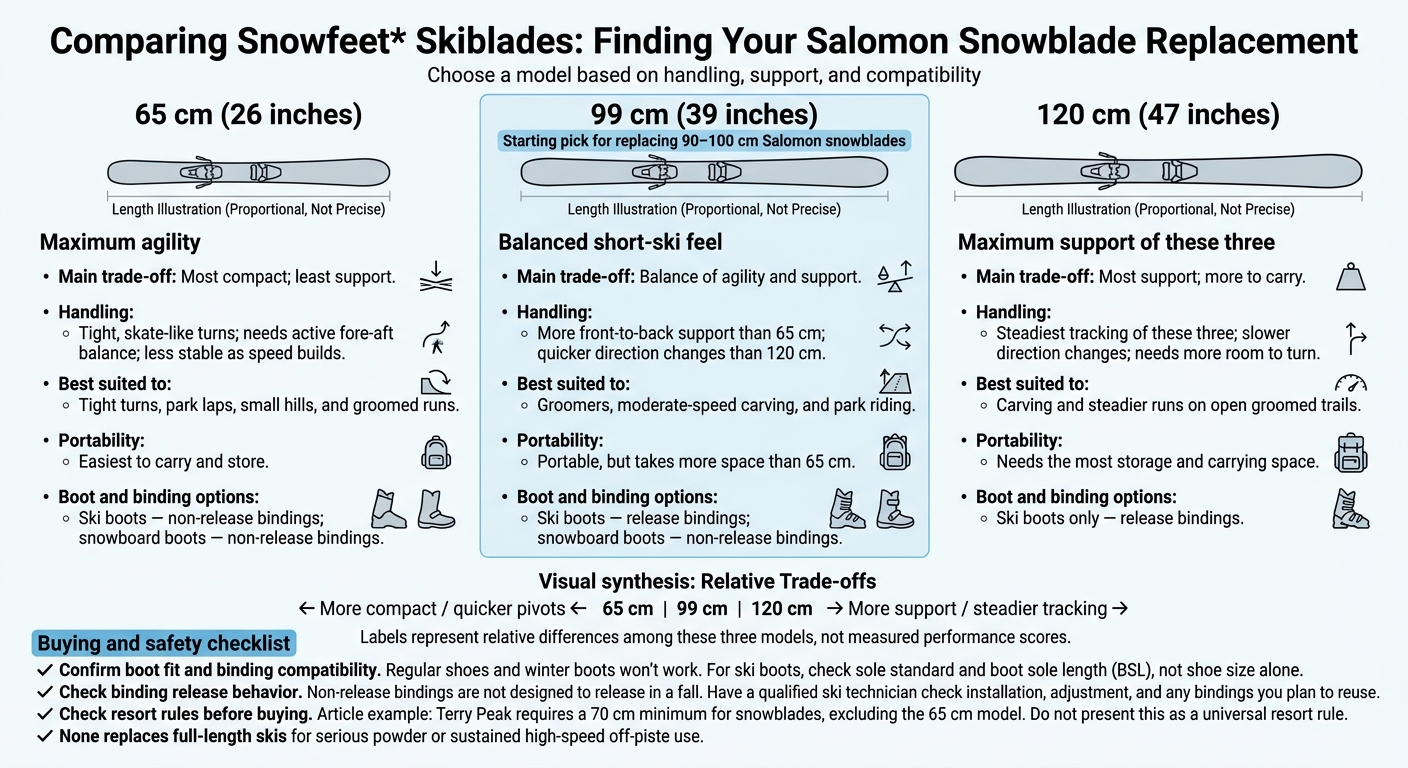
I’d start with Snowfeet* 99 cm if you’re replacing Salomon snowblades around 90–100 cm long. It’s the middle ground for groomed resort runs: more support than the 65 cm model, with less bulk than the 120 cm option.
Here’s how I’d narrow it down:
- 65 cm (26 inches): For tight turns, park laps, and easy carrying. Less steady as speed builds. Available with non-release ski-boot or snowboard-boot bindings.
- 99 cm (39 inches): My starting pick for familiar short-ski handling. Choose release ski-boot bindings or non-release snowboard-boot bindings.
- 120 cm (47 inches): For more support and steadier tracking on open groomers. Uses ski boots and release bindings.
Quick Comparison
| Model | Main trade-off | Boot options |
|---|---|---|
| 65 cm | Most compact; least support | Ski or snowboard |
| 99 cm | Balance of agility and support | Ski or snowboard |
| 120 cm | Most support; more to carry | Ski only |
Before I’d buy, I’d check <u>boot fit, binding release behavior, and resort rules</u>. Shoe size alone won’t confirm ski-boot fit, and some resorts exclude blades under 70 cm. Have a qualified ski technician check any bindings you plan to reuse.
Treat the listed prices as reference figures, not confirmed October 24, 2026 prices. Check the exact binding package, stock, shipping, and tax before checkout. My rule: choose the fit first, then compare the total - not just the sale tag.
Salomon Snowblades Replacement: 65 vs 99 vs 120 cm
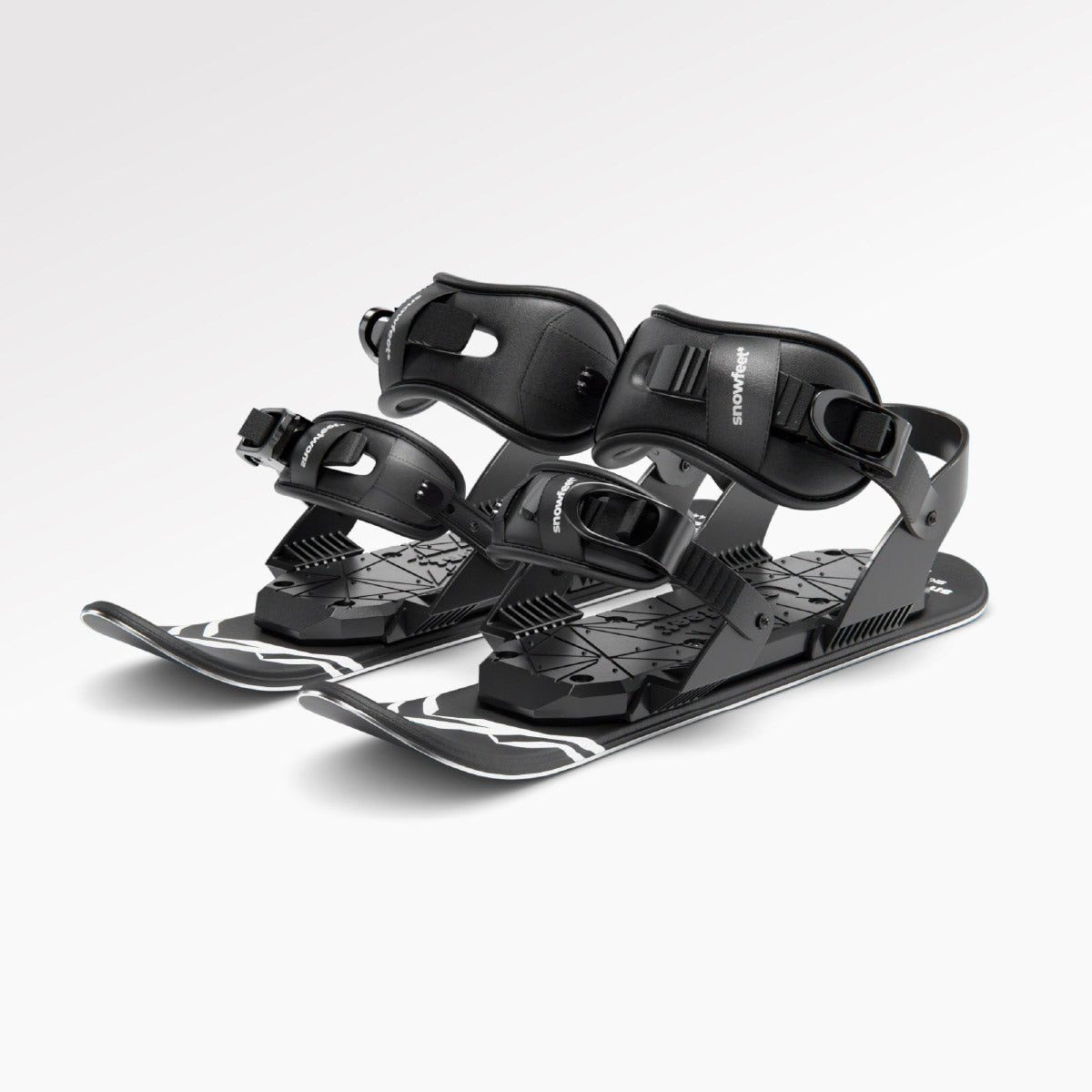
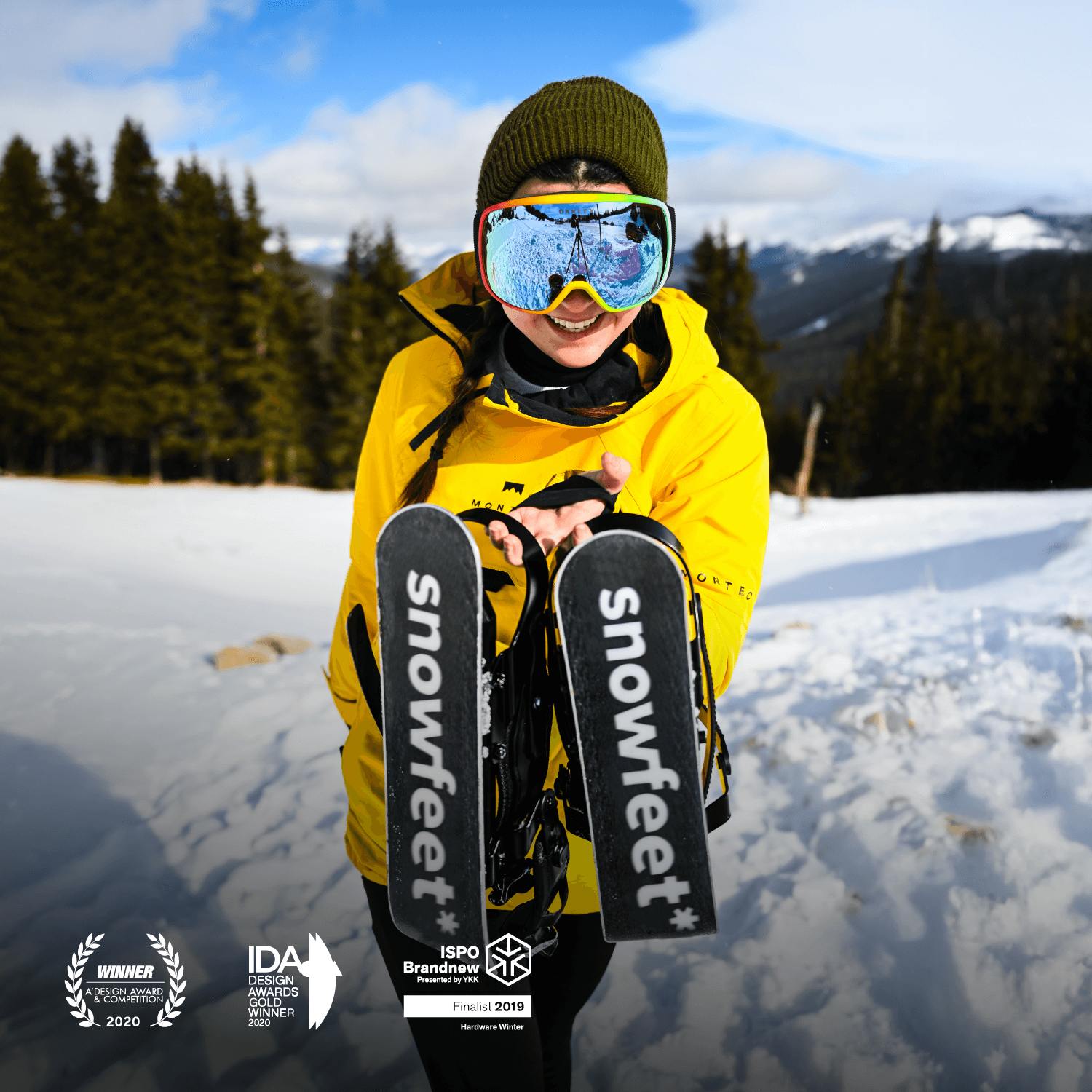
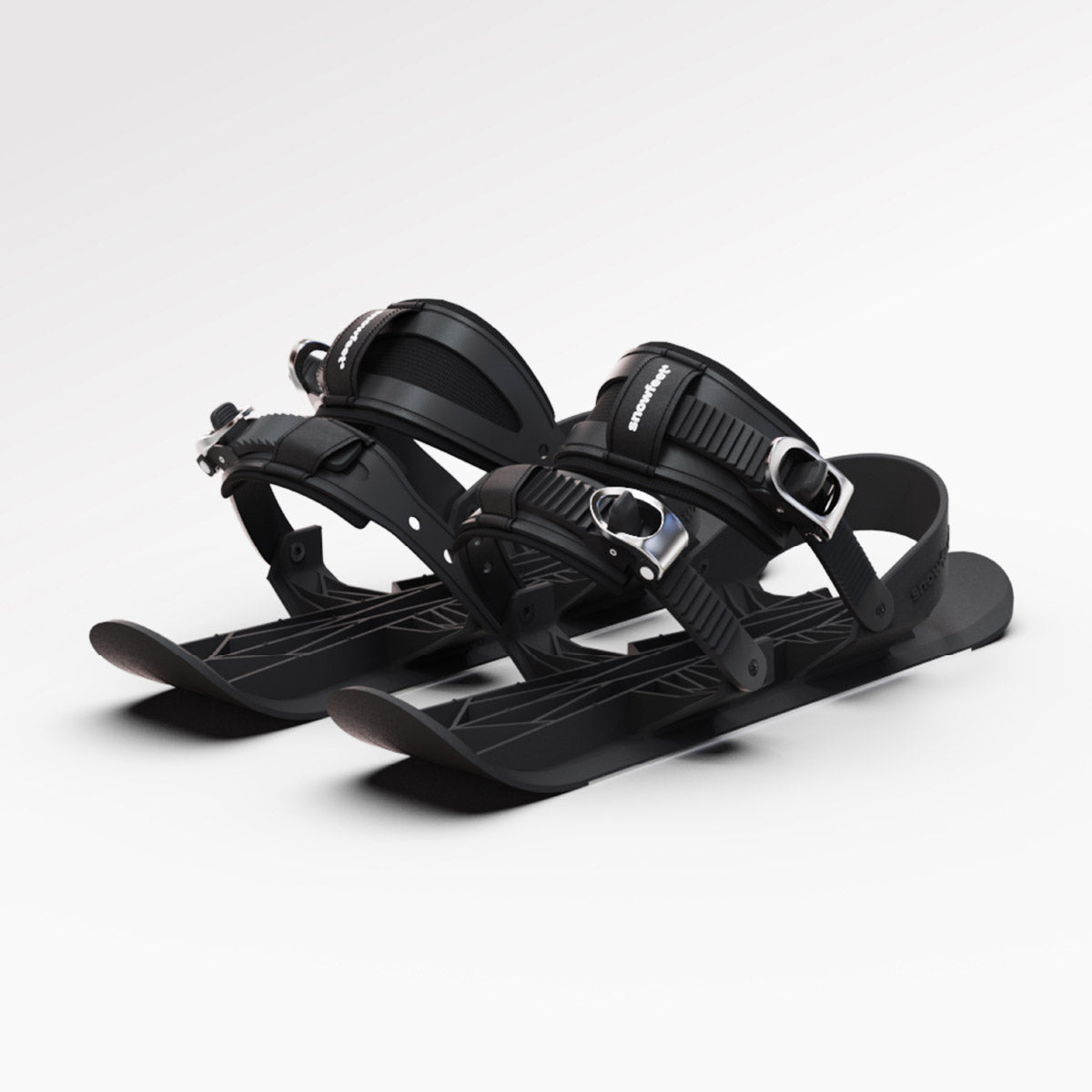
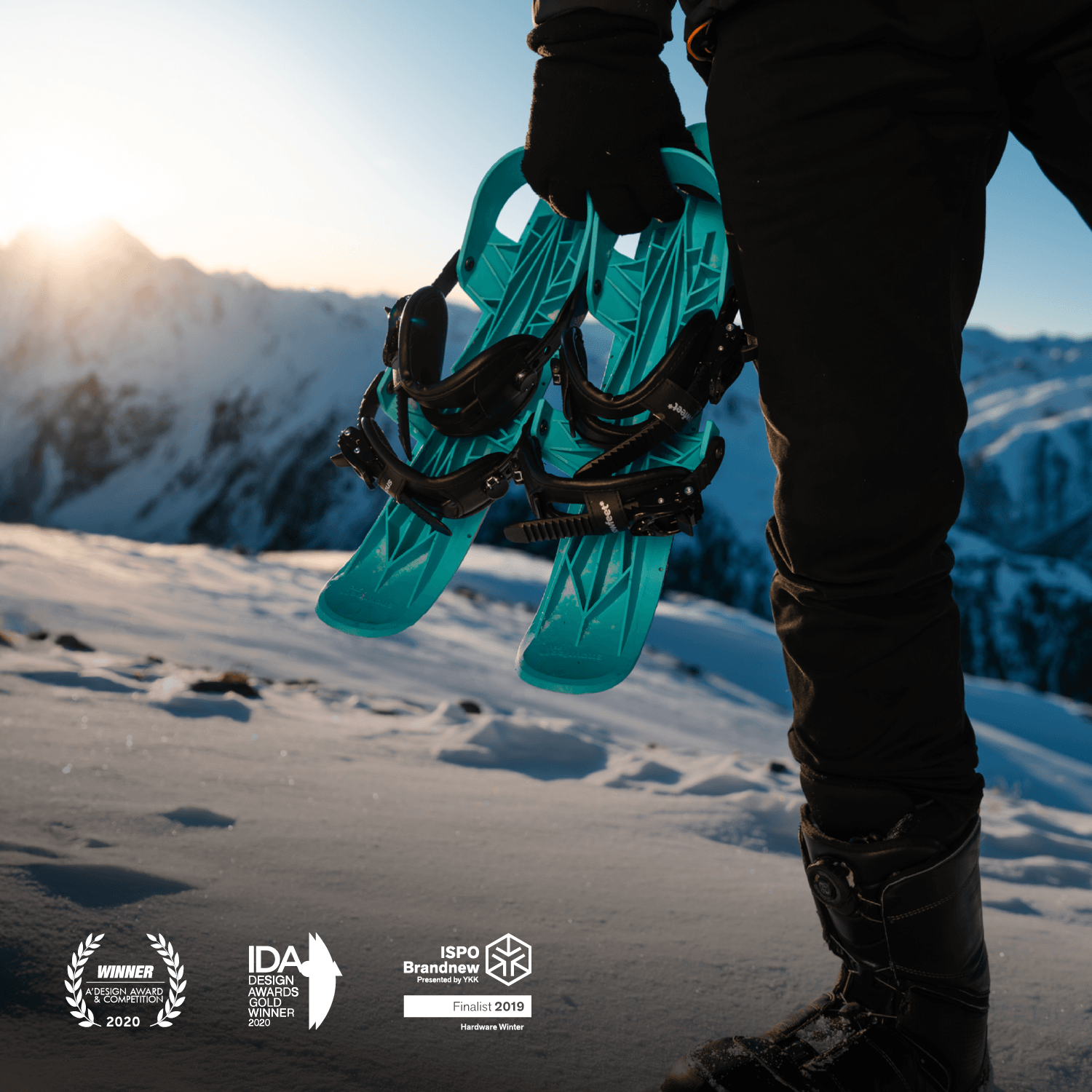
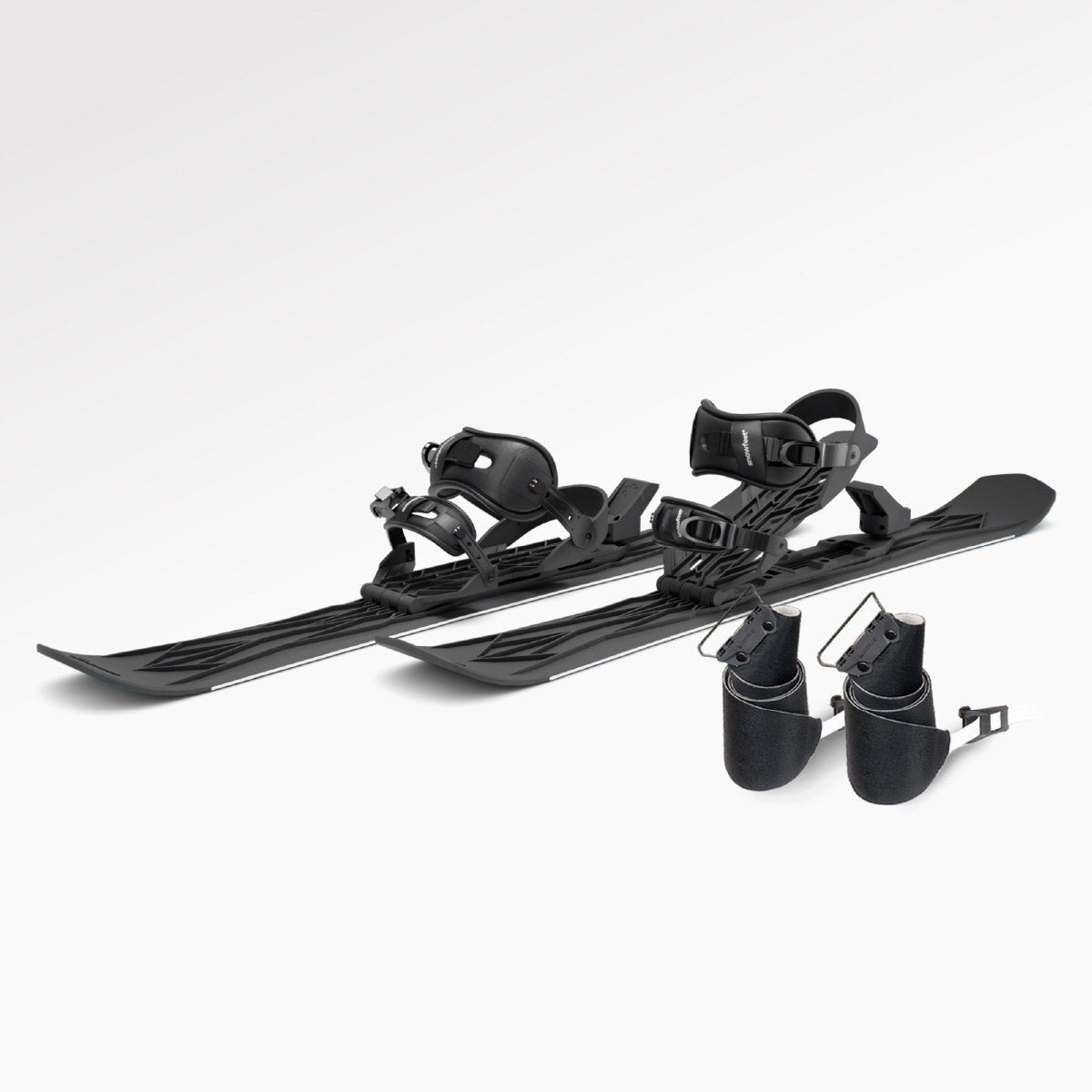
Ultimate Short Skis 🎿 Snowfeet* Skiblades 99 CM
1. Snowfeet* Skiblades 65 cm
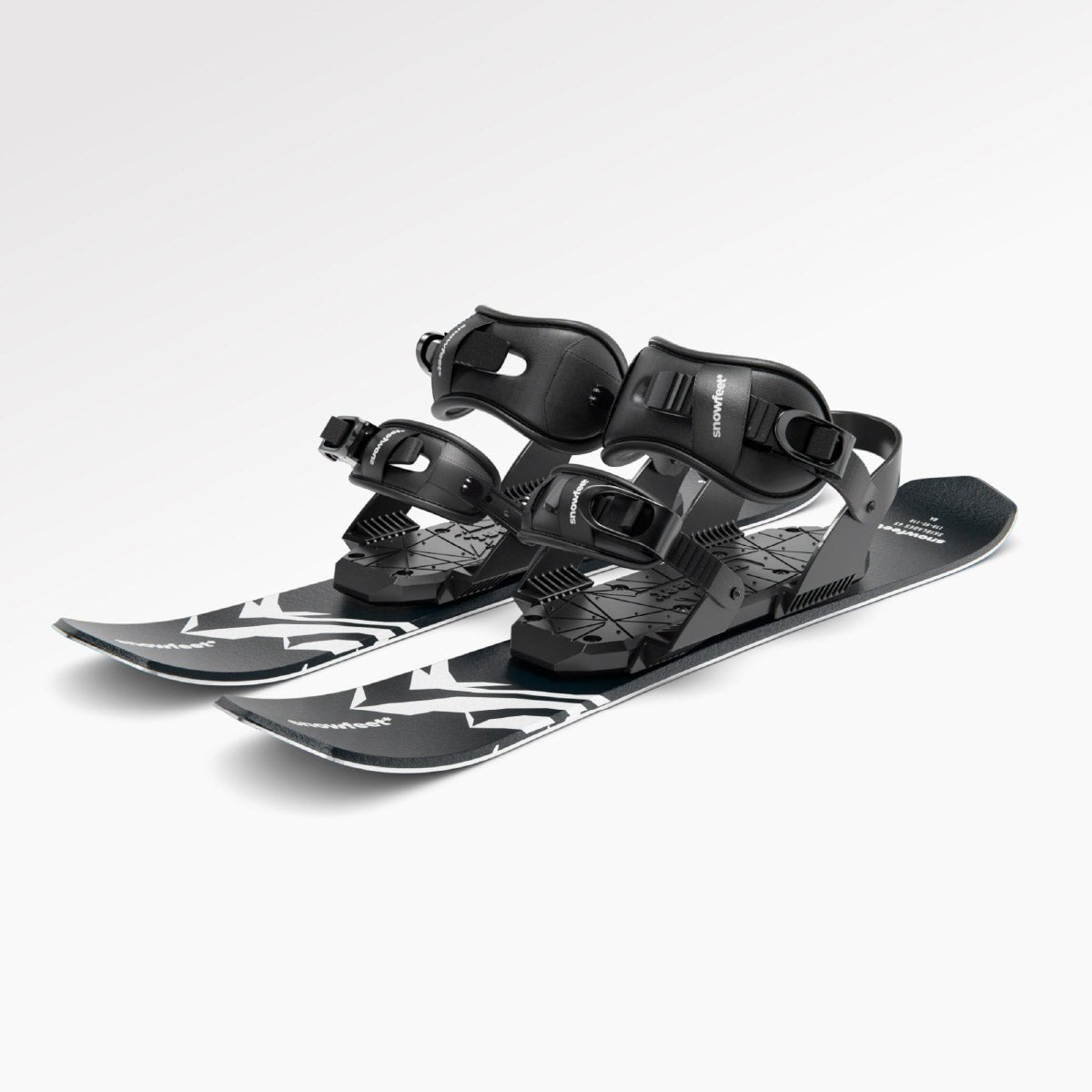
The 65 cm (25.6-inch) Snowfeet* skiblade is the most compact and agile replacement in the lineup.
Boot and binding compatibility
Choose ski-boot bindings for a stiffer feel or snowboard-boot bindings for more comfort and easier walking. Check the fit before you buy:
- Ski-boot bindings: EU 36–49 / US 4.5–14.5 / MP 22.5–32.5.
- Snowboard-boot bindings: EU 38–49 / US 6–14.5.
Both versions use non-release bindings, so they don’t release easily in a fall.
Handling and stability
The 4-meter (13.1-foot) turn radius suits tight turns. But the short platform means you need to stay centered and control your front-to-back balance. Leaning back won’t help here.
At high speeds, it’s less stable than the 99 cm or 120 cm models. Pick this length if agility matters more to you than stability.
Terrain and portability
Best for parks, small hills, and groomed runs, the 65 cm model is easy to carry and turns with little effort. Its smaller surface area gives you less float in deep powder, so a longer Snowfeet* model is a better pick for soft snow.
For riders switching from longer Salomon snowblades, this is the most playful step down in size.
Price and configuration
Pricing starts at $970 on the product page. Another retailer lists it from $550 on sale. Shop Snowfeet* Skiblades 65 cm.
For more stability and a closer all-around replacement for older Salomon Snowblades, compare the 99 cm model next.
2. Snowfeet* Skiblades 99 cm
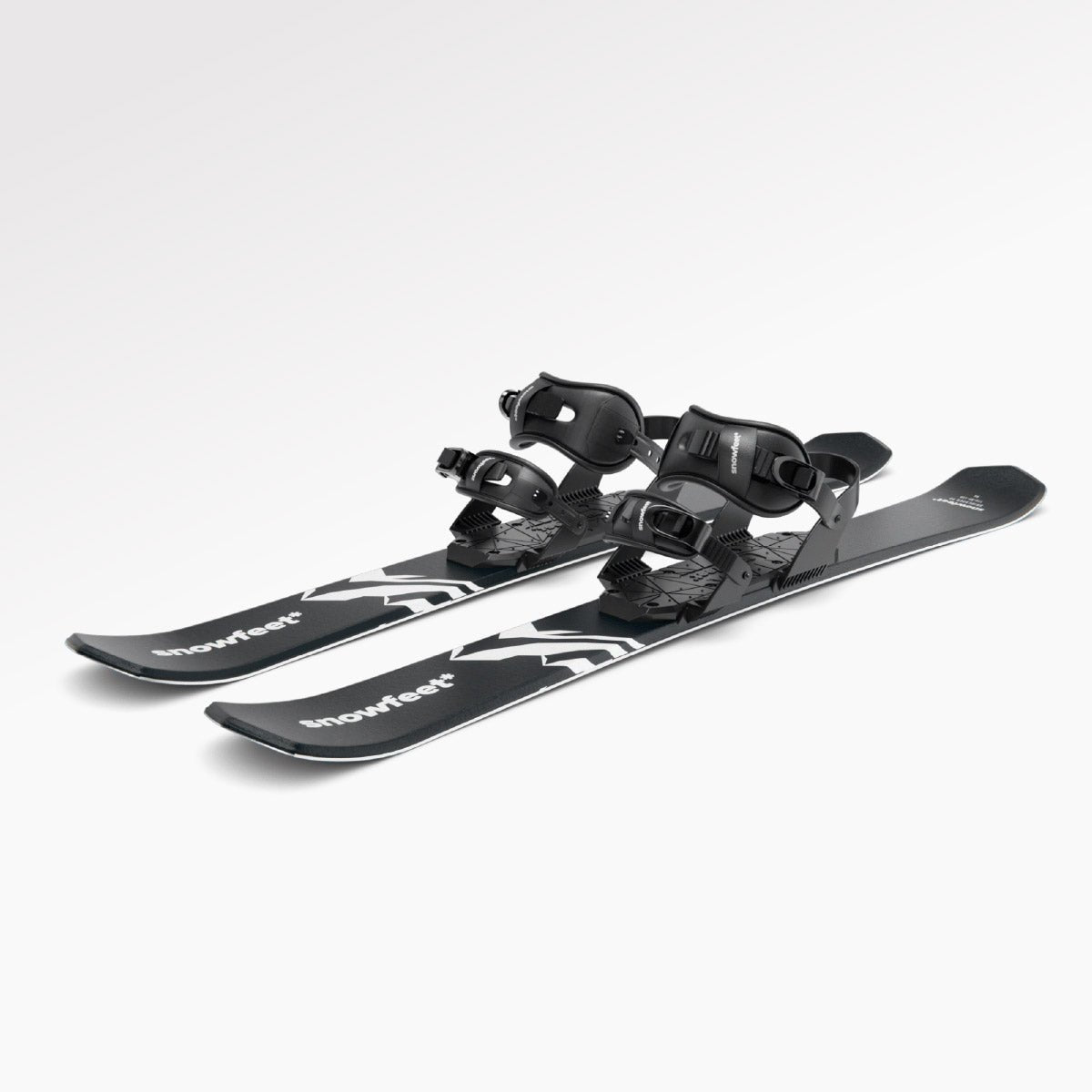
The 99 cm model keeps that classic short-ski feel, with more support than the 65 cm version.
Boot and binding compatibility
Choose standard-release ski-boot bindings for a familiar ski feel, or non-release snowboard-boot bindings for more comfort and easier walking. Check the fit before you pick:
- Ski-boot bindings: EU 36–49 (US 4.5–14.5)
- Snowboard-boot bindings: EU 38–49 (US 6–14.5)
Handling and stability
The longer platform adds front-to-back support and feels steadier at moderate speeds than the 65 cm model. Turns still feel compact, and you can change direction faster than on the 120 cm option.
It’s the best middle ground if you want familiar snowblade handling without the shorter model’s skate-like feel. For more support and calmer tracking, compare the 120 cm model next.
Terrain and portability
The 99 cm works well for groomers, moderate-speed carving, and park riding. Twin tips let you ride forward or switch, while the 39-inch length fits in most car trunks or roof boxes.
Move up to 120 cm if you want more speed and better performance in deeper snow. That extra length suits riders who care more about speed and float than the short-ski feel.
Price and configuration
The 99 cm wood-core model starts at $1,119, with sale pricing from $750. Shop Snowfeet* Skiblades and select the 99 cm wood-core model.
3. Snowfeet* Skiblades 120 cm
Boot and binding compatibility
Using ski boots? Choose the Regular ski boot bindings. The 120 cm model uses release bindings only.
Handling and stability
At 120 cm (47 inches), this is the most stable, most ski-like option in the lineup. Its listed turn radius is 4 meters (about 13 feet).
Compared with the 65 cm and 99 cm models, it trades quick pivots for steadier tracking. It’s a good fit if you’re replacing aging Salomon snowblades and want more stability than the 99 cm model offers.
Terrain and portability
This model works best for carving on groomed trails and steadier runs. It’s less portable and won’t pivot as quickly as the shorter models, but it handles soft snow better.
Price and configuration
Prices start at $1,190. Shop Snowfeet* Short Skis 120 cm.
Before ordering, compare boot fit, binding type, and the final price.
sbb-itb-17ade95
Boot Fit, Binding Checks, and Prices
Choose your boot setup before comparing prices. These are reference figures, not live prices for October 24, 2026.
| Snowfeet* model | Boot configurations to check | Unverified reference price |
|---|---|---|
| 65 cm | Ski-boot or snowboard-boot version | $550–$710 |
| 99 cm | Ski-boot or snowboard-boot version | About $690 |
| 120 cm | Generally ski boots only | About $950 |
Check that the binding fits your current ski or snowboard boots before you buy. Regular shoes and winter boots won’t work. For ski boots, check both the sole standard, such as Alpine or GripWalk, and the boot sole length (BSL) in millimeters. Shoe size alone won’t tell you whether they fit. For snowboard boots, make sure the straps fit your boot brand and size.
Non-release bindings won’t release in a fall. Have a qualified technician install and adjust any release bindings based on your weight, height, and ability level.
Before ordering your Salomon replacement, confirm the exact Snowfeet* configuration, included bindings, current price, stock, shipping charges, and applicable taxes. Don’t count on free shipping until it shows up at checkout.
With fit and pricing checked, compare how each length handles on snow.
Handling, Terrain, and Portability Trade-Offs
The comparison below shows how each length handles, where it fits, and how easy it is to carry. The 99 cm keeps that short-ski feel without the 65 cm model’s greater balance demands. Length is less about size and more about how much support you want underfoot.
| Handling factor | 65 cm (26 in.) | 99 cm (39 in.) | 120 cm (47 in.) |
|---|---|---|---|
| Main advantage | Compact, skate-like movement | Mix of agility and support | Most support of the three |
| Main drawback | Needs active fore-aft balance | Less compact than 65 cm; less stable than 120 cm | Needs more room to turn and transport |
| Quick turns | Tightest, most skate-like movements | Agile without feeling as twitchy | Slower direction changes; needs more space |
| Moderate-to-higher-speed stability | Least forgiving as speed builds | Middle ground | Best of these three, but no substitute for long skis at sustained high speed |
| Beginner confidence | Nimble, but offers less support if you lean forward or back | More balanced platform for learning | More support, but needs room for turns |
| Park use | Suits spins and compact, playful movements | Good all-around playful option | Less nimble for tight moves |
| Groomed-slope carving | Short, tight turns at controlled speeds | Mix of quick turns and support | Better for longer turns on open runs |
| Portability | Easiest to carry, store, and move through lift lines or lodge areas | Portable, but takes more room in a ski bag and vehicle | Needs the most storage and carrying space |
The 65 cm model makes the clearest trade-off: more agility, less support. Its 4 m (about 13 ft.) turn radius fits that tight-turn focus. Shorter doesn’t always mean easier.
For mostly groomed resort laps, the 99 cm offers the best balance of playful handling and support. Choose 120 cm for steadier turns on open groomers. Full-length skis handle open terrain better; none of these three replaces them for serious powder or high-speed off-piste use.
Length and resort rules are the last buying filters:
Terry Peak requires a 70 cm minimum for snowblades, which would exclude the 65 cm model.
Before you buy, check your resort’s rules for lifts, parks, bindings, and retention devices. Use those limits to narrow your choice in the final recommendation.
Which Snowfeet* Replacement Should You Buy?
Start with Snowfeet* 99 cm if you’re replacing Salomon snowblades around 90–100 cm long.
Use your old Salomon length and boot setup to find the closest match.
| Your priority and existing boots | Best choice | Buying guidance |
|---|---|---|
| Familiar short-ski handling for resort days; ski boots | 99 cm | Best all-around match |
| Playful turns and compact gear; ski or snowboard boots | 65 cm | Best for maximum maneuverability and a more skate-like feel |
| More support and a standard ski feel; ski boots | 120 cm support model | Choose for steadier tracking |
| Using snowboard boots | 65 or 99 cm | Choose the snowboard-boot binding package |
Before checkout, check boot fit, binding type, mounting pattern, and release behavior. Don’t assume your old Salomon bindings and boots will work with the new setup.
With boot fit confirmed, pick your length by riding style: 99 cm as the starting point, 65 cm for maximum agility, or 120 cm for maximum support. Shop the 99 cm, 65 cm, and 120 cm models in the official store.
FAQs
How should my weight affect my Snowfeet* length choice?
Choose based on your skill level, riding style, and goals - not just height or weight. Snowfeet* models fit a broad range of body types.
- 65 cm (about 26 in): Best for maximum agility and skate-like park tricks.
- 99 cm (about 39 in): A good fit for all-around stability and easy turns.
- 120 cm (about 47 in): Suited to advanced riding, high-speed stability, and the feel of full-length skis.
Have a professional adjust your release bindings for your weight, boots, and skill level.
Can a technician reuse my old bindings on Snowfeet*?
_No - your old Salomon bindings won’t work on Snowfeet Skiblades._* These skiblades use their own model-specific binding systems. Older Salomon gear can also be hard to service due to its age and safety concerns.
Choose a Snowfeet* package with bindings that suit your boots and riding style: release ski bindings, non-release bindings, or snowboard boot bindings.
How do I compare Snowfeet* prices across binding packages?
Compare the full cost of a ride-ready setup, not just the sticker price. Prices vary by model, length, and binding type: non-release, release ski bindings, or snowboard boot bindings.
Check the checkout total, including shipping and taxes. Make sure the bindings work with your current boots, too. Reusing compatible boots can help keep costs down, while premium release bindings and any ski gear you need add to the total.




Laat een reactie achter
Deze site wordt beschermd door hCaptcha en het privacybeleid en de servicevoorwaarden van hCaptcha zijn van toepassing.