



















Yes - short skis can float in powder. But here’s the simple answer: if you ski in 4–12 inches of new snow on most resort days, short powder skiblades can work well. If you ski 12+ inches a lot and like more speed in open terrain, long powder skis still do that job better.
If I were to boil this whole thing down, I’d say:
- 99 cm powder skiblades = most fun in tight spots, trees, and short laps
- 120 cm skiblades = best middle option for mixed resort powder days
- 170–190 cm powder skis = most float in deep snow and more calm at speed
So, the tradeoff is simple:
- Shorter gear gives you more control
- Longer gear gives you more float
- Your best pick depends on snow depth, speed, terrain, and your weight
Here’s the part most skiers care about: in the kind of powder many U.S. resorts get on a normal storm day, a short powder setup can be a lot more skiable than people think. But once the snow gets deep, the math starts to win, and more length helps keep you on top.
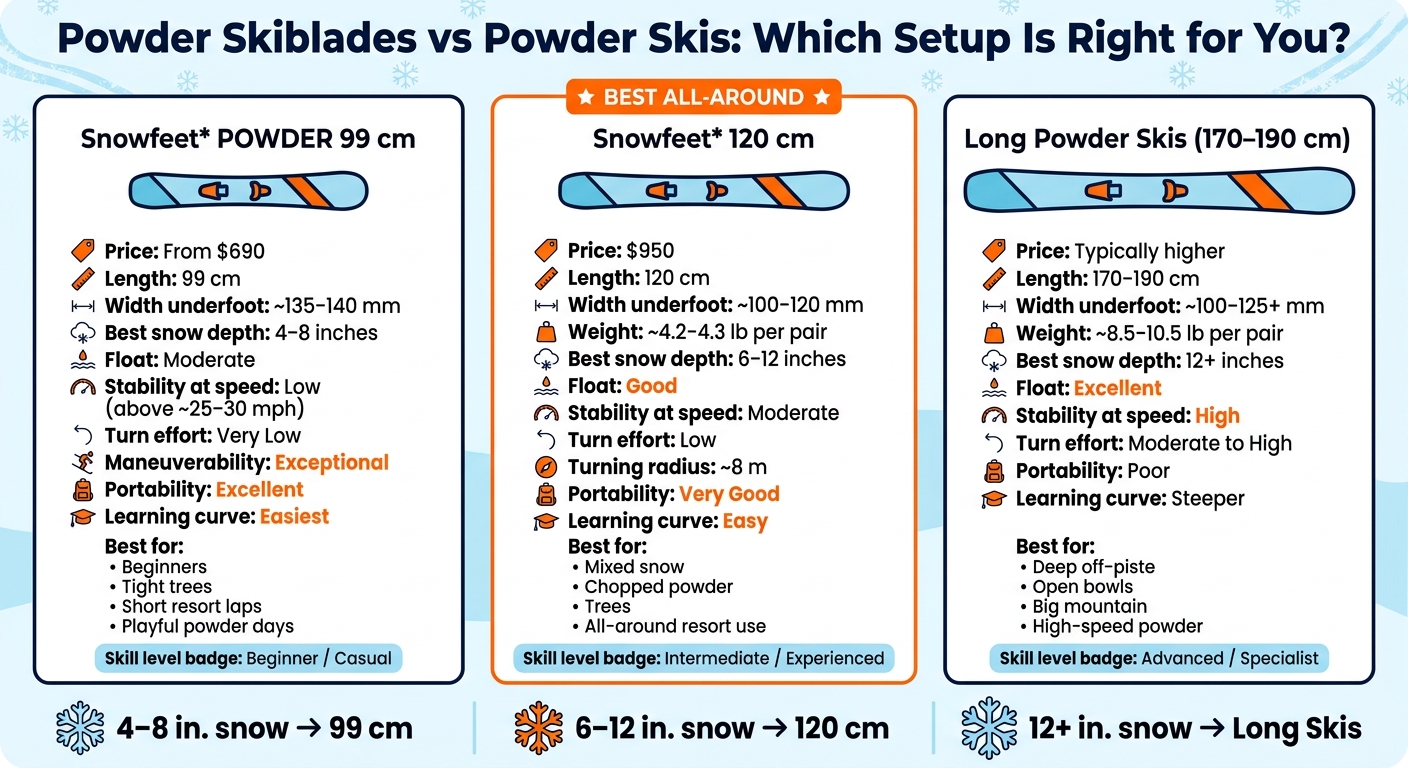
Powder Skiblades vs Powder Skis: Which Setup Is Right for You?
Snowfeet* Snowblades | Skiboards | Skiblades | Short Skis - All you need to know
Quick Comparison
| Setup | Best Snow Depth | Best Use | Feel on Snow | Best For |
|---|---|---|---|---|
| Snowfeet* POWDER 99 cm | 4–8 in. | Trees, tight lines, short runs | Loose, playful, easy to pivot | Beginners, casual riders, fun powder laps |
| Snowfeet* 120 cm | 6–12 in. | Mixed resort powder, chop, trees | More balanced, steadier | Riders who want one short setup |
| Long Powder Skis | 12+ in. | Open bowls, deep off-piste, higher speed | More planted, more float | Powder-first skiers |
A few numbers stand out:
- 99 cm POWDER: about 135–140 mm underfoot
- 120 cm: about 100–120 mm underfoot, depending on the point measured
- Long powder skis: often 170–190 cm long with a 100–120 mm waist
- Speed note: the 99 cm setup tends to feel less settled above about 25–30 mph
If you want the short version of the short version :) :
- Pick 99 cm if you want the most playful ride
- Pick 120 cm if you want the best balance
- Pick long powder skis if deep snow is your main thing
If you want a video view before reading, these YouTube links can help:
Now let me walk you through what matters most, without the fluff.
Powder Skiblades vs Powder Skis in Fresh Snow
In fresh snow, the 99 cm floats better than most short skis, the 120 cm brings more stability, and long powder skis still come out on top when the snow gets deep. You notice that pretty fast. Fresh snow is where the gap between the 99 cm, 120 cm, and long skis is easiest to spot.
Yes, wider skis help in powder. But once the snow stacks up, length still plays a big role.
How the Snowfeet* POWDER 99 cm Handles Soft Snow
The POWDER 99 cm is built around a simple idea: use width to make up for short length. Its wide-body shape - about 135–140 mm underfoot - helps it stay up in soft snow. In 4–8 inches of fresh snow, it floats well enough for playful turns and short powder laps, without the size and weight of full-length skis.
Once the snow gets deeper - past about 10 inches - the short length starts to show its limits. There’s less front-to-back support, and the tips can dive if you get too far forward. So, it works best in light to medium powder. Heavier riders will hit that limit sooner.
The upside? It feels super nimble. You can pivot fast, snake through tight lines, and make quick moves that don’t come as naturally on longer skis. The 120 cm can handle the same snow with a bit more breathing room.
Why the Snowfeet* 120 cm Gives More Stability
The 120 cm adds 8 inches of extra length over the POWDER 99 cm. That extra length helps with balance and gives you a steadier ride in deeper snow. It handles 6–12 inches with more ease and still turns with far less effort than a full-size ski.
For a lot of U.S. resort powder days - think boot-top to knee-deep snow - this is the more forgiving pick between the two.
Where Long Powder Skis Still Have the Edge
Once the snow gets past about 12 inches, long powder skis start to pull away. A 170–190 cm ski with a 110–120 mm waist has more total surface area, which helps it stay on top of the snowpack at speed. They also feel steadier in open terrain when you want to let them run.
Here’s the quick side-by-side:
| Feature | Snowfeet* POWDER 99 cm | Snowfeet* 120 cm | Long Powder Skis |
|---|---|---|---|
| Float | Moderate | Good | Excellent |
| How easily it sinks | Higher in deep snow | Moderate | Low |
| Approx. width | ~135–140 mm | ~110–120 mm | ~100–125+ mm |
| Turn effort | Very low | Low | Moderate to high |
| Best in | 4–8 in. | 6–12 in. | 12+ in. |
Fresh snow is only part of the story. The bigger edge for short skis shows up once the snow gets chopped up.
sbb-itb-17ade95
Chopped Powder, Trees, and Short Resort Runs
Once powder gets tracked out, float matters less than control. That’s where short skis start to make a lot of sense.
Short Skis in Chopped and Mixed Snow
In chopped snow, the 99 cm feels quick and reactive. The 120 cm feels more settled. And long powder skis still feel the most planted when speeds move from moderate to fast. For most casual riders, the 120 cm is the best all-around pick in this kind of snow.
| Feature | Snowfeet* POWDER 99 cm | Snowfeet* 120 cm | Long Powder Skis (170 cm+) |
|---|---|---|---|
| Stability in Chop | Lower - needs active balance | Moderate - steady at mid-speeds | High - most planted at speed |
| Bump Absorption | Low - direct terrain feel | Moderate - softens many hits | High - smooths rough snow |
| Tree Maneuverability | Exceptional - instant pivots | Very high - easy redirection | Moderate - needs wider turns |
| Speed Control | High - easy to scrub and stop | High - predictable | Moderate - prefers smoother, straighter turns |
| Fatigue (Full Day) | Low - light, but rough chop can wear you down | Lowest overall for casual riders | High - more leverage and more leg work |
That quick, snappy feel helps a lot in tight trees too. When the snow gets messy, being able to redirect fast can save your legs and your line.
Tight Trees and Narrow Lines
In trees, the 99 cm can pivot almost in place. That makes fast line changes and speed checks feel easy. The 120 cm keeps much of that nimble feel, but adds a calmer ride when the gaps open up a bit.
For many U.S. resort tree runs, where spacing can get pretty tight, both short setups make life easier for casual riders. Less wrestling. Less second-guessing. More “okay, I can sneak through there” energy.
On short resort laps, that same quick feel pays off again.
Why Short Runs Work Better with Shorter Gear
A lot of resort laps are short and over before you know it. So fast turn initiation and easy speed control matter more than max float.
Both the 99 cm and 120 cm let you:
- start turns fast
- scrub speed in a few feet
- move through crowded runouts without feeling over-geared
Long powder skis shine on long descents where you can open things up and let them run. But on a short resort lap, many casual riders never get the chance to use that extra top-end feel before the run is done.
That’s why short setups work so well here. They make quick, controlled laps easier, and they do it without the bulk of full-length powder skis.
Speed, Stability, and Ease of Use
Short skis are easier to control, but they give up some calmness once you start going faster. That tradeoff shows up the most when the terrain gets steeper, the snow gets deeper, or your speed starts to climb. With less surface area under you, short skis ask a bit more from the rider in those moments. That’s the line between the playful Snowfeet* POWDER 99 cm and the more balanced Snowfeet* 120 cm.
Which Setup Is Easiest for Beginners and Casual Riders
The Snowfeet* POWDER 99 cm is the easiest setup to learn on. It feels compact, quick to respond, and way less intimidating than a full-length ski. For beginners and casual riders, that’s a big plus.
The Snowfeet* 120 cm isn’t far behind. It takes only a little more time to get used to, but in return you get a calmer ride. It still turns with ease, while adding more support and stability than the 99 cm.
Long powder skis need the most time and practice before they feel natural. They fit riders who already have solid fundamentals and want more confidence when speed picks up.
When More Stability Matters
Once you get above about 25–30 mph, the 99 cm starts to feel less settled, especially on open terrain. The 120 cm stays calmer while still keeping that easy, friendly feel.
If your focus is open powder terrain, long steep runs, and stronger top-end confidence, long powder skis still have the edge.
Here’s the quick side-by-side view:
| Feature | Snowfeet* POWDER 99 cm | Snowfeet* 120 cm | Long Powder Skis (170 cm+) |
|---|---|---|---|
| Ease of Learning | Very High | High | Moderate |
| Stability at Speed | Low - less composed above ~25–30 mph | Moderate - handles higher speeds well | High - most stable at speed |
| Portability | Excellent | Good | Low |
| Ideal Skill Level | Beginner / Casual | Intermediate / Experienced | Advanced / Specialist |
That’s why the 120 cm is often the better all-around pick before you choose between these setups. From there, it comes down to what you want most: max playfulness, better balance across conditions, or a setup built more for deep snow.
Which One Should You Buy?
Once you stack up float, control, and stability, the call comes down to where you ski and how often you hit powder. Put simply: how much float do you actually need for the snow you ski most days?
For a lot of skiers, Snowfeet* make more sense day to day than long powder skis. They’re easier to handle, less bulky, and a lot more fun in tighter spots. But let’s be fair - if you spend your time charging through deep, untouched powder at speed, long skis still win.
Choose Snowfeet* POWDER 99 cm for Playful Powder Days
Starting at $690, the Snowfeet* POWDER 99 cm is a smart pick if you want something compact, quick, and easy to get used to. It’s wider and tuned for powder, so it floats better in soft snow than a standard short ski.
It’s also a great fit for:
- Tight trees
- Short resort laps
- Skiers who want a short learning curve
In plain English, this one is for fun days when you want to stay light on your feet and keep things playful.
Choose Snowfeet* 120 cm for the Best All-Around Short-Ski Balance
The Snowfeet* 120 cm at $950 is the stronger all-around option. Its ~100 mm waist and rocker-camber-rocker shape give it more support in chopped snow and deeper conditions. At the same time, its ~8 m turning radius makes it much easier to pivot than most powder skis.
It’s also much lighter. The pair weighs about 4.2–4.3 lb, while many long powder skis come in around 8.5–10.5 lb per pair.
If you ski a mix of:
- Fresh powder
- Chopped snow
- Trees
- Short resort runs
...and you want one short ski that can handle all of it, this is the one.
Here’s the fast match-up for each setup.
Choose Long Powder Skis Only If Deep Snow Is Your Main Priority
This is where long powder skis make sense. They’re not the default pick. They’re a specialist tool.
They’re flat-out better in one clear situation: consistently deep, untracked powder at speed.
If that sounds like most of your ski days, go with long skis. That’s their lane. For most riders, though, the extra float doesn’t make up for the size and bulk.
| Snowfeet* POWDER 99 cm | Snowfeet* 120 cm | Long Powder Skis | |
|---|---|---|---|
| Price | From $690 | $950 | Typically higher |
| Best For | Playful resort powder, trees | Mixed snow, all-around use | Deep off-piste, big mountain |
| Float | Good in fresh snow | Better support | Maximum |
| Portability | Excellent | Very good | Poor |
| Learning Curve | Easiest | Easy / Familiar | Steeper |
FAQs
Can my weight affect how well short skis float in powder?
Yes. Your weight has a big impact on how well short skis float in powder. Short skis have less surface area than longer skis, so heavier riders tend to sink deeper into the snow.
Snowfeet* models like the 99 cm POWDER and 120 cm Short Skis use wider shapes to help with float. That said, they’re still more compact than standard ski gear. In deep snow, weight distribution plays a big role, and Snowfeet* stays a nimble pick for casual riders.
Are 120 cm skiblades enough for most U.S. resort powder days?
Yes - 120 cm skiblades are enough for most U.S. resort powder days.
Snowfeet* 120 cm models are made to give you the stability and speed you need for moderate powder and open groomers. They hit a nice middle ground: more float than short skiblades, but without the extra size and weight of 150+ cm skis.
That extra length means more surface area, which helps them deal with the kind of snow most riders see at resorts. So if you're skiing a normal powder day at a U.S. resort, 120 cm skiblades should do the job just fine.
The main exception is deep backcountry terrain with more than 12 inches of fresh powder. That’s when longer skis tend to make more sense.
When should I choose long powder skis over short skiblades?
Choose longer powder skis when you need high-speed stability on steep, hard terrain or in very deep, ungroomed backcountry powder, where the extra surface area helps keep you from sinking.
They’re also the better pick if you want top-end precision for aggressive carving on icy, hard-packed snow. Their added length and shape give you more power and stability than compact skiblades.












Laat een reactie achter
Deze site wordt beschermd door hCaptcha en het privacybeleid en de servicevoorwaarden van hCaptcha zijn van toepassing.