




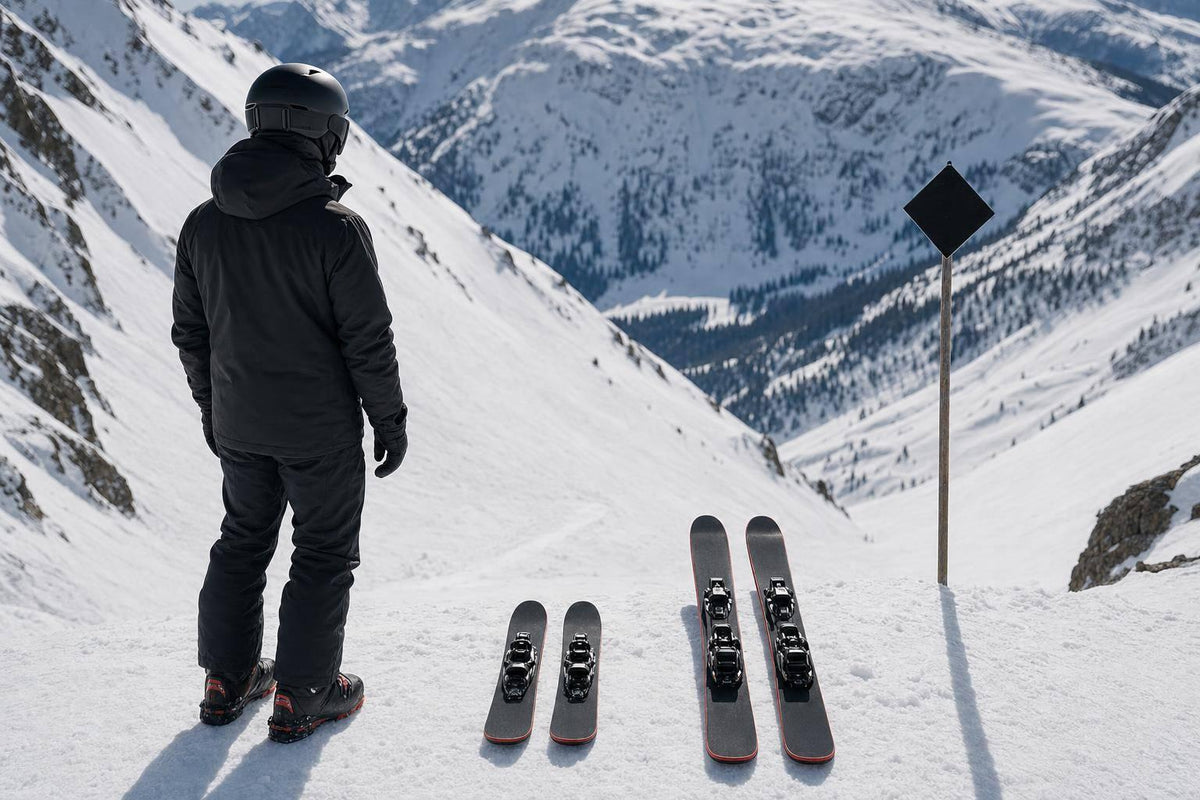
Yes - skiblades can work on black diamond runs, but only on the right run and with the right rider. If I had to give the short answer, I’d say this: 99 cm and 120 cm skiblades are the safest bet for black terrain, while 44 cm and 65 cm models are better for playful, low-speed sections.
Here’s the simple breakdown:
- Best use: groomed black runs, moderate moguls, and tight sections
- Harder use: deep powder, long icy pitches, and open steep faces
- Best lengths for most advanced riders: 99 cm or 120 cm
- Main limit: short gear loses calmness as speed climbs
- Big thing to remember: a black diamond in one U.S. resort may feel much easier than a black at another
So, if you ski with tight turns, control, and planned speed checks, skiblades can make sense. If you want to bomb open steeps like a missile with lift tickets, uh, long skis still make more sense :)
What matters most is not the trail sign. It’s the snow, pitch, space, and your skill.
Snowboarder tries Snowfeet* | Which Snowfeet* Short Ski is the Best? | Snowblades 44, 65, 99 Review
Quick Comparison
| Option | Best for black diamonds? | Best terrain | Main drawback |
|---|---|---|---|
| 44 cm Skiskates | No, except in short controlled spots | Playful sections, trick-style movement | Very little support on steep terrain |
| 65 cm Skiblades | Sometimes | Moguls, steep groomers at low to mid speed | Less edge grip and less calm feel |
| 99 cm Skiblades | Yes, for many advanced riders | Groomed blacks, bumps, mixed black terrain | Still less stable than long skis |
| 120 cm Short Skis | Yes, best in the lineup for steeper blacks | Faster black runs, mixed snow, more exposed lines | Less nimble than shorter models |
| Long skis | Yes, broadest fit | Open steeps, powder, icy faces, faster skiing | More work in tight spots |
A few facts stand out:
- Snowfeet’s line runs from 44 cm to 120 cm
- The brand says these short models handle light powder up to about 4 inches
- On black runs, length matters more than people think
If I were helping a friend in the shop, I’d keep it plain: go short for agility, go longer for support. On black diamonds, that extra length can make a big difference.
If you’re picking one setup for expert terrain, I’d look at 99 cm first, then 120 cm if you want more support.
What black diamond terrain actually demands
Black diamond ratings change from resort to resort, so that symbol points to relative difficulty, not one set slope angle or snow type. For skiblades, that’s the big thing to watch. The trail color matters less than whether the run fits a shorter platform.
At one mountain, a black run might be a wide groomer with a steady pitch. At another, it can be tight, bumped out, lined with trees, and ready to punish mistakes.
Before you take skiblades onto a black run, check a few things:
- Pitch
- Surface
- Width
- Traffic
- Obstacles
- Escape options
Once you know the run, the next step is simple: does your skill level match what’s in front of you?
Skills you need before taking skiblades on black runs
Skiblades need real control. You should be able to make parallel turns, check speed with purpose, stop with confidence on steep snow, and hold an edge on firm surfaces. Short skis don’t give sloppy technique much room to hide. They tend to call you out fast.
You also need to handle bumps without getting tossed into the backseat and adjust when the snow shifts from smooth groomed corduroy to ice or chopped-up piles. That part matters more than people think. A run can feel fine for the first 200 yards, then turn into a mess.
In moguls, speed control has to come from complete, deliberate turns. Not panic braking. Not a last-second hockey stop every few feet. That’s why the same pair of skiblades can feel calm on one black run and a little wild on another.
Best and worst black diamond conditions for skiblades
| Condition | How it plays for skiblades |
|---|---|
| Firm, groomed black | Best place to start - more predictable snow |
| Moguls | Quick between bumps, but you need steady speed control |
| Narrow technical descent | Easy to pivot, but there’s less room to fix mistakes |
| Deep powder | Less flotation and less fore-aft support; tougher to stay stable |
| Sustained ice | Short platform means less edge grip and a smaller margin for error |
| Open, high-speed face | Traditional skis are the better tool here |
The trade-off is pretty plain. Skiblades reward agility and short turns when the terrain stays controlled. But when the job shifts to high-speed stability, flotation in deep snow, or edge hold on long icy pitches, longer skis have the edge. On steep slopes, it all comes back to edge hold, stability, and speed control.
sbb-itb-17ade95
How skiblades handle steep terrain
Steep terrain rewards quick turns and punishes uncontrolled speed. That’s where skiblades can work well if you keep things tight and controlled. They pivot fast, which helps on narrow, technical lines. But there’s a catch: shorter platforms lose stability as the slope gets steeper and speed starts to build.
That’s the big thing to keep straight. Maneuverability is not the same as stability. On black runs, the real test is simple: can the rider hold an edge and control speed before the slope starts running the show?
Control, edge hold, and speed limits
Edge hold comes down to three things: tune, snow, and rider input. You can finish turns across the slope, scrub speed with a firm edge set, and move your feet faster than you can on longer skis. But none of that happens by magic.
A short ski with dull edges on a firm, icy pitch is bad news. There’s less ski under you, so there’s less room to recover if you slip. On steep terrain, sharp edges matter a lot more than they do on a mellow groomer. So, yeah, check your tune before you drop into a black run.
Speed is where skiblades ask the most from you. Use them to bleed speed, not build it. Finish each turn across the fall line or even a bit uphill. Stay centered and forward - hips over feet, knees flexed, hands in front. If you lean back on short gear, steering gets tougher, and mistakes on icy pitches get ugly fast.
The second you stop managing speed on purpose, steep terrain can get away from you in a hurry.
That trade-off shifts a lot by length, which is why the 99 cm and 120 cm models stand out on black runs.
Snowfeet* lengths compared for black diamond use
Length is the biggest variable in the Snowfeet* lineup, and it changes how each model feels on steep terrain.
| Model | Maneuverability | High-speed stability | Edge hold | Mogul performance | Powder support | Best black-diamond use |
|---|---|---|---|---|---|---|
| Skiskates, 44 cm | Extremely high | Very low | Limited; highly technique-dependent | Best in tight, controlled tricks | Very low | Short, playful sections for highly skilled riders; not suited for steep or fast terrain |
| Skiblades, 65 cm | Very high | Low | Limited to moderate | High on steep, controlled groomers and bumps | Low | Steep groomers and moguls at controlled speeds for riders prioritizing quick pivots |
| Skiblades, 99 cm | High | Moderate | Moderate to good when tuned and properly skied | High | Moderate | The most versatile choice for advanced riders combining short turns, speed checks, and occasional faster sections |
| Short Skis, 120 cm | Moderate to high | Highest of these options | Highest of these options | Good, though less nimble than shorter models | Best among these four | Steeper, faster black diamonds for advanced riders wanting more support and stability |
The 44 cm Skiskates and 65 cm Skiblades are the most playful picks. Fun? Absolutely. Forgiving on long, steep terrain? Not so much. With less platform, you get less fore-aft support, less damping in rough snow, and a smaller margin for error when things get fast or icy. Skilled riders can make them work if they keep speed on a short leash, but they’re not the smart default for a long, committing black run.
The 99 cm Skiblades land in the sweet spot for advanced riders. They still feel quick, but the added length gives you more support and better edge hold than the shorter models. You’ll notice that most when the snow gets choppy or the pitch kicks up.
The 120 cm Short Skis trade a bit of agility for more stability. And on steep terrain, that’s often a good trade. For advanced riders who want short-ski handling without giving up confidence, they’re the best Snowfeet* option for steep, mixed black runs.
Long skis still win when the trail opens up, the snow gets deep, or speed becomes the main goal. That’s where the comparison with long skis starts to matter most.
Skiblades vs. long skis on black diamonds
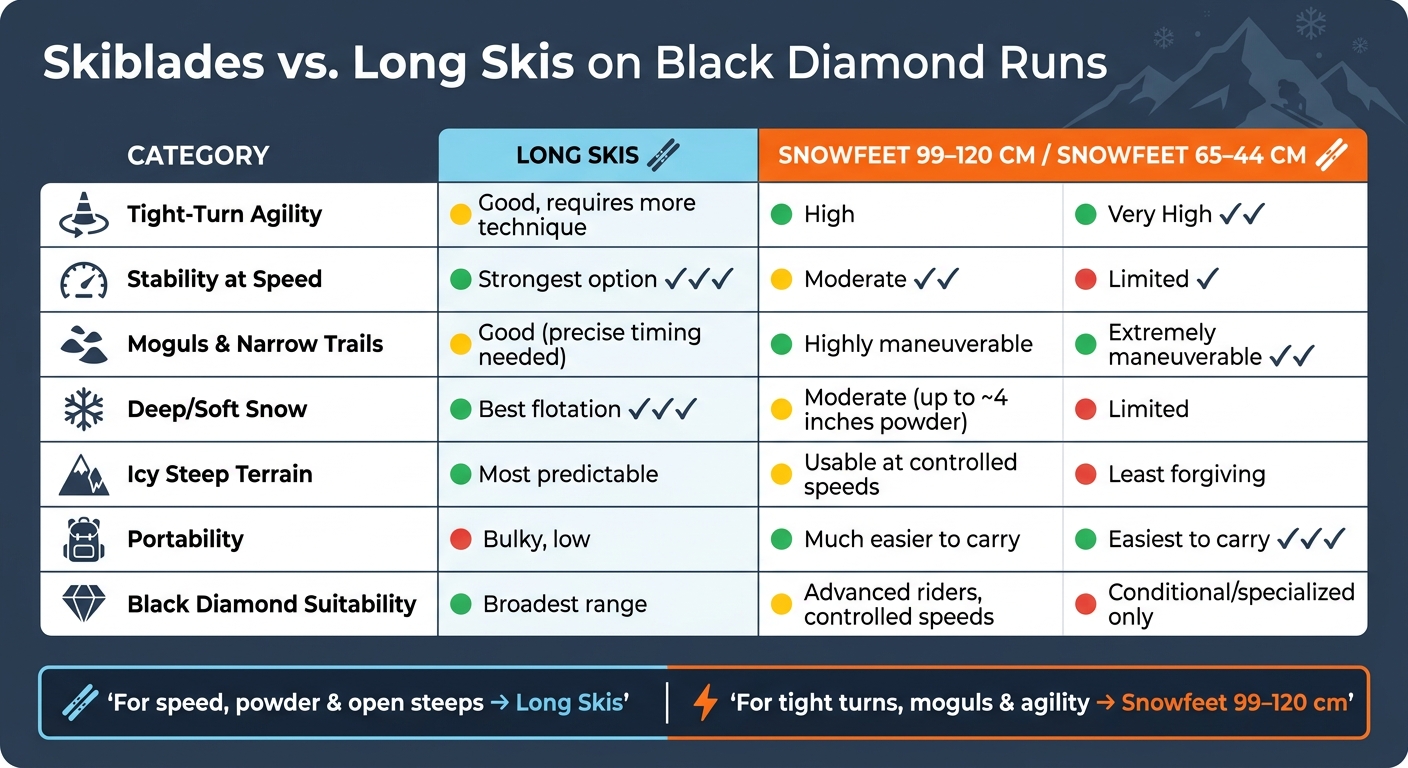
Skiblades vs. Long Skis on Black Diamond Runs: Which Length Wins?
Long skis and skiblades do different jobs on black diamonds. Long skis lean toward speed and float. Snowfeet* leans toward tight turns and control.
That makes this pretty simple: if you want open, fast skiing and more support in soft snow, long skis make more sense. If you care more about fast direction changes, tighter lines, and keeping speed in check, Snowfeet* has the edge.
Where long skis still have the edge
Long skis do best on open black runs where you want to ski fast and let the skis run. Their longer shape gives you more stability, stronger edge hold, and better float in soft snow.
That last part matters. Snowfeet* products handle only light powder up to about 4 inches. Once snow gets deeper or more mixed, regular skis are the safer bet. So if your black-diamond day means open steeps, chopped-up snow, or deeper powder, long skis are still the go-to tool.
But that doesn’t mean they win everywhere. In spots where the run gets tight, bumpy, or technical, a shorter setup can feel a lot less work.
Why many riders will still choose Snowfeet*
Skiblades are easier to pivot and redirect in tight spaces. That’s a big plus in moguls, narrow trails, and short-turn sections where you need quick reactions.
They’re also much easier to carry and stash. And that’s not nothing. Anyone who’s dragged full-length skis through a parking lot knows the deal :)
Snowfeet* also gives you more size options than many other short-ski setups. The lineup runs from 44 cm to 120 cm, which gives riders a clear choice between max agility and more support.
For black diamonds, the 99 cm and 120 cm models are the main ones to look at. They keep that short-ski feel but give you enough platform for tougher terrain. The 65 cm and 44 cm models are more niche. They work best in controlled sections where quick pivots matter more than top-end stability.
Use this rule:
| Category | Long skis | Snowfeet* 99–120 cm | Snowfeet* 65 cm / 44 cm |
|---|---|---|---|
| Tight-turn agility | Good, but requires more technique and space | High | Very high |
| Stability at speed | Strongest option | Moderate; better than very short models, but below full-length skis | Limited at high speed |
| Long-radius carving | Excellent | Possible, but with a shorter platform | Not the main use |
| Moguls and narrow trails | Good for skilled skiers with precise timing | Highly maneuverable | Extremely maneuverable |
| Deep or soft snow | Best flotation | More capable than the shortest models | Limited flotation |
| Icy steep terrain | Most predictable when properly edged | Usable for skilled riders at controlled speeds | Least forgiving for fast or exposed terrain |
| Portability | Lower; full-length skis are bulkier | Much easier to carry and store | Easiest to carry |
| Black-diamond suitability | Broadest range, including speed-focused skiing | Suitable for advanced riders on appropriate snow and at controlled speeds | Conditional and specialized; not ideal for very steep expert terrain |
If you want high-speed descents, long carving turns, or the most predictable feel on icy open steeps, go with long skis.
If you want tight turns, moguls, easy transport, and a more playful ride on controlled black-diamond terrain, the 99 cm or 120 cm Snowfeet* skiblades are the better match.
From here, the next step is matching the Snowfeet* length to your speed, terrain, and confidence level.
Which Snowfeet* model to pick and the final verdict
Best picks by riding style and terrain
Now that the trade-offs are on the table, the last step is pretty simple: pick the length that fits the runs you ski most.
The 44 cm Skiskates and 65 cm Skiblades are more niche. They shine when you want quick pivots, moguls, and playful turns on controlled terrain. But they’re not the go-to pick for steep expert blacks. The short platform gives you less edge hold and less stability, so things can get twitchy in a hurry.
The 99 cm Skiblades are the best all-around pick for most advanced riders. You get more stability and edge hold than the shorter models, but you still keep enough maneuverability for controlled speed, tight turns, and solid confidence on black runs. It’s the sweet spot for a lot of skiers.
The 120 cm Short Skis feel closest to a standard ski. If you want more stability on open, committing black-diamond terrain, this is the better call.
Put in plain English:
- Shorter Snowfeet* = more agility
- Longer Snowfeet* = more stability
Conclusion: Are skiblades okay for black diamond runs?
For most advanced riders, 99 cm is the answer. If the terrain asks for more stability, go with the 120 cm. The 44 cm and 65 cm make sense only in controlled, niche situations where agility matters more than stability.
Match the length to your skill level and the kind of descent you actually want to ski, and skiblades can be a solid tool on black runs.
FAQs
Can beginners use skiblades on black diamonds?
Generally, no. If you're new to skiblades, black diamond runs are not the place to learn.
Snowfeet skiblades are easy to turn and can feel friendly on groomed green and blue runs. That’s where most beginners should stick. Black diamonds are steeper, faster, and far less forgiving, and skiblades aren’t made for that kind of expert terrain.
For learning, the 65 cm and 99 cm models make more sense. They’re better for building confidence on easier slopes without biting off more than you can chew.
When you get into high-speed, steep, or off-piste terrain, you’ll want the extra stability and edge grip that traditional long skis give you.
How do I know if 99 cm or 120 cm is better for me?
Choose 99 cm if you want the best all-around pick. It feels agile, stable, and easy to control on groomers, moguls, and light powder. For most riders, it’s the safer default. You get a playful ride without that twitchy, nervous feel.
Choose 120 cm if speed is the main goal. It gives you more stability for aggressive carving, steeper groomers, and firm snow. It’s a better match for intermediate to advanced riders who like longer turns and a more planted feel.
Are skiblades safe on icy black runs?
Yes - Snowfeet skiblades can handle icy or hard-packed black runs, but you need to ski them a bit differently than long skis.
Their metal edges and wood cores help them grip and stay in control. That said, the shorter length can feel less planted when you hit icy sections. You’ll notice it most if you like to charge fast.
On icy black runs, the 120 cm Short Skis are the best pick. They give you the strongest edge hold and the most stability in the Snowfeet lineup. The 99 cm models do a good job too, especially if you want a more nimble feel.
Still, for high-speed skiing on ice, long skis keep the edge. They tend to feel more stable and calmer when conditions get firm and slick.











Laat een reactie achter
Deze site wordt beschermd door hCaptcha en het privacybeleid en de servicevoorwaarden van hCaptcha zijn van toepassing.