



















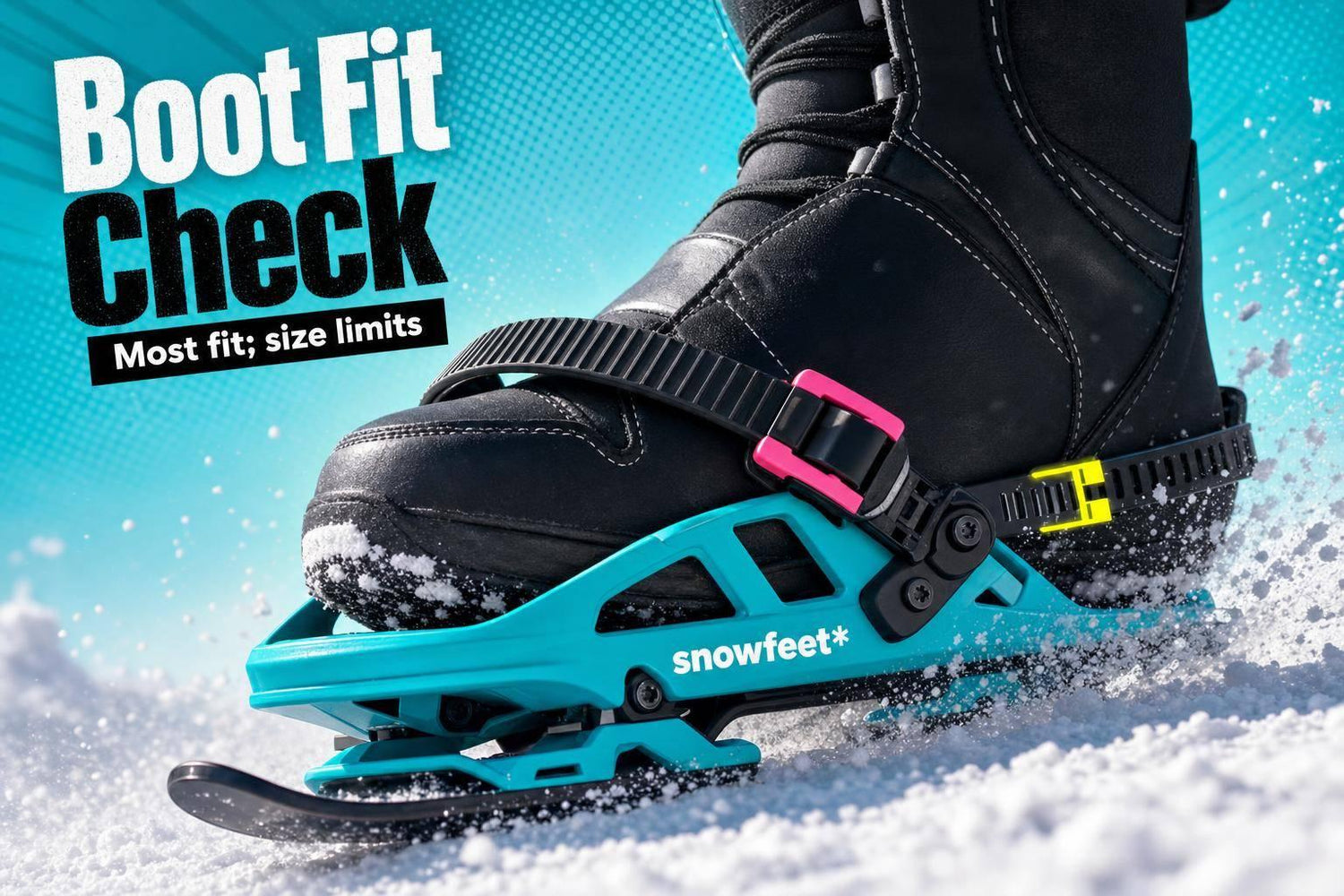
No - skiskates don’t fit every snowboard boot. The fit mostly comes down to binding type, boot bulk, and boot size. In plain English: a slim US men’s 10 boot may fit fine, while a bulky US men’s 12–13 boot can run out of strap length fast.
Here’s the short version:
- Ski-boot-only bindings won’t fit snowboard boots
- Snowboard-boot versions can fit many boots, but not all
- Skiskates 44 cm has the biggest stated range: US 6–14.5
- Snowfeet PRO 50 cm and Snowfeet 50 cm usually top out at US 13
- Bulky boots are often the problem, not the size tag alone
- Medium-to-stiff boots usually feel better than very soft ones
So, if you’re shopping in the U.S., I’d check your boot’s outer shape, not just the number on the liner. A boot can be “in range” on paper and still fit like a stuffed burrito :)
If you want the safest bet:
- pick the snowboard-boot binding version
- double-check the stated size range
- be extra careful if you wear US 12, 13, or 14+
- ask about longer toe straps if your boots are bulky
Quick comparison
| Model | Snowboard Boot Fit Range | Best Match |
|---|---|---|
| Skiskates 44 cm | US 6–14.5 | Bigger size range, slope use |
| Snowfeet PRO 50 cm | US 6–13 | Resort laps, more stability |
| Snowfeet 50 cm | Up to US 13 | Casual use |
| Snowfeet 38 cm | Up to adult US 6 | Kids/smaller boots |
One stat that jumps out: two boots with the same listed size can fit very differently because outer shell shape and padding vary a lot. That’s why the answer isn’t a simple yes or no.
If I had to sum it up in one line: many snowboard boots work, but not all of them - and bulky big-size boots need the most caution.
Helpful videos:
- Snowfeet official YouTube
- How snowboard boot bindings work on short skis
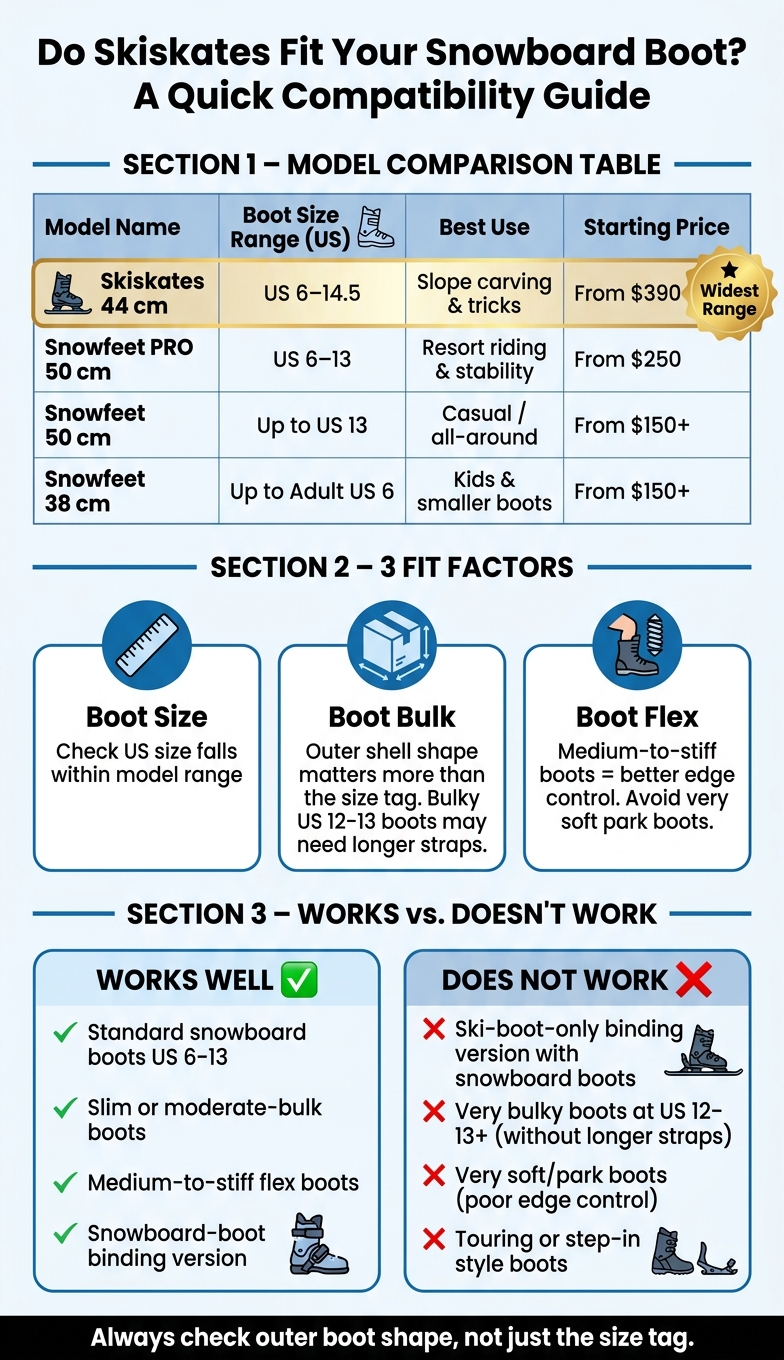
Skiskates vs Snowfeet: Snowboard Boot Compatibility Chart
All you need to know - Snowfeet* | Skiskates | Skiboards | Snowblades | Skiblades FAQ
How Skiskate Bindings Work With Snowboard Boots
Snowfeet* doesn’t use standard snowboard bindings. It uses its own systems. So boot fit comes down to three things: the binding version, your boot size, and your boot shape. After that, you’ve got one more thing to check - whether the boot’s shape and stiffness work well with the binding.
Snowboard-Boot Bindings vs. Ski-Boot Bindings
Snowfeet* has two binding setups, and they are not interchangeable. That part matters a lot.
Ski-boot-only bindings lock onto the hard toe and heel shapes found on alpine ski boots. Snowboard boots don’t have those contact points, so they won’t fit.
Snowboard-boot bindings work in a different way. They use a two-strap system - one strap over the toe and one over the ankle - to hold a soft boot in place. That setup is used on the Skiskates 44 cm model. The Snowfeet PRO 50 cm uses a universal strap system, which means heavy-duty adjustable straps made to fit snowboard boots.
So, when you check out, pick the right binding version. A ski-boot-only version won’t work with snowboard boots. No hacks, no workarounds, no duct tape miracle :)
The 3 Fit Factors That Matter Most
Even if you pick the right binding, fit still comes down to three things: size, bulk, and stiffness. Get the binding right first. Then these three factors decide how well the setup rides.
Size range comes first. Most Snowfeet* models fit US sizes 6–13, while Skiskates 44 cm can fit up to US size 14.5. If your boot is outside that range, the straps won’t close the right way, no matter how much you adjust them.
Boot bulk and shape can trip people up. Two boots can have the same listed size and still look nothing alike on the outside. One might be slim. The other might be wide, thick, and padded like a couch cushion. If your snowboard boot is extra-wide or heavily padded, it may be too wide for the binding baseplate or hit the strap limit before the fit is snug. That’s why bulky boots in US sizes 12–13 can be harder to fit.
Stiffness matters less for fit and more for control. Very soft park boots don’t give much lateral support, which makes it harder to hold an edge on firm snow. Medium-to-stiff boots give you better edge control and more ankle support on skiskates.
That’s why the next step is to match these fit factors to the right Snowfeet* model.
Which Snowfeet* Models Are Compatible With Snowboard Boots
Once you know your boot size and binding type, picking a model gets pretty simple. If your boots fit the size and bulk limits, the rest comes down to how you like to ride. Here’s the fast match-up for each Snowfeet* option.
Snowfeet* Skiskates 44 cm: Best for Slope Riding and Control
The Skiskates 44 cm is the premium wood-core model for riders who want more of a ski feel on the slopes. It has a sustainable wood core, metal edges, and a sintered graphite base. The snowboard-boot version fits US sizes 6–14.5 (EU 38–49), which gives it the widest size range in the Snowfeet* lineup.
At 44 cm, this model gives you the most precise, ski-like control in the lineup. That makes it a strong pick for groomers, snow parks, and anyone who wants sharp edge response without hauling around full-length skis. Starting at $390.
Snowfeet PRO 50 cm and Snowfeet 38 cm / 50 cm: Best for Casual Riding and Portability
If you want a more laid-back setup, the Snowfeet PRO 50 cm and Snowfeet 38 cm / 50 cm are the easier way in. The PRO uses adjustable, tool-free bindings that work with snowboard boots in US sizes 6–13. It’s fiberglass-reinforced, so it feels lighter and a bit more forgiving than the wood-core Skiskates. The extra length also adds a little more stability on uneven snow. Starting at $250.
If you wear larger snowboard boots - especially US 12–13 - take a close look at the outer bulk before you buy. Very bulky boots can run into strap-length limits with standard straps.
The Snowfeet 38 cm is the smallest option, fitting EU 27–38 / US Kids 10 to Adult 6. The 50 cm version covers the standard adult range up to US 13. Both are light, easy to pack, and great for riders who want snow fun without going all-in on a full ski setup. Starting at $150+.
Next, compare these models with common boot setups to see which pairings fit cleanly.
sbb-itb-17ade95
Boot Setups That Work and Boot Setups That Do Not
What Usually Works: Compatible Boot Setups
Using the three fit factors above, here are the boot setups that fit best in Snowfeet* bindings.
The best match is a standard snowboard boot with snug heel hold, moderate stiffness, and a shape that stays within the strap range. That combo tends to feel secure without turning your setup into a wrestling match.
Boots that fit smaller feet often sit more neatly in the binding, so they’re a good place to start. But size alone doesn’t decide it. If a boot checks those three boxes, it should work well across the Snowfeet* lineup.
What Does Not Work Well: Problem Boot Setups
These are the setups that most often lead to fit or control issues.
Very bulky snowboard boots in US sizes 12–13 can push the straps to their limit, more so with shorter straps. In that case, you may need extra-long front toe straps. Very soft boots can also make edge control weaker, most of all when you pick up speed.
Boots with unusual shapes, like touring boots or step-in boots, often don’t sit well in the binding. They may still strap in, sure, but on snow they can feel awkward and slow to respond. Kind of like wearing work boots to play basketball - you can do it, but it won’t feel great.
Snowboard Boots vs. Ski Boots on Short Skis
Once the boot fits, the next call is simple: comfort or precision.
Ski boots give sharper edge control on hardpack and at higher speeds. That makes them a better fit for aggressive carving. For most casual riders, though, snowboard boots are the better pick. They’re more comfortable for all-day use and feel more natural for the skating motion of skiskates.
| Feature | Snowboard Boots | Ski Boots |
|---|---|---|
| Comfort | High - flexible, easy to walk in | Low - stiff and heavy |
| Edge control | Moderate - great for casual riding | High - better precision at speed |
| Ease of use | Very short learning curve | Short - familiar for traditional skiers |
| Best use | Slopes, terrain parks, all-day fun | Hardpack, fast carving, aggressive riding |
Next, use those fit rules to choose the best Snowfeet* model for your boot size and riding style.
How to Pick the Right Snowfeet* Model for Your Boots
Best Model by Riding Style
Pick the model based on how you ride and your boot size. The chart below makes that part easy.
| Model | Best For | Boot Size (US) | Price |
|---|---|---|---|
| Skiskates 44 cm | Slope carving and tricks | 6–14.5 | From $390 |
| Snowfeet PRO 50 cm | All-around resort riding, trails, light powder | 6–13 | From $250 |
| Snowfeet 38 cm / 50 cm | Local hills, sledding hills, backyard terrain | 6–13 | From $150+ |
The Skiskates 44 cm is the best pick for riding on slopes. It also fits the biggest range of boot sizes, up to US 14.5. If you like carving and messing around with tricks, this is the one that leans that way.
The Snowfeet PRO 50 cm is a better fit if you want more balance and stability on resort runs, hiking trails, or in light powder. Think of it as the steady middle ground. Not flashy, just solid where it counts.
If your boots are bulky or fit large, the PRO 50 cm or Skiskates 44 cm will usually be the safer bet. The Snowfeet 38 cm / 50 cm is the most portable option, which makes it a nice match for smaller hills, sledding spots, and backyard laps.
Key Points to Check Before You Buy
Before you order, check these three things:
- Size range - Make sure your US boot size falls within the model’s fit range.
- Boot bulk - Look at your boot’s outer size, not just the number on the tag. Bulky US 12–13 boots may need longer straps on the PRO 50 cm. If that sounds like your setup, contact Snowfeet* before ordering.
- Boot flex - Go with a medium-flex snowboard boot that holds your ankle firmly. Skip very soft boots.
Next, compare the boot setups that fit cleanly and the ones that need strap changes.
FAQs
How do I measure whether my snowboard boots are too bulky?
Do a quick fit test before you head to the slopes. Set your boot in the center of the binding platform. Then close the strap around it. If the strap won’t close all the way, the boot is likely too bulky.
This happens more often with US sizes 12–13 and some freeride boots. If that’s the case, you’ve got a couple of simple fixes:
- Move the strap to a different hole with a screwdriver
- Use Snowfeet* extra-long straps
A 30-second check here can save you a lot of hassle in the snow :)
Can I swap between snowboard-boot and ski-boot bindings later?
No. You can’t switch between snowboard-boot and ski-boot bindings on the same pair of skiskates after you buy them.
Snowfeet* models come with bindings built for either ski boots or snowboard boots. So you’ll need to pick your boot type at the time of purchase.
That setup helps give you the best fit, better comfort, and more control on the snow.
What should I do if my size 12 or 13 boots barely fit?
If your size 12 or 13 snowboard boots barely fit, the problem is often the boot’s outside shape, not just your foot size. Some boots are simply bulkier, so the stock straps don’t reach far enough to lock things down.
First, check that the boot sits dead center on the binding base. Even a small shift can make strap fit worse. If the straps still come up short, swap the stock toe straps for extra-long toe straps. That gives you a snug, stable fit without slop, which helps with edge control and keeps the boot from moving around.











댓글 남기기
이 사이트는 hCaptcha에 의해 보호되며, hCaptcha의 개인 정보 보호 정책 과 서비스 약관 이 적용됩니다.