



















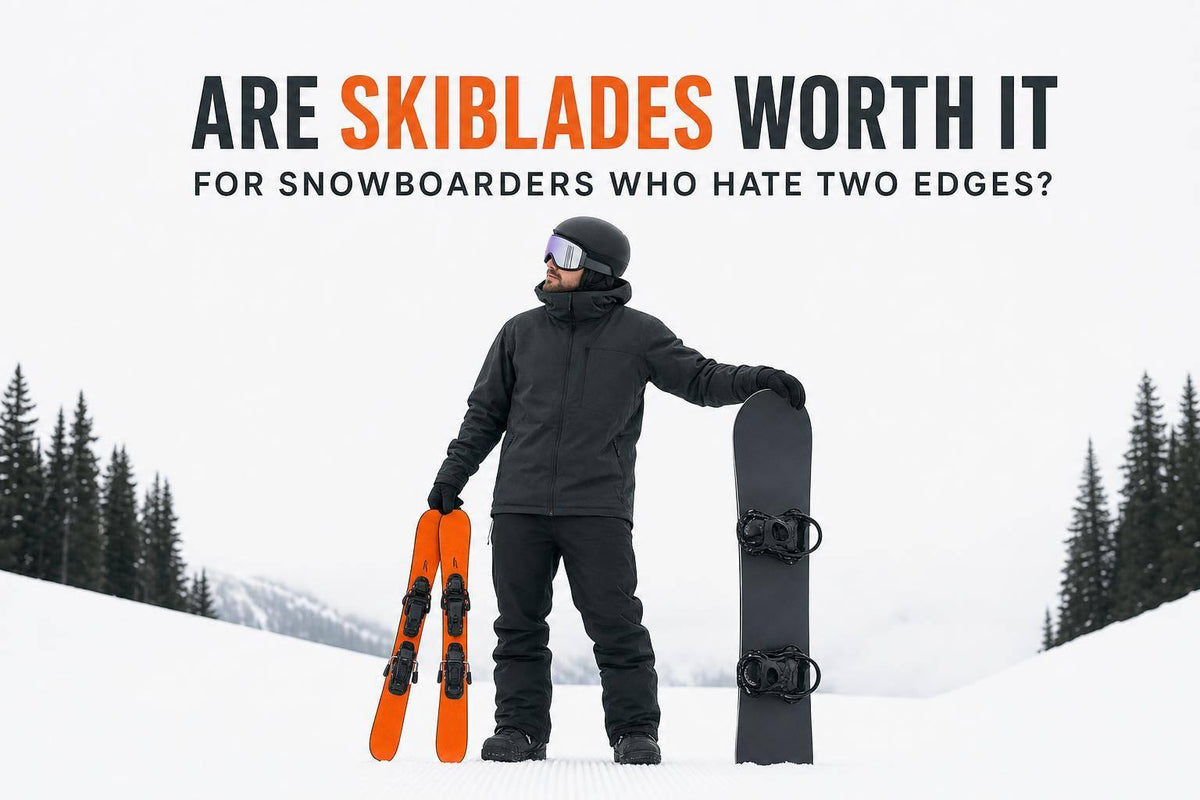
Yes - if you snowboard and long skis feel awkward, skiblades are often the easier next step. I’d put it this way: short skis usually feel less clunky, turn with less effort at slow speed, and let you use your snowboard boots with Snowfeet* models. That cuts cost, gear hassle, and learning pain.
Here’s the short answer:
- Skiblades make sense if you want tight turns, park laps, side hits, and an easy-to-carry setup.
- Snowboards still win in powder, big lines, and fast carving.
- Long skis still win for top-speed grip, rough snow, and big-mountain control.
-
Snowfeet* gives you three clear size options:
- 44 cm Skiskates: smallest, lightest, most skate-like
- 65 cm Skiblades: most playful and trick-friendly
- 99 cm Skiblades: best pick if you want more stability
A few numbers stand out:
- 44 cm = most compact option
- 65 cm = short length for tight, playful turns
- 99 cm = more comfort as speed builds
- 4 m turn radius on the 65 cm model
- Starting prices: $460, $590, and $690
If I were helping a snowboarder in a ski shop, I’d say this: if you hate the split feel of long skis, skiblades are the clean middle ground between a board and full skis.
Snowboarder tries Snowfeet* | Which Snowfeet* Short Ski is the Best? | Snowblades 44, 65, 99 Review
Quick Comparison
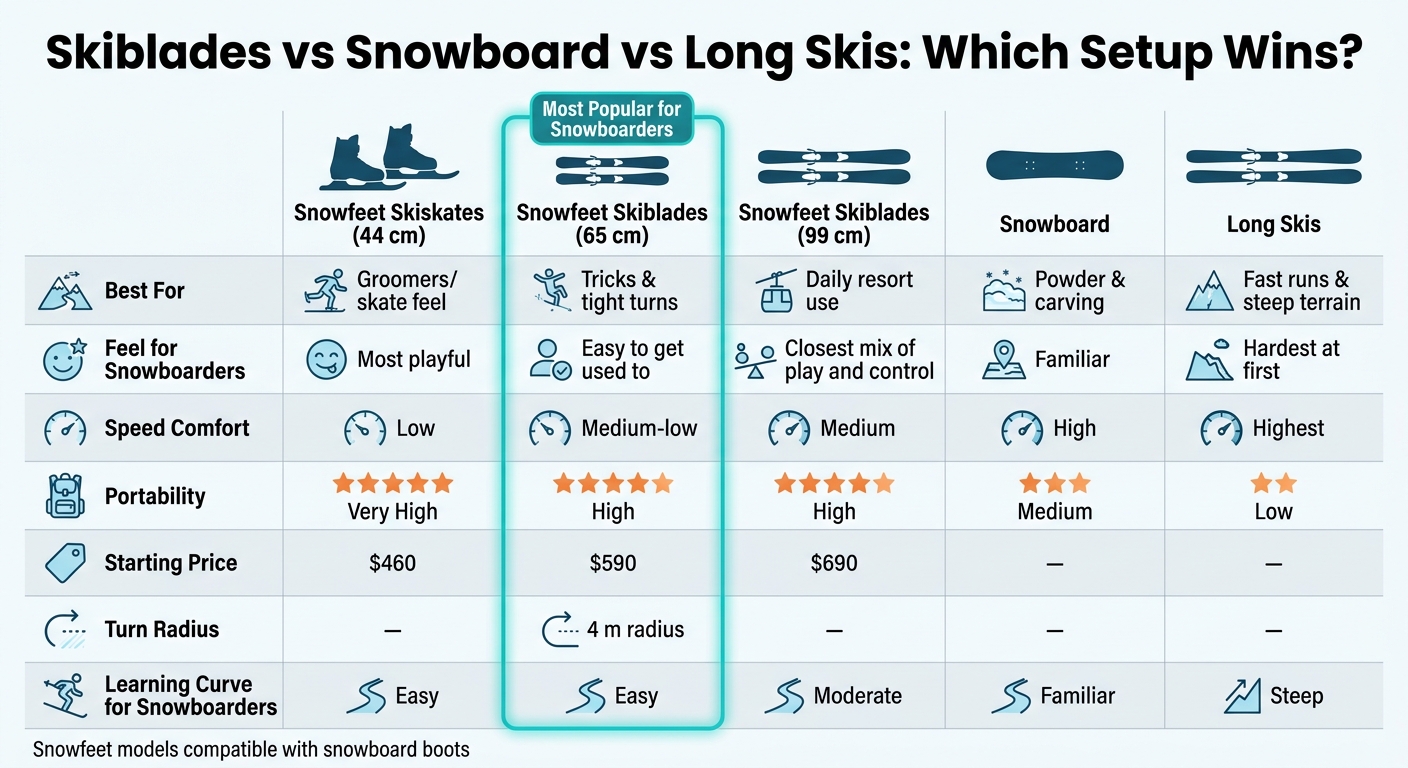
Skiblades vs Snowboard vs Long Skis: Which Setup Wins?
| Setup | Best for | Feel for snowboarders | Speed comfort | Portability | Starting price |
|---|---|---|---|---|---|
| Snowfeet* Skiskates | Groomers, short laps, skate feel | Most playful | Low | Very high | $460 |
| Snowfeet* Skiblades 65 cm | Tricks, side hits, tight turns | Easy to get used to | Medium-low | High | $590 |
| Snowfeet* Skiblades 99 cm | Daily resort use | Closest mix of play and control | Medium | High | $690 |
| Snowboard | Powder, carving, all-day riding | Familiar | High | Medium | - |
| Long skis | Fast runs, steep groomers, technical terrain | Hardest at first | Highest | Low | - |
So, if your main issue is “I don’t like dealing with two long skis under me,” skiblades are worth a shot. They won’t replace a snowboard on deep days, but for resort fun, they can feel a lot less weird :)
Why two edges feel wrong to snowboarders
The biggest disconnect is simple: snowboarders are used to one board, not two skis.
On a snowboard, balance and edge control live in one piece of gear. You tip one board, use one set of edges, and your body works as one unit. Skis split that job in half. Each ski has its own edge, its own path, and its own little opinion about where it wants to go. At first, yeah, that can feel weird.
For someone who rides a board, this means learning a new movement pattern. Skiing asks for smaller lower-body movements to start turns. Snowboarders often lean on hip rotation instead. So the motion that feels natural on a board can feel off on skis. Same mountain, same snow, totally different dance.
Why long skis feel awkward after a snowboard
Long skis add more swing and more instability. A small balance mistake can feel much bigger, most of all at low speeds when momentum isn’t helping smooth things out.
On a busy green run, that gets frustrating fast. Every speed check and every direction change has to happen with both skis working together. That’s a lot to sort out when you’re still trying to figure out which edge to press and when.
Long skis can take much longer to feel normal, most of all at slow speeds and in traffic. Then there’s the stance. You’re facing forward, not sideways. Your hips and shoulders turn forward. Your field of view changes. For many snowboarders, that alone can make skis feel shaky, even at mellow speeds.
It’s not a fitness issue. It’s not that the rider suddenly forgot how to slide on snow. It’s that the moves that worked on a snowboard don’t transfer in the same way on skis.
That’s the exact spot where shorter skis can help.
Why skiblades help solve this problem
Short skis shrink that gap. They make turning feel more reactive and, for many snowboarders, more familiar.
Because less ski touches the snow, they pivot fast, even at low speed. Many skiblades turn with less effort and feel easier to control when things are moving slow. That matters a lot when you’re learning, merging through traffic, or just trying not to yard-sale your gear in front of the lift line :)
And if you catch an edge? The shorter length usually makes the fix smaller and less dramatic. You’re not dealing with the same full-body scramble that long skis can cause.
So if two separate edges feel odd at first, skiblades soften that mismatch. That’s why compact options like Snowfeet* can feel closer to what snowboarders already know.
sbb-itb-17ade95
Why skiblades feel more natural than long skis
For snowboarders, skiblades usually feel better in three big ways: edge feel, turn speed, and control at slow speeds. You notice it right away when you start a turn, try to stay balanced, or make small fixes on the fly.
| Trait | Snowboard | Long skis | Skiblades |
|---|---|---|---|
| Edge control | Familiar single-board feel | Two edges, harder to sync at slow speeds | Short length makes edge changes fast and forgiving |
| Turning style | Hip-led turns | Needs more precise leg input | Quick pivot turns, small radius - Snowfeet* Skiblades 65 cm turn in a tight 4 m radius |
| Balance & stance | Sideways, locked in | Forward-facing, long lever arms | Compact underfoot and easier to balance |
| Learning curve | Familiar for snowboarders | Slower to adapt, especially at low speeds | Easier to recover from mistakes at slow resort speeds |
| Terrain-park fun | Great for freestyle | Possible but demands more commitment | Playful, easier spins and side hits |
Edge control, turning, and low-speed confidence
The main thing? Skiblades react fast when you're not moving fast. That’s a big deal.
With less ski touching the snow, turns happen sooner. Small balance fixes kick in faster too. On long skis, little mistakes can snowball at slow speed. The longer shape gives you more to manage, and that can feel awkward, especially if you're coming from a snowboard.
Skiblades keep things simpler. They have less swing weight, so shifting your weight feels easier. Turns start sooner and finish cleaner, without as much exact leg work as long skis need. It’s a bit like switching from a long pickup truck to a small hatchback in a tight parking lot. Same job, way less fuss.
Balance, stance, and freestyle movement
That quick response changes how skiblades feel underfoot too. The platform is more compact, so balance fixes feel instant instead of delayed.
For snowboarders, this matters a lot. You get independent leg movement without dragging around full-length skis on each foot. On long skis, each leg has to handle a big lever arm. That can feel clunky at first. Skiblades sit in the middle: each leg moves on its own, but without that extra bulk and inertia.
And yeah, that’s a big part of why they feel more natural for riders used to quick weight shifts and board control. Top speed matters less here than easy movement. So spins, butters, and fast direction changes tend to feel smoother and more intuitive.
That same compact feel is why short setups like Snowfeet* make sense for riders who want boot-in, grab-and-go freestyle handling.
Best Snowfeet* options for snowboard-boot riders
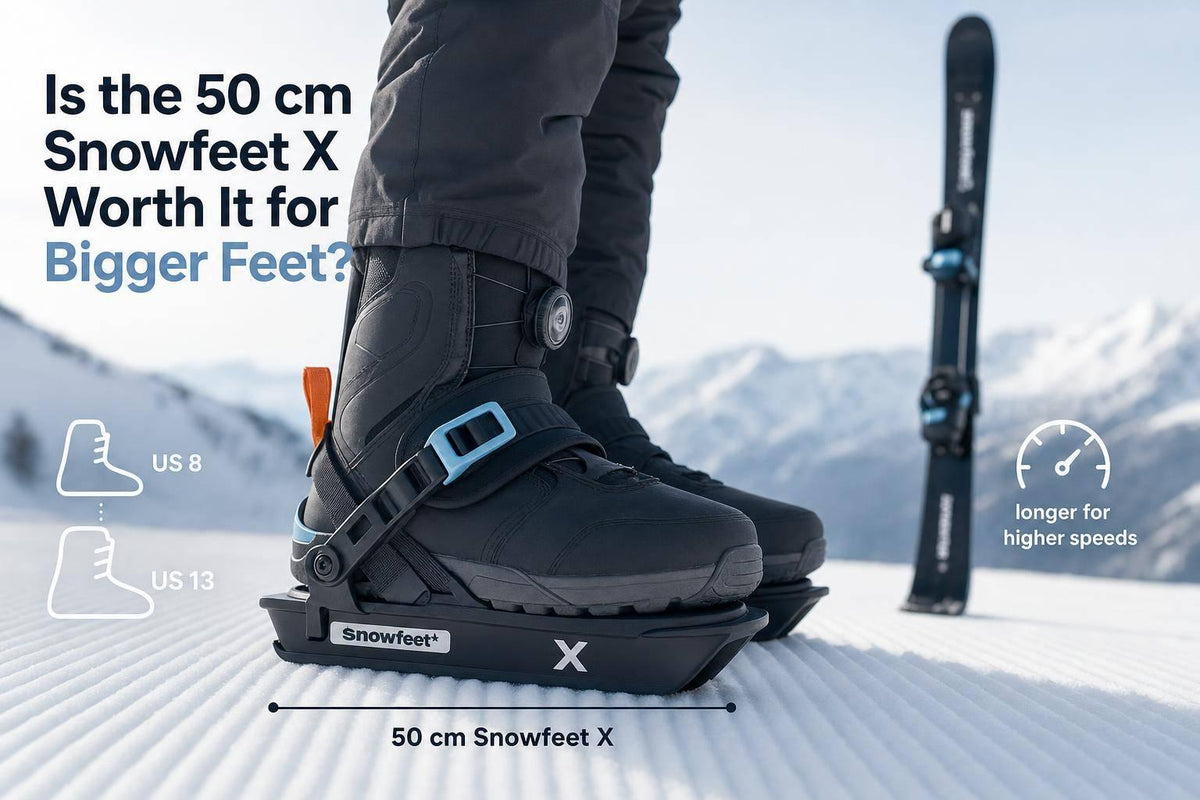
Snowfeet* models work with snowboard boots, so you don’t need to swap into a whole new boot setup. That alone is a big win if you like to travel light or just hate hauling extra gear. They’re small enough to pack with less hassle, too.
For snowboarders who don’t love the two-edge feel of skis, Snowfeet* can feel like a simpler way into ski-style riding. The main choice comes down to this: max agility, better all-around use, or small, skate-like gear.
Snowfeet* Skiskates 44 cm: best for a skate-like feel
Starting at $460, the 44 cm Skiskates are the smallest option in the lineup. They feel the most like skating, which makes them a natural fit for quick groomer laps and short-burst fun.
If you come from skateboarding or another board sport, this model lines up well with that fast, snappy reaction on snow. It turns fast and feels loose in a fun way.
The catch? High-speed stability. These are at their best on groomed runs and small features, not long carving sessions or faster, more open runs. If you want more range, the 65 cm and 99 cm skiblades are the better bet.
Snowfeet* Skiblades 65 cm and 99 cm: tight turns vs all-around stability
The 65 cm Skiblades start at $590. They’re made for quick direction changes, tight turns, and a playful ride across mixed resort terrain. If you like a nimble setup for tricks and sharp moves, this is the one that stands out.
The 99 cm Skiblades start at $690. For snowboarders, they offer the most stability in the Snowfeet* lineup without jumping all the way to full-length skis. That extra length gives you a bit more comfort when conditions change or speeds creep up.
Both options help shrink the gap between snowboarding and skiing, which is kind of the whole point here.
| Model | Length | Starting Price | Best For |
|---|---|---|---|
| Skiskates | 44 cm | $460 | Skate-like feel, max portability, groomed laps |
| Skiblades | 65 cm | $590 | Tight turns, tricks, agile resort riding |
| Skiblades | 99 cm | $690 | All-around stability, broader comfort range |
Here’s the simple version:
- Pick 44 cm if you want portability and a skate feel.
- Pick 65 cm if you want the most agile, trick-friendly ride.
- Pick 99 cm if you want the best mix of maneuverability and stability for day-to-day resort use.
Those differences stand out even more when you stack skiblades up against snowboards and long skis.
When skiblades win - and when snowboards or long skis still make more sense
Once you know how skiblades feel, the next step is simple: where do they beat a snowboard, and where do they fall short?
When skiblades beat a snowboard
Skiblades make a lot of sense on groomed runs, side hits, and short resort laps. They turn faster than a snowboard and feel more playful, especially if you like that skate-like feel instead of standing sideways all day. If you want separate feet but don’t want the full length and leverage of long skis, this setup hits a sweet spot.
Packing matters too. Snowfeet* Skiblades are much easier to carry than a snowboard, and the 44 cm Skiskates take up way less space. That’s a pretty nice perk when you’re hauling gear through a parking lot or trying to cram stuff into a car trunk.
| Setup | Stability at higher speed | Portability | Ease of learning | Best terrain |
|---|---|---|---|---|
| Skiblades | Moderate | High | High for snowboarders and skaters | Groomed runs, side hits, moderate speed |
| Snowboard | High | Moderate | High for riders who want a single platform | Groomers, powder, big lines |
| Long skis | Very high | Low | Low–Moderate | All-mountain, high speed, technical terrain |
The trade-off is pretty clear: more agility and easier carrying, less float and less stability once speeds climb.
Still, skiblades aren’t the right call in every condition.
When a snowboard or long skis are still the better choice
Pick the setup for the terrain, not the hype. If you live for powder days, a snowboard handles deep snow better than short skiblades and gives you more float. If you like steep groomers or big carving turns with lots of power behind them, a full-length snowboard or long skis will hold an edge better at speed.
Long skis are still the top pick for hardpack grip and high-speed control. That includes race-style carving and aggressive big-mountain lines.
So, yeah - Snowfeet* makes a lot of sense for casual resort riders who want something simpler, lighter, and more playful :)
FAQs
Are skiblades easier than skis for snowboarders?
Yes. Skiblades are usually much easier for snowboarders to learn than standard skis. For most people, the switch clicks fast - often in a single session, and sometimes in as little as five minutes.
Why? They’re light, short, and a lot less awkward than long skis. One of the biggest pain points for new skiers is crossing the tips. Skiblades cut out much of that hassle, which makes the first run feel far less clunky.
They can feel even more natural when you use them with comfortable snowboard boots instead of stiff ski boots. That setup tends to feel more familiar right away. You still need to face forward, so it’s not the same stance as snowboarding. But thanks to their easy turning and playful feel, skiblades are often much more approachable than standard skis.
Which Snowfeet* size should I choose?
Choose based on how you want to ride:
- 44 cm Skiskates: the most agile option, with a skate-like feel
- 65 cm Skiblades: the best all-around mix of stability and nimbleness
- 99 cm Skiblades: best if you want more stability, more speed, and longer groomer runs
All three work with existing snowboard boots in U.S. sizes 6–14.5 when paired with the right bindings.
Can I use my snowboard boots with Snowfeet*?
Yes. Most Snowfeet* models work with snowboard boots thanks to tool-free adjustable bindings that keep them snug and secure. That means you can skip stiff ski boots and ride in the boots you already like.
This includes:
- 44 cm Skiskates
- 65 cm Skiblades
- 99 cm Skiblades
These fit U.S. snowboard boot sizes 6–14.5.
One heads-up: the 120 cm model is ski-boots-only. So if you're buying for snowboard boots, make sure you pick the snowboard-boot version to get the right fit and solid edge control.











댓글 남기기
이 사이트는 hCaptcha에 의해 보호되며, hCaptcha의 개인 정보 보호 정책 과 서비스 약관 이 적용됩니다.