



















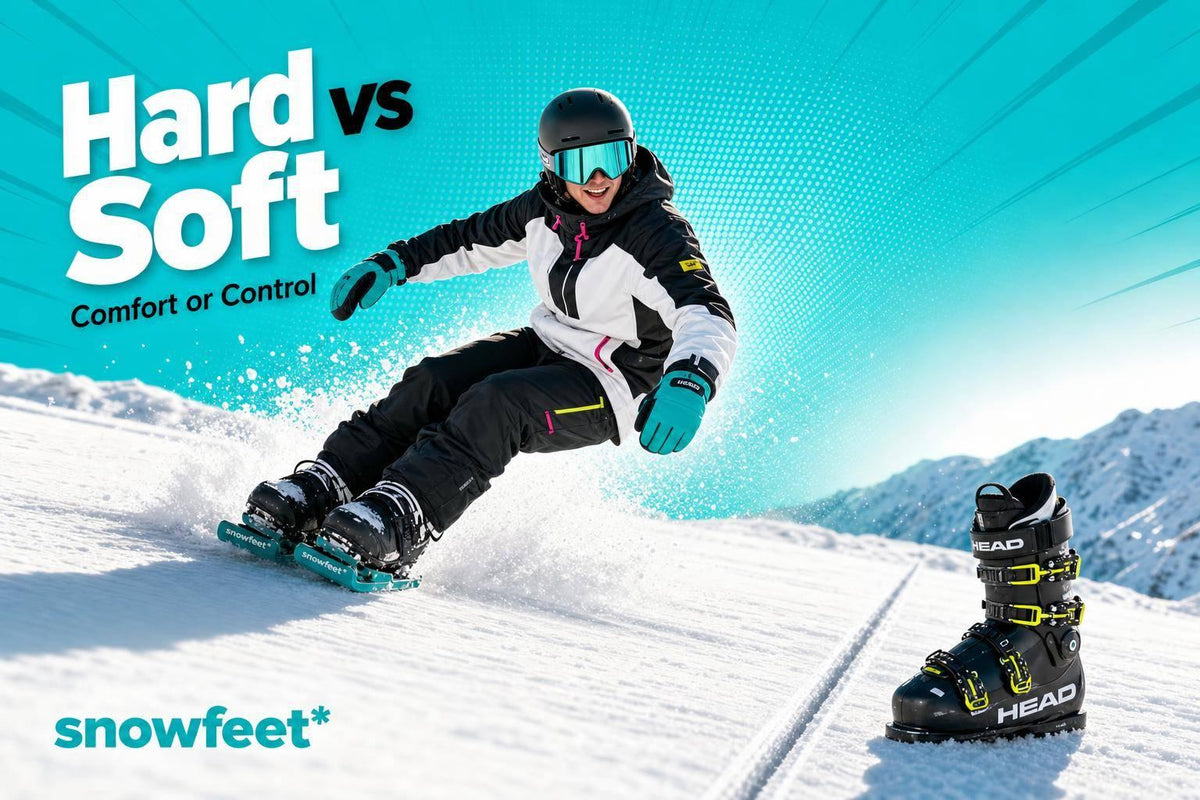
If you want the short answer: most people should start with soft boots. They’re easier to wear, easier to learn in, and more fun for tricks and casual resort laps. Hard boots make more sense if you want tighter control, stronger edge hold, and a setup that feels closer to skiing.
Here’s the whole thing in plain English:
- Hard boots = better control, better grip on firm snow, more stable at speed
- Soft boots = more comfort, easier learning, better for jumps, spins, and all-day use
- Best for beginners = soft boots on 44 cm Skiskates or 50 cm PRO
- Best for skiers who like carving = hard boots on 65–99 cm Skiblades or 120–140 cm Short Skis
- Best for travel = 44 cm Skiskates or 50 cm PRO, since both are small enough to pack
From the model list in the article, 5 Snowfeet* types are covered, with lengths from under 44 cm to 140 cm. Boot fit also matters: Snowfeet* bindings fit ski boots from US 4.5 to 14.5 and snowboard boots from US 6 to 14.5.
So, I’d put it like this: if you want a setup that feels light, relaxed, and playful, go soft. If you want sharper response and a more locked-in ride, go hard. Comfort vs control - that’s the whole battle :)
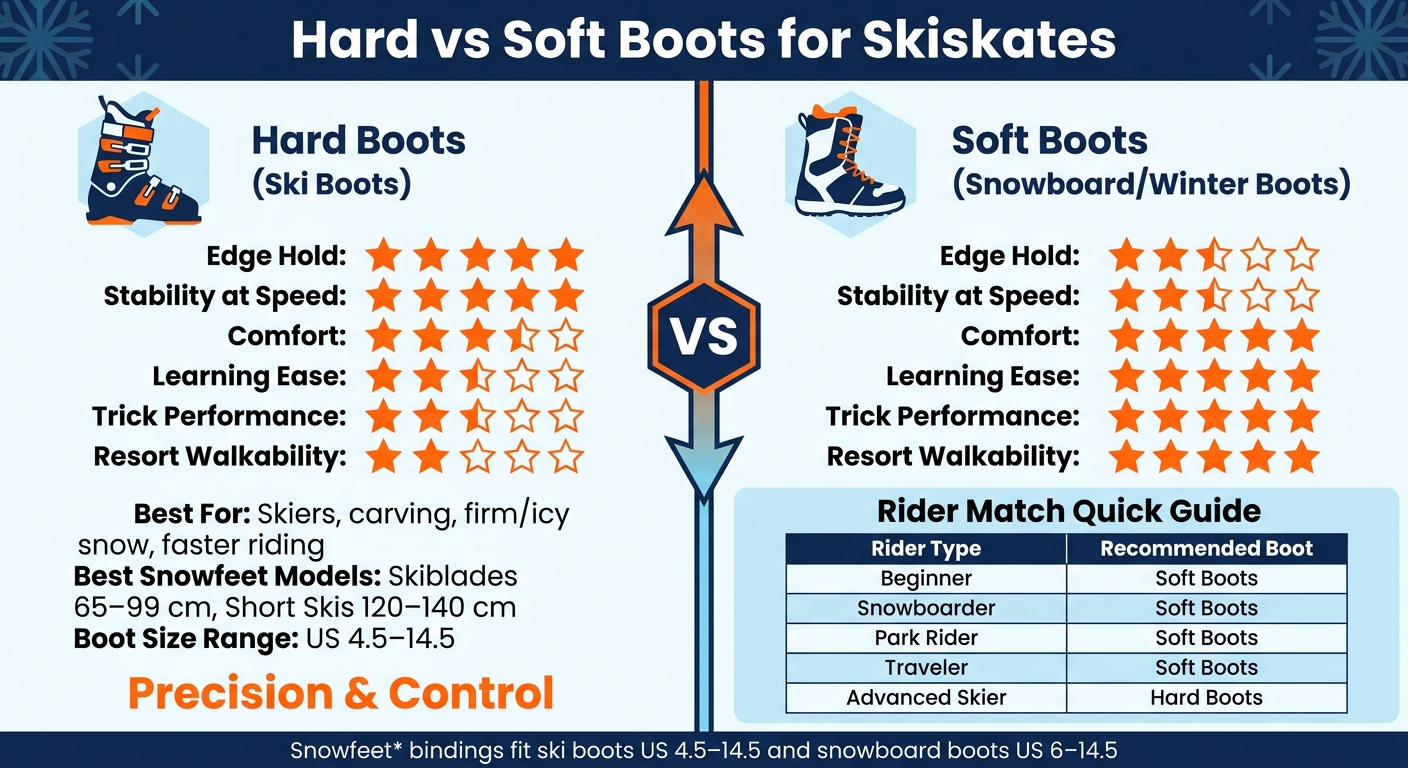
Hard vs Soft Boots for Skiskates: Side-by-Side Comparison
Snowfeet* & Skiskates Complete Guide | All you need to know about Skiskating
Quick Comparison
| Boot Type | Best For | Feel on Snow | Comfort | Control | Trick Use | Best Match |
|---|---|---|---|---|---|---|
| Hard boots | Skiers, faster riding, firmer snow | Direct and locked-in | Lower | Higher | Good | Skiblades, Short Skis |
| Soft boots | Beginners, park laps, casual riding | Smooth and playful | Higher | Lower | Better | Skiskates, PRO |
A few quick takeaways before you read on:
- Soft boots win for most casual riders
- Hard boots win for precision
- 44 cm Skiskates are the sweet spot for playful riding
- Longer models usually feel better with stiffer boots
- If you already own ski boots, that can cut your cost to $0 for new boots, which is always nice
If you’re stuck between the two, I’d keep it simple: pick soft boots for fun and comfort, hard boots for edge hold and speed. No drama. No gear-snob nonsense. Just the setup that fits how you ride.
If you want a quick visual before diving in, these can help:
Bottom line: I’d tell most riders to start soft, then switch to hard only if they want more grip, more speed, and a ski-like feel.
Control, Stability, and Riding Feel
Boot stiffness changes how fast skiskates react, how steady they feel, and how much of the snow you feel under your feet.
Hard boots: stronger edge grip and direct response
Hard boots move pressure to the edge with almost no delay. On groomed snow or icy patches, that direct link gives you sharper, more confident turns. Even small weight shifts go straight to the edge.
This matters most on longer Snowfeet* models. The Skiblades 65 cm and 99 cm, along with the Short Skis 120 cm, 130 cm, and 140 cm, work best for riders who want steadier control at speed. Snowfeet's ski-boot fit also adds more stability and makes life easier for riders who already own ski boots. That extra precision shows up most when speed and edge hold matter more than comfort.
Soft boots: easier turns and a more playful feel
Soft boots flex at the ankle, so the ride feels smoother and more forgiving. Instead of snapping from edge to edge, transitions come on more gradually. The boots also soak up terrain a bit more, rather than sending every bump right up your legs.
On the 44 cm Skiskates, soft boots keep things quick, light, and playful without giving up too much response. For most casual riders, less precision in exchange for more comfort and freedom is an easy trade. That same flex also makes soft boots easier for new riders to get used to.
Control and stability trade-offs: comparison table
| Factor | Hard Boots | Soft Boots |
|---|---|---|
| Edge hold | Stronger; more direct power transfer | Moderate; more forgiving feel |
| Stability at speed | Higher; better for groomed and icy slopes | Moderate; best for casual riding |
| Turn initiation | Immediate and precise | Smooth, playful, skate-like |
| Terrain forgiveness | Lower; stiffer and less absorbing | Higher; more ankle flex and comfort |
| Best Snowfeet* match | Skiblades 65–99 cm, Short Skis 120–140 cm | Skiskates 44 cm, Snowfeet* PRO 50 cm |
Control is only half the choice. Comfort and how fast you learn can matter even more.
sbb-itb-17ade95
Comfort, Learning Curve, and Trick Performance
Why soft boots are easier for most beginners
After edge hold and response, comfort is usually the next big thing people care about. And this is where soft boots pull ahead for most beginners.
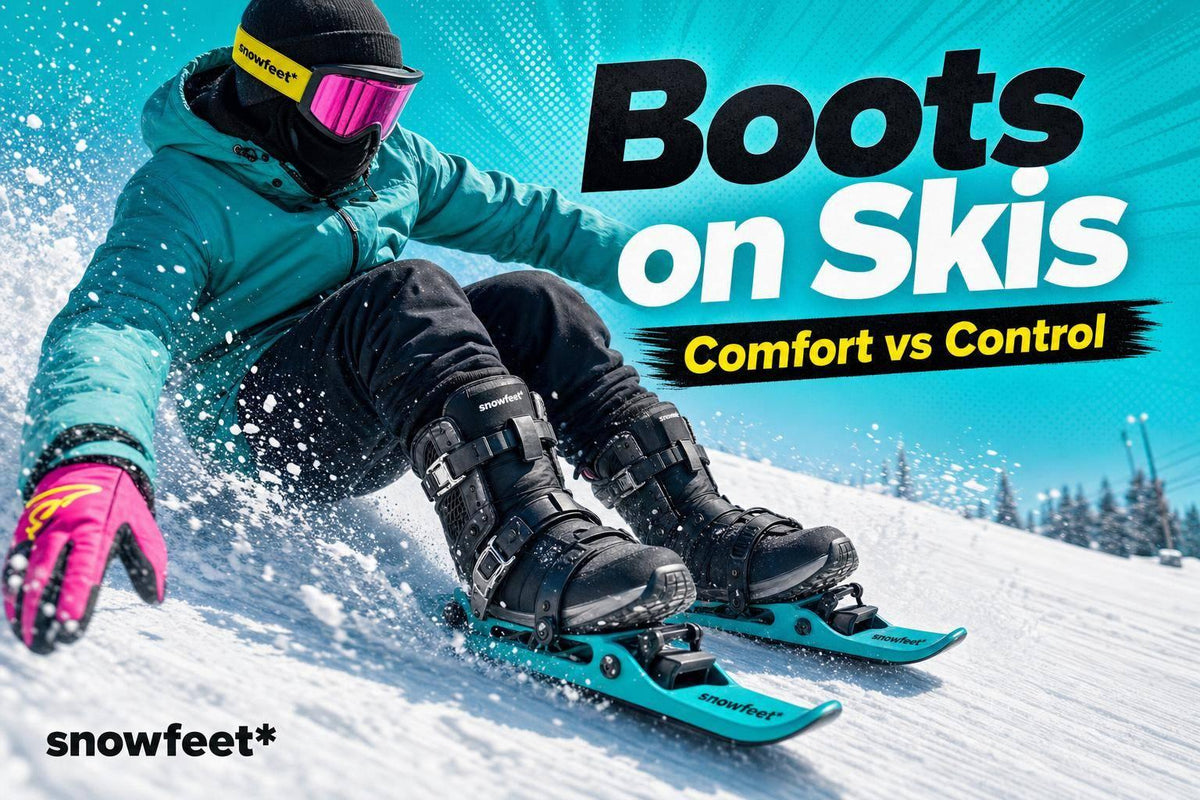
Soft boots, especially snowboard boots, tend to feel easier right away. They flex more, they’re easier to walk in around lift lines and the resort, and that softer feel makes skiskates less intimidating to learn on. You’re not fighting a stiff setup from the first run.
That’s why the Snowfeet* Skiskates 44 cm with snowboard boots are such a good fit for first-timers and casual riders. The setup stays light and mobile, so you can put your energy into learning instead of wrestling with your gear. For most riders, soft boots are the easiest place to start.
They also shine when you want a more playful ride. For tricks, jumps, spins, and switch riding, that extra ankle freedom helps a lot. Soft boots feel less restrictive, which makes moving around on skiskates feel more natural.
The catch? You give up some precision.
When hard boots are worth the extra learning curve
Hard boots make more sense for skiers who already own ski boots that fit well and want a more precise setup. If you already ski, the ski-boot setup will feel familiar. That said, it’s heavier and less forgiving.
That’s the main trade-off: more edge control, less all-day comfort.
So, it comes down to what matters more to you. If you want a lighter, easier, more playful ride, soft boots usually win. If you care more about precision and direct control, hard boots can be worth it.
Comfort, learning, and tricks: comparison table
Here’s the trade-off at a glance:
| Factor | Soft Boots | Hard Boots | Best Snowfeet* Match |
|---|---|---|---|
| Comfort | Higher; flexible and cushioned | Moderate; stiff and restrictive | Skiskates 44 cm, snowboard-binding setup |
| Walking around the resort | Excellent; easy to move in | Poor; clunky ski-boot walk | Skiskates 44 cm, snowboard-binding setup |
| Learning ease | High; less intimidating from day one | Moderate; familiar for experienced skiers | Skiskates 44 cm, snowboard-binding setup |
| Tricks and jumps | Superior; more ankle movement | Good; more direct response | Skiskates 44 cm, snowboard-binding setup |
| Stability and edge control | Moderate; playful at lower speeds | High; better for precise control | Ski-boot binding setup |
For most casual riders, soft boots are the better all-around choice.
Best Boot Setup by Rider Type
The boot trade-off above makes it easier to match the setup to the rider. Pick the right combo, and the whole day feels smoother.
Beginners, snowboarders, and casual resort riders
If you're new, start simple. Soft boots are the best match for Skiskates 44 cm or PRO 50 cm. Snowfeet* PRO and Mini work best with regular winter boots.
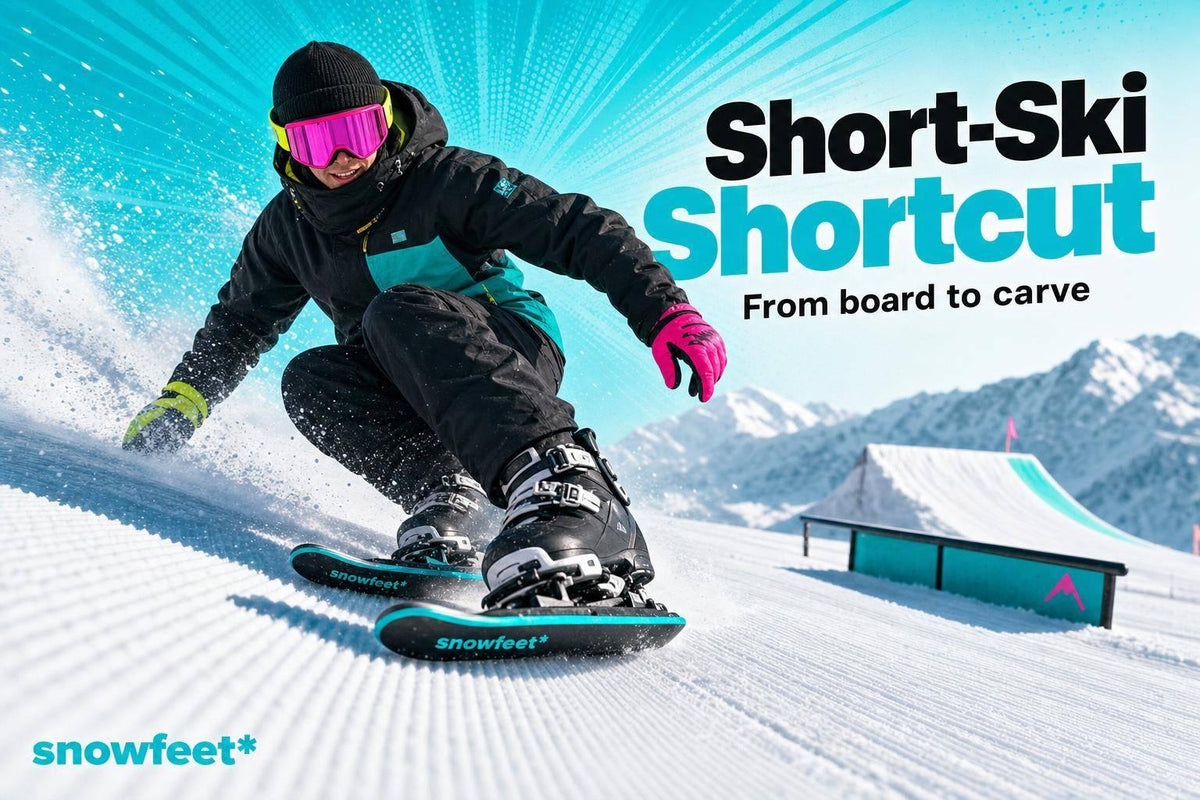
Snowboarders usually have an easier time right away. Snowboard boots feel most natural on Skiskates 44 cm and Skiblades 65 cm. If you already know how to skate, that learning curve gets a lot shorter.
For casual resort riders, a soft-boot setup keeps things easy, relaxed, and fun. No need to make it harder than it has to be :)
Park riders, travelers, and experienced skiers
Once you're comfortable, the best boot choice comes down to how hard you want to push it.
Park riders usually do best in soft snowboard boots. Go with Skiskates 44 cm or PRO 50 cm if you want clean spins, jumps, and quick direction changes.
Travelers get the biggest perk from compact Snowfeet* setups. The 44 cm Skiskates and 50 cm PRO are small enough to fit in a backpack. That makes them a smart pick for weekend trips or for flying to a resort.
Experienced skiers who want more precision should go with ski boots and pair them with 99 cm Skiblades or 120 cm Short Skis. This setup asks more from you, but it’s the right fit for faster carving and stronger edge pressure.
Best setup by rider profile: comparison table
Here’s the quick-match version.
| Rider Profile | Control | Comfort | Tricks | Travel | Recommended Snowfeet* Model | Boot Type |
|---|---|---|---|---|---|---|
| Beginner | Moderate | High | Low | High | PRO 50 cm / Skiskates 44 cm | Winter or snowboard boots |
| Snowboarder | Moderate | High | Moderate | High | Skiskates 44 cm / Skiblades 65 cm | Snowboard boots |
| Park Rider | Moderate | High | Very High | High | Skiskates 44 cm / PRO 50 cm | Soft snowboard boots |
| Traveler | Moderate | High | Moderate | Very High | Skiskates 44 cm / PRO 50 cm | Winter or snowboard boots |
| Advanced Skier | Very High | Moderate | Moderate | Moderate | Skiblades 99 cm / Short Skis 120 cm | Hard ski boots |
Conclusion: Which Boot Type Works Better for Skiskates?
Hard boots win on precision. Soft boots win on comfort and ease.
After looking at control, comfort, and the learning curve, the choice comes down to how you like to ride. Ski boots give you stronger edge grip and a more direct feel. Soft snowboard boots give you more flex, an easier start, and better comfort for long days on snow.
For most casual riders, soft boots are the better default. They’re easier to get used to and just plain nicer to wear. If you already own ski boots and like that classic, direct feel, the hard-boot setup makes sense. But if you want comfort, easier learning, and a more playful ride, go soft - that’s the more fun and convenient Snowfeet* setup for most people.
FAQs
Can I use regular winter boots with Snowfeet* skiskates?
It depends on the model.
Snowfeet Skiskates 44 cm* need ski boots or snowboard boots. So, regular winter boots won’t work with that model.
Other models, like 38 cm, 50 cm, and PRO 50 cm, work with regular waterproof winter boots because they use adjustable strap bindings. That said, if you’re heading onto steeper terrain or plan to ride at higher speeds, snowboard boots are still strongly recommended. They give you better support, more control, and a steadier ride.
Should I switch to hard boots after learning on soft boots?
It depends on your goals.
If you're still learning, or you want all-day comfort, easy walking, and a more natural feel for tricks, stick with soft snowboard boots. For most Snowfeet riders, they’re the better match. They give you support, feel more forgiving, and are just plain easier to wear for hours.
Move to hard ski boots only if you want max precision, stronger edge hold on icy or steep runs, and more stability when your speed climbs.
Which Snowfeet* length feels best with each boot type?
The best Snowfeet* length comes down to your boots and how you like to ride.
The shorter models - 44 cm Skiskates, 50 cm Snowfeet PRO, and 65 cm Skiblades - pair best with snowboard boots. That setup feels more playful, loose, and easy to move around in. If you like quick turns, a nimble feel, and a ride that’s a bit more fun-first, this is the sweet spot.
For the 99 cm and 120 cm models, ski boots are the better pick. They give you more edge hold, more stability, and better precision. That matters most if you want to ride faster or make cleaner, more ski-like carving turns.











댓글 남기기
이 사이트는 hCaptcha에 의해 보호되며, hCaptcha의 개인 정보 보호 정책 과 서비스 약관 이 적용됩니다.