





If you want the short answer: get the Snowfeet* WALKSKI 100 cm if you want the closest thing to touring without buying AT boots. It starts at $595, works with winter, snowboard, or ski boots, and has skins plus a free-heel uphill mode. A full touring setup can run about $2,200, so the price gap is big.
Here’s the simple breakdown:
- Best for short backcountry tours: WALKSKI 100 cm
- Best for playful downhill laps: Skiblades 99 cm
- Best for tiny, short-run fun: Skiblades 65 cm
- Best for max packability: PRO Ski Skates 50 cm
- Best for flat or rolling snow: NORDIC 90 cm
- Best for long tours and steeper terrain: Standard touring setup
What I’d keep in mind:
- Shorter skis are easier to carry
- Longer skis feel better at speed
- Only the WALKSKI is built for actual uphill touring
- Cheap gear doesn’t remove backcountry risk
- You still need a beacon, shovel, and probe
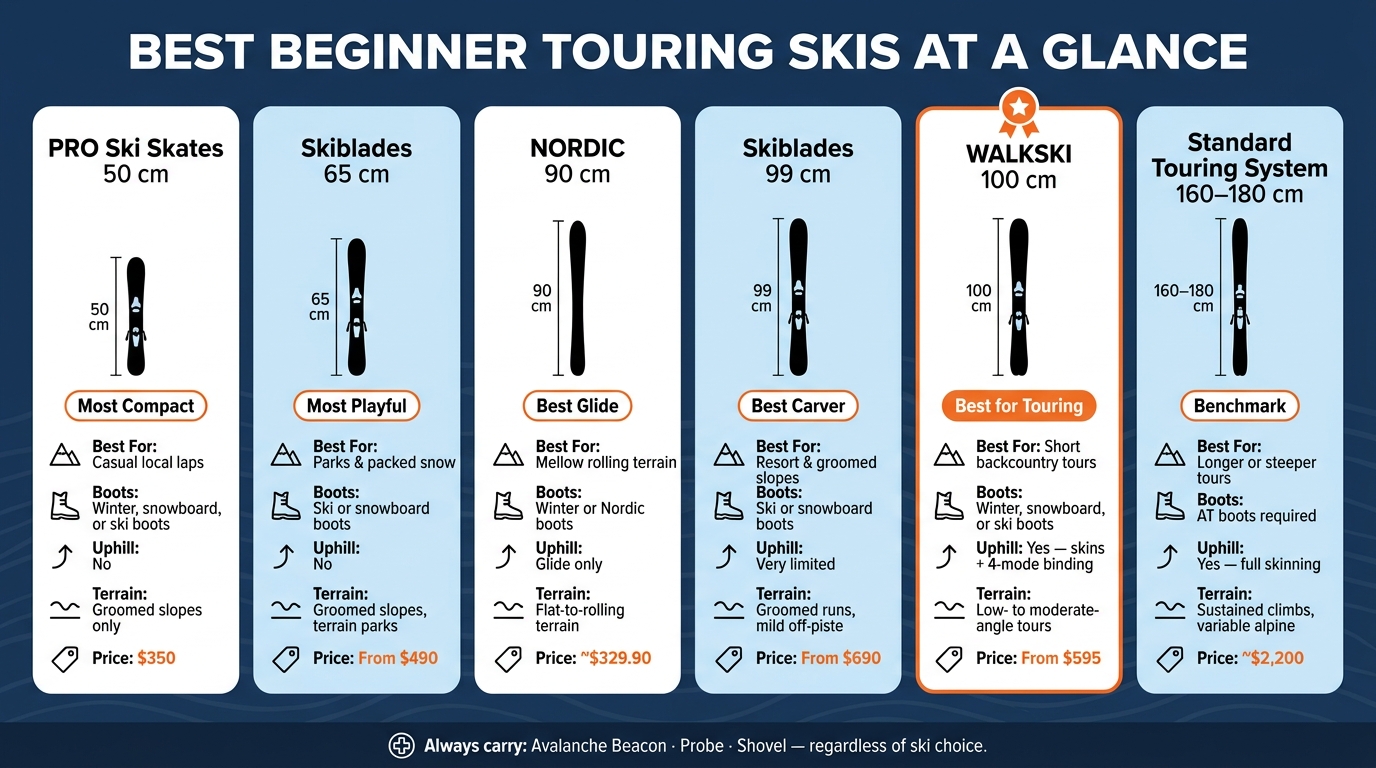
Best Beginner Touring Skis: Side-by-Side Comparison
Snowfeet WALKSKI | Backcountry Skiing in Georgia
Quick Comparison
| Option | Best For | Boots | Uphill Use | Downhill Feel | Price |
|---|---|---|---|---|---|
| WALKSKI 100 cm | Short tours | Winter, snowboard, or ski boots | Yes, with skins and heel lift modes | Fine on mellow descents; less steady at speed | From $595 |
| Skiblades 99 cm | Playful short outings | Ski or snowboard boots | Very limited | Fast-turning and fun on gentle slopes | From $690 |
| Skiblades 65 cm | Very short laps, park use | Ski or snowboard boots | No | Easy to turn, low float | From $490 |
| PRO Ski Skates 50 cm | Brief local sessions | Winter, snowboard, or ski boots | No real touring use | Best on easy terrain | $350 |
| NORDIC 90 cm | Packed snow, rolling terrain | Winter boots or NNN boots | Glide-based travel on mellow ground | Best on flat to low-angle snow | About $329.90 |
| Standard touring system | Long tours, steeper lines | AT boots | Yes | Best control and float | About $2,200 |
So, if you hate heavy gear, I’d start with terrain first, then boots, then budget. That cuts through the noise fast and keeps you from buying a setup that looks cool in the garage but feels wrong on snow :)
1. Snowfeet* WALKSKI Backcountry Touring 100 cm
The WALKSKI is the closest match here to a touring ski, just without the full-size headache.
Carry Weight
You can get the WALKSKI in two core versions:
- Wood core: 6.9 lb (3,116 g) per pair
- Fiberglass core: 8.8 lb (3,980 g) per pair
At 100 cm, it’s short enough to strap to a backpack, which is a big plus if you don’t want long skis poking out like antennae.
Boot Compatibility
This is where the WALKSKI stands out. The patented binding works with standard winter boots, snowboard boots, and ski boots. So, you don’t need touring boots to use it.
The binding fits boot sole lengths of about 9.5 to 15 inches (24–38 cm). That’s a pretty broad range, but don’t wing it - check your boot sole length before you order.
Uphill and Downhill Range
The binding has four positions: Walk, Climb 1, Climb 2, and Ski. It also comes with removable climbing skins for uphill grip.
On mellow terrain, the short length makes turning feel easy and quick. That’s the fun part.
The trade-off is simple: shorter skis are less stable at higher speeds than longer ones. So the WALKSKI makes the most sense for short tours, local hills, and lower-speed outings, not steep lines where you want to charge hard. Out of the Snowfeet* lineup, it’s the strongest pick for actual touring, even though it still won’t feel as planted as full-length skis when things speed up.
Price and Required Gear
The WALKSKI is listed at $595 on the product page, but the collection page shows $499. Yeah, that’s a bit odd, so check the current listing before you buy.
You’ll also need:
- Poles
- Avalanche beacon
- Shovel
- Probe
If you want something even shorter and more playful, the next options are easier to carry and snap through turns faster, but they give up some touring range.
2. Snowfeet* Skiblades 99 cm
If the WALKSKI leans a bit too much toward touring, the 99 cm Skiblades are the simpler next move. They’re lighter, easier to haul around, and more playful than full touring skis. But let’s be clear: these are not made for serious uphill touring. Compared with the WALKSKI, they’re easier to carry, but they give up a lot when it comes to uphill travel.
Carry Weight
The 99 cm Skiblades weigh 4.94 lb per pair with ski bindings or 5.60 lb with snowboard bindings. They’re also about 39 inches long.
That short length makes a big difference. They’re much less awkward to carry than full-size skis, which is nice when you’re walking through a parking lot, tossing gear in a car, or just trying not to bonk into every doorway on the way to the lift :)
Boot Compatibility
Snowfeet offers three binding choices:
- Simple ski-boot bindings for US men's 4.5–14.5
- Pro ski-boot bindings for Mondopoint 26–36.5
- Snowboard-boot bindings for US 6–14.5
Before you order, double-check that your boots match the binding. Sounds obvious, sure, but this is one of those small details that can save you a big headache later.
Uphill and Downhill Range
This is not a touring setup, and it doesn’t use climbing skins. So if your plan is long uphill missions, these won’t be the right tool.
On the downhill side, though, they’re built to feel quick and nimble. Their 6-meter turning radius helps them turn fast on groomers and mellow terrain, which makes them fun in tighter spaces or for skiers who like a more playful ride. The trade-off is less stability once speed picks up.
Price and Required Gear
The Skiblades 99 cm start at $690, depending on the setup you choose. That’s still much less than a standard touring setup, which comes in at about $2,200 all-in.
If you want even more portability and easier handling, the 65 cm Skiblades push things even further in that direction.
3. Snowfeet* Skiblades 65 cm
If the 99 cm Skiblades still sound like a lot to lug around, the 65 cm version strips things down even more. At 65 cm (26 inches), with a wood core, they’re small, light, and easy to carry for short laps or quick walk-ups.
That said, there’s a clear limit here: they work best for short access hills, not long climbs. Think quick up-and-down fun, not all-day uphill missions.
Boot Compatibility
You get two binding options:
- Ski-boot bindings fit US 4.5–14.5 (EU 36–49)
- Snowboard-boot bindings fit US 6–14.5 (EU 38–49)
Check your boot size before you order. Saves a headache later.
Uphill and Downhill Range
These fit a broad range of boots, but they still aren’t made for true touring. These are not touring skis. No climbing skins, no heel risers, and no touring mode.
So where do they shine? Short, playful laps and brief walk-ups where you’re carrying most of the climb anyway. On the way down, the 4-meter turning radius makes them super quick to spin and carve on groomed runs and in the park.
Price and Required Gear
The 65 cm Skiblades are listed at $490 with your chosen binding.
If you want even less bulk and better glide, the next option leans more toward Nordic-style movement.
sbb-itb-17ade95
4. Snowfeet* PRO Ski Skates 50 cm
If you want the smallest, easiest-to-pack pick in the lineup, the PRO Ski Skates are it. They’re the most compact option here and weigh 1.65 kg (3.64 lb) per pair.
Boot Compatibility
The universal binding system works with standard winter boots, snowboard boots, and ski boots. So, you don’t need special touring footwear to use them. The current listing shows a size range of US 6–13 (EU 38–47).
Uphill and Downhill Range
These don’t come with climbing skins or a touring mode, so they’re not a replacement for a true backcountry setup. That’s the big thing to know.
They make more sense for brief climbs, resort access, rolling terrain, and casual local outings. On the way down, the 50 cm length makes them quick to turn and easy to redirect. That helps a lot at low speed, where control matters most. The downside? They feel less stable at higher speeds than longer skis.
Price and Required Gear
The PRO Ski Skates are listed at $350. That’s still way below a conventional beginner touring setup, which averages about $2,200.
If you want more glide and more of that classic touring feel, the NORDIC Cross-country 90 cm is the next step.
5. Snowfeet* NORDIC Cross-country 90 cm
For beginners who want the lightest, simplest option with a smooth glide, the NORDIC lands somewhere between ski skates and full touring skis. Snowfeet calls it a very short cross-country ski, and that fits. At 90 cm (35 inches), it’s easy to carry and doesn’t feel like a big chunk of gear. You get less weight and less setup hassle, which is great for new users. But let’s keep it real: this is not the pick for steep backcountry touring.
Boot Compatibility
The NORDIC comes in two binding versions:
- A universal binding for standard winter boots
- An NNN version for cross-country boots
The universal binding fits US 6–13 (EU 38–47). Still, don’t just assume it’ll work. Make sure your boots lock in well and feel secure. If you already own compatible cross-country boots, the NNN version may make more sense. If not, the universal version keeps things simple.
Uphill and Downhill Range
The NORDIC is made for packed snow, gentle hills, and flat-to-rolling terrain. It uses a skate-ski motion: push, glide, repeat, not long touring climbs. That’s a big part of its appeal. It feels less intimidating, and beginners can get moving without wrestling with a long ski.
On descents, the short length helps keep things under control on mellow terrain. That’s good news if you’re still getting your ski legs :) But it won’t keep up with a longer touring ski on steep, fast, icy, or rough snow. So if your plan is groomed trails or easy rolling routes, this is the most beginner-friendly option in this group.
Price and Required Gear
One marketplace listing showed the NORDIC at $329.90. Your total cost depends on the binding version you choose.
If you pick the universal binding, you may need to buy waterproof winter boots if you don’t already have a pair that fits well. If you choose the NNN version, add the cost of compatible cross-country boots.
Next, it helps to compare that trade-off with a standard lightweight touring setup.
6. Standard Lightweight Touring Ski System (Benchmark)
Use this as the benchmark: a standard lightweight touring setup is the long-ski baseline that Snowfeet* short skis are trying to beat on convenience. It usually includes full-length touring skis (160–180 cm), touring bindings, ski-touring boots with a walk mode, climbing skins, and poles. Backcountry touring still calls for a beacon, probe, and shovel.
Portability
Full-length skis are a pain to carry and stash. Even a light touring setup gets bulky once you add boots, bindings, skins, and poles. That’s one of the first spots where Snowfeet* feels easier for beginners: less gear, less bulk, less fuss.
Boot Compatibility
Light tech bindings need boots with matching tech inserts, so most alpine boots won’t work with them. Frame bindings fit more boot types, but they’re much heavier - about 4 lb 5.1 oz per pair versus 1 lb 13 oz for a light tech binding. On a long climb, that extra weight adds up fast.
Before you buy, check that your alpine, GripWalk, or touring boot soles match your binding. That simpler path is a big reason Snowfeet* can feel less intimidating for casual riders.
Ease of Learning
A standard touring system asks more from the rider. Beginners need to learn skinning, climbing skins, heel risers, kick turns, and binding transitions. That means more setup and more technique to sort out before the fun starts.
Uphill and Downhill Versatility
A standard setup is the right tool for multi-hour tours, serious vertical, and mixed mountain conditions. On long climbs and open terrain, full-length skis glide better and spread weight more evenly. On descents, they give you more edge hold, better float in deeper snow, and more stability at speed.
For short local outings or casual exploring, though, all that comes with a price many beginners don’t need to pay.
That makes the Snowfeet* trade-off pretty easy to see: less bulk and a simpler setup versus more stability on longer tours.
What You Gain and What You Give Up
Bottom line: shorter skis make it easier to get started. That’s the big win. But there’s no free lunch. You get less support, less grip, and less float.
For most beginners, the sweet spot is the lightest setup that still fits the terrain.
The 50–65 cm models are the easiest to carry, the easiest to learn on, and the best pick for quick local laps. That convenience comes with a trade-off: less grip and float. So they’re not made for speed, deep powder, or anything technical. If your goal is simple, short outings, they make a lot of sense.
If you want to do more than a few short laps, move up to the 90–100 cm range. The WALKSKI, 99 cm Skiblades, and NORDIC 90 cm give you a better all-around platform for flat and rolling terrain. A simple way to think about it:
- WALKSKI: best for real touring use
- NORDIC 90 cm: best if you want a compact, glide-first setup
- 99 cm Skiblades: best for playful short outings
Longer skis still feel more stable at speed. Short skis, on the other hand, are easier to turn, easier to manage, and way easier to carry. That’s the trade.
Full-length touring skis still come out ahead on flotation, edge hold, and downhill stability, especially on longer or steeper terrain.
Here’s the fastest way to compare the trade-offs:
| Use Case | Biggest Advantage | Biggest Limitation | Best Terrain | Who It Fits Best |
|---|---|---|---|---|
| Very short outings (50–65 cm) | Maximum portability; easiest to carry and learn | Less grip and float; no touring capability | Gentle snow, local hills | Beginners who want maximum simplicity |
| Casual short tours (90–100 cm) | Better balance of portability and support | Less stable and efficient than full-length touring skis | Rolling terrain, short forest loops, gentle backcountry | Beginners who want a compact touring compromise |
| Downhill-focused short skiing (65–99 cm) | Tight turns, playful handling, compact transport | Not suited for high speeds, icy slopes, or deep snow | Groomed runs, narrow glades, mellow descents | Casual carvers and resort visitors |
| Long tours and steeper terrain | Best flotation, skin efficiency, and edge control | Higher cost, heavier system, steeper learning curve | Sustained climbs, firm traverses, variable alpine snow | Beginners planning longer or steeper tours |
Those same safety basics still matter, so the next step is matching the setup to your terrain and how you want to ski.
Which Setup Should You Buy?
If portability matters more than downhill performance, this is where the choice gets simple.
For most beginners who want less weight and less setup fuss, the Snowfeet* WALKSKI Backcountry Touring 100 cm is the best fit. It’s the only true touring option in this group, and it stays small enough for short tours. Before you buy, check the bundle and make sure your boots match.
Go with the shorter models only if you want something more playful and less bulky than a touring setup.
Use the chart below to line up your terrain, boot setup, and budget.
| Outing Type | Best Match | Boots Needed | Bindings & Skins | Approx. Price | Terrain Limits |
|---|---|---|---|---|---|
| Short backcountry tours | WALKSKI 100 cm | Winter, snowboard, or ski boots | 4-mode binding + removable skins | From $595 | Short, low- to moderate-angle tours |
| Resort & groomed slopes | Skiblades 99 cm | Ski or snowboard boots | Adjustable bindings; no skins | From $690 | Groomed runs, mild off-piste |
| Parks & packed snow | Skiblades 65 cm | Ski or snowboard boots | Adjustable bindings; no skins | From $490 | Groomed slopes, terrain parks |
| Casual local laps | PRO Ski Skates 50 cm | Winter or snowboard boots | Simple bindings; no skins | From $350 | Groomed slopes only |
| Mellow rolling terrain | NORDIC 90 cm | Standard winter or Nordic boots | Universal or NNN binding; no skins | Price varies by binding | Flat-to-rolling terrain only |
| Longer or steeper tours | Standard touring system | Specialized AT boots | Separate touring bindings and skins | About $2,200 | Baseline for longer, steeper terrain |
If you don’t need touring mode, choose by terrain first. Groomers? Parks? Flat trails? Start there.
Before you buy, make boot compatibility your first checkpoint. According to Snowfeet's listed specs, the WALKSKI supports snowboard and winter boots in US sizes 6–14.5 and ski boots from MP 22.5–32.5. Also check if skins, bindings, and poles are part of the package. A low sticker price can fool you if key touring parts are sold on their own. Check the current product page for the latest pricing.
One last thing: lightweight gear doesn’t make avalanche terrain safer. If you’re heading beyond a resort boundary, carry an avalanche transceiver, probe, and shovel - and know how to use all three. Compact gear doesn’t replace training, a forecast check, or a partner who knows the plan.
FAQs
Do I need AT boots?
No. You don’t need AT (alpine touring) boots to use Snowfeet* WALKSKI.
Its universal free-heel binding works with boots you may already own, like winter boots, hiking or trekking boots, snowboard boots, or ski boots. So you can skip buying dedicated AT boots, which standard touring setups often call for.
Are short skis good in powder?
Yes - short skis like the Snowfeet WALKSKI 100 cm can work well in powder, mostly in light snow up to 4 inches.
Their wide shape and rockered tips give them enough float for mellow backcountry meadows, glades, and sidecountry laps. Think easy turns, tight spaces, and that fun, slashy feel instead of big, fast powder lines.
Traditional long touring skis still do a better job with float and stability in deep, fast alpine powder. That’s where longer skis have the edge.
But Snowfeet models are more agile and easier to move around in tight terrain. So if you’re skiing trees, sneaking through narrow lines, or just want something that feels less like a bus and more like a go-kart, they make a lot of sense :)
For a setup that leans more toward soft snow, the Snowfeet Skiblades 99 cm POWDER feel more playful and surfy.
Which option is best for real touring?
For most casual backcountry riders, the Snowfeet WALKSKI 100 cm is the best pick for actual touring. It’s the only short-ski setup made just for uphill travel, with a four-mode binding system and climbing skins included.
Full-length touring skis still make more sense for long, fast alpine missions or deep powder days. But the WALKSKI is the more practical, lower-cost, and beginner-friendly option for short tours, local hills, and sidecountry laps.













댓글 남기기
이 사이트는 hCaptcha에 의해 보호되며, hCaptcha의 개인 정보 보호 정책 과 서비스 약관 이 적용됩니다.