



















If you're 6'1" or taller, start with 99 cm or 120 cm. That's the short answer.
I’d put it like this: 99 cm is the best all-around pick, 120 cm is the best pick for more support and higher speed, and 44–65 cm models are more for tricks, travel, and low-speed fun. Prices run from $299 to $950, and the main tradeoff is simple: smaller skis feel more playful, longer ones feel more planted.
Here’s the quick breakdown:
- Best for most tall adults: Snowfeet* Skiblades 99 cm
- Best for speed and steeper runs: Snowfeet* Short Skis 120 cm
- Best for soft snow: Snowfeet* POWDER 99 cm
- Best for park and tight turns: Snowfeet* Skiblades 65 cm
- Best for travel and short sessions: Snowfeet* PRO 50 cm
- Most compact option: Snowfeet* Skiskates 44 cm
A few things stood out to me:
- The lineup runs from 17 inches to 47 inches (44 cm to 120 cm)
- The 120 cm model suits many taller, heavier adults in the 180–250 lb range
- The 99 cm models hit the sweet spot between easy turning and enough support for resort laps
- The 44 cm and 50 cm options work with winter or snowboard boots, while 65 cm and up lean more toward ski-boot control
Ultimate Short Skis 🎿 Snowfeet* Skiblades 99 CM
Quick Comparison
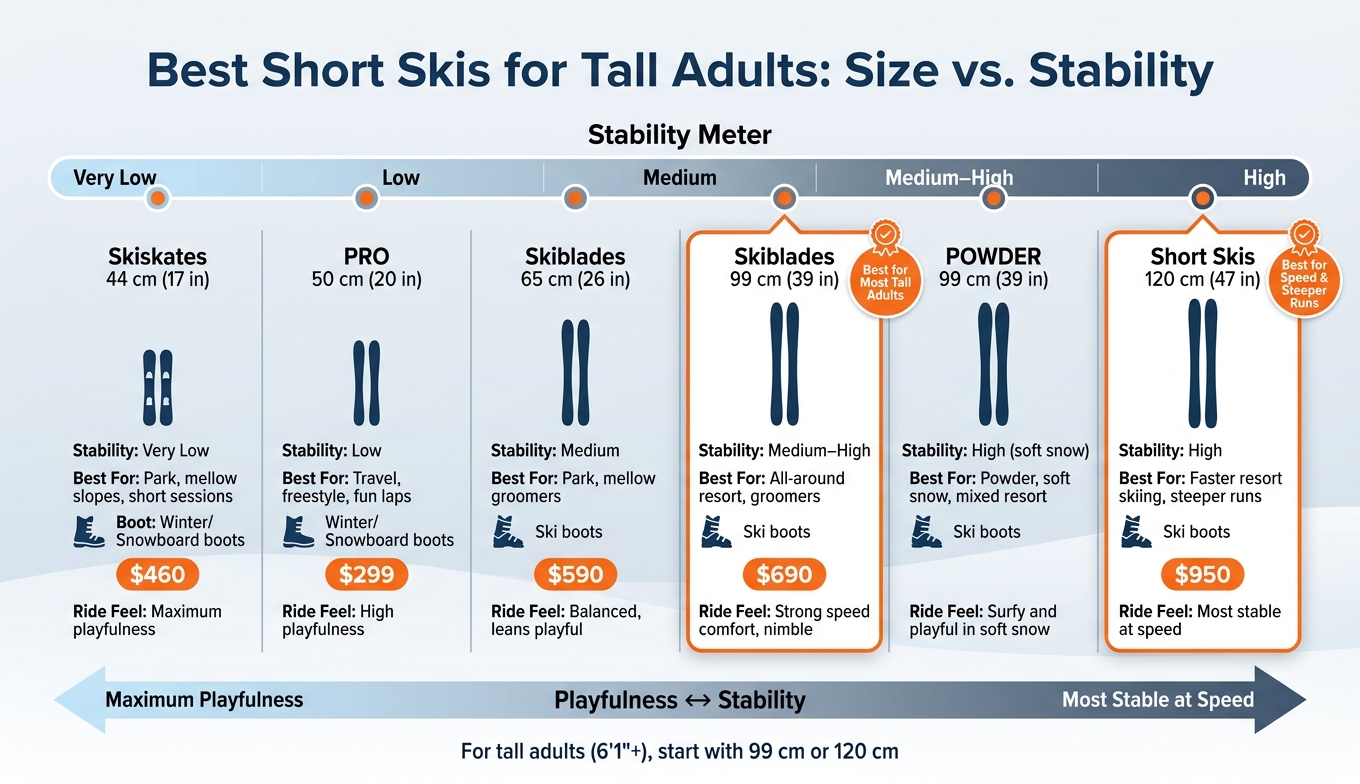
Best Short Skis for Tall Adults: Size vs. Stability Comparison
| Model | Length | Best For | Stability for Tall Adults | Boot Setup | Starting Price |
|---|---|---|---|---|---|
| Skiskates | 44 cm / 17 in | Park, mellow slopes, short sessions | Very low | Winter boots / snowboard boots / ski boots | $460 |
| PRO | 50 cm / 20 in | Travel, freestyle, fun laps | Low | Winter boots / snowboard boots | $299 |
| Skiblades | 65 cm / 26 in | Park, mellow groomers, easy turns | Medium | Ski boots | $590 |
| Skiblades | 99 cm / 39 in | Most tall adults, groomers, all-around resort use | Medium-high | Ski boots | $690 |
| POWDER | 99 cm / 39 in | Soft snow, mixed conditions | High in soft snow | Ski boots | Not listed in the article |
| Short Skis | 120 cm / 47 in | Faster resort skiing, steeper runs, more support | High | Ski boots | $950 |
So, if I were helping a tall customer in the shop, I’d keep it simple:
- Pick 99 cm if you want the safest all-around starting point
- Pick 120 cm if you want more calm underfoot
- Pick 65 cm or shorter only if portability or park riding matters more than top-end control
If you want a quick visual on how short skis ride, these YouTube links may help:
That’s the whole story in a nutshell: for tall adults, short skis can work well - but most people will be happiest on 99 cm or 120 cm. :)
1. Snowfeet* Skiblades 65 cm
At 65 cm, these Skiblades are short. No way around it. But they still ride more like a ski than a skate, which is a big deal for tall riders.
On snow, that short length means fast turn-in and easy control. The 65 cm Skiblades come with a wood core, metal edges, graphite bases, and a wide, stable shape. They also use a deep parabolic sidecut and a 4 m turn radius, so they like to pull into turns on their own. On groomed slopes, at low to mid speeds, they feel steady and fun.
Here’s the trade-off: taller riders will notice less stability at speed than with the 99 cm or 120 cm models. That shows up even more in soft snow. These work best on groomed runs and in terrain parks. In deep powder, taller and heavier riders will sink faster than they would on the 99 cm POWDER or 120 cm versions.
If your main goal is park riding, the short length plays in your favor. It makes:
- spins easier
- switch riding smoother
- quick recoveries less sketchy
The twin tips help with riding switch, and the short platform makes tricks feel less like work. So, if you want a nimble, park-ready ride, this size does the job. If you want more calm at higher speeds, better carving, or more support on steeper runs, go with the 99 cm or 120 cm models instead.
Boot fit is broad, which is nice if you don’t want gear drama :) Ski boots fit 4.5–14.5 US / 36–49 EU / 22.5–32.5 MP, and snowboard boots fit 6–14.5 US / 38–49 EU. For tall riders, ski boots give better edge control on firm snow. A pair weighs 3.79 lb with ski bindings. Price starts at $590.
If you want a bit more stability but still want that short-ski feel, the 99 cm models are the next move.
2. Snowfeet* Skiblades 99 cm
After the ultra-short 65 cm model, the 99 cm gives tall adults more of the stability they usually want. It’s the best all-around short-ski pick for a lot of taller riders: quick and easy in turns, but still steady enough to feel good under your feet. If you want solid control without jumping to full-length skis, this length lands in a sweet spot.
On groomed runs, these Skiblades feel more planted and hold an edge better at moderate speeds. No, they won’t feel like a 170–190 cm ski when you open things up. But they’re much easier to steer, and they still feel secure on groomers. That trade-off makes a lot of sense for riders who want fun handling without the extra bulk.
They also stay park-friendly. Compared with the 65 cm model, you get quicker landings and more support. In chopped-up snow, though, taller and heavier riders will start to feel the limits. That’s where the 99 cm POWDER model makes more sense. If you spend more time in softer snow, that’s the better next move.
The included bindings fit standard ski boots in EU 36–49 / US 4.5–14.5 / 22.5–32.5 MP. For tall riders, ski boots are the better call. They give you sharper edge control and more side-to-side stability, which matters more when your height puts extra leverage over the ski.
Priced from $690, the 99 cm Skiblades cost $100 more than the 65 cm model. They work well for:
- tall beginners
- casual resort riders
- park skiers
- travelers who want compact gear without giving up control
If speed and steeper terrain matter more, the 120 cm model is the better fit.
For deeper snow or more speed, step up to the 99 cm POWDER or 120 cm model.
3. Snowfeet* POWDER 99 cm
The POWDER 99 cm keeps the same 99 cm length as the standard Skiblades, but the wider shape changes how it rides. It leans more toward soft snow. And for taller riders, that extra width can matter more than length by itself.
With a 15 / 12 / 15 cm profile and a 6 m sidecut radius, it gives taller riders more float in powder and quick, snappy turns without much effort. Compared with the standard 99 cm, you give up a bit of grip on hardpack, but you get more float in return. So if you're skiing soft snow, trees, or mixed resort conditions, this is the better pick. The standard 99 cm still works better on firm groomers.
The cap construction and wood core help the ski feel more stable and smoother through turns. It won’t keep up with a longer carving ski when speeds climb, but that’s not the point here. In soft snow, tight trees, and mixed conditions, it feels sharper and more playful.
The raised tip and tail help keep the ski from diving and make fast pivots easier. That’s a big plus for tall beginners. The ski is easy to steer, and the sidecut does a lot of the work, so you don’t need perfect form to stay in control. More skilled riders get a fun setup for switch riding and freestyle.
Boot fit is the same as the standard 99 cm model. If you care more about speed, steeper runs, or firmer snow, step up to the 120 cm model.
4. Snowfeet* Short Skis 120 cm
The 120 cm Short Skis are the most ski-like pick in the Snowfeet lineup. That extra length matters, and tall riders tend to feel it right away. This is most true for people in the 6'0"–6'6" range weighing 180–250 lbs. Once speed, leverage, and edge hold start to matter, the gap becomes pretty clear.
You get a wood core, metal edges, graphite bases, a 7.8 cm waist, and rocker-camber shaping. Put all that together, and the ride feels more planted under bigger riders.
On hardpack, the longer edge carves with more confidence than the 65–99 cm models. Tall riders also get less of that twitchy feel at moderate speed, which makes sense when you think about how much more leverage a taller person puts over the ski. The added platform also works better with standard ski boots and a more classic ski stance.
It comes with pre-installed, adjustable ski bindings for standard alpine ski boots, so the setup feels familiar if you've skied in alpine boots before. Here, boot fit and DIN settings matter even more. Taller, heavier riders put more force through the binding, so this isn’t the place to wing it.
The 120 cm length sits in a nice middle ground between control and agility. It gives up some high-speed stability compared with full-length skis, but it turns faster and feels easier for bigger riders. That’s the trade-off, and for a lot of people, it’s a good one.
This is the most ski-like option here without losing Snowfeet's compact feel. It’s also the strongest match for tall adults who want more stability than the 44–99 cm models without jumping to full-length skis. At $950, it covers most of the mountain without the bulk of standard gear. If you want to go much smaller, the 44 cm and 50 cm models head the other way.
sbb-itb-17ade95
5. Snowfeet* Skiskates 44 cm
At 44 cm (17 inches), the Skiskates are the shortest model in the Snowfeet* lineup. They sit way out on the agility side of the spectrum, with much less stability than the 65 cm and 99 cm Skiblades.
For tall riders, that short length can feel a bit like standing on two very eager little rockets. There’s not much ski in front of the boot or behind it, so you have to stay on top of your balance the whole time. And when you’ve got a higher center of gravity, every small weight shift shows up fast.
These shine on groomed runs and in the park. Quick pivots, fast direction changes, and playful moves feel easy. But once you take them into powder, crust, or steep icy terrain, their weak spots show up in a hurry. You get:
- very little float
- less edge grip
- less control once speed builds
Next to the 65 cm and 99 cm models, this one leans more toward fun than day-to-day use.
The bindings fit ski boots (EU 36–49 / US 4.5–14.5) and snowboard boots (EU 38–49 / US 6–14.5). Ski boots give you better edge control. Snowboard boots feel softer and looser, which can be nice for laid-back park laps.
At $460, these make the most sense as a second setup for park runs and short sessions. If you like the compact style but want a bit more control, the PRO 50 cm is the next move.
6. Snowfeet* PRO 50 cm
At 50 cm (20 inches), the PRO is 6 cm longer than the 44 cm Skiskates. That extra length makes it a bit more stable and a bit easier to turn.
For tall adults, though, the PRO solves the carry-it-anywhere problem more than the stability problem. Snowfeet* built it with a higher tip and tail, a narrower base, and more platform height. It also has metal ski edges, which help with quick stops on groomed snow. This model sits at the far edge of the compact category, where easy packing matters more than speed.
On snow, it does best on groomers and light carving. Push it onto steeper slopes or icier patches, and stability drops off fast. For taller riders, the best way to think about it is compact, playful, and easy to carry. If you want calm control at higher speeds, this isn’t the top pick.
One of the PRO’s biggest strong points is boot fit. The universal strap-on bindings work with most winter boots and snowboard boots. Snowfeet* lists an official fit range of US sizes 6–13 / EU 38–47. One catch: US size 12–13 snowboard boots can be a tight squeeze because the straps may run short.
Compared with the Skiskates 44 cm, the PRO feels more forgiving for tall riders and gives a bit more confidence on small park features. Compared with the 65 cm and 99 cm Skiblades, it gives up a clear amount of fore-to-aft stability, edge hold, and speed range. Put plain and simple: the PRO is the most portable adult option, but it’s also the first model where taller riders will plainly feel the drop in stability.
At $299, it’s the lowest-priced adult option in the lineup. It also fits in a backpack and can go into a checked suitcase, which makes it one of the easiest models to travel with. The side-by-side comparison below shows how the PRO stacks up against the 44 cm, 65 cm, and 99 cm models.
Side-by-Side Comparison: Stability, Terrain, Boots, and Ride Feel
The table below shows which model tends to work best for tall adults based on stability, terrain, boots, and overall ride feel. If you want the short version, start with your boot setup, then look at how much speed and support you want.
| Model | Length | Ideal User | Best Terrain | Boot Type | Stability (Tall Adults) | Ride Feel |
|---|---|---|---|---|---|---|
| Skiskates | 44 cm (17 in) | Confident skaters, park riders | Gentle slopes, park | Winter boots or snowboard boots | Very Low | Maximum playfulness, poor speed stability |
| PRO | 50 cm (20 in) | Trick-focused, portable-first riders | Groomers, park, fun zones | Winter boots or snowboard boots | Low | High playfulness, moderate speed stability |
| Skiblades | 65 cm (26 in) | Beginners to intermediates, casual riders | Green/blue groomers, park | Alpine ski boots | Medium | Balanced, leans playful |
| Skiblades | 99 cm (39 in) | Intermediate to advanced, tall all-rounders | Groomers, mixed resort, light park | Alpine ski boots | Medium–High | Strong speed comfort, still nimble |
| POWDER | 99 cm (39 in) | Tall riders on soft or variable snow | Powder, soft snow, mixed resort | Alpine ski boots | High in soft snow; Medium–High on groomers | Surfy and playful in soft snow |
| Short Skis | 120 cm (47 in) | Beginners and tall adults wanting all-mountain confidence | Groomers, mixed terrain, shallow off-piste | Alpine ski boots | High | More stable at speed, still somewhat playful |
Boot type is the clearest divider. The 44 cm and 50 cm models lean hard into portability. They work with winter boots or snowboard boots, which makes them easy to pack and easy to hop into. But for tall adults, the 65 cm models and up give you better power transfer and edge control. That’s a big deal once speed picks up.
Here’s the simplest way to think about length for taller riders:
- 44–50 cm: best for low-speed fun, tricks, and messing around
- 65 cm: the first length that feels like a real step up in support
- 99–120 cm: the practical range for resort stability
So, if you’re tall and not sure where to begin, 99 cm and 120 cm are the default starting points. They make the most sense for most resort days. Go shorter only if portability or tricks matter more to you than stability.
The ride feel changes in a pretty clear way as length goes up. The 120 cm Short Skis feel the closest to regular skis. The 99 cm models hit that sweet spot between stability and agility. The 65 cm Skiblades lean more playful. And the 44 cm and 50 cm models are mostly about tricks and low-speed fun.
That trade-off gets much easier to judge in the pros and cons below.
Pros and Cons for Tall Adults
Use this summary to match ski length to how you’ll ski most often. Then look at the trade-offs and pick the one that fits your style best.
For most tall adults, 99 cm is the default. 120 cm is the safest pick for speed and steeper terrain. 44–65 cm are more niche options.
| Model | Biggest Pros | Biggest Cons | Best Fit |
|---|---|---|---|
| Short Skis 120 cm (47 in) | Most stable at speed; best edge control; feels closest to a standard ski; supports heavier riders better | Least easy to pack for travel; loses some of the skate-like quickness of shorter models | Main ski for all-day resort use |
| Skiblades 99 cm (39 in) | Nice middle ground between agility and stability; strong edge contact; easy to start turns on groomers | Less stable on icy or very steep runs; less float in deep snow than the POWDER version | Main ski for groomed resort days |
| POWDER 99 cm (39 in) | Wider shape adds float in soft snow; surfy, playful feel in powder and mixed conditions | Slightly less sharp on firm hardpack than the narrower 99 cm; still short for hard charging at high speed | Main ski for soft-snow and mixed conditions |
| Skiblades 65 cm (26 in) | Very easy to turn; easy to pack; great for tight turns on mellow runs | Limited front-to-back stability at speed; less confidence on steeper terrain | Backup for easy runs and travel |
| Skiskates 44 cm (17 in) | Ultra-portable; works with regular winter boots; fun for short, low-speed sessions | Very little edge length; less stable at speed; steeper learning curve for riders with a higher center of gravity | Mellow hills and short sessions only |
| PRO 50 cm (20 in) | More support than the 44 cm model; works with winter shoes or snowboard boots; better for park and freestyle | Too short for all-day resort stability; needs strong balance and core control | Portable freestyle and park tool |
A simple way to think about it: 120 cm is the calm, planted option. 99 cm is the do-most-things pick. 44–65 cm models are more like fun side tools than your go-to setup for a full resort day.
With the trade-offs laid out, the conclusion below gives the fastest path to the right length for your height, weight, and terrain.
Conclusion
Tall adults don’t need long skis. Pick your length based on speed, terrain, and confidence.
Once you look at stability, terrain, and boot fit, the choice gets pretty simple.
- Tall beginner: Start with the Snowfeet* Skiblades 99 cm. Move to 120 cm if you want more speed and more support, especially if you’re taller or heavier.
- Tall casual resort skier: Choose the Short Skis 120 cm for all-day resort use. Go with the 99 cm Skiblades if you ski at a slower pace and want a more playful feel.
- Tall park rider: Pick the Skiblades 99 cm for a solid short-ski park setup. If you’re an experienced rail rider, the 65 cm model is worth a look. Add the POWDER 99 cm only if you also want soft-snow range.
- Tall traveler: The PRO 50 cm and Skiskates 44 cm are portable specialty picks, not full-day resort skis. If you want actual resort performance while traveling, a 99 cm or 120 cm model in a compact ski bag is still way easier to carry than long skis.
For steep, fast, or icy runs, 99 cm and 120 cm are the safest bets. The 44–65 cm range asks for more balance and a steadier touch.
Snowfeet* gives tall adults a rare mix of portability, control, and size-specific options. So, the best length is the one that fits how you ski in the real world, not what old-school ski charts say :)
FAQs
Are short skis harder for tall adults to learn on?
Usually, no. Short skis are often easier for tall adults to learn on than longer, old-school skis. Snowfeet short skis tend to feel more natural and a bit more like skating, which can help people build confidence and control faster.
For taller riders, slightly longer short-ski options like 99 cm or 120 cm can give you better stability and weight distribution without losing that easy, nimble feel.
How much does my weight matter when choosing 99 cm vs. 120 cm?
Your weight matters a lot here. If you’re a heavier rider, 120 cm is usually the better pick. That extra surface area helps with float, adds stability, and gives you a smoother ride.
99 cm gives you a nice mix of agility and control. But for heavier riders, 120 cm can help stop the tip from sinking in softer snow and give the board a more stable, supported feel.
Can I use snowboard boots instead of ski boots?
Yes. Snowboard boots work with most Snowfeet* models, and a lot of riders like them for one simple reason: they feel better on your feet.
They fit almost all Snowfeet* skiskates and skiblades. The one exception is the 120 cm model. That model needs standard alpine ski boots for safety at higher speeds.
Snowboard boots also give you more natural flex. And when you’re off the slope, they’re much easier to walk in. That’s a big plus if you don’t want to clomp around like a robot :)











댓글 남기기
이 사이트는 hCaptcha에 의해 보호되며, hCaptcha의 개인 정보 보호 정책 과 서비스 약관 이 적용됩니다.