



















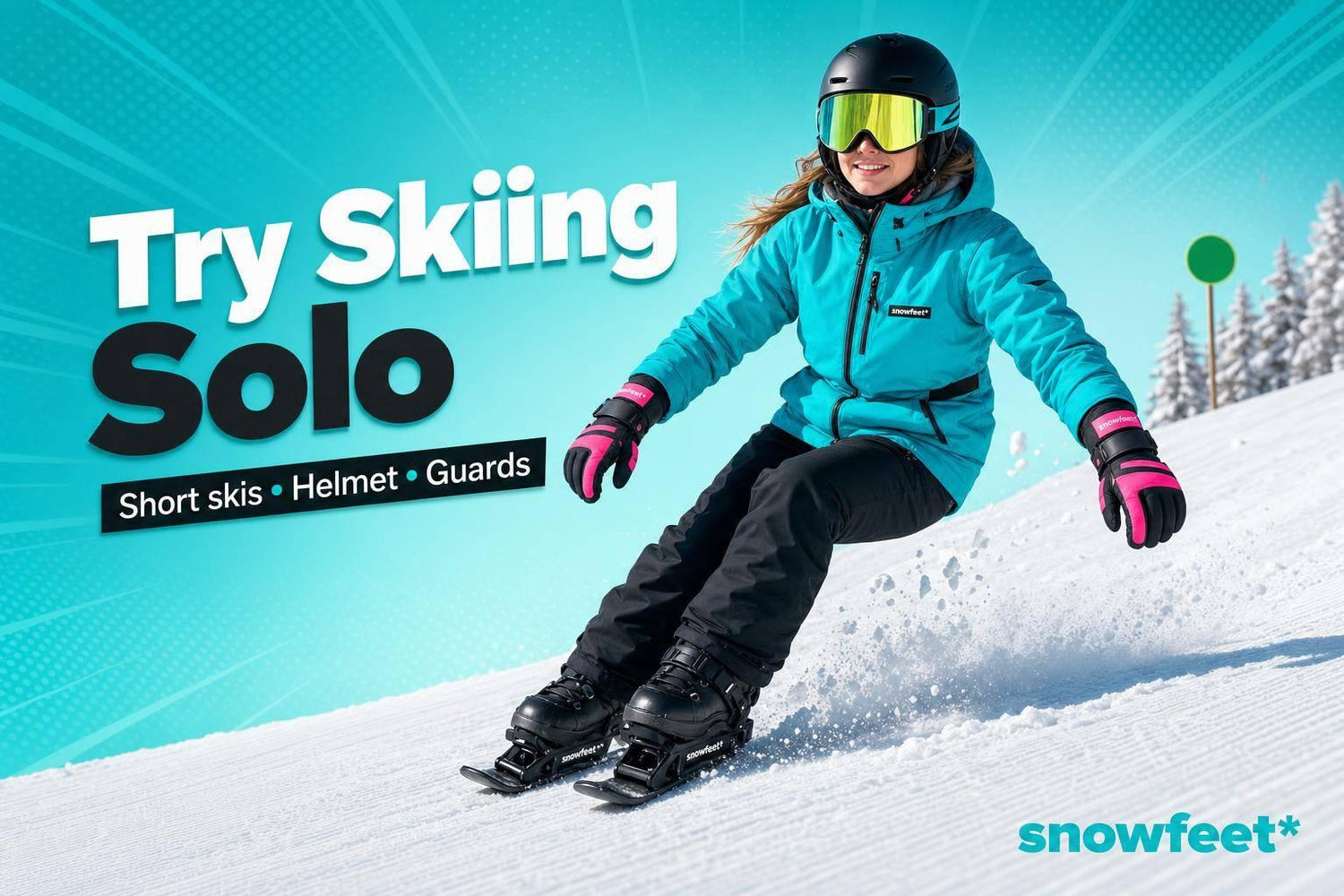
If I were helping a first-timer skip lessons, I’d keep it simple: use short skis, wear a certified helmet, add wrist guards, and stay on a green run. That setup won’t make skiing risk-free, but it can make day one feel less awkward and less intimidating.
Here’s the short version:
- Best for complete beginners: Snowfeet* PRO Ski Skates 50 cm from $299
- Best if you want more of a ski feel: Snowfeet* Skiblades 65 cm from $590
- Best for skaters: Snowfeet* Skiskates 44 cm from $460
- Best for more stability: Snowfeet* Skiblades 99 cm from $690
- Must-have safety gear: helmet, wrist guards, goggles, waterproof gloves, and the right boots
- Best terrain for day one: wide, groomed green runs or bunny slopes
- Big watch-out: all Snowfeet* models here use non-release bindings, so the ski stays on in a fall
A lot of beginners struggle with long skis because there’s more ski in front of and behind the boot. That can make turning, stopping, and staying balanced feel harder. Short skis and ski skates cut that down. In plain English: they’re often easier to turn and less scary at low speed.
Are Short Skis Better for Beginners?
My quick take
If you want the easiest start, I’d look at these in this order:
- Snowfeet* PRO 50 cm - lowest barrier to entry, works with winter boots or snowboard boots, has a heel brake
- Snowfeet* Skiblades 65 cm - best middle ground for learning skiing basics
- Snowfeet* Skiblades 99 cm - more support underfoot, closer to full-size skis
- Snowfeet* Skiskates 44 cm - fun and nimble, but best if skating already feels natural to you
Quick Comparison
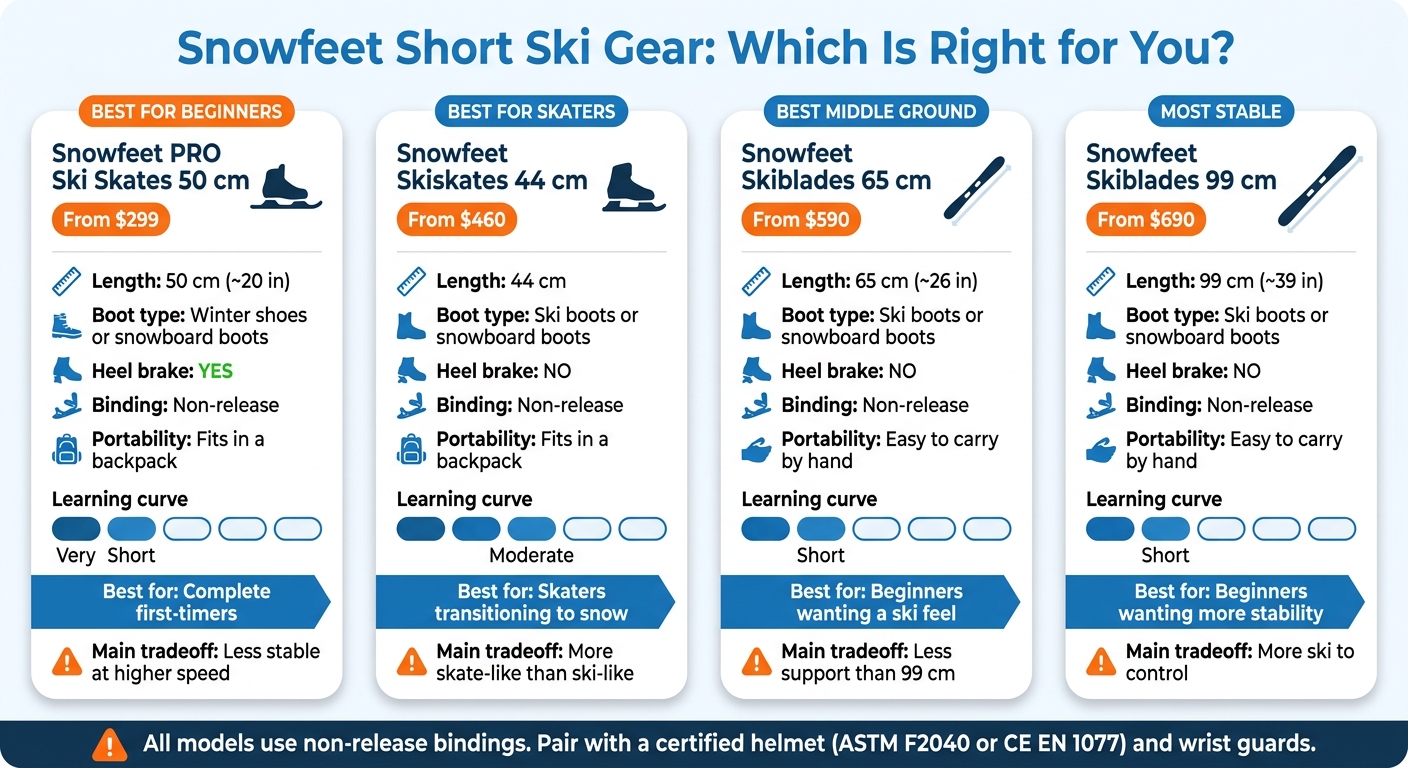
Snowfeet Short Ski Gear Comparison for Beginners
| Gear | Starting Price | Best For | Boot Options | Main Tradeoff |
|---|---|---|---|---|
| Snowfeet* PRO 50 cm | $299 | First-timers | Winter boots or snowboard boots | Less stable at higher speed |
| Snowfeet* Skiskates 44 cm | $460 | Skaters | Ski boots or snowboard boots | More skate-like than ski-like |
| Snowfeet* Skiblades 65 cm | $590 | Beginners who want a ski feel | Ski boots or snowboard boots | Less support than 99 cm |
| Snowfeet* Skiblades 99 cm | $690 | Beginners who want more stability | Ski boots or snowboard boots | More ski to control |
What I’d tell a friend before they go
- Don’t go out with just the skis
- Buy a helmet with ASTM F2040 or CE EN 1077
- Add wrist guards
- Use goggles, not just sunglasses
- Keep your speed low
- Practice stopping before you head farther down the hill
So, if your goal is a fun first day - not carving like a movie hero by lunch - short Snowfeet* gear is the easier place to start. Long skis still win for speed, steeper terrain, and hard carving. But for a low-pressure intro, short gear makes more sense :)
If you want, I can also turn this into a buying guide, a product roundup, or a pros-and-cons list.
What Beginners Should Know Before Teaching Themselves to Ski
Short skis and ski skates can feel a lot easier for beginners. The main reason is simple: they reduce leverage. With less ski sticking out in front of and behind your boot, you’re less likely to catch an edge, cross your skis, or get pushed into a turn you didn’t mean to make. The movement also feels closer to skating than standard skiing. So if you’ve done inline skating or ice skating, it may click faster. A lot of beginners feel at ease within minutes on a gentle slope.
Before you pick your gear, start with the right conditions. This part matters more than people think. If you’re teaching yourself, stay on wide, groomed green runs with soft or packed snow. Skip icy patches, moguls, crowded trails, and steep sections until you can stop with control.
A simple way to start:
- Begin on the flattest part of the run
- Slide a few feet
- Turn across the hill to slow down
- Move to longer stretches only after stopping feels steady
For gear, wear a ski/snowboard helmet and fasten the chin strap. In the U.S., look for ASTM F2040. In Europe, look for CE EN 1077. Goggles should block UV rays and help with wind and glare. Wrist guards are a smart add-on too, since beginners often put their hands out during a fall. Insulated waterproof gloves or mittens will help keep your hands warm and dry.
After helmet and eye protection, the next big choice is boots and bindings. And yeah, this part can feel a bit wonky at first. Ski boots give you the most control. Snowboard boots tend to feel warmer and more comfortable. Waterproof winter boots feel familiar, but they transfer the least power to the ski.
If you use standard skis with release bindings, have a shop check the fit and release settings. That check is worth it. Snowfeet* short-gear models use non-release bindings, so the ski stays attached in a fall instead of popping off like a standard alpine binding.
Very short platforms also cut down leverage, which lowers the force during a fall. At low speed, that often means a slide or a sit-down instead of a hard twisting crash. Keep your speed low, stay on mellow terrain, and keep your knees slightly bent so they can soak up bumps. That’s why the shortest Snowfeet* options come first.
1. Snowfeet* Skiskates 44 cm
Starting price: from $460 | View on Snowfeet*
At 44 cm, Snowfeet* Skiskates are the shortest option in the lineup. That makes them the easiest to handle on a first run. They feel more like skating than classic skiing, so quick turns and slow-speed control tend to feel more natural for beginners. If you want the shortest and most nimble pick, this is the one.
The setup is simple, too. They fit ski boots in US sizes 4.5–14.5 and snowboard boots in US sizes 6–14.5. The bindings adjust without tools, which is nice when you just want to get on the snow and go.
They’re easy to carry as well. Their compact size fits in a standard backpack, which is pretty handy if you hate lugging around long skis. The build uses a certified sustainable wood core, full metal steel edges, and a graphite/sintered base.
These work best on groomed or packed snow at low to moderate speeds. Powder, steep terrain, and fast carving aren’t their thing. So, they make a smart starter choice for cautious beginners, not for people chasing speed.
If you want a bit more length and more stability, the 65 cm Skiblades are the next step up.
2. Snowfeet* Skiblades 65 cm
Starting price: from $590 | View on Snowfeet*
If the 44 cm Skiskates feel a bit too much like skates, the 65 cm Skiblades sit right in the sweet spot. At 65 cm (26 inches), they’re long enough to give you real glide and more of that classic skiing feel. But they’re still short enough to stay quick, light, and easy to turn.
That shorter length matters a lot for new riders. They tend to feel less intimidating than full-size skis, which can make those first runs a lot less nerve-racking.
Bindings adjust without tools. The ski boot version fits US sizes 4.5–14.5, and the snowboard boot version fits US sizes 6–14.5.
With ski bindings, the pair weighs about 3.79 lbs, so carrying them through the lodge won’t feel like a gym workout.
They work best on groomed slopes and gentle runs. For beginners, 65 cm gives a nice mix of stability and quick turns.
If you want a bit more stability, the 99 cm Skiblades are the next step up.
3. Snowfeet* Skiblades 99 cm
Starting price: from $690 | View on Snowfeet*
The 99 cm Skiblades are a smart next move if the 65 cm model feels a bit too short, but full-length skis still sound like too much. At 99 cm, or about 39 inches, they’re far shorter than standard adult skis, which usually land in the 150 to 180+ cm range. That said, they still give you more edge contact and better tracking than the 65 cm or 44 cm models.
That extra length makes a difference. On groomed runs, they help you stay on a straighter line. They also make wedge turns and early parallel turns easier to work on by yourself. So if you’re learning and want a bit more support under you, this size hits a nice middle ground.
The build is beginner-friendly too. You get a certified sustainable wood core, a wood core, metal edges, and a graphite base for durability and cleaner turns. There’s also a sidecut and twin tips, which help make turning easier and let you ride in both directions.
Boot fit is pretty flexible:
- Ski-boot bindings fit US sizes 4.5–14.5
- Snowboard-boot bindings fit US sizes 6–14.5
That matters more than it may seem. A lot of beginners find snowboard boots more comfortable, so having that option is a nice perk. And compared with full-length skis, these are still much easier to carry, stash in the car, or store at home.
They work best on groomed runs, where they feel quick and responsive. If you want something even shorter and more skate-like, the 50 cm PRO model is the next one to look at.
| Feature | Snowfeet* Skiblades 99 cm | Traditional Skis |
|---|---|---|
| Length | 99 cm (about 39 in) | Typically 150–180+ cm |
| Portability | High - easy to carry and store | Lower - often needs a ski bag or roof rack |
| Learning curve | Short - easier for beginners | Longer |
| Boot options | Ski boots or snowboard boots | Ski boots only |
| High-speed stability | Moderate | Higher, especially at very high speeds |
4. Snowfeet* PRO Ski Skates 50 cm
Starting price: from $299 | View on Snowfeet*
If the 99 cm Skiblades feel like a bit much for day one, the PRO 50 cm is the smaller, easier pick. At 50 cm (about 20 in.), it’s compact, simple to carry, and has the lowest learning curve in the lineup.
For a lot of beginners, the skating-style motion feels natural right away. That shorter shape also helps cut down on crossed tips, which is a common reason people fall on long skis. And compared with the 44 cm model, the PRO gives you a little more balance and makes turns easier to start.
One nice part? The integrated bindings work with standard waterproof winter shoes or snowboard boots in US 6–13 / EU 38–47, so you don’t need stiff ski boots. On groomed resort runs, snowboard boots are the better bet because they give your ankles more support. For hiking trails or sledding hills, regular winter boots are a handy option.
This is the most stripped-down choice in the lineup, which can be a good thing when you want less gear drama and more time on snow :)
The build comes with full metal ski edges for grip and a built-in heel brake to help you slow down and stop. Before your first run, pair it with a certified helmet and wrist guards.
| Feature | Snowfeet* PRO 50 cm |
|---|---|
| Length | 50 cm (about 20 in.) |
| Edges | Full metal ski edges |
| Boot compatibility | Winter shoes or snowboard boots |
| Size range | US 6–13 / EU 38–47 |
| Safety features | Metal edges, built-in heel brake |
sbb-itb-17ade95
5. Certified Snow Sports Helmet
Price range: ~$40–$70 (budget) | $80–$150 (mid-range) | $150–$250+ (premium)
Buy a certified helmet first. After short skis, this is the next piece of gear you shouldn’t skip. New skiers fall in odd, hard-to-predict ways, so head protection matters on every run. Short skis can make falls less harsh, but they don’t replace a helmet.
Look for ASTM F2040 in the U.S. or CE EN 1077 in Europe. Those labels mean it’s a snow-sports helmet, not just any helmet with a winter vibe.
Once certification is covered, fit is what matters most. The helmet should:
- Sit level and low on your forehead
- Feel snug, but not painfully tight
- Stay put when you shake your head
- Work well with your goggles, with no big gap
Price matters less than fit. A $60 helmet that fits well is a better pick than a pricey one that slides around. Simple, but huge.
If you want extra protection, look for MIPS. It helps cut twisting forces in angled falls, which are common for beginners. A light in-mold or hybrid helmet with an adjustable fit system often feels best when you're starting out. And skip used helmets with an unknown crash history. Even if one looks fine, past impact damage can weaken how well it protects you.
Next, protect your wrists, since beginners often reach out during falls.
6. Wrist Guards for Snow Sports
Beginners often throw their hands out when they fall. That’s why snow-specific wrist guards are the better pick. They’re slimmer than skate-style guards, so they slide under ski gloves or mittens with less hassle.
This matters even more with short Snowfeet* gear, which turns fast and can feel a bit twitchy at first. If you want a few solid options, Dakine, Burton, and Demon all make snow-sports wrist guards.
Next up: goggles that block glare and wind without fogging up.
7. OTG or Beginner-Friendly Ski Goggles
Wind, glare, and snow spray can make a first day on skis feel tougher than it should. Goggles help a lot. They shield your eyes from wind, glare, snow spray, and UV on early runs. Fresh snow can bounce back a lot of UV, even when the sky looks gray and cloudy. And unlike sunglasses, goggles seal around your eyes and stay put if you take a tumble. For beginners, that alone is a big win.
After that, fit and lens color are the main things to watch.
If you wear prescription glasses, go with OTG goggles, short for over-the-glasses. These have extra room inside and cutouts at the temples, so your glasses sit better and don’t get jammed into your face. It’s a small detail, but on the hill it makes a big difference.
Lens tint also matters more than people think:
- Amber, yellow, or rose lenses help boost contrast in flat or overcast light
- Gray or brown lenses help cut glare on sunny days
- Photochromic lenses adjust on their own as light shifts
Nice lens tech is great, but fog control is just as big on a first run. A fogged-up goggle is like trying to ski through a steamed-up bathroom mirror. Not fun.
Entry-level goggles usually cost about $20 to $60. OTG models often cost more because they need extra space for glasses. One tip here: don’t wipe the inside of the lens. That can mess up the anti-fog coating. If your goggles fog up, let them air-dry instead.
With your eyes covered, the next priorities are warm hands and dry feet.
8. Insulated Waterproof Gloves or Mittens
Cold, wet hands can wreck a first ski day in a hurry. And beginners hit the snow more often, so your hands end up in it a lot while you stand up, fix gear, or catch your balance.
Go for a waterproof shell with synthetic insulation like Thinsulate or PrimaLoft. Synthetic fill stays warmer when damp and dries faster than down.
Here’s the simple split:
- Gloves give you more finger movement for zippers, buckles, and straps.
- Mittens are warmer since they keep your fingers together and hold heat better.
So, gloves make sense in milder weather, while mittens are the better pick when it’s colder.
A few small features make a big difference. Look for long gauntlet cuffs to block snow, wrist leashes so you don’t drop them off the lift, and a snug fit with about 1/4 inch of space at the fingertips.
For price, plan on about $20 to $80 for a good beginner pair.
Next, the right boots matter just as much, because they shape how well your movements transfer to the snow.
9. Waterproof Boots or Binding-Compatible Ski and Snowboard Boots
Boots come right after your helmet, goggles, and gloves for one simple reason: they decide which Snowfeet* setup you can use. Get this part right, and your first day on snow gets a whole lot easier.
Snowfeet* PRO 50 cm works with regular waterproof winter boots. Go for boots with a firm sole and solid ankle support. Skip soft fashion boots. They may look nice in the parking lot, but on snow? Not so much. In the U.S., basic insulated waterproof winter boots usually cost $80 to $150. Nice bonus: you can wear them off the slopes too.
For Skiskates 44 cm, Skiblades 65 cm, and Skiblades 99 cm, you’ll need snowboard boots or ski boots. For most beginners, snowboard boots are the easier pick. They’re warmer, easier to walk in, and give you a nice mix of comfort and support while you learn. Entry-level snowboard boots in the U.S. usually cost about $150 to $250. One thing to watch: if you wear a U.S. size 12–13, check that your boot isn’t too bulky for the straps.
Traditional alpine ski boots give you the most precise control, which helps if you want to carve harder or ride at higher speeds. They’re less fun to walk in, though - let’s be honest, ski boots have all the charm of moon boots in a hardware store. Entry-level pairs usually cost $250 to $400 in the U.S.. They make the most sense for the 65 cm or 99 cm Skiblades if you want a feel closer to regular skiing.
So, the choice is pretty simple: match the boot to the Snowfeet* model.
| Boot Type | Compatible Snowfeet* Models | Typical U.S. Price |
|---|---|---|
| Waterproof winter boots | PRO 50 cm | $80–$150 |
| Snowboard boots | 44 cm, 50 cm, 65 cm, 99 cm | $150–$250 |
| Traditional ski boots | 44 cm, 65 cm, 99 cm | $250–$400 |
With boots sorted, the next question is how short Snowfeet* gear stacks up against full-length skis.
How Short Snowfeet* Gear Compares With Long Skis
Now that boots and gear are out of the way, here’s the big comparison: short Snowfeet* setups vs. full-length skis.
The short version? Short gear is easier for first runs. Long skis are better for speed and hard carving.
On groomed runs, turning with ease matters more than going fast. That’s where Snowfeet* stands out. Short Snowfeet* gear takes less effort to turn than full-length skis. The 44 cm models feel the most like skating. The 65 cm and 99 cm options bring a bit more ski-like stability.
That trade-off matters a lot. Short models tend to feel less intimidating on day one. Full-length skis start to make more sense as speed picks up and edge control becomes a bigger deal.
Long skis still have the upper hand in two big areas:
- Stability at higher speeds
- Edge hold on steeper, icier terrain
Snowfeet*, on the other hand, is lighter, easier to carry, and simpler to use. Long skis are bulkier and ask more from the rider. So if the goal for a first run is control, not speed, Snowfeet* is the easier pick.
The table below shows the trade-offs at a glance.
| Feature | Skiskates / PRO (44–50 cm) | Skiblades (65–99 cm) | Full-Length Skis |
|---|---|---|---|
| Turning effort | Very low - skate-like | Low - responsive carving | Higher - requires more technique |
| Stability at speed | Low | Moderate | Highest |
| Portability | Fits in a backpack | Easy to carry by hand | Bulky and less convenient to transport |
| Setup complexity | Tool-free, adjustable | Tool-free, adjustable | Requires professional mounting and adjustment |
| Best for beginners on groomed runs | ✓ Fun, low-pressure learning | ✓ Closest to traditional skiing | Better once skills develop |
For a first self-guided day on snow, Snowfeet* is the easier and less intimidating choice.
Gear Comparison Tables
If you want the fastest way to choose, use the tables below.
Compare the four Snowfeet* options below to pick the easiest first-day setup.
| Feature | Snowfeet* Skiskates 44 cm | Snowfeet* PRO Ski Skates 50 cm | Snowfeet* Skiblades 65 cm | Snowfeet* Skiblades 99 cm |
|---|---|---|---|---|
| Price (from) | $460 | $299 | $590 | $690 |
| Binding type | Non-release (ski or snowboard) | Non-release (universal) | Non-release (ski or snowboard) | Non-release (ski or snowboard) |
| Compatible footwear | Ski boots or snowboard boots | Winter shoes or snowboard boots | Ski boots or snowboard boots | Ski boots or snowboard boots |
| Heel brake | No | Yes | No | No |
| Portability | Fits in a backpack | Fits in a backpack | Easy to carry | Easy to carry |
| Learning curve | Moderate - easiest for skaters | Very short - easiest for true beginners | Short - the sweet spot for learning | Short - the most stable of the four |
| Best for | Skaters making the jump to snow | Complete first-timers | Beginners wanting a ski-like feel | Athletic beginners who want the most stable short-ski option |
A quick read on that table: if you want the lowest-friction start, the Snowfeet* PRO Ski Skates 50 cm stand out. If you want something that feels more like skiing, the 65 cm Skiblades are a nice middle ground. And if stability is your top concern, the 99 cm Skiblades give you the most support of these four.
Next, compare Snowfeet* with generic short skis and long skis on the stuff that matters most on day one.
| Category | Snowfeet* Short Gear (44–99 cm) | Generic Short Skis | Traditional Long Skis |
|---|---|---|---|
| Learning curve | Very short - easier to pick up quickly | Varies widely by brand and model | Steep without instruction |
| Turning effort | Low - responsive and forgiving | Low to moderate | Higher - requires more technique |
| Portability | Backpack to hand-carry | Hand-carry | Bulky - needs a ski bag or roof rack |
| Boot flexibility | Winter shoes, snowboard boots, or ski boots | Usually ski or snowboard boots | Requires dedicated ski boots |
| Good for day one? | Yes | Sometimes - depends on the model | Not ideal without lessons |
| Good at higher speeds? | No | Partial | Yes |
This is where the tradeoff gets plain. Short gear is easier to handle and way less of a hassle to carry. Long skis come into their own once speed and technique enter the picture, but they’re not always the friendliest place to start.
For safety, here’s how non-release and release bindings change the gear you need.
| Non-Release Bindings (all Snowfeet* models) | Release Bindings (traditional long skis) | |
|---|---|---|
| Skis detach in a hard fall? | No | Yes - when correctly adjusted |
| Requires professional adjustment? | Usually not | Yes - critical for injury prevention |
| Compatible footwear | Winter shoes, snowboard boots, or ski boots | Dedicated ski boots only |
| Essential gear pairing | Certified helmet, wrist guards, goggles, insulated waterproof gloves, and sturdy waterproof boots with ankle support | Certified helmet, beginner-friendly goggles, insulated waterproof gloves, and properly fitted ski boots |
| Strongly recommended extras | Knee/hip padding for beginners | Wrist guards optional |
| Best terrain for DIY learning | Gentle groomed slopes, wide beginner hills, green runs | Resort green runs with clear signage only |
| Recommended protection emphasis | Wrists and head - forward and sideways falls are common | Knees and ankles - release bindings reduce but don't eliminate leg injury risk |
One point matters more than it may seem at first glance: with non-release bindings, the ski stays attached in a fall. That means your setup, your speed, and your terrain choice all matter a lot more. Gentle slopes are your friend here. No hero moves on day one :)
Shorter skis reduce the lever force on the knee joint during a fall, which is one reason they’re often suggested for less skilled recreational skiers. But with non-release bindings, that doesn’t mean you can get sloppy. The ski stays on your feet, so sticking to gentle terrain and low speeds is the smart play on day one.
Final Takeaway
After looking at the options above, the best pick for most first-timers is pretty clear: short Snowfeet* models, a certified helmet, and wrist guards.
Once you’ve picked your skis, protect the spots beginners tend to hit first. A certified helmet and wrist guards aren’t optional. Add goggles, insulated waterproof gloves, and well-fitting waterproof boots, and you’ve got a setup that helps you stay warm, see well, and keep your footing.
Start on wide, groomed bunny slopes or green runs. Work on wide, deliberate turns to keep your speed in check. Go slow until stopping feels automatic.
After safety and control, the big tradeoff comes down to ease of learning vs. speed. Long skis still come out ahead for speed, steep terrain, and hard carving.
Pick the Snowfeet* setup that fits your comfort level, gear up, and begin on the easiest slope you can find. For self-taught beginners, Snowfeet* is the easiest way in. Long skis usually make more sense later.
FAQs
Are short skis really easier than regular skis?
Yes. Short skis and skiskates are usually easier to learn on than long, standard skis.
Why? They’re short, light, and a lot less intimidating. That makes turning, stopping, and moving around feel more natural, especially when you’re just starting out.
Long skis still have their place. They tend to do better at higher speeds and in deep powder. But if your goal is to learn fast and have fun without feeling like you’ve strapped on two fence posts, Snowfeet short skis often give you a smoother start.
For beginners, the 65 cm or 99 cm Snowfeet Skiblades are the best pick. They offer more stability than the 44 cm Skiskates, which can feel a bit twitchier for first-timers.
Which Snowfeet* model is best for my first day?
Snowfeet Skiblades 65 cm* are the best pick for your first day. They hit the sweet spot: stable, forgiving, and easy to turn. For beginners, that makes a big difference.
The 44 cm Skiskates and 50 cm Snowfeet PRO are fun if you want something small, easy to carry, and trick-friendly. But they ask more from your balance, and they’re tougher to learn on.
The 65 cm Skiblades, on the other hand, feel steadier under your feet and easier to control than long, old-school skis. That means less fighting the gear and more time getting the hang of it :)
Can I use regular winter boots with Snowfeet*?
Yes - some Snowfeet* models work with regular winter boots, which makes them a handy swap for stiff ski boots.
The Snowfeet PRO 50 cm* and 38 cm models are built for standard waterproof winter shoes with secure ankle support. That means you can skip the usual hard-shell ski boot setup. Nice, right? :)
The 44 cm Skiskates and 65 cm Skiblades are a bit different. These models usually need snowboard boots, which still feel more flexible and easier on your feet than rigid ski boots.











댓글 남기기
이 사이트는 hCaptcha에 의해 보호되며, hCaptcha의 개인 정보 보호 정책 과 서비스 약관 이 적용됩니다.