



















Yes - but only if they solve a clear problem for you. If you want faster direction changes in trees, moguls, lift lines, or park laps, skiblades can make sense. If you care most about high-speed stability, deep powder, or long groomer carves, I’d stick with a snowboard.
Here’s the short version:
- Best fit: snowboarders who want a second setup for tight terrain and playful resort laps
- Not the best fit: riders who chase powder days, icy steeps, or top-end speed
- Easiest entry point: short models that work with snowboard boots
- Best all-around pick for most riders: 99 cm
- Best for park and tight spaces: 65 cm
- Best low-commitment test: 44 cm
- Best if you want more ski-like control: 120 cm
A few numbers help frame it:
- Skiblades in this lineup run from 44 cm to 120 cm
- Some models fit snowboard boot sizes from about U.S. men’s 6 to 14.5
- Prices in the article range from $460 to $950
So, my honest take is simple: skiblades are worth it as a side tool, not as a full board replacement. They shine in places where a snowboard can feel long, awkward, or annoying to shuffle around. Think of them as the fun spare key in your pocket, not the truck you use every day :)
Quick Comparison
| Option | Best for | Main downside |
|---|---|---|
| Snowboard | Speed, powder, carving | Harder in tight spots |
| Skiskates 44 cm | Travel, short laps, playful feel | Least stable at speed |
| Skiblades 65 cm | Park, quick turns, narrow terrain | Weak on fast or rough runs |
| Skiblades 99 cm | Mixed resort use, better balance | Less compact |
| POWDER 99 cm | Softer snow | Less ideal on firm groomers |
| Short Skis 120 cm | Most control in this group | Bigger, heavier, costs more |
If I already owned a snowboard, I’d buy skiblades only for one of three reasons:
- I ride tight terrain a lot
- I want a playful second option
- I don’t want to buy ski boots just to try something new
That’s the whole story up front. The rest is just matching the right length to how and where you ride.
Snowboarder tries Snowfeet* | Which Snowfeet* Short Ski is the Best? | Snowblades 44, 65, 99 Review
Why snowboarders look at skiblades in the first place
A lot of snowboarders start eyeing skiblades for one simple reason: a snowboard can feel limiting when the mountain gets tight or crowded.
That usually shows up in the same spots over and over:
- Flat traverses
- Choke points
- Lift lines
- Moguls
- Tree runs
On a snowboard, you're working with one wide platform set sideways. That's great on open groomers and smooth carves. But in packed resort traffic or narrow terrain, that same setup can start to feel like you're driving a long van through a cramped parking garage. At that point, many riders start looking for something shorter, snappier, and easier to redirect.
Better maneuverability in moguls, trees, and crowded runs
A snowboard gives you one wide platform, which works well on open runs. In tighter spaces, though, it can fight you a bit.
In moguls, for example, a board tends to push you into longer turns when what you want is a fast, small correction. In trees and narrow catwalks, changing direction at the last second takes more effort. That’s where shorter gear starts to make a lot of sense.
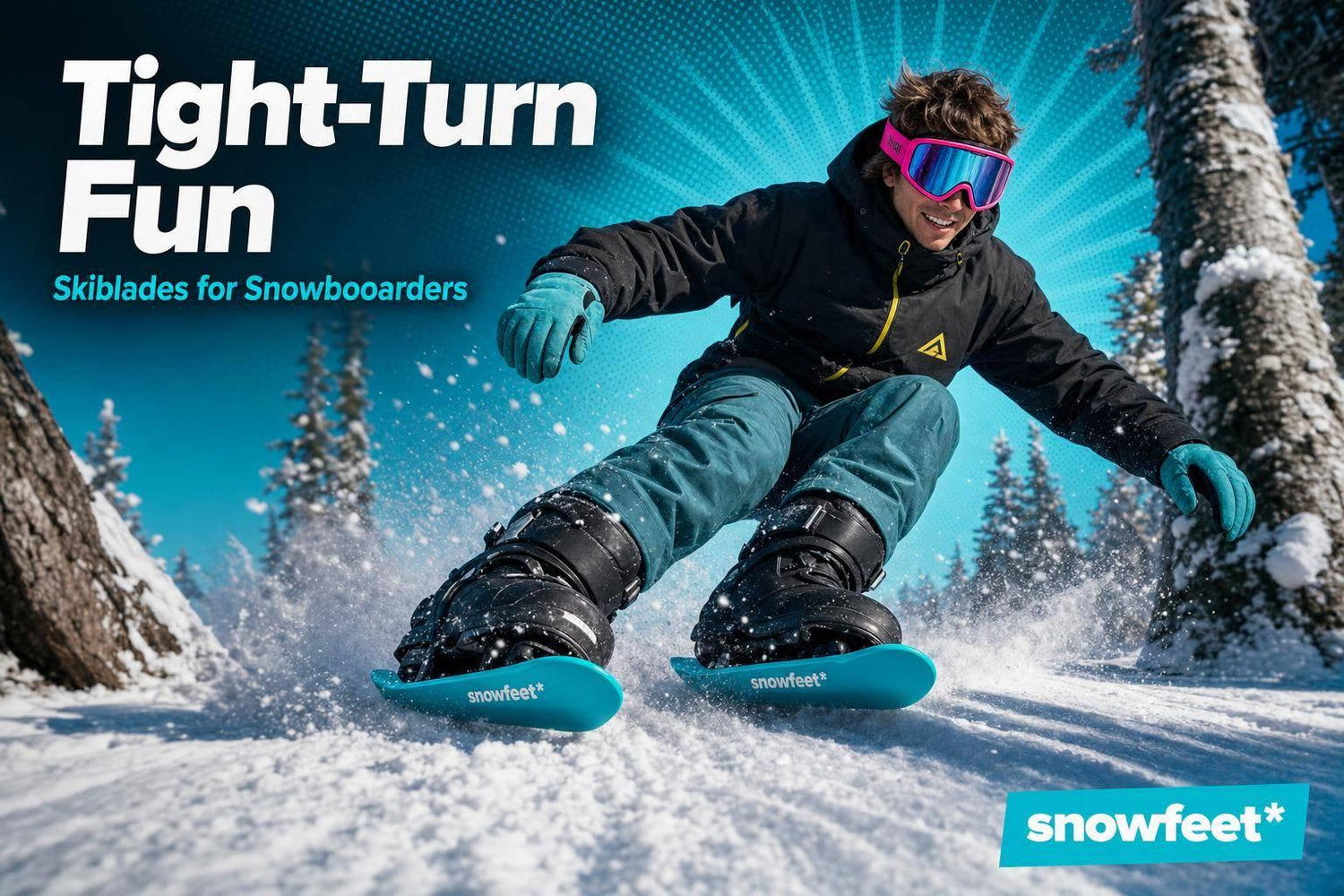
Snowfeet* Skiskates (44 cm) and Skiblades (65 cm) take that quick-move feel even further. 180° spins, sharp redirects, and stop-and-go movement feel much easier in busy resort zones, lift lines, and park traffic. If a snowboard can sometimes feel like a big brushstroke, these feel more like a fine-tip marker.
An easier way to pick up a second snow sport
A lot of snowboarders are curious about skiing, but they don’t want the whole “begin from zero” experience. Fair enough.
Skiblades lower that barrier. They’re shorter, feel less intimidating, and usually come with a gentler learning curve. There’s less chance of crossing ski tips, and they don’t feel as awkward at moderate speeds. That alone can make the switch feel less like homework and more like fun.
Most snowboarders already have a feel for weight shifts and edge control, so moving to two-edge riding on short skis can click fast, often within a few runs. It tends to feel more like a quick crossover than a full reset. For riders who want to try a second snow sport without swapping their whole identity on the mountain, that matters a lot.
Boot comfort and portability matter more than most riders think
Let’s be honest: alpine ski boots aren’t known for comfort. They’re stiff, narrow, and kind of miserable to walk in.
That’s why Snowfeet* gear is designed to work directly with snowboard boots. You don’t need separate hard boots, and you don’t need to book a fitting appointment just to try something new. For casual riders, that’s a big deal.
Snowfeet* Skiskates (44 cm) and Skiblades (65 cm) are also compact enough to fit easily in a car trunk, which makes weekend trips and travel way easier. Less bulk means less hassle. And less hassle means there’s a better chance you’ll actually bring them instead of leaving them in the garage.
Those are the big reasons skiblades get a snowboarder’s attention. The next step is seeing how they stack up against a snowboard or full-size skis.
Skiblades vs. snowboards vs. long skis: an honest comparison
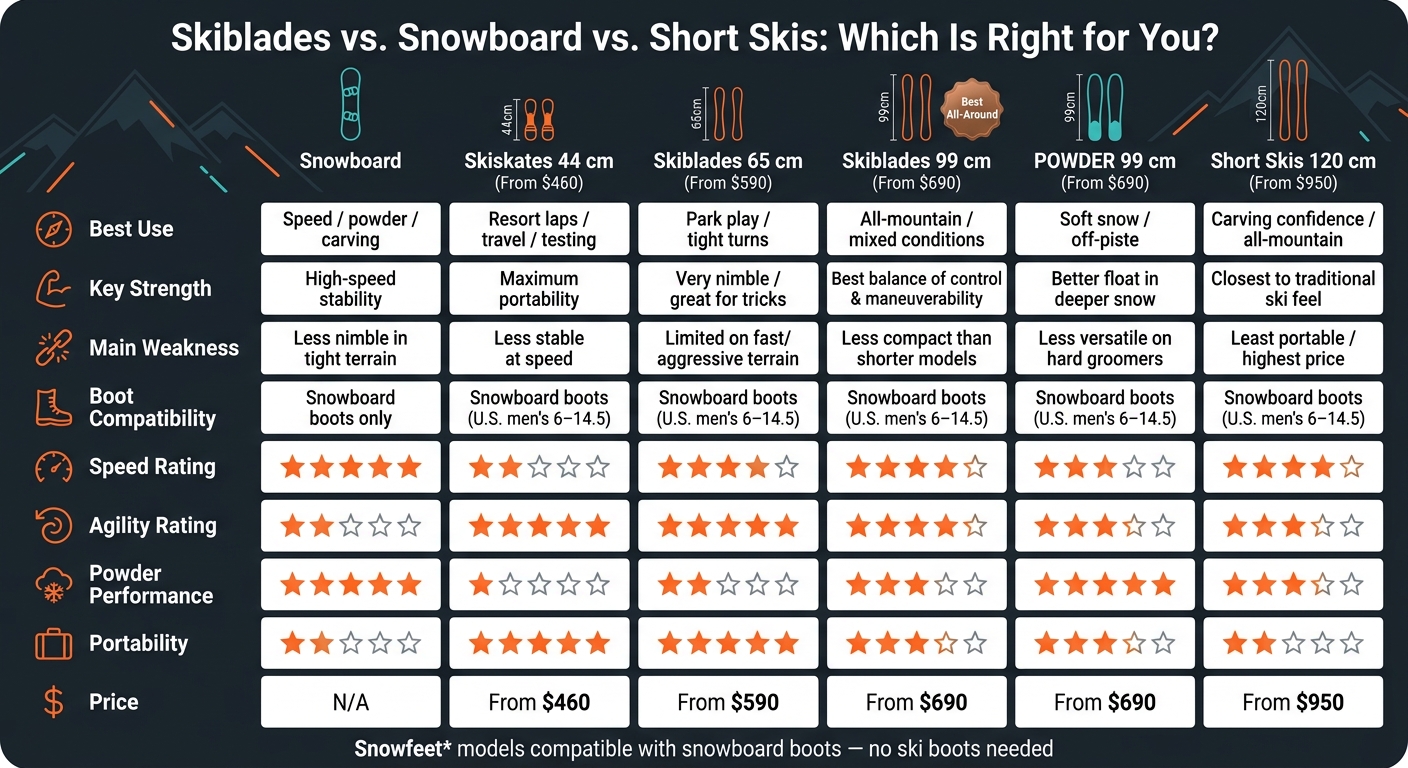
Skiblades vs Snowboard vs Short Skis: Which Is Right for You?
Here’s the plain trade-off: snowboards win on speed and powder, while short skis win on agility. For a snowboarder, that’s the heart of it. The main thing to figure out is where each setup works best for the way you ride.
| Option | Best use | Weak point |
|---|---|---|
| Snowboard | Speed, powder, high-speed carving | Less nimble in tight terrain |
| Long skis | Speed stability, powder performance | Require ski boots |
| Snowfeet* Skiskates 44 cm | Maximum agility, playful riding | Less stable at speed |
| Snowfeet* Skiblades 65 cm | Quick turns, easy maneuverability | Less stable at speed |
| Snowfeet* Skiblades 99 cm / POWDER 99 cm | All-around control, mixed snow conditions | Still shorter than standard skis |
| Snowfeet* Short Skis 120 cm | Most stability in the Snowfeet* lineup | Still shorter than standard skis |
Where skiblades clearly beat a snowboard for some riders
The biggest edge skiblades have is agility. Short skis pivot fast, change direction with less effort, and don’t feel as bulky in tight spots. That matters in trees, narrow runs, and terrain parks where quick moves can make the whole day more fun.
If you’re a snowboarder who likes spins, jumps, and playful laps through the park, the 44 cm and 65 cm Snowfeet* models can be a blast. They feel light, loose, and easy to throw around.
Snowfeet* also keeps things simple by working with snowboard boots. That’s a big plus if you don’t want to mess with ski boots. And the lineup gives you a clear path from 44 cm to 120 cm, so you can pick a setup that matches your comfort level and riding style.
Where a snowboard or long skis still come out ahead
This is where the trade-off gets real. As speed goes up, skiblades lose stability, especially on firm snow. The 44 cm and 65 cm models have less edge hold, which means less grip on icy patches and less confidence on steeper terrain.
The shortest Snowfeet* models do best on groomers or lightly soft snow. If you ride mixed conditions more often, the 99 cm, POWDER 99, and 120 cm models are the better fit.
If your thing is wide-open groomers, fast carving, or deep powder days, a snowboard or long skis will usually serve you better. That’s why length matters so much here. Shorter setups feel playful. Longer ones feel calmer when the mountain starts moving under you.
Why Snowfeet* makes more sense than other short-ski options
For snowboarders, Snowfeet* stands out because the range covers almost everything from super playful riding to something much closer to a standard ski feel. The 44 cm to 120 cm lineup makes it easier to match your gear to your terrain, speed, and style.
So, if you want tiny and playful, that’s there. If you want more control and a smoother ride, that’s there too. Next: which model fits which rider.
sbb-itb-17ade95
Who should buy skiblades and which Snowfeet* model fits best
If the comparison made skiblades sound like the right middle ground, here’s the quick buyer’s guide.
Rider profiles that get the most out of skiblades
Skiblades work best as a second setup, not as a full snowboard replacement.
They make the most sense for a few types of riders:
- Park riders who want spins and quick takeoffs
- Casual resort riders who want easy, playful laps
- New skiblade riders who want a shorter learning curve than standard skis
Snowboarders who should stick with their board
Skiblades aren’t the right call for every snowboarder.
If you spend your days riding steep ice, laying down fast carves, or chasing deep powder, stick with your snowboard or go with longer skis. That’s where they still make more sense.
Model guide: 44 cm, 65 cm, 99 cm, POWDER 99 cm, and 120 cm
In plain English, longer models give you more stability and range. Shorter ones feel more playful and are a lot easier to carry around.
Once you know your rider type, length is the next choice.
| Model | Price (from) | Best for | Key strength | Trade-off |
|---|---|---|---|---|
| Skiskates 44 cm | From $460 | Resort laps, travel, first-time testing | Easy to pack; maximum portability | Less stable at speed; not for powder |
| Skiblades 65 cm | From $590 | Park play, tight turns, easy handling | Very nimble; great for tricks and quick moves | Limited on aggressive or fast terrain |
| Skiblades 99 cm | From $690 | All-mountain, mixed resort conditions, casual carving | Best balance of control and maneuverability | Less compact than shorter models |
| POWDER 99 cm | From $690 | Soft snow, off-piste, powder-friendly sessions | Better float in deeper snow than the standard 99 cm | Specialized; less versatile on hard groomers |
| Short Skis 120 cm | From $950 | Carving confidence, all-mountain performance | Closest to traditional ski behavior in the lineup | Least portable; highest price |
For most snowboarders, the 99 cm model is the best first pick. Go with 65 cm if your main goal is park play, and choose 120 cm if you want the most ski-like feel.
Conclusion: Are skiblades worth it for snowboarders?
After weighing the trade-offs, the short answer is yes for most snowboarders who want a fun second setup - but not for everyone.
Skiblades make sense for riders who want quicker handling, easier transport, and snowboard-boot compatibility. That’s the sweet spot. They help with a clear mountain problem: tight terrain, crowded runs, and park laps, all without forcing you into a full gear swap.
But once speed, deep carving, or powder move to the top of your list, that upside fades fast. In that case, stick with your snowboard. It’s still the better tool for the job.
If you want a second snow sport or just a more playful option, Snowfeet* has a lineup that runs from the ultra-playful 44 cm and 65 cm models to the more stable 99 cm and 120 cm options.
For most snowboarders, it comes down to one simple thing: how often do you ride tight terrain versus fast, open runs? If you want the best middle ground, go with 65 cm or 99 cm. If you want the easiest, lowest-commitment way to test skiblades, 44 cm is the place to start.
FAQs
Are skiblades hard for snowboarders to learn?
No. For snowboarders, skiblades are usually much easier to learn than long skis.
That’s the big draw. They’re short, light, and simple to control, so most riders can pick up the basics of Snowfeet* skiblades in as little as five minutes to one day.
If you already ride a snowboard, the switch tends to feel pretty natural. The tight turns and easy, intuitive handling make skiblades far less awkward than long skis for many first-timers.
Can I use my snowboard boots with skiblades?
Yes - Snowfeet skiblades can work with snowboard boots. Snowfeet makes special adjustable bindings for snowboard boots, so you can use the boots you already like instead of standard ski boots.
These bindings fit U.S. snowboard boot sizes 6 to 14.5. That means the setup stays comfortable, supportive, and pretty easy to get into without a big learning curve.
Which skiblade length should I start with?
Your first Snowfeet* Skiblades should match what you want out on the mountain, but for most beginners, 65 cm is the sweet spot.
It has a more skate-like feel, turns fast, and is easy to pick up without a long learning curve. If you want something that feels playful and simple from day one, this is the one most people should start with.
Choose 99 cm if you want more stability, deeper carving, and a bit more help in light powder. Pick 120 cm if you want something closer to the feel of regular skis, with better stability at higher speeds and on mixed terrain.











Lascia un commento
Questo sito è protetto da hCaptcha e applica le Norme sulla privacy e i Termini di servizio di hCaptcha.