



















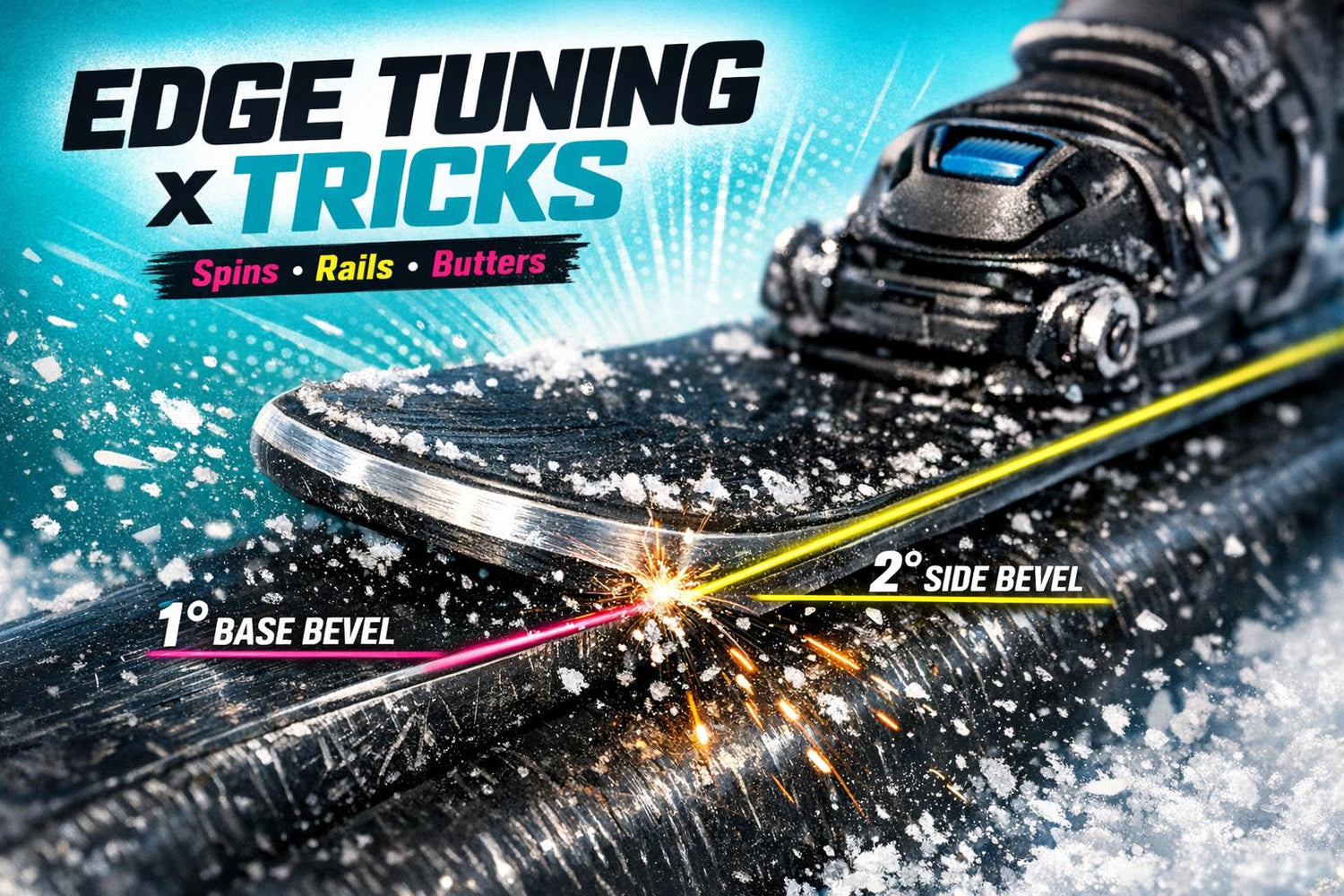
Edge tuning might not be the flashiest part of freestyle skiing, but it’s a game-changer for your tricks. Whether you’re spinning, hitting rails, or buttering, how you tune your ski edges directly affects control, grip, and flow. Here’s the deal:
- Sharp edges give you grip on icy snow but can catch during spins or landings.
- Base beveling (1°–2°) makes spins smoother and reduces edge catching.
- Detuning tips and tails (lightly dulling edges) prevents snagging on rails or during switch landings.
- Short skis or skiskates (like Snowfeet) need extra attention since their smaller edge length means every adjustment matters more.
The right tune balances grip and forgiveness, making your gear predictable and your tricks cleaner. If you’re riding park or freestyle gear, edge maintenance is key - check for burrs, wax often, and adjust for snow conditions. A solid starting point? A 1° base bevel and 2° side bevel, with detuned tips and tails for park features.
Want smoother spins, better rail slides, and fewer edge catches? Tune those edges regularly, and match your setup to your style and snow conditions. It’s the secret sauce for better freestyle performance.
Snowfeet* Mini Ski Skates Guide: Tuning | Sharpening Edges | Waxing Base

The Science Behind Edges and Freestyle Performance
Let’s dive deeper into how edge geometry, snow conditions, and the forces at play during tricks shape your freestyle skiing experience.
Edge Geometry and Its Role in Tricks
The way your ski edges are tuned - specifically the side bevel angle and base bevel - has a huge impact on how your skis handle during tricks. Side bevels, typically between 1° and 4°, create sharper angles for better grip, while the base bevel slightly lifts the edge off the snow. This lift reduces the chance of catching an edge during spins or switch landings, which can make or break your performance.
Edge angles also play a big role in determining your turn radius, thanks to something called the Ideal Carving Equation. Here’s the gist: at a 60° edge angle, your turn radius is exactly half of your ski’s sidecut radius. This tighter arc is a game-changer when setting up spins or carving transitions. For shorter skis like Snowfeet* Skiblades or Skiskates, this effect is even more noticeable because their shorter edge length means every degree of edge angle has a bigger impact on how the ski behaves.
But edge geometry is only part of the story - snow conditions can completely change how your edges perform.
How Snow Conditions Affect Edge Behavior
Snow type can dramatically alter how your edges interact with the surface. The coefficient of friction (COF) for freestyle skis varies widely, from as low as 0.023 to as high as 0.139, depending on snow conditions. That’s nearly a sixfold difference, which can significantly affect your speed on the in-run and the grip you feel on takeoff.
On hard or icy snow, edges act like precise cutting tools, with the turn radius closely following the edge angle. But on softer snow, edges dig deeper into the surface. Interestingly, at high edge angles - above 50° - the turn radius stops tightening and levels out:
"For large edging angles (>50°) the calculated turn radius leveled out... This effect was more pronounced for soft snow than for hard snow conditions." - Peter Federolf, Human Performance Laboratory, University of Calgary
So, on a soft spring day at the park, cranking your edges to extreme angles won’t give you the extra grip you might expect. This is where adjusting both your technique and edge tuning to match the day’s snow conditions really pays off. These variations in snow also increase the wear and tear on your edges, which is critical during high-stress freestyle tricks.
Forces on Edges During Freestyle Tricks
Freestyle tricks put a lot of stress on your edges. During elite-level maneuvers, the forces can reach up to 5.0 times your body weight. This load directly impacts how your skis bend and how well they track on the snow.
Here’s an important concept: you need to set your edge angle before applying pressure. If you apply force too soon, the ski flattens out, causing it to skid instead of carve.
"Edge angle establishment must precede pressure application. Applying pressure before edge angle flattens the ski via torque, causing skid rather than carve." - Axiom 5.4, Angles Before Pressure
Edge sharpness also plays a crucial role. For instance, an edge radius of about 5 micrometers concentrates stress twice as much as a 20-micrometer edge. This can mean the difference between a clean carve on icy terrain and a full-on skid-out. For shorter skis or skiskates, which already have a smaller edge contact area, keeping edges sharp is non-negotiable if you want to stay in control.
How Edge Tuning Affects Specific Freestyle Tricks
Different freestyle tricks demand specific edge tuning setups. Spins, rails, and flat-ground moves each benefit from tailored adjustments to maximize performance and control.
Spins and Switch Landings
For spins and switch landings, sharp edges are key for solid takeoffs on hard or icy snow. But here's the catch: edges that are too sharp at the tips or tails can cause problems mid-spin or during landings. They might hook unexpectedly, throwing off your balance. To avoid this, a 2° base bevel at the tips and tails is ideal. This slight adjustment - just a 0.5° increase at the tips and tails - makes transitions smoother and allows for easier pivoting. Pair this with a 2° base and 0° side bevel setup for a balanced approach.
When it comes to rails and jib features, though, the setup needs to be different.
Rails, Boxes, and Jib Features
On rails and boxes, overly sharp edges can ruin your slide and mess with your balance. The solution? Lightly detune the contact zones - typically the first 3 to 6 inches of the tip and tail. Using a gummy stone here reduces edge bite and keeps things smooth.
For a classic jib setup, go with a 2° base bevel and 0° side bevel. This combination minimizes catching and maximizes your ability to slide. Keep in mind, most factory tunes (usually 0.5° to 1° base and 1° to 3° side) are too aggressive for park features and need adjustments.
If you're using gear like Snowfeet* Skiskates or short skis, the focus should be on tuning the base edges rather than the sides. This keeps the equipment playful and easy to pivot. Flat-ground tricks, though, require yet another approach.
Butters, Presses, and Flat-Ground Tricks
For flat-ground maneuvers like butters and presses, smooth smearing and pivoting are the name of the game. While sharp edges underfoot provide grip, overly sharp tips and tails can catch the snow and disrupt your flow.
"Too sharp: the ski feels unstable and catches during smearing when you need to adjust line quickly." - SlopeRiders
To fix this, go for a higher base bevel (around 1.5° to 2°) at the tips and tails. This helps the ski release more smoothly during tricks. For Snowfeet* Mini Ski Skates, this adjustment is especially important. Their shorter effective edge and pronounced sidecut already make them easy to pivot, so only a light detuning with a gummy stone at the tip and tail contact points is needed to fine-tune them for flat-ground freestyle.
sbb-itb-17ade95
Short Skis and Skiskates vs. Standard Gear: A Direct Comparison
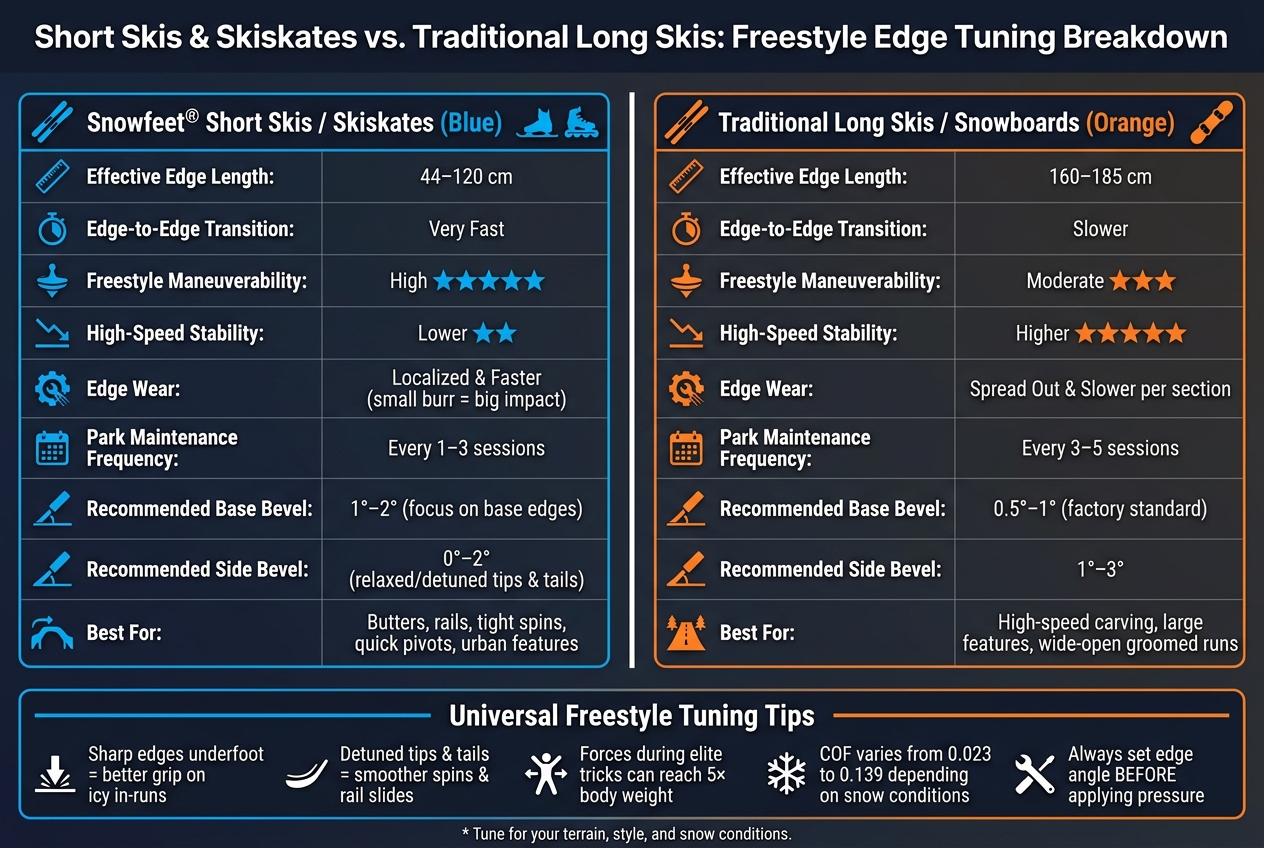
Short Skis vs. Traditional Skis: Edge Tuning & Freestyle Performance Comparison
Effective Edge Length and Turn Response
The most obvious difference between Snowfeet* products and traditional ski gear lies in the edge length. Standard all-mountain skis typically measure 160–185 cm, while Snowfeet* Skiskates are just 44 cm. Skiblades come in at 65 cm and 99 cm, and even the longer Snowfeet* Short Skis max out at 120 cm.
This shorter edge length gives Snowfeet* gear a unique advantage when it comes to agility. They allow for quick pivots, tight spins, and fast setup turns before hitting a jump or feature. In contrast, longer skis or snowboards, with their extended effective edge, are slower to transition between edges. This makes them better for high-speed, long, carved turns but less nimble in tight park settings. Snowfeet* products bring a skating-like feel to the slopes, making rapid direction changes feel natural and effortless. This is a key reason why they shine in freestyle scenarios compared to traditional skis.
Stability vs. Playfulness in Freestyle
Longer skis and snowboards are all about stability, especially at high speeds. Their extended edge contact provides better grip and support, which is ideal for fast, wide-open runs or tackling large features. But in freestyle park riding, where agility is king, this stability can feel like a disadvantage. It makes the gear less nimble, slower to spin, and less forgiving if you land slightly off-axis.
Snowfeet* gear flips the script. Their shorter length makes tricks like butters and presses easier to initiate, spins feel snappier, and under-rotated landings are easier to correct with a quick pivot. While they may feel twitchier at higher speeds or on icy terrain, their playful nature is perfect for low-to-medium-speed park riding. That said, this playful design does require regular maintenance to keep performance sharp.
Edge Wear and Upkeep
Because Snowfeet* products have shorter edges, the wear and tear from rails or other impacts are more concentrated. A small burr from a rail can affect a significant portion of the edge, unlike on a 180 cm ski where the damage is more spread out. To keep your gear in top shape, inspect the edges after rail sessions and use a diamond stone to smooth out any burrs. Apply oil to the edges before storing them to prevent rust, and wax the base every few sessions to maintain glide and reduce snow buildup. This is especially crucial for short gear since even minor drag is immediately noticeable. Regular upkeep ensures Snowfeet* gear retains its signature agility and responsiveness.
| Factor | Snowfeet* Short Skis / Skiskates | Traditional Long Skis / Snowboards |
|---|---|---|
| Effective edge length | 44–120 cm | 160–185 cm |
| Edge-to-edge transition | Very fast | Slower |
| Freestyle maneuverability | High | Moderate |
| High-speed stability | Lower | Higher |
| Edge wear concentration | Localized, faster | Spread out, slower per section |
| Maintenance frequency (park use) | After every 1–3 sessions | Every 3–5 sessions |
Tuning Guidelines for Freestyle Short Skis and Skiskates
Tuning Setups for Different Freestyle Styles
Your edge setup should match your riding style. For all-around freestyle, start with a 1° base bevel and a 2° side bevel - this setup works well for most situations. If you’re hitting rails and boxes with your Snowfeet* 44 cm Skiskates or 65 cm Skiblades, detuning the tips and tails slightly helps prevent edge hooking on metal features. On the other hand, if you prefer carving hard on icy snow between park laps, increasing the side bevel to 3° can improve precision. For mini ski skates, focus primarily on base edge tuning. These setups act as a starting point, but you’ll want to tweak them based on the snow and terrain you’re riding.
| Freestyle Style | Base Bevel | Side Bevel | Key Focus |
|---|---|---|---|
| All-around freestyle | 1° | 2° | Consistent edge underfoot |
| Carving / hardpack | 1° | 3° | Sharp, precise side edges |
| Jibbing / rail-heavy | 1° | Relaxed/Detuned tips | Smooth contact at tips and tails |
Adjusting Edge Tuning for Snow and Terrain
Once you’ve got your initial tune dialed in, it’s important to adjust for changing snow conditions. Snow across the U.S. can vary a lot - from icy morning groomers at places like Park City to slushy afternoons at Mammoth. On icy or hardpack snow, a sharper 3° side bevel gives your Snowfeet* gear the grip needed for clean turns and solid landings. But in softer, wetter park snow, overly sharp edges can feel grabby. If your skiskates feel too aggressive during spins or landings, a quick pass with a gummy stone can detune the tips and tails, making transitions smoother.
Spring riding is especially tricky since snow can go from firm to slushy in just a few hours. A clean, consistent tune helps your gear stay predictable as conditions shift.
Maintenance Tips for Regular Park Use
Once your tuning is set, regular maintenance is key to keeping your gear performing well in the park. After every 1–3 sessions:
- Check your Snowfeet* edges for rough spots and smooth them out with a diamond or sharpening stone.
- Apply liquid wax to the base for smoother gliding.
- Dry the metal edges immediately after riding to prevent rust.
For long-term storage, coat the edges with a thin layer of oil to keep rust at bay. This is especially important for short gear like Snowfeet* Skiskates and Skiblades. Their compact edge length means even small burrs or drag can have a big impact on their agility and playfulness - qualities that set them apart from traditional long skis in freestyle settings.
Pro Tip for Snowfeet* Users: During sharpening, you might notice small bits of plastic being shaved off around the integrated edges. Don’t worry - this doesn’t affect performance.
Conclusion: Better Freestyle Performance Through Edge Tuning
Edge tuning isn’t just a one-and-done task - it’s something you’ll revisit regularly to keep your riding sharp and safe. Whether you’re spinning 180s on icy East Coast parks, sliding rails in Utah, or hitting urban ledges under city lights, dialed-in edges make your gear predictable, your tricks cleaner, and your sessions safer. Did you know ACL tears make up 20–30% of serious ski injuries? Unexpected edge catches are a big reason why.
Here’s the bottom line: match your edge tuning to your riding style. Detuning the tips and tails slightly helps your spins flow better and reduces those dreaded edge catches on landings. A softer edge setup underfoot makes sliding rails and boxes feel smooth, while sharper edges underfoot give you the grip you need on icy in-runs or hard landings. A 1° base bevel and 2° side bevel, combined with detuned contact points, is a great starting point (as discussed earlier).
For those riding shorter skis or skiskates - like the Snowfeet* 44 cm Skiskates (with a 5.0/5 rating from 123 reviews) or 65 cm Skiblades - edge tuning becomes even more critical. Their compact design means even small adjustments are noticeable, helping you fine-tune your setup quickly and progress faster. As verified user Brad Tolin shared:
"Super easy to control, quick to turn, and way more forgiving than traditional skis."
Make maintenance part of your routine, not an afterthought. After hitting rails, deburr your edges. Wax your bases regularly. Dry everything off after every session to avoid rust. For urban riders tackling concrete ledges and metal rails, these habits protect your edges and keep your tricks consistent. Taking care of your gear doesn’t just preserve it - it keeps your tuning adjustments working for you.
As you improve, your edge tuning should evolve too. Beginners can focus on forgiving setups to reduce edge catches, while advanced riders may want sharper edges underfoot for bigger features, keeping tips and tails softer. The goal isn’t a “perfect” tune - it’s a setup that matches your terrain, style, and skills as they grow. Edge tuning is your secret weapon for better freestyle performance at every level.
FAQs
How do I know if my edges are too sharp for park tricks?
If your snowboard edges feel too aggressive or seem to trip you up during tricks, especially in the tip and tail areas, they might be overly sharp. This is a common issue in terrain parks where smooth pivots are essential. To fix this, grab a gummi stone or some abrasive rubber and lightly detune the contact points. This reduces the risk of catching an edge while still keeping the rest of the edge sharp for better control and precision.
What edge tune is safest for rails and boxes?
To ride rails and boxes safely, you’ll want to detune the metal edges underfoot - about a 6- to 7-inch section around the midsole. Use a file at a 45-degree angle to round them off. Also, lightly round the contact points near the tip and tail (about 2 inches back) to reduce the risk of catching an edge. Unlike traditional skis, Snowfeet offers a lightweight and portable option, sparing you the trouble of lugging heavy gear or dealing with complicated upkeep.
How often should I deburr and retune Snowfeet* skiskates or short skis?
To keep your Snowfeet* skiskates or short skis in top shape, make sure to sharpen the edges every 3 to 5 days if you're skiing on icy slopes. Thanks to their compact design, maintaining them is simpler than dealing with traditional long skis. Here's how to care for them:
- Use a diamond stone to remove burrs from the edges.
- Smooth out the tips and tails with a gummi stone for easier, smoother turns.
- Always dry the edges thoroughly after each use to avoid rust.
A little regular maintenance goes a long way in keeping your gear performing like a dream!













Lascia un commento
Questo sito è protetto da hCaptcha e applica le Norme sulla privacy e i Termini di servizio di hCaptcha.