




















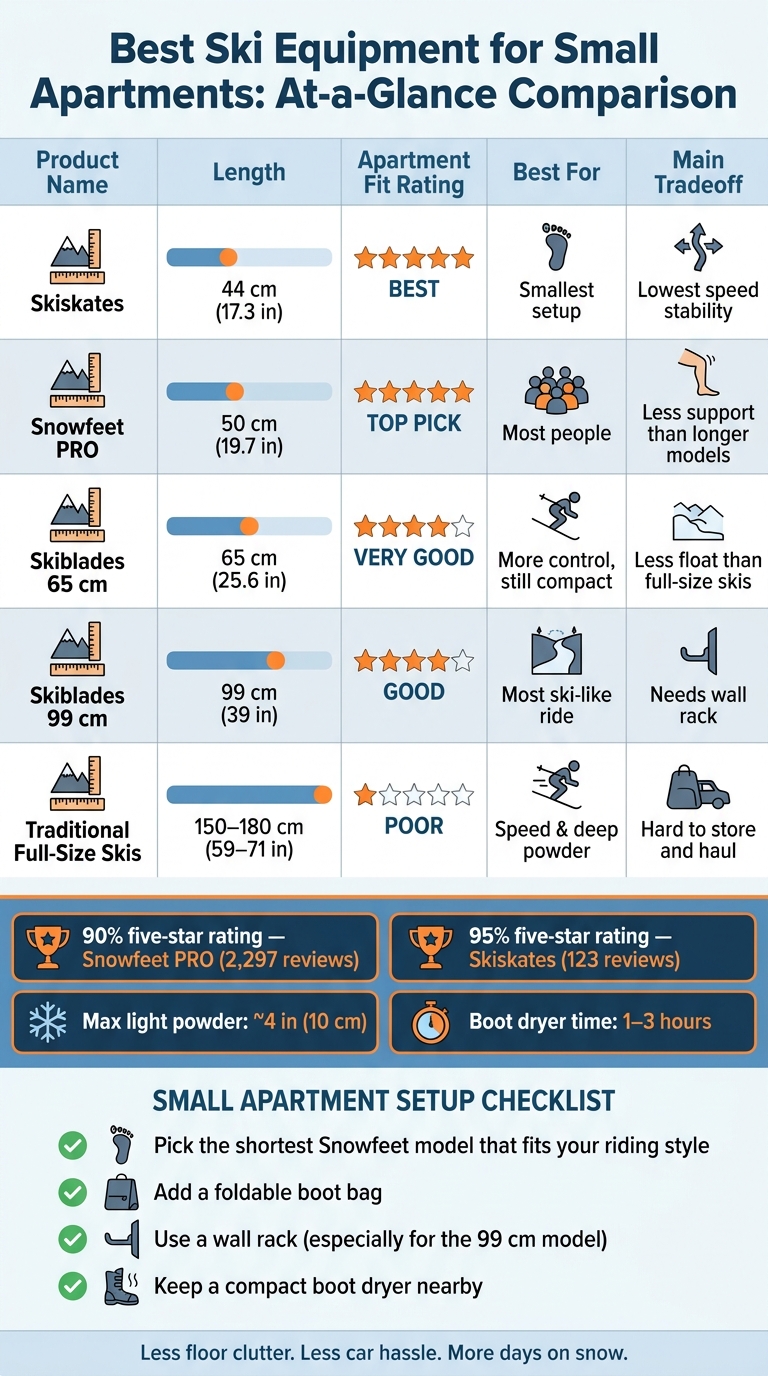
If you live in a small apartment, shorter ski gear is the easiest fix. Based on the article, I’d put the Snowfeet PRO 50 cm at the top for most people, the Skiskates 44 cm first for the smallest setup, the Skiblades 65 cm first for more control, and the Skiblades 99 cm first if you want the closest feel to full-size skis.
Here’s the short version:
- Best all-around for tight spaces: Snowfeet PRO 50 cm
- Smallest option: Skiskates 44 cm
- Best middle ground: Skiblades 65 cm
- Most ski-like feel: Skiblades 99 cm
- Best add-ons for apartment life: foldable boot bag, wall rack, compact boot dryer
What stood out to me most is simple: length changes everything. Going from about 59–71 in full-size skis to 17.3–39 in gear makes storage, car loading, and drying way less annoying. That matters if your hallway is already doing too much :)
Compact Ski Gear vs. Full-Size Skis: Small Apartment Storage Guide
Snowboarder tries Snowfeet* | Which Snowfeet* Short Ski is the Best? | Snowblades 44, 65, 99 Review

Quick Comparison
| Item | Length | Best For | Main Tradeoff | Small-Apartment Fit |
|---|---|---|---|---|
| Skiskates | 44 cm (17.3 in) | Smallest setup | Lowest speed stability | Best |
| Snowfeet PRO | 50 cm (19.7 in) | Most people | Less support than longer models | Top pick |
| Skiblades | 65 cm (25.6 in) | More control, still compact | Less float than full-size skis | Very good |
| Skiblades | 99 cm (39 in) | More ski-like ride | Takes more room than the other Snowfeet options | Good |
| Full-size skis | 150–180 cm (59–71 in) | Speed and deep powder | Hard to store and haul | Poor |
A few numbers help tell the story:
- Snowfeet PRO: 90% five-star rating from 2,297 reviews
- Skiskates: 95% five-star rating from 123 reviews
- Light powder limit noted in the article: about 4 in (10 cm)
- Boot dryer time: often 1–3 hours
So, if I were setting up a studio or one-bedroom, I’d keep it simple:
- pick the shortest model that still fits how you ride
- use a foldable boot bag
- add a small dryer
- use a wall rack if you go with the 99 cm pair
That’s the whole game: less floor clutter, less car hassle, more days on snow.
If you want a quick visual before you buy, these YouTube searches can help:
- Snowfeet PRO videos
- Snowfeet Skiskates videos
- Snowfeet Skiblades 65 cm videos
- Snowfeet Skiblades 99 cm videos
I’d sum it up like this: if your home is small, your ski setup should stop acting huge.
1. Snowfeet* PRO 50 cm
At 50 cm (19.7 in), the Snowfeet* PRO is small enough to slide under a bed, sit on a shelf, or hang on a small wall rack. That’s a big deal if you live in an apartment and don’t want your gear taking over the whole place. It’s much shorter than full-length skis, and it can even fit inside a backpack. For most casual riders with limited space, this hits a sweet spot between easy storage and solid use on the slopes.
Storage Footprint
That 50 cm length gives you way more storage choices than regular skis. You can tuck it on a short wall rack behind a door, stash it in an entryway closet, drop it into a cube organizer, or slide it into an under-bed bin. Simple stuff. No gear Tetris needed.
Portability
Carrying the PRO is easy. It works well on public transit, and it fits in a car trunk or back seat next to your other bags. No need to fold seats down or mess with a roof rack, which is nice when it’s cold and you just want to get moving.
Boot Compatibility
Another nice part: it works with winter boots or snowboard boots. So you may not need a separate ski-boot setup, which can save space and cut down on extra gear.
On-Slope Usefulness
On the snow, the PRO is stable enough for groomed runs and casual laps. If your top goal is the smallest setup possible, the 44 cm Skiskates are even smaller. But there’s a tradeoff: you lose some stability.
The PRO can handle up to about 4 in (10 cm) of light powder. That said, it’s not made for deep powder or all-out speed. It also holds a 90% five-star rating based on 2,297 reviews, which gives you a pretty good sense of how riders feel about it.
Here’s the quick side-by-side:
| Snowfeet* PRO 50 cm | Traditional Skis | |
|---|---|---|
| Length | 50 cm (19.7 in) | 150–180 cm (59–71 in) |
| Storage | Under bed, shelf, small rack | Wall rack or large closet |
| Car transport | Trunk or back seat | Roof rack or folded seats |
| Boot type | Winter boots or snowboard boots | Ski boots only |
2. Snowfeet* Skiskates 44 cm
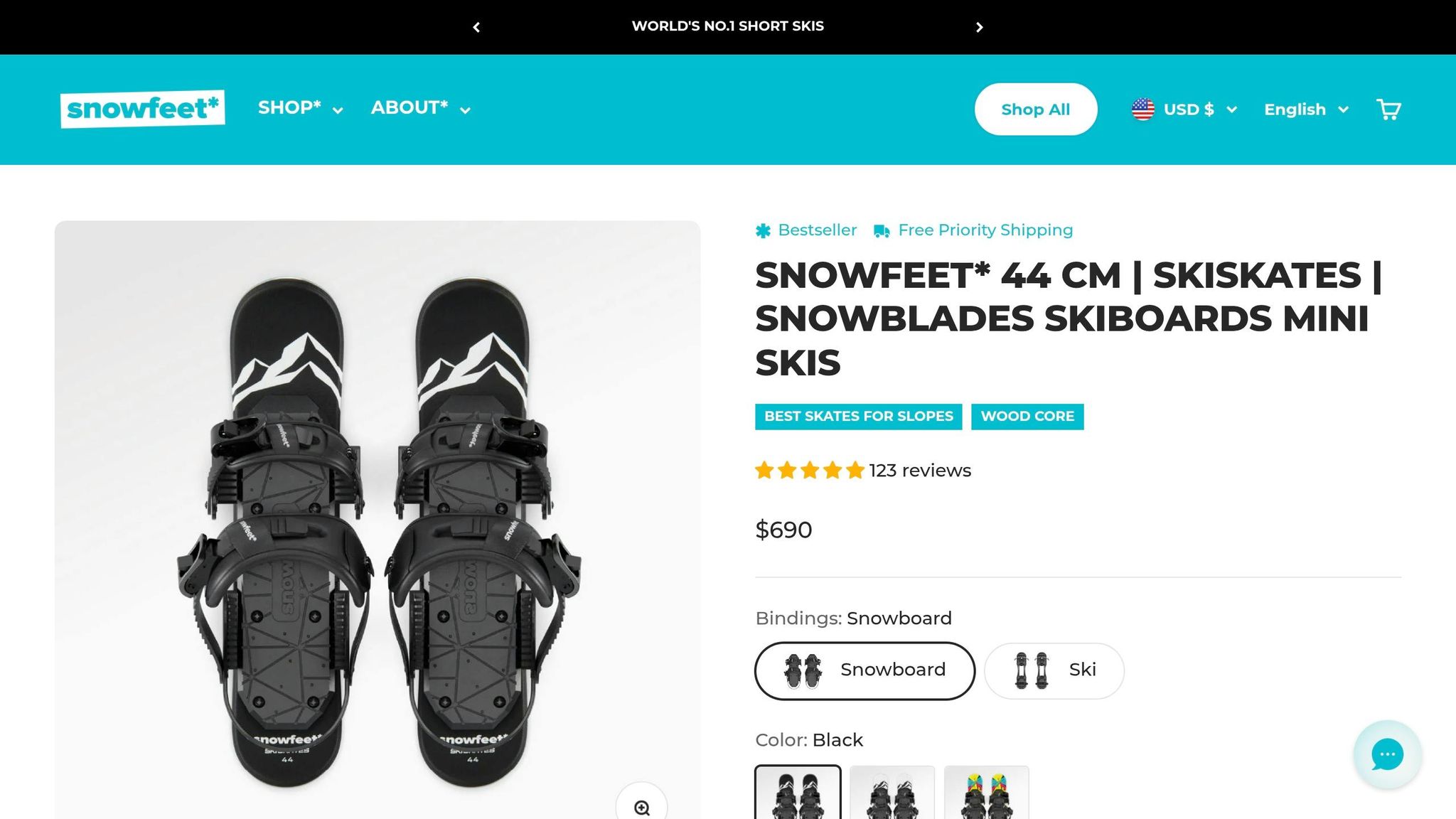
At 44 cm (17.3 in), Skiskates are among the shortest rideable snow options you can buy. That tiny size is the whole point. They’re small enough to stash in a backpack, a drawer, or on a wall hook, so they take up less room than the PRO. In a studio apartment or a tight closet, that can be a big deal. If the PRO is the compact pick, Skiskates are the ultra-compact one.
Storage Footprint
That 6 cm gap versus the PRO might sound minor. In a small apartment, though, it’s the kind of thing you notice fast. Each Skiskate can fit into spots where full-size skis have zero chance, like a compact gear bin, an entryway cabinet, or an under-bed storage drawer.
Portability
These are even easier to carry than the PRO. They fit in a backpack and can often go in a checked bag too, depending on the airline. Nice if you don’t want your gear acting like it owns the whole trip.
On-Slope Usefulness
Skiskates use a certified sustainable wood core, metal edges, and a graphite base. On groomed runs and in snow parks, that setup gives them good control and a lively, skating-like feel. If you come from skating or hockey, there’s a decent chance they’ll click pretty fast.
The catch is speed stability. Their short length makes them easy to turn, but also less steady on steep or icy terrain than longer skis. They’re not made for powder or fast, aggressive riding, so they fit beginners to intermediate riders who want quick, playful resort laps more than hard-charging terrain. They also hold a 95% five-star rating across 123 reviews.
| Feature | Skiskates 44 cm | Snowfeet* PRO 50 cm | Traditional Skis |
|---|---|---|---|
| Length | 44 cm (17.3 in) | 50 cm (19.7 in) | 150+ cm (60+ in) |
| Core | Sustainable wood | Fiberglass flex | Wood/composite |
| Storage | Backpack, drawer, or small closet | Backpack or shelf | Wall rack or large closet |
| Best terrain | Groomed slopes, parks | Slopes, casual hills | Wider variety of terrain |
| Stability at speed | Lower | Moderate | Highest |
Boot Compatibility
Like the PRO, Skiskates work with ski boot bindings (US sizes 4.5–14.5) or snowboard boot bindings (US sizes 6–14.5). So you don’t need to buy or store another pair of boots. That helps keep the whole setup small and simple.
If you want a bit more stability but still want gear that stores easily, the 65 cm Skiblades are the next move.
3. Snowfeet* Skiblades 65 cm
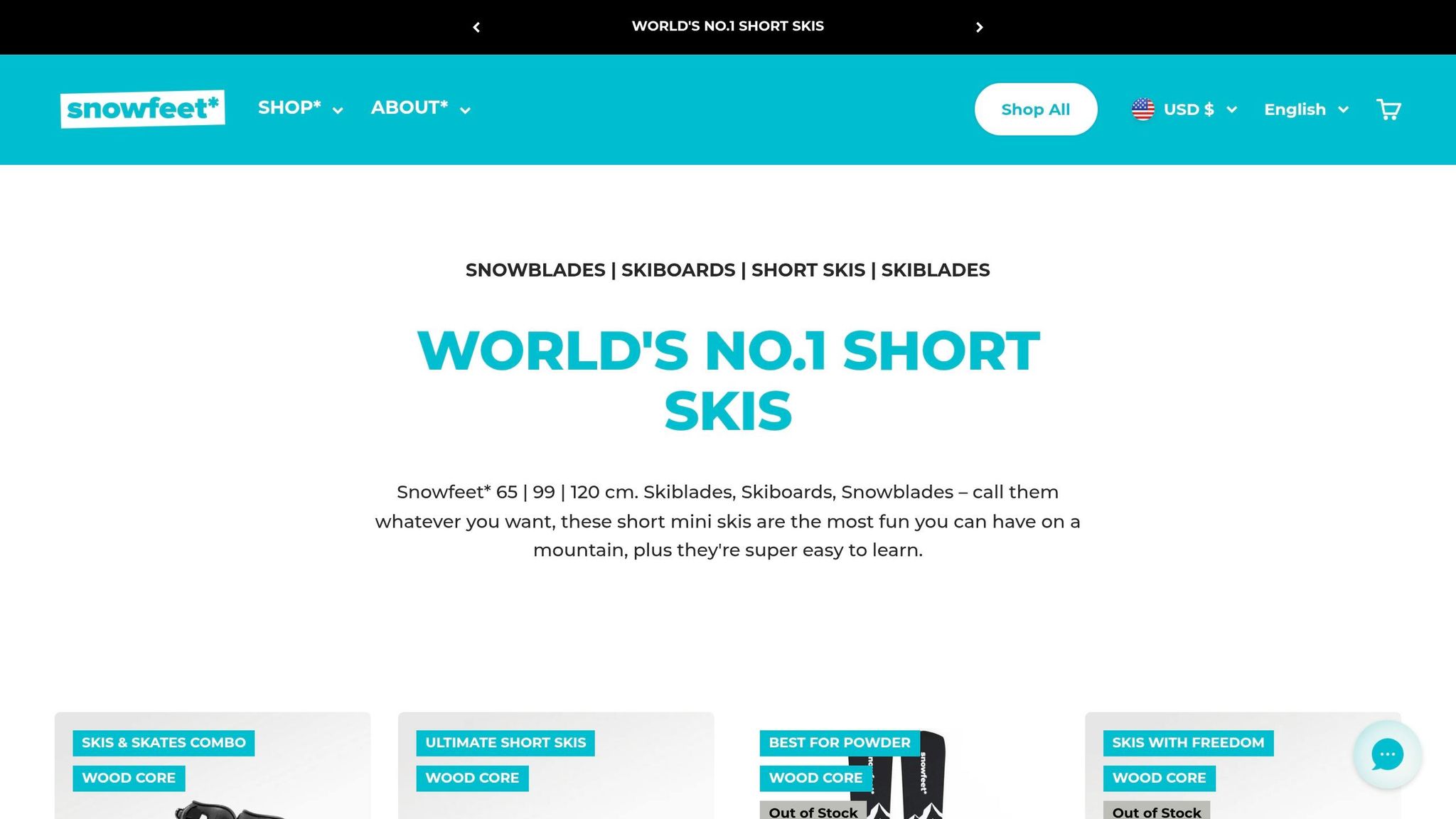
At 65 cm (25.6 in), these Skiblades land right in the middle of the Snowfeet* lineup. They’re longer than the Skiskates and PRO, and shorter than the 99 cm model. That middle length gives you a nice mix of carve control, easy turning, and simple storage. If the 44 cm or 50 cm models feel a bit too short, but the 99 cm sounds like more ski than you want, the 65 cm is the sweet spot.
Storage Footprint
These fit in a backpack and stash easily under a bed, on a shelf, or in a small closet. That’s a whole lot easier than dealing with long skis that seem to take over your place.
Portability
No roof rack. No wrestling with giant gear bags. And you can skip the pain of oversized equipment fees at the airport.
On-Slope Usefulness
The 65 cm model is built with a certified sustainable wood core, sintered bases, full steel metal edges, and cap construction. On snow, it gives you more stability than the 44 cm and 50 cm models, while staying more agile than the 99 cm version.
The parabolic shape and narrow waist help it carve with a quick, responsive feel. Most beginners can get used to it fast. And if you come from skating, hockey, or rollerblading, it often feels natural even sooner.
Boot Compatibility
The 65 cm Skiblades work with ski boots or snowboard boots thanks to tool-free adjustable bindings. Snowfeet* recommends snowboard boots if you want easier walking.
| Feature | Skiblades 65 cm |
|---|---|
| Length | 65 cm (25.6 in) |
| Core | Certified sustainable wood |
| Best terrain | Groomed slopes, moguls, snow parks |
| Storage | Backpack, closet shelf, or under bed |
The 65 cm Skiblades start at $590. If you want more speed stability, move up to the 99 cm Skiblades.
4. Snowfeet* Skiblades 99 cm
At 99 cm (about 39 inches), this is the longest Snowfeet* option in this lineup. And yep, it feels a lot closer to a normal ski.
If the 65 cm model hits that fun middle ground between playful and steady, the 99 cm version leans more toward a classic ski feel. Snowfeet* calls it its bestseller, and that checks out. If you live in an apartment, it gives you that near-full-ski ride without the usual storage pain.
On-Slope Usefulness
The 99 cm model gives up a bit of compact size in exchange for a ride that feels more like skiing as most people know it. It uses a certified sustainable wood core, sintered base, full steel metal edges, and cap construction.
That extra length means more edge contact with the snow. In plain English: better grip, smoother carving, and a feel that’s closer to skis than the 44–65 cm models. On groomers and mellow black runs, they carve cleanly and hold better when your speed starts to climb.
There is a clear tradeoff, though. At very high speeds or in deep powder, full-length skis still do better. But for casual resort riders who spend weekends on groomed runs, the 99 cm model has plenty to offer.
Storage Footprint
If you want the most ski-like pick here that still works in a small living space, this is probably it. At 39 inches, it can fit in most closets or slide under a bed. That’s a lot easier than trying to stash a full-size ski setup in a tight apartment. No awkward corner balancing act required :)
Portability
They’re short enough to fit sideways in a small car trunk, and they’re easy to carry from the parking lot to the lift. That’s a nice win if you’re trying to keep your whole setup simple and easy to live with.
| Feature | Skiblades 99 cm |
|---|---|
| Length | 99 cm (≈39 in) |
| Core | Certified sustainable wood |
| Best terrain | Groomed blues, mellow blacks, moguls |
| Storage | Standard closet, under bed |
| Boot compatibility | Standard ski boots or snowboard boots |
Snowfeet* Skiblades 99 cm start at $690.
sbb-itb-17ade95
5. Foldable Boot Bags
Once your skis are sorted, boots usually become the next headache. And, honestly, they’re often the toughest thing to store. A foldable boot bag fixes that without eating up closet space.
Unlike hard boot boxes, foldable bags use durable fabric like polyester or ripstop nylon. When they’re empty, they collapse flat. That’s the big win. Some also have pockets for your helmet, gloves, and goggles, so you can skip a few extra bins. Slide the bag under a bed, stash it on a closet shelf, or hang it on a hook.
Travel and Home Use
A good foldable boot bag does two jobs. It protects your boots on the way to the mountain, and it helps keep your floors dry at home. Look for a water-resistant base to stop melted snow from soaking floors or nearby stored items. Mesh side panels or ventilation grommets help moisture escape, which means less stink later. Simple, but it matters.
Storage Footprint
This is where foldable bags stand out. When empty, most shrink down to just a few inches thick. That’s a huge shift from a hard boot box, which hogs the same floor space whether it’s packed or empty.
Pair compact Snowfeet* gear with a foldable boot bag, and the whole setup stays in one small carry.
Portability
If you use public transit or rideshares to get to the mountain, backpack-style straps are a smart pick. They make the bag easier to carry and keep the load tight and easy to manage. That can make those early-morning apartment exits a lot less clumsy.
For hard gear that still needs a home, wall storage is the next space saver.
6. Wall Racks and Vertical Storage
In a small apartment, wall space is often the easiest spot for ski gear. Once boot bags tame the soft stuff, wall racks take care of the hard gear.
Why Compact Gear Wins Here
Snowfeet gear is short enough to fit where full-size skis just don't. Snowfeet's 44–99 cm range fits narrow 12–18 inch wall sections that 160–180 cm skis can't use. On that same slice of wall, you can fit 4–6 pairs of Snowfeet gear with a tiered setup.
That’s the big win in a tight space. You’re using wall areas that would otherwise sit there doing nothing.
Once you know the gear can fit, the next step is picking a rack that won’t get you in trouble with your lease.
Choosing the Right Rack Type
| Rack Type | Best For | Renter-Friendly? | Capacity |
|---|---|---|---|
| Fixed wall rack (stud-mounted) | Permanent, sturdy setups | Requires drilling | 1–4 pairs + poles |
| Adjustable track system | Mixed gear, seasonal changes | Requires drilling | 4–6+ pairs |
| Over-the-door / freestanding vertical organizer | No-drill renters | Yes | 1–2 compact items or accessories |
If you're renting, that last option can be a lifesaver. No drill, no patch job, no awkward chat with the landlord later.
Mounting Safely
Use rubber-coated arms so the gear doesn’t get scuffed up. Mount into studs when you can, and check your lease before drilling. Drywall anchors are fine for lighter loads, but they’re not the move for heavier setups. Some landlords also want racks placed inside closets instead of out on living-room walls.
A wall rack clears the floor without stuffing your gear out of sight. Nice and simple. Now you’ve got one more apartment headache to deal with: drying wet boots and skis without turning the place into a soggy mess.
7. Compact Drying Solutions
Wet gear after a ski day is a pain in a small apartment. The good news? Short Snowfeet gear dries fast. The bigger hassle is usually your boots, gloves, and shells. That’s where a compact heated boot and glove dryer helps. It handles the damp stuff without eating up your floor space.
Once you’ve got storage sorted out, moisture is the last annoying small-space issue.
Space Efficiency
A compact heated boot and glove dryer is often about the size of a small space heater. So it’s easy to tuck into a corner, closet, or bathroom. And it can dry boot liners in about 1–3 hours instead of making you wait until the next morning.
That’s a big win if you ski on back-to-back days. Nobody wants to start the day by putting on cold, soggy boots. That’s just cruel :)
Drying Speed and Day-to-Day Practicality
If you ride on weekends, your gear needs to be dry and ready for the next trip. A heated dryer is the best pick for boots and gloves. For wet layers, use a fold-flat rack for simple airflow drying.
| Solution | Best For | Footprint | Speed |
|---|---|---|---|
| Heated boot/glove dryer | Boots and gloves | Small, vertical footprint | Fast (often 1–3 hours) |
| Wall-mounted or over-door rack | Jackets, pants, base layers | Very high; folds flat | Moderate |
| Compact heated drying rack | Socks, gloves, light layers | Moderate–small | Moderate–fast |
| Portable fan-based gear dryer | Budget option for soft gear | Small | Slow–moderate |
A wall-mounted or over-door rack works well when you need to dry jackets or base layers but don’t want a setup sitting out all week. It folds flat, which matters a lot in a tight apartment.
Beginner-Friendliness and Safety
A few simple habits make this setup much easier to live with:
- Keep gear off radiators. Too much heat can warp bases and damage bindings.
- Pick dryers with auto shutoff and overheat protection so they can run on their own.
- A 5- to 6-foot cord usually reaches most bathroom outlets.
- Run the bathroom fan while drying gear so moisture goes outside instead of hanging around indoors.
- Put a waterproof boot tray or rubber mat underneath to catch drips and save your floors.
With long skis, this same drying setup takes up more room and is harder to hide. That’s one more reason compact gear is easier to deal with in a small place.
8. Traditional Long Skis
This is the baseline gear Snowfeet* is trying to replace.
Traditional long skis are still GREAT at two things: high-speed stability and deep powder. If you’re a serious backcountry skier or you like charging down steep black diamond runs, long skis are still the right tool for that job.
But in an apartment? Yeah, that’s where things get awkward.
They’re tough to store, they usually need rigid ski boots, and getting them around often means a roof rack or a big ski bag. That’s fine if you’ve got space. Not so fun if you live in a small place and already feel like your hallway is doing too much.
The trade-off is pretty simple: long skis win on raw performance, while Snowfeet* win on convenience in tight spaces. And for small apartments, that difference matters a lot. Storage and transport often decide what you’ll use most.
| Feature | Traditional Long Skis | Snowfeet* Gear |
|---|---|---|
| Storage | Requires wall racks or large closets | Fits in a backpack or small shelf |
| Transport | Needs roof rack or large ski bag | Fits in a car trunk or on public transit |
| Boot type | Rigid ski boots only | Snowboard boots or winter shoes |
| Deep powder | Excellent | Limited to about 4 in (10 cm) |
| High-speed stability | Best-in-class | Good; 99 cm is closest to traditional |
| Maneuverability | Lower | High |
For most casual riders, that extra performance doesn’t beat the hassle of storing big skis. So the pros and cons here are pretty easy to see.
Pros and Cons
Here’s the fast read. If you want to compare storage, portability, and ride feel in about 30 seconds, this table does the job.
Below is the shortest version of the tradeoffs.
| Item | Best For | Pros | Cons | Apartment Fit |
|---|---|---|---|---|
| Snowfeet PRO 50 cm | Small-apartment riders who want maximum portability | Fits in a backpack or small travel bag; quick, playful turns; works with winter boots | Less edge hold at higher speeds; not ideal for deep powder or icy steep terrain | Excellent - fits on a closet shelf or in a storage bin |
| Skiskates 44 cm | Riders who want the smallest possible setup | Smallest footprint; intuitive for skaters; fun for terrain parks and casual resort laps | Least stable at speed; less versatile than longer skis | Best - fits in a backpack or shares a bin with helmets and gloves |
| Skiblades 65 cm | Riders who want the best balance of size and stability | Better edge grip and support than 44–50 cm lengths; better on steeper terrain; fits in most small cars and closets | Less float and stability than full-length skis; not ideal for high-speed carving | Very Good - fits in most coat closets upright or in a corner |
| Skiblades 99 cm | Riders who want the most ski-like ride in a compact format | Most ski-like ride; more stability for carving and moderate speed; easier transition for skiers downsizing from longer skis | Least apartment-friendly Snowfeet option; usually needs a dedicated wall rack or vertical corner | Good - requires vertical storage but is still much easier than full-length skis |
| Foldable Boot Bags | Renters with minimal storage | Collapsible when empty; fits in a drawer or on a shelf; compartments for goggles, gloves, and socks; easier to carry than rigid bags | Less structural protection than rigid ski bags; may not stand upright when partially filled | Excellent - stores in a drawer or on a shelf between ski days |
| Wall Racks | Studios and one-bedrooms where floor space is tight | Frees up floor area; keeps gear organized; no-drill renter-friendly options exist | Many stable racks require drilling; may conflict with lease terms | Very Good - a strong option, but check your lease before drilling |
| Compact Drying Solutions | Apartments without mudrooms or gear rooms | Low footprint; smaller gear dries faster; over-door or small electric boot dryers work well | Needs a bit of planning in a small entryway | Very Good - a small drying mat or compact dryer handles Snowfeet gear well |
| Traditional Long Skis | Serious skiers with dedicated storage space | Best for speed and powder; superior carving on steep terrain | Bulky; hard to transport; awkward to store in small apartments | Poor - storage and transport are a real challenge in small apartments |
A simple way to read the table: the shorter the gear, the easier life gets at home. But there’s a tradeoff. As length goes down, you usually give up some stability at speed and some support in rough snow.
If you live in a studio or one-bedroom, that matters a lot. A setup that fits in a closet, under a bed, or inside a storage bin can mean the difference between skiing often and feeling like your hallway has turned into a gear shop.
The next part narrows these tradeoffs to the best overall pick for small apartments.
Conclusion
For most casual riders living in studios or one-bedroom apartments, Snowfeet* is a better match for small-space life than long skis.
Once you’ve picked your ski length, storage gets pretty simple. Go with Skiskates 44 cm if you want the smallest setup. Pick PRO 50 cm if you want the best compact all-around option. Choose 65 cm if you want more stability. And if you want the closest thing to a ski feel without dealing with full-length skis, 99 cm is the move.
Traditional long skis still come out on top in deep powder, steep terrain, and at high speeds. But let’s be honest: they’re a pain to store and haul around. That makes them a rough match for small apartments.
Boots and moisture matter too. Pair your skis with a foldable boot bag and a compact dryer. That helps keep your setup dry, tidy, and easy to live with. A smart small-apartment setup looks like this:
- Pick the Snowfeet* length that fits how you ride
- Add a foldable boot bag
- Use a wall rack for the 99 cm model
- Keep a compact dryer nearby
For small apartments, the best gear is the gear you can store with no hassle, carry without a fight, and still have fun with on snow.
FAQs
Which Snowfeet* length is best for beginners?
For beginners, the best Snowfeet* length comes down to what feels easy and fun on the snow.
The 65 cm Skiblades are a top pick. They’re light, easy to control, and simple to turn and stop. That makes them a great match if you’re still getting your legs under you.
If you want a bit more stability, go with the 50 cm Snowfeet PRO. It’s made with beginners in mind, so it feels less twitchy and more forgiving.
The 99 cm Skiblades are another solid option. They work well as an all-mountain choice and fit all skill levels, which is nice if you want something you can keep using as you improve.
Can I use my regular winter boots with Snowfeet* gear?
Yes. Many Snowfeet* models work with regular winter boots. That’s a big plus compared to standard ski gear.
Models like the 38 cm Mini Ski Skates, 44 cm Skiskates, and 50 cm Snowfeet PRO are made to strap onto waterproof winter boots or snowboard boots.
For the best ride, go with boots that have firm ankle support.
How much space do I need to store Snowfeet* at home?
Not much at all. Snowfeet* products are built for tight spaces and run from just 15 to 47 in. long, while standard skis are usually 5 to 6 ft. long.
That means you can stash them under a bed, slide them into a closet, or even tuck them into a drawer. And since they’re light and compact, they also fit with no fuss in a standard backpack or small duffel bag.











Lascia un commento
Questo sito è protetto da hCaptcha e applica le Norme sulla privacy e i Termini di servizio di hCaptcha.