



















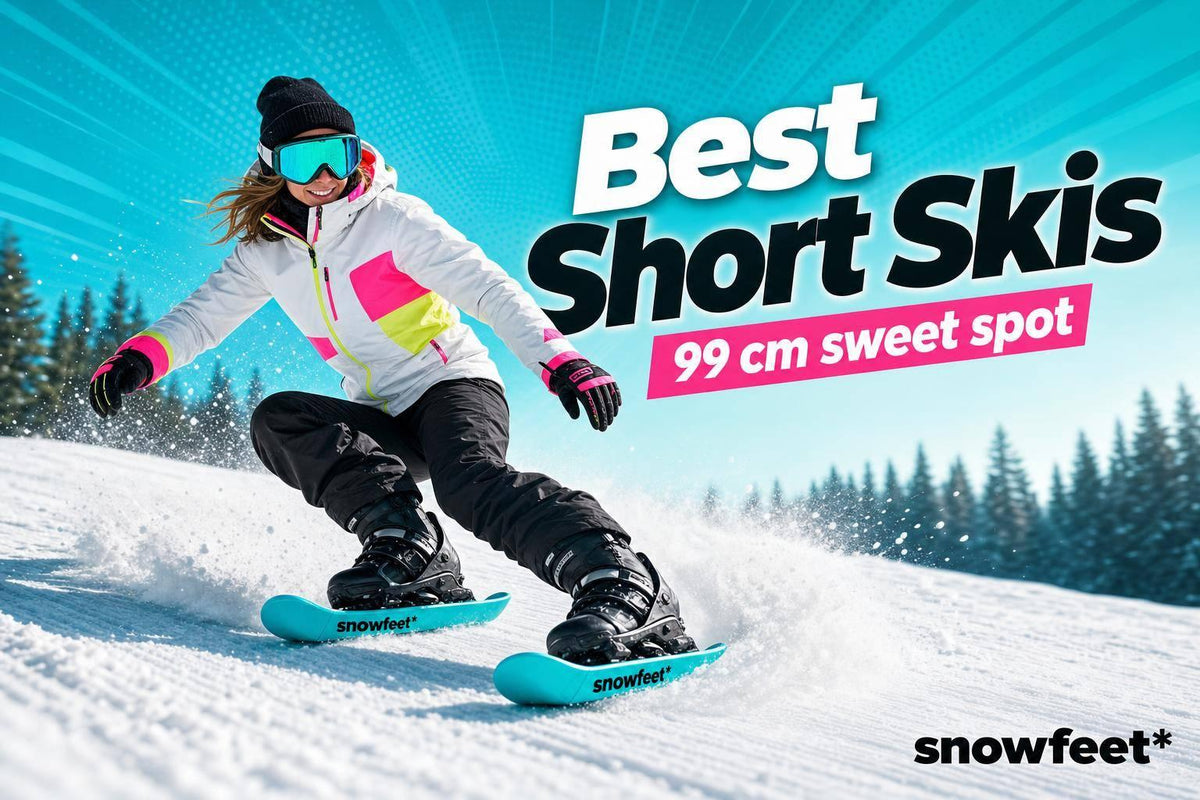
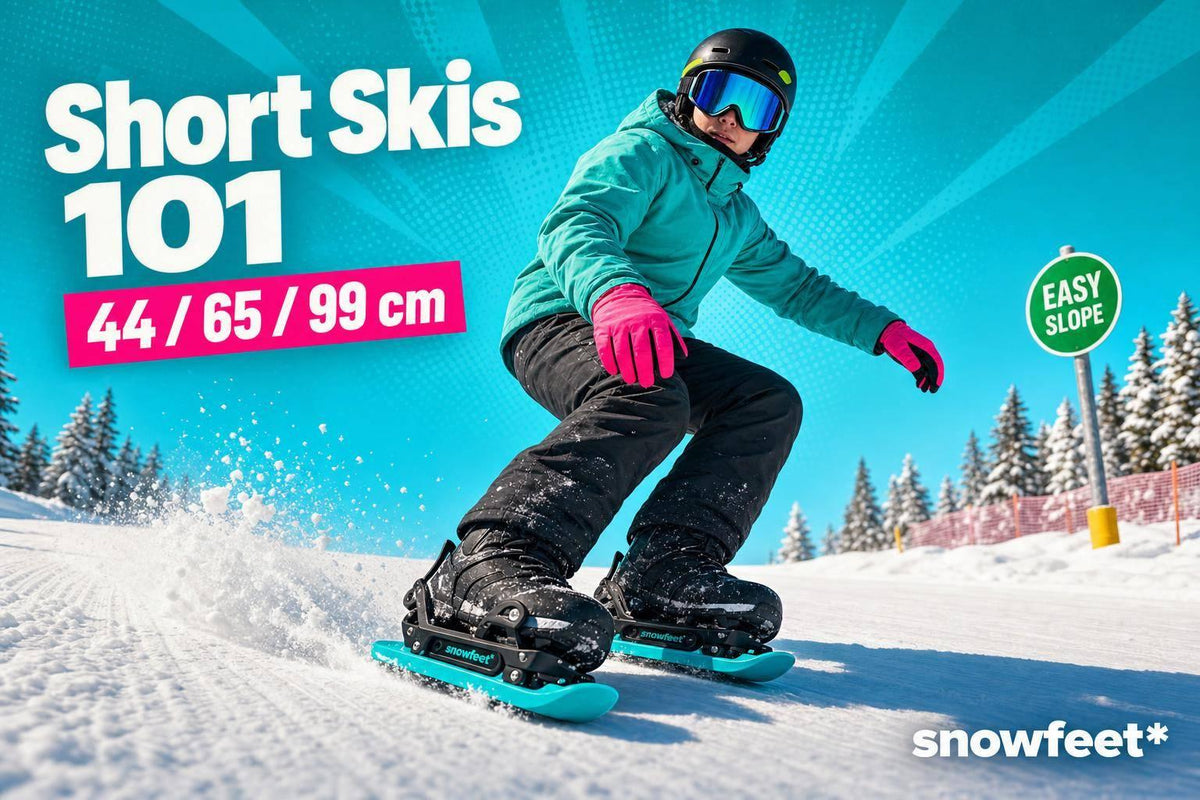
If I had to give one fast answer, it’s this: for most adults learning to ski, the 99 cm Snowfeet* Skiblades look like the best middle ground.
They sit between the tiny 44 cm Skiskates and the more ski-like 120 cm Short Skis. That means you get easy turning, more calm at speed, and room to grow without jumping straight to full-length skis.
Here’s the short version:
- 44 cm / 17 in.: best if you’re very nervous, want slow speed, or like a skate feel
- 65 cm / 26 in.: best if you want fast, tight turns and easy carrying
- 99 cm / 39 in.: best for most adult beginners
- 120 cm / 47 in.: best if you’re athletic, want more stability, and plan longer resort days
A few things stood out to me:
- Prices run from $460 to $950
- The shortest model is about 63% shorter than the 120 cm option
- 44 cm and 65 cm can work with snowboard boots
- 99 cm and 120 cm make more sense if you want skills that carry over to longer skis later
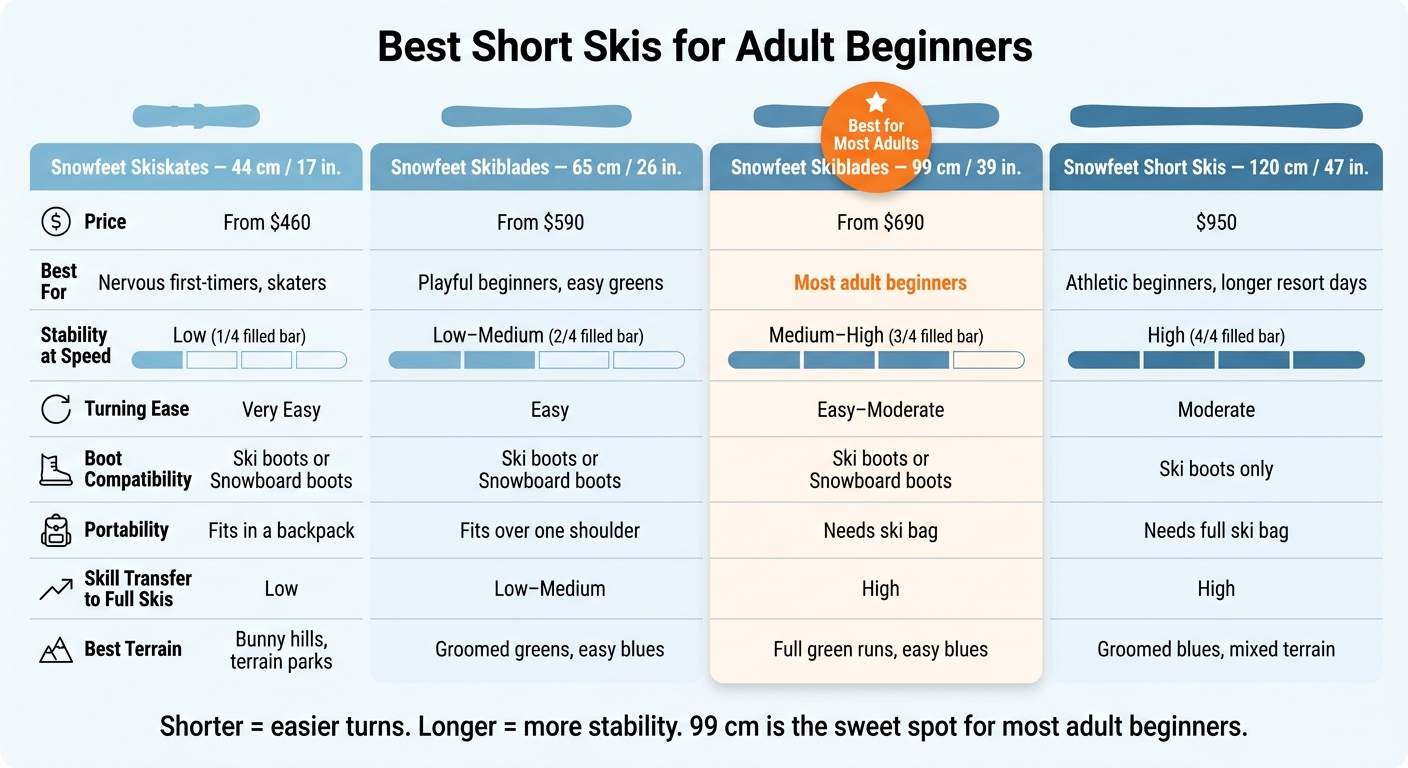
Best Short Skis for Adult Beginners: Side-by-Side Comparison
Snowboarder tries Snowfeet* | Which Snowfeet* Short Ski is the Best? | Snowblades 44, 65, 99 Review
Quick Comparison
| Model | Length | Price | Best For | Feel |
|---|---|---|---|---|
| Snowfeet* Skiskates | 44 cm / 17 in. | From $460 | Nervous first-timers, skaters | Very nimble, least steady |
| Snowfeet* Skiblades | 65 cm / 26 in. | From $590 | Playful beginners, easy greens | Fast turns, light feel |
| Snowfeet* Skiblades | 99 cm / 39 in. | From $690 | Most adults learning to ski | Best mix of turn ease and calm |
| Snowfeet* Short Skis | 120 cm / 47 in. | $950 | Athletic beginners, longer runs | Most stable, closest to regular skis |
My take? Shorter skis feel less scary. Longer short skis feel more settled. So, if you want the plain answer: go 44–65 cm for low-speed confidence, 99 cm for the best all-around pick, and 120 cm if you want a more ski-like ride from the start.
If you want a quick visual before you buy, these may help:
So, if you’re staring at ski lengths and thinking, “Uh, which one won’t make me eat snow in front of strangers?” - this guide points to a pretty clear answer: start with the length that matches your confidence, not your ego :)
1. Snowfeet* Skiskates 44 cm
At 44 cm (17 in.), Snowfeet* Skiskates are the shortest pick in this group. They feel much closer to skates than to standard skis.
Turning vs. Stability
Because they have less edge on the snow, they pivot fast and let you make tight turns without much effort. That’s a big plus if you’re new and don’t want to fight your gear.
The flip side shows up when you start going faster. The short platform needs more active front-to-back balance, and it won’t feel as planted as longer short skis. Verified customer Brad Tolin said it best:
"Only trade-off is at higher speeds, where longer skis still feel more stable."
Boot Compatibility
The 44 cm Skiskates work with ski boots or snowboard boots.
- Ski boots give you more precise control.
- Snowboard boots feel softer and more comfortable, which fits a more relaxed, skate-like ride.
Best Beginner Terrain
These are best on groomed slopes and in terrain parks. Deep snow, steep runs, and rough ungroomed terrain are not their happy place.
Learning Curve
If you already ski a little, ice skate, or rollerblade, the movement tends to click fast. For a lot of first-timers, basic sliding and steering come together pretty quickly on mellow slopes.
That said, the short platform does take some practice. You’ll need to get used to balancing over less ski. If you want something that feels steadier right from day one, the 99 cm or 120 cm options will be more forgiving.
If you like the idea of the 44 cm Skiskates but want a bit more stability, the 65 cm Skiblades are the next logical step.
2. Snowfeet* Skiblades 65 cm
If the 44 cm Skiskates feel a bit too twitchy, the 65 cm Skiblades are the next move.
At 65 cm (about 25.5 in.), they land right between the 44 cm Skiskates and the longer 99 cm version. So you get more edge contact and a steadier ride, without giving up that easy, quick feel.
Turning vs. Stability
This length gives you playful, fast turns with some carve support. It sits in that sweet spot between skates and skis. More steady than the 44 cm Skiskates, but still much quicker to move than the 99 cm Skiblades.
The wider skiblade platform also adds more surface area. For beginners, that can help with balance and edge grip on groomed snow at lower speeds.
Boot Compatibility
The 65 cm Skiblades work with ski boots or snowboard boots. Pricing starts at $590, and the binding setup changes the final cost.
Best Beginner Terrain
These work best on groomed runs and beginner terrain parks. Their short size makes them easy to carry from the parking lot and a lot less annoying in crowded ski areas than long skis.
That matters more than people think. When you're new, even small stuff helps. Less gear to wrestle with means more time riding and less time doing the awkward parking-lot shuffle.
They’re a good fit for:
- Easy greens
- Mellow blues
- Crowded base areas
Learning Curve
The 65 cm length can give early beginners more confidence than the 44 cm Skiskates, while still keeping that quick-turn feel.
If you want a bit more length and a steadier ride, the next step is the 99 cm Skiblades.
sbb-itb-17ade95
3. Snowfeet* Skiblades 99 cm
The 99 cm Skiblades (about 39 in.) are the sweet spot for a lot of adult beginners. Starting at $690, they sit right between the super-short, super-quick feel of the 65 cm model and the more ski-like feel of the 120 cm option.
Put simply: they’re easy to turn, but they don’t feel nervous once you start moving faster.
Turning vs. Stability
At 99 cm, you get more edge contact than with the 65 cm version. That matters. It helps the skiblades track better and feel less twitchy when speed builds.
You can still start turns with small steering inputs, which is nice when you're new and don’t want to wrestle your gear. But the added length keeps things calmer and more settled. The feel here is forgiving, not flimsy. More planted than the 65 cm. Easier to handle than the 120 cm.
Boot Compatibility
The 99 cm Skiblades usually come with ski bindings made for standard ski boots. Some setups also work with snowboard boots, but ski boots give you the best control when you're learning. That extra precision helps a lot, plain and simple.
Best Beginner Terrain
These do a better job with small bumps and chopped-up afternoon snow than the 65 cm version. So if the run gets a little messy later in the day, you’re less likely to feel thrown around.
They’re also still short enough to stay easy to manage in most resort conditions. That’s a nice middle ground for beginners who want something calm but not sluggish.
Learning Curve
Most adults can go from basic sliding to controlled wedge turns within a few sessions. That’s a big reason this length works so well for learning.
The 99 cm size also helps teach proper edge control. And those skills carry straight over to longer skis later on. You’re not just getting through your first days on snow - you’re learning movements that make the next step feel smooth and natural.
If you want more stability and a feel that’s closer to regular skis, move up to the 120 cm Short Skis.
For quick context, here’s how the mid-range options compare:
| Model | Best Stage of Learning | Stability at Speed | Tight-Space Maneuverability | Mixed-Terrain Capability | Confidence Fit |
|---|---|---|---|---|---|
| 65 cm Skiblades | First-day, ultra-beginner | Low–Medium | Excellent | Limited (best on smooth groomed) | Very anxious beginners |
| 99 cm Skiblades | Early-to-intermediate beginner | Medium–High | Very good | Solid for typical resort conditions | Cautious beginners |
| 120 cm Short Skis | Confident beginner ready to progress toward intermediate skiing | Highest | Good | Strongest for variable snow and firm patches | Confident or athletic beginners |
For adults who want the most stable short-ski option, the 120 cm model is next.
4. Snowfeet* Short Skis 120 cm
At $950, the 120 cm Short Skis are the longest Snowfeet* pick in this beginner-friendly part of the lineup. They’re also the most ski-like option in this group.
At 120 cm, they’re still much shorter than a standard beginner ski. But they feel more planted than the 99 cm model. So if the 99 cm feels a bit too zippy, the 120 cm version is a calmer next step.
Turning vs. Stability
The 120 cm length gives you more stability than the 99 cm model. It feels steadier on snow and deals with firmer, slightly rougher conditions with less twitch.
You can still turn them far more easily than long skis. That said, you give up a little of that fast, snappy pivot feel that the shorter Snowfeet* models have. For many adults, that’s a good trade. You get more confidence without losing the short-ski edge that makes learning less of a wrestling match.
Boot Compatibility
This model uses ski boots. Pick the binding setup that feels secure and familiar on day one.
Best Beginner Terrain
These skis do best on groomed beginner slopes and gentle blue runs. Think wide, predictable terrain where you can work on basic turns and build speed little by little.
They also handle slightly chopped-up or firmer snow better than the shorter models. So if a run has been skied out a bit, they won’t feel as unsettled. They’re happiest on open groomers, where the extra length feels calm and controlled.
Learning Curve
The 120 cm model fits adults who already have decent balance or plan to take a few lessons before skiing on their own.
The extra length asks a bit more from you when you start a turn. But it also helps you build better habits, like:
- stance
- edge control
- speed management
If you want a more ski-like platform while you build control, this model makes a lot of sense.
Here’s the quick comparison with the 99 cm model:
| Model | Length | Traditional Ski Feel | Stability | Turning Effort | Room to Progress | Best Beginner Type |
|---|---|---|---|---|---|---|
| Snowfeet* Skiblades | 99 cm (39 in.) | Low–Medium | Medium | Low | Moderate | Cautious first-timers |
| Snowfeet* Short Skis | 120 cm (47 in.) | Medium–High | Medium–High | Moderate | Good | Confident beginners wanting a more ski-like feel |
Next, match each length to the beginner type it fits best.
Pros and Cons for Each Beginner Type
The best short ski comes down to three things: your confidence, your balance, and where you want to ride.
This table makes that choice easier. Instead of sorting by length alone, it matches each model to a type of beginner.
| Model | Main Strength | Main Trade-Off | Best For Nervous Adults | Best For Athletic Adults | Portability | Boot Flexibility |
|---|---|---|---|---|---|---|
| Skiskates 44 cm (from $460) | Lowest intimidation factor of the four | Not the best pick for all-day resort use | Timid adults who want short glides near the lodge, not full runs | Fun secondary option for fit adults with skating or hockey backgrounds | Fits in a backpack; easiest to travel with | Ski boots or snowboard boots |
| Skiblades 65 cm (from $590) | More surface area than the 44 cm for better edge grip on groomed snow | Can chatter and feel less planted when speed builds on longer runs | Cautious learners who can already skate and want real resort runs | Good for sporty beginners who want quick turns on greens and easy blues | Fits diagonally in many car trunks; easy to carry over one shoulder | Ski boots or snowboard boots |
| Skiblades 99 cm (from $690) | Skills transfer directly to full-sized skis later | Demands better weight distribution and edge control than shorter models | Beginners who want faster progress and don't want to outgrow their gear quickly | Best match for fit newcomers who want fast progression to parallel turns and moderate-speed carving | Needs a standard ski bag; still far easier to handle than 160–180 cm skis | Ski boots or snowboard boots |
| Short Skis 120 cm ($950) | Handles longer, more open runs with the most stability of the four | More intimidating for absolute first-timers than shorter options | Nervous but goal-driven adults taking formal lessons who can work through early fear for long-term stability | Ideal for confident beginners - fit adults with board-sport experience can make parallel turns on greens within a day or two | Requires a full-length ski bag; most awkward to carry of the four, though still shorter than standard skis | Ski boots |
Here’s the plain-English version:
- 44 cm works best for the most cautious beginners
- 65 cm fits skaters and people who like quick turns
- 99 cm suits learners who want faster progress
- 120 cm is a better fit for adults who want a more planted ski on longer runs
Boot choice follows the same logic. Ski boots give you the most control. Snowboard boots feel softer and more relaxed on the shortest models.
So, keep it simple: match the ski to how confident you feel right now. Then move up only if you want more stability.
Final Pick: Match Your Short Ski to Your Confidence and Terrain
After looking at all four lengths, the choice comes down to how confident you feel and where you plan to ski. Shorter options feel easier at low speed. Longer short skis feel steadier when the hill gets faster or the terrain gets a bit tougher.
If speed makes you nervous and you plan to stay on a bunny hill, start with the Skiskates 44 cm ($460). They make the most sense when ease is your top goal. If you want a little more stability than 44 cm, move up to 65 cm.
The 65 cm Skiblades ($590) work well for active beginners who want quick turns and easy control. The 99 cm Skiblades ($690) fit riders who want more stability, less chatter, and better confidence on full green runs and when starting on easy blue runs.
For athletic adults planning full resort days on mixed terrain, go with the Short Skis 120 cm ($950). They’re the right pick for full-day resort use on varied terrain. Plain and simple.
Here’s the simple way to think about it:
- 44–65 cm: easiest to handle, easiest to carry, best for slower speeds and nearby weekend hills
- 99 cm: the sweet spot for most adult beginners
- 120 cm: best for athletic adults skiing bigger terrain for longer days
For short weekend trips, 44–65 cm is easier to pack and carry. For bigger trips out West, 99–120 cm is worth the extra bag space. For most adult beginners, the 99 cm Skiblades offer the best mix of ease, stability, and room to improve.
FAQs
Should I start with 99 cm or 120 cm?
It depends on what you want as you move past the beginner stage. The 99 cm Snowfeet Skiblades hit a nice middle ground between quick turns and steady control, which makes them a smart pick for groomed runs and light powder.
The 120 cm model fits riders who want more speed, sharper carving, or more float in deeper snow. It feels closer to regular skis, but still keeps the easy, nimble feel Snowfeet is known for.
Are short skis easier to learn on than regular skis?
Yes. Short skis are usually easier to learn on than long, regular skis.
Why? They’re lighter and more compact. That means turning feels simpler, stopping takes less effort, and the skis don’t feel as awkward under your feet.
Compared with bulkier standard skis, Snowfeet skiblades tend to feel easier to control and easier to move around on. For beginners, that can make a big difference. You spend less time fighting the gear and more time getting used to balance, movement, and basic turns.
So, if you’re just starting out, short skis can help you build confidence faster and make those first runs feel a lot less intimidating :)
Do I need ski boots, or can I use snowboard boots?
You don’t need specialized ski boots. That’s one of the best things about Snowfeet*: they work with regular winter boots or snowboard boots, unlike standard skis that need stiff alpine boots.
For the best ride, go with boots that are:
- Waterproof
- Built with firm soles
- Made with good ankle support
That setup can save you money and make your gear a lot easier to carry. Nice and simple :)











Lascia un commento
Questo sito è protetto da hCaptcha e applica le Norme sulla privacy e i Termini di servizio di hCaptcha.