



















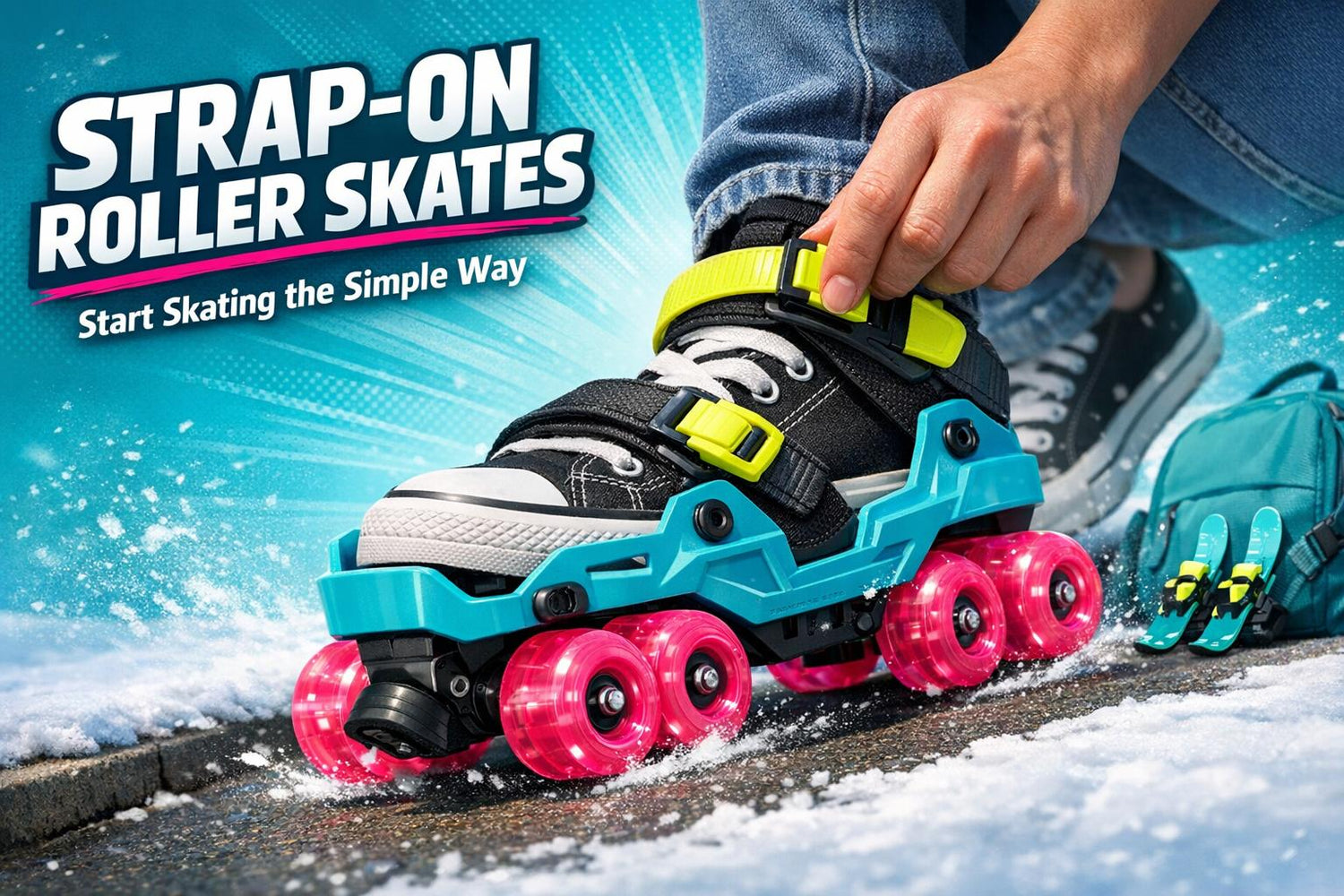
Les patins à roulettes à sangles sont le moyen le plus simple de s’initier au patinage sans investir dans un équipement encombrant. Fixez-les simplement à vos chaussures habituelles et vous êtes prêt à rouler — pas besoin de bottines rigides ni d’installation complexe. Ces patins sont parfaits pour les débutants, car :
- Stabilité : La conception à quatre roues, avec deux roues à l’avant et deux à l’arrière, facilite beaucoup l’équilibre par rapport aux patins en ligne.
- Transportabilité : Légers et compacts, ils se glissent dans votre sac à dos pour patiner où que vous soyez.
- Facilité d’utilisation : Fixez-les en quelques minutes et commencez à vous entraîner sans avoir besoin de chaussures spéciales.
Les patins Wheelfeet de Snowfeet sont une option remarquable. Ils conviennent aux pointures américaines 6 à 13, utilisent des sangles durables pour un maintien sécurisé et fonctionnent aussi bien sur le bitume que sur la neige. Que vous soyez débutant ou que vous cherchiez simplement une manière peu contraignante de vous essayer au patinage, les patins à sangles sont un choix amusant et simple.
Nouveaux patins à roulettes pour débutants dès la sortie de la boîte : comment les installer et les essayer pour la première fois
Que sont les patins à roulettes à sangles ?
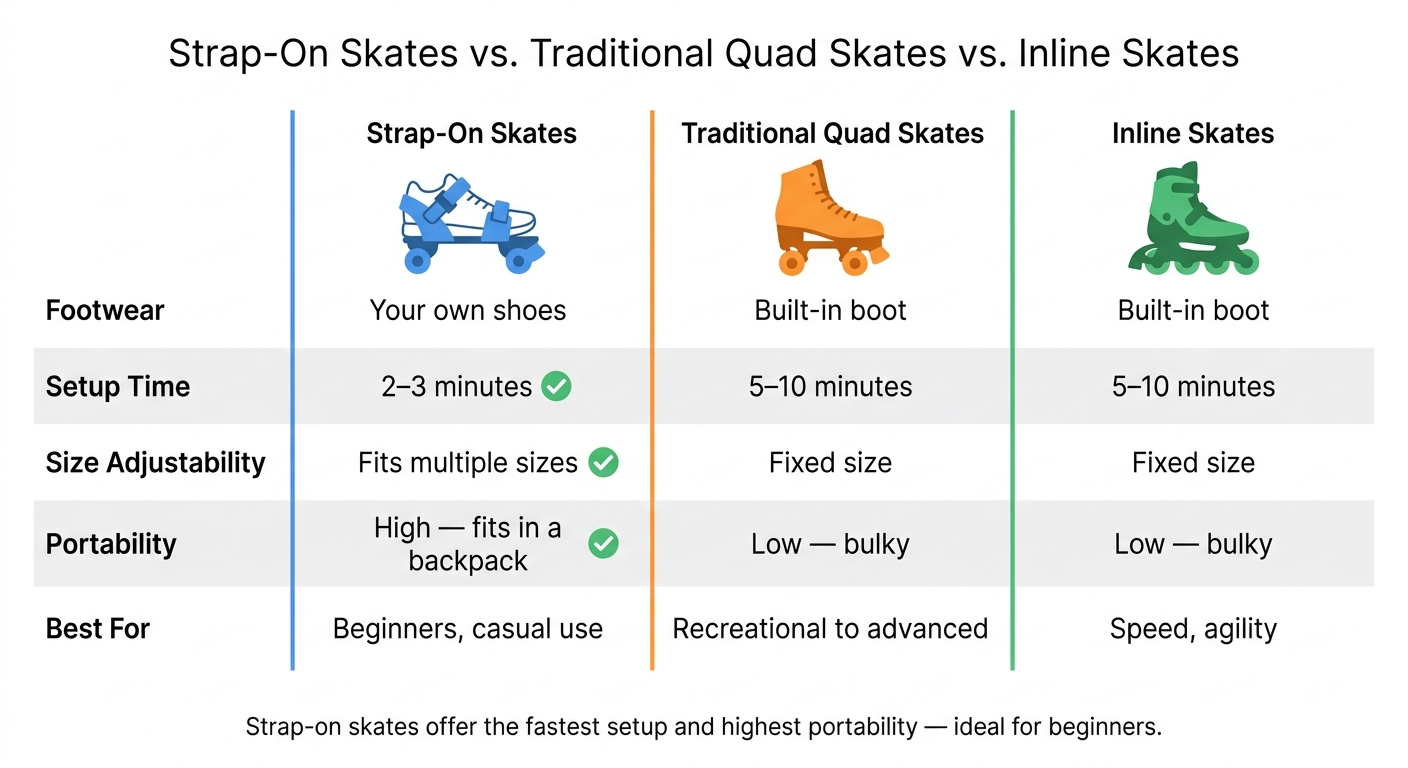
Patins à roulettes à sangles contre patins quads traditionnels et patins en ligne : comparaison des caractéristiques
Les patins à roulettes à sangles sont de petites plateformes équipées de roues qui se fixent directement à vos chaussures de tous les jours. Contrairement aux patins traditionnels, ils n’ont pas de bottine intégrée. Les roues et le cadre se placent sous votre chaussure. Il vous suffit d’aligner votre chaussure, de serrer les sangles et vous êtes prêt à rouler. Leur conception simple et leur installation facile en font une excellente option pour les débutants.
La conception est simple, mais efficace : un cadre robuste maintient les roues, tandis que des sangles réglables maintiennent fermement votre chaussure en place. La plupart des modèles comprennent également des coussinets texturés ou caoutchoutés sur le dessus pour empêcher votre pied de glisser. En général, deux sangles réglables et des fermetures rapides garantissent un maintien bien ajusté.
Principales caractéristiques de conception des patins à sangles
Le cadre est généralement fabriqué à partir de matériaux tels que le plastique renforcé, l’aluminium ou des matériaux composites. Ces matériaux gardent les patins légers tout en offrant suffisamment de solidité pour supporter le poids du patineur. Les roues sont souvent en polyuréthane, ce qui garantit une bonne adhérence sur des surfaces comme les trottoirs, l’asphalte ou les sols intérieurs lisses.
L’un des principaux atouts est l’ajustabilité. De nombreux patins à sangles s’adaptent à plusieurs pointures américaines, ce qui les rend particulièrement pratiques pour les enfants qui grandissent encore. Certains modèles pour enfants peuvent même couvrir 4 à 5 pointures avec une seule paire.
Prenons par exemple les patins Wheelfeet de Snowfeet. Ces patins à fixer sont conçus pour être polyvalents et conviennent aux pointures américaines 6 à 13 (UE 38 à 47). Ils utilisent des sangles résistantes et des boucles à cliquet pour garantir un ajustement sûr et confortable, sans avoir besoin de lacets. Cela en fait une option adaptée aux débutants par rapport aux patins traditionnels.
Ces caractéristiques rendent les patins à fixer non seulement durables et adaptables, mais offrent également une option accessible aux personnes qui débutent en patinage.
Pourquoi les patins à fixer sont faciles à utiliser pour les débutants
L’absence de chaussure intégrée change complètement la donne pour les débutants. Comme vous utilisez vos propres chaussures, l’ajustement est naturel et familier dès le départ, ce qui peut rendre l’apprentissage moins intimidant.
Ils sont également incroyablement faciles à installer. En quelques minutes seulement, vous pouvez les fixer à vos chaussures et commencer à vous entraîner, ce qui facilite l’intégration de courtes séances et permet de gagner rapidement en confiance. Et si le patinage ne vous plaît finalement pas, vous n’aurez pas investi dans un équipement complet.
Voici une comparaison rapide entre les patins à fixer et les autres types de patins :
| Caractéristique | Patins à fixer | Patins traditionnels à quatre roues | Patins en ligne |
|---|---|---|---|
| Chaussures | Vos propres chaussures | Chaussure intégrée | Chaussure intégrée |
| Temps d’installation | 2 à 3 minutes | 5 à 10 minutes | 5 à 10 minutes |
| Réglage de la taille | Convient à plusieurs pointures | Taille fixe | Taille fixe |
| Transportabilité | Élevée - tient dans un sac à dos | Faible - encombrants | Faible - encombrants |
| Idéal pour | Débutants, utilisation occasionnelle | De loisir à avancé | Vitesse, agilité |
Pour une expérience optimale, privilégiez les chaussures fermées avec des semelles plates et solides, comme des baskets de sport. Évitez les sandales, les chaussures sans lacets ou les chaussures à talons surélevés, car elles peuvent bouger dans les sangles et nuire à votre contrôle.
Avantages des patins Snowfeet* à fixer

Les patins Snowfeet* apportent un tout nouveau niveau de praticité et de polyvalence aux sports d’hiver. Ils sont conçus pour être utilisés sur différentes surfaces et en toute saison, ce qui en fait une excellente option pour les débutants qui souhaitent profiter du patinage sans investir dans un équipement encombrant ou coûteux.
Design compact et portable
L’un des principaux atouts des patins Snowfeet* est leur facilité de transport. Ils sont suffisamment petits pour tenir dans un sac à dos classique, ce qui évite de transporter un équipement surdimensionné. Vous allez au parc ou dans une station de ski ? Il vous suffit de les mettre dans votre sac et vous êtes prêt à partir.
"Assez compacts pour tenir dans un sac à dos, évitant ainsi d’avoir à transporter un équipement encombrant." - Big Frog 104
Leur portabilité contribue également à leur utilisation toute l’année, pour encore plus de praticité.
Utilisation sur différentes saisons et surfaces
Les patins Snowfeet* sont conçus pour toutes sortes de conditions. Sur le bitume, ils glissent en douceur, tandis que sur la neige, ils se comportent comme des mini-skis qui se fixent à vos chaussures d’hiver ou à vos chaussures de snowboard. Que vous soyez sur des pistes de ski, des sentiers de ski de fond ou même sur un terrain verglacé, ces patins s’adaptent parfaitement.
« Un mélange de skis et de patins qui apporte le plaisir du patinage sur les pistes. Ils sont essentiellement comme des patins à glace pour les pistes de ski ! » — Snowfeet.com
Cette flexibilité en fait un excellent choix si vous n’êtes pas prêt à investir dans un équipement distinct pour chaque saison ou chaque surface.
Patins Snowfeet* ou équipement de ski et de snowboard
Lorsque l’on compare les patins Snowfeet* à l’équipement de ski ou de snowboard traditionnel, les différences sont évidentes. Ils sont plus légers, plus abordables et plus faciles à utiliser, ce qui en fait une option attrayante pour les débutants en sports d’hiver.
| Caractéristique | Patins Snowfeet* | Équipement de ski et de snowboard traditionnel |
|---|---|---|
| Transportabilité | Tient dans un sac à dos standard | Nécessite des barres de toit ou un grand véhicule pour le rangement |
| Courbe d’apprentissage | Intuitif, comme le patinage sur glace | Difficile ; nécessite de maîtriser un équipement long |
| Chaussures | Utilisez vos propres chaussures d’hiver ou de snowboard | Chaussures de ski spécialisées et rigides requises |
| Prix | À partir d’environ 149 $ | Généralement plus de 400 $ pour un équipement d’entrée de gamme |
| Entretien | Minimal ; facile à ranger | Fartage et affûtage réguliers, rangement encombrant |
Pour les débutants, la différence de prix est considérable. Un équipement de ski de base — comprenant les skis, les chaussures et les fixations — peut facilement dépasser 400 $, sans compter les forfaits ou les cours. Les patins Snowfeet*, quant à eux, commencent à seulement 149 $ et s’utilisent avec les chaussures que vous possédez déjà. C’est un investissement bien moindre, tant sur le plan financier que logistique, pour toute personne qui souhaite découvrir les sports d’hiver.
sbb-itb-17ade95
Comment choisir les bons patins à sangles
Choisir la bonne taille, privilégier une construction robuste et s’assurer que les patins correspondent à votre niveau sont essentiels pour profiter pleinement de votre expérience. Maîtrisez ces facteurs et vous progresserez plus facilement.
Caractéristiques clés à rechercher
La sécurité des sangles est indispensable. Des sangles desserrées peuvent perturber votre équilibre ; recherchez donc des sangles larges et réglables qui maintiennent fermement votre talon en place. Un maintien ferme du talon est essentiel pour des mouvements sûrs et maîtrisés. Snowfeet* prend cet aspect très au sérieux avec son système de boucle à cliquet, qui offre un ajustement précis et sécurisé, bien supérieur aux modèles de sangles classiques.
Les roues en uréthane de haute qualité sont une autre caractéristique essentielle. Elles offrent une meilleure adhérence et absorbent bien les chocs, que vous patiniez en intérieur ou sur des chemins extérieurs accidentés. Les roues Snowfeet* sont conçues pour être polyvalentes, ce qui en fait un choix fiable pour les patineurs qui évoluent sur différentes surfaces.
Une taille réglable est particulièrement importante pour les jeunes patineurs. De nombreux modèles pour débutants s’ajustent à plusieurs pointures sans outils, ce qui vous évite d’acheter de nouveaux patins chaque saison. Snowfeet* se distingue avec son système de fixation réglable compatible avec les baskets, les bottes d’hiver ou les bottes de snowboard — un avantage majeur par rapport aux patins traditionnels, qui nécessitent des chaussures spécifiques.
Choisir selon l’âge et le niveau
Après avoir identifié les caractéristiques essentielles, tenez compte de votre âge et de votre niveau pour trouver le modèle adapté.
Pour les enfants, les modèles réglables proposés entre 39,99 $ et 54,99 $ constituent une solution économique qui s’adapte à la croissance du pied. Pour les adultes, Snowfeet* propose une option d’entrée de gamme plus haut de gamme. À partir d’environ 250 $, ces patins se fixent à vos chaussures habituelles et offrent de bonnes performances sur différentes surfaces et en toute saison. Comparés aux patins à roulettes traditionnels ou même aux équipements de ski et de snowboard, ils offrent un bien meilleur rapport qualité-prix.
Comment débuter avec des patins à roulettes à sangles
Préparer vos patins et vos chaussures
Avant de vous lancer sur le bitume ou la neige, prenez un moment pour vérifier votre équipement. Assurez-vous que les roues tournent librement, que les boulons des axes sont bien serrés et qu’aucun débris ne s’est coincé dans les roues. Inspectez les sangles et les boucles pour vous assurer qu’elles se verrouillent correctement. Si quelque chose semble desserré, prenez une petite clé hexagonale et resserrez-le avant de commencer.
Le choix de vos chaussures joue un rôle essentiel dans la sécurité et le contrôle de votre glisse. Pour le bitume, optez pour des baskets à semelle rigide ou des chaussures de randonnée légères avec un laçage complet et un bon maintien de la cheville. Évitez les chaussures souples et flexibles, comme les modèles sans lacets ou les baskets décontractées. Pour la neige avec Snowfeet*, choisissez des bottes d’hiver imperméables ou des bottes de snowboard offrant un maintien ferme de la cheville. Les bottes rembourrées ou trop souples peuvent poser problème en empêchant les sangles de se resserrer correctement. Un bon conseil ? Utilisez une technique de laçage avec blocage du talon en passant par les œillets supérieurs, afin de maintenir votre pied en place et d’éviter qu’il ne glisse.
Une fois votre équipement préparé et vos chaussures prêtes, il est temps d’attacher vos patins.
Comment enfiler des patins à sangles
Après avoir inspecté vos patins, suivez ces étapes pour les enfiler correctement :
- Ouvrez toutes les sangles : Desserrez complètement les sangles et les boucles, puis posez le patin à plat sur le sol.
- Positionnez votre pied : Placez votre pied de manière à ce que sa plante soit centrée au-dessus de l’empattement des roues et que votre talon repose bien dans la zone de la sangle arrière.
- Serrez la sangle à l’avant-pied : Tirez sur la sangle pour la resserrer sur une partie rigide de votre chaussure. Avec les fixations Snowfeet*, abaissez la sangle à cliquet jusqu’à ce que votre pied soit bien maintenu, sans inconfort.
- Fixez la sangle de cheville : serrez cette sangle suffisamment pour éliminer le soulèvement du talon. Ajustez la longueur de la sangle si vous alternez entre différents types de chaussures, comme des baskets et des bottes.
- Effectuez un test de secouage : en position assise, soulevez un pied et secouez-le franchement. Votre patin et votre chaussure doivent bouger d’un seul bloc. S’il y a du jeu, resserrez les sangles d’un cran à la fois.
Avant de bouger, tenez-vous sur une surface comme de l’herbe, de la moquette ou de la neige tassée, puis balancez-vous doucement d’avant en arrière pour vérifier que tout semble stable. Les patins Snowfeet* sont conçus pour s’adapter aussi bien au bitume qu’à la neige grâce à leurs fixations à cliquet et à leur conception polyvalente.
Compétences de base : équilibre, déplacements et arrêt
Une fois vos patins chaussés et ajustés, il est temps de vous concentrer sur les bases : l’équilibre, les déplacements et l’arrêt. Commencez par vous tenir debout, les pieds écartés de la largeur des épaules, les genoux légèrement fléchis et les hanches abaissées. Gardez les bras écartés sur les côtés, les coudes fléchis, et regardez devant vous à environ 3 à 4,5 mètres plutôt que vos patins. Cette posture aide à garder votre poids centré et votre équilibre.
Évitez de vous pencher en arrière, car cela peut vous faire perdre l’équilibre. Si vous sentez que vous basculez vers l’arrière, pliez davantage les genoux et avancez légèrement le torse au-dessus d’eux.
Lorsque vous êtes prêt, commencez par de petits pas de marche. Soulevez un pied de quelques centimètres, reposez-le, puis alternez. Une fois à l’aise, essayez de courtes glissades : poussez sur le côté avec un pied tandis que l’autre glisse sur quelques mètres, puis inversez. Sur le bitume, gardez votre poids centré au-dessus du pied qui glisse et les genoux fléchis. Sur la neige avec Snowfeet*, faites de petits pas en V (orteils légèrement orientés vers l’extérieur, talons rapprochés) sur des pentes douces, en laissant la gravité vous aider à avancer lentement.
Apprendre à s’arrêter est essentiel. Avec des patins à sangles équipés de roues et d’un frein au talon, pliez les genoux, transférez votre poids sur le pied qui freine, avancez-le légèrement, puis appuyez fermement le frein au talon sur le sol. Avec Snowfeet* sur la neige, essayez un arrêt en chasse-neige : tournez vos orteils vers l’intérieur, poussez vos talons vers l’extérieur et pliez les genoux pour permettre aux carres intérieures des patins de s’enfoncer dans la neige et de vous ralentir.
L’American Academy of Orthopaedic Surgeons indique que plus de 50 % des blessures liées au patinage en ligne touchent le poignet ou l’avant-bras. Porter des protège-poignets et un casque est indispensable lors de vos premières séances.
Limitez votre première séance : 20 à 40 minutes, c’est idéal. La fatigue peut provoquer des chutes, et des séances d’entraînement plus courtes et ciblées vous aident à développer plus rapidement votre mémoire musculaire sans vous épuiser.
Conclusion : pourquoi les patins à sangles sont un bon moyen de commencer le patinage
Les patins à sangles rendent le patinage simple et accessible aux débutants. Grâce à leur conception à quatre roues, ils offrent la stabilité dont les nouveaux patineurs ont besoin. De plus, ils se fixent directement à vos chaussures habituelles : nul besoin d’investir immédiatement dans des chaussures spécialisées.
Ce qui distingue les Snowfeet*, c’est qu’ils fonctionnent toute l’année. Contrairement à l’équipement traditionnel de ski ou de snowboard, limité à l’hiver, les patins Snowfeet* glissent sur le bitume en été et s’attaquent à la neige en hiver. En associant des chaussures de tous les jours à une conception durable, les patins Snowfeet* offrent une manière abordable et flexible de profiter du patinage quelle que soit la saison.
FAQ
Les patins à roulettes à sangles sont-ils sûrs pour les débutants ?
Les patins à roulettes à sangles, comme les Snowfeet, sont une excellente option pour les débutants lorsqu’ils sont utilisés correctement. Leur conception légère et leur facilité d’utilisation les rendent parfaits pour toute personne qui débute. Comparés aux patins traditionnels ou à des activités comme le ski, ils privilégient davantage la stabilité et la simplicité. Pour rester en sécurité, portez toujours un équipement de protection, restez dans des zones d’entraînement sûres et suivez les conseils adaptés aux débutants proposés dans les guides. Pour les jeunes patineurs, une supervision adéquate est toujours une bonne idée.
Quelles chaussures conviennent le mieux aux patins à sangles Snowfeet* ?
Les patins à sangles Snowfeet s’associent idéalement à des chaussures robustes et confortables offrant un bon maintien de la cheville et un ajustement parfait. Les bottes de randonnée ou les bottes d’hiver sont d’excellents choix : ce sont des modèles souvent portés pour les activités sur neige et les sports d’hiver.
Où puis-je utiliser les Snowfeet* (sur le bitume ou sur la neige) ?
Les patins à sangles Snowfeet changent la donne pour les amateurs d’activités en plein air. Sur la neige, ils fonctionnent comme des mini-skis et offrent une glisse fluide avec une stabilité étonnante, idéale pour le ski loisir ou les plaisirs de l’hiver. Sur le bitume, leur conception légère permet de passer facilement des trottoirs aux sentiers ou aux parcs. Contrairement à l’équipement encombrant de ski ou de snowboard, les Snowfeet sont compacts et faciles à transporter, ce qui les rend parfaits pour des aventures toute l’année.
Articles de blog associés
- Patins à glace à sangles ou patins à glace traditionnels : avantages et inconvénients pour les débutants
- Meilleurs patins à sangles abordables : patinez avec n’importe quelles chaussures (guide 2025) ← positionnement de Snowfeet
- Patins à roulettes sans chaussures : les patins à sangles expliqués
- Patins à roulettes pour débutants qui se fixent à toutes les chaussures (sélection 2026)











Laisser un commentaire
Ce site est protégé par hCaptcha, et la Politique de confidentialité et les Conditions de service de hCaptcha s’appliquent.