



















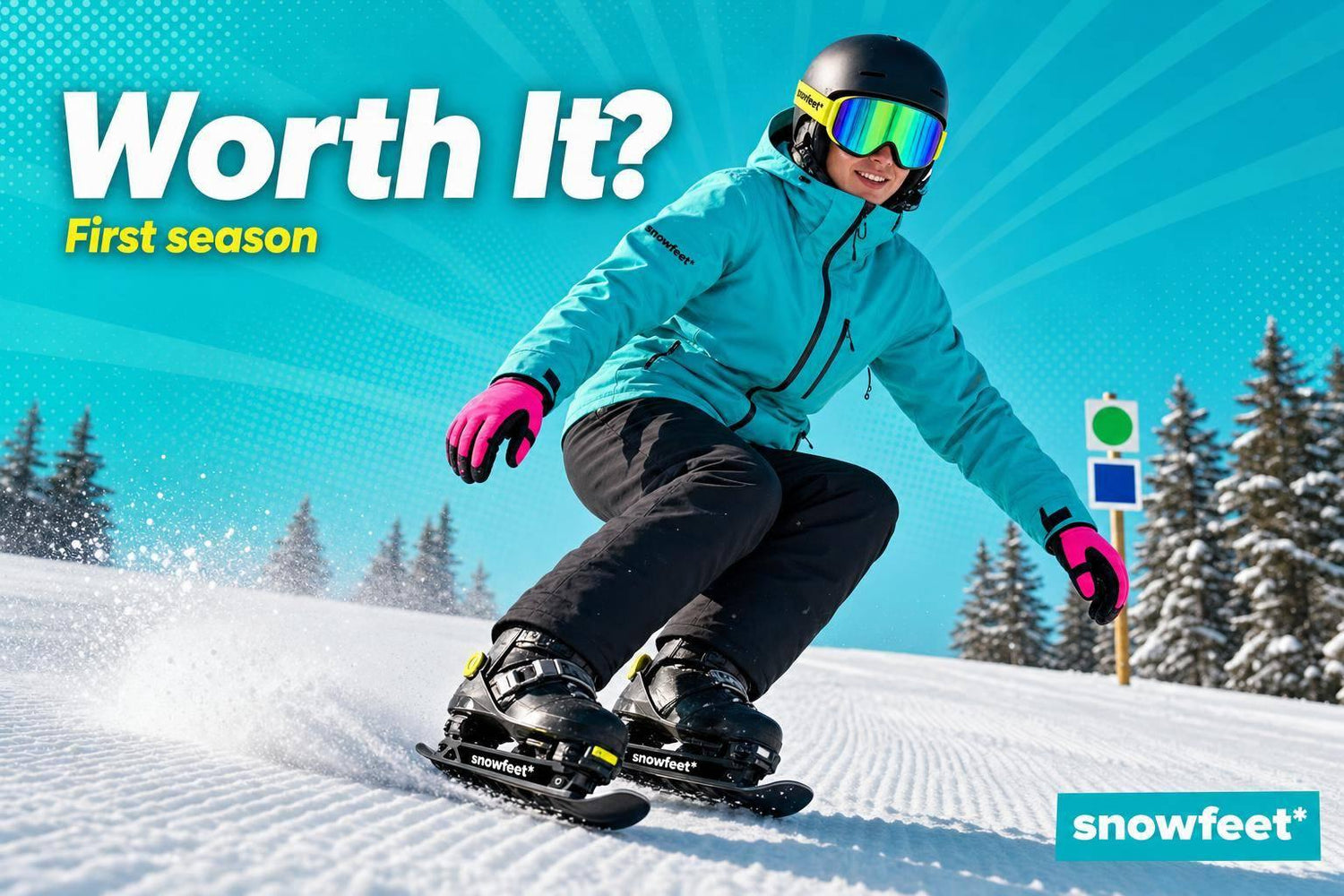
Oui — si vous débutez dans les sports d’hiver et prévoyez de rester sur des pistes vertes damées ou des pistes bleues faciles, les skiskates peuvent être un excellent premier achat. Je les conseillerais à la plupart des pratiquants de première saison qui recherchent un contrôle facile, moins de contraintes liées à l’équipement et un équipement qui ne semble pas énorme dès le premier jour.
Voici la version courte :
- Les skiskates sont plus faciles à transporter et à ranger que des skis ou un snowboard.
- Ils sont plus efficaces à vitesse faible ou modérée sur une neige damée et régulière.
- Ils sont particulièrement adaptés si vous avez déjà fait du patin à glace ou du roller.
- Ils ne conviennent pas à la poudreuse, aux pistes raides ni à la grande vitesse.
- Pour la plupart des débutants, le modèle Snowfeet* PRO 50 cm est un choix plus sûr que le modèle de 44 cm.
Quelques chiffres permettent de mieux comprendre :
- La location de skis dans les stations américaines coûte en moyenne environ 65 $/jour
- Les frais de bagage de sport des compagnies aériennes peuvent atteindre 60 à 100 $ par trajet
- De nombreux skieurs débutants ont besoin de 1 à 3 journées complètes pour enchaîner les virages sur une piste verte
- Les nouveaux snowboardeurs ont souvent besoin de 2 à 4 jours pour dépasser la phase où les chutes s’enchaînent sans arrêt
Ainsi, si votre objectif est simple — apprendre vite, vous sentir stable et éviter de devoir vous battre avec un équipement encombrant sur le parking — les skiskates méritent vraiment votre attention.
| Option | Idéal pour | Principal avantage | Principale limite |
|---|---|---|---|
| Snowfeet* Skiskates 44 cm | Les débutants ayant déjà pratiqué le patinage | Virages très faciles, sensation proche du patinage | Moins stables à grande vitesse |
| Snowfeet* PRO 50 cm | La plupart des débutants en première saison | Plus stables, plus rassurants | Un peu moins agiles |
| Skis | Les pratiquants qui veulent de la vitesse et de la poudreuse plus tard | Meilleurs à grande vitesse et sur neige irrégulière | Plus difficiles à transporter, plus exigeants dès le premier jour |
| Snowboard | Les pratiquants décidés à faire du snowboard | Une bonne option polyvalente pour la montagne | Des premiers jours plus difficiles, davantage de chutes au début |
Mon avis ? Si vous voulez débuter de façon amusante et sans complications, les skiskates sont un choix judicieux. Si vous savez déjà que vous voulez profiter de journées en poudreuse, de terrains plus raides ou progresser à long terme en montagne, optez plutôt pour des skis ou un snowboard.
Et oui, voilà l’idée, en termes simples : les skiskates valent le coup pour beaucoup de débutants, mais pas pour tous les types de pratique.
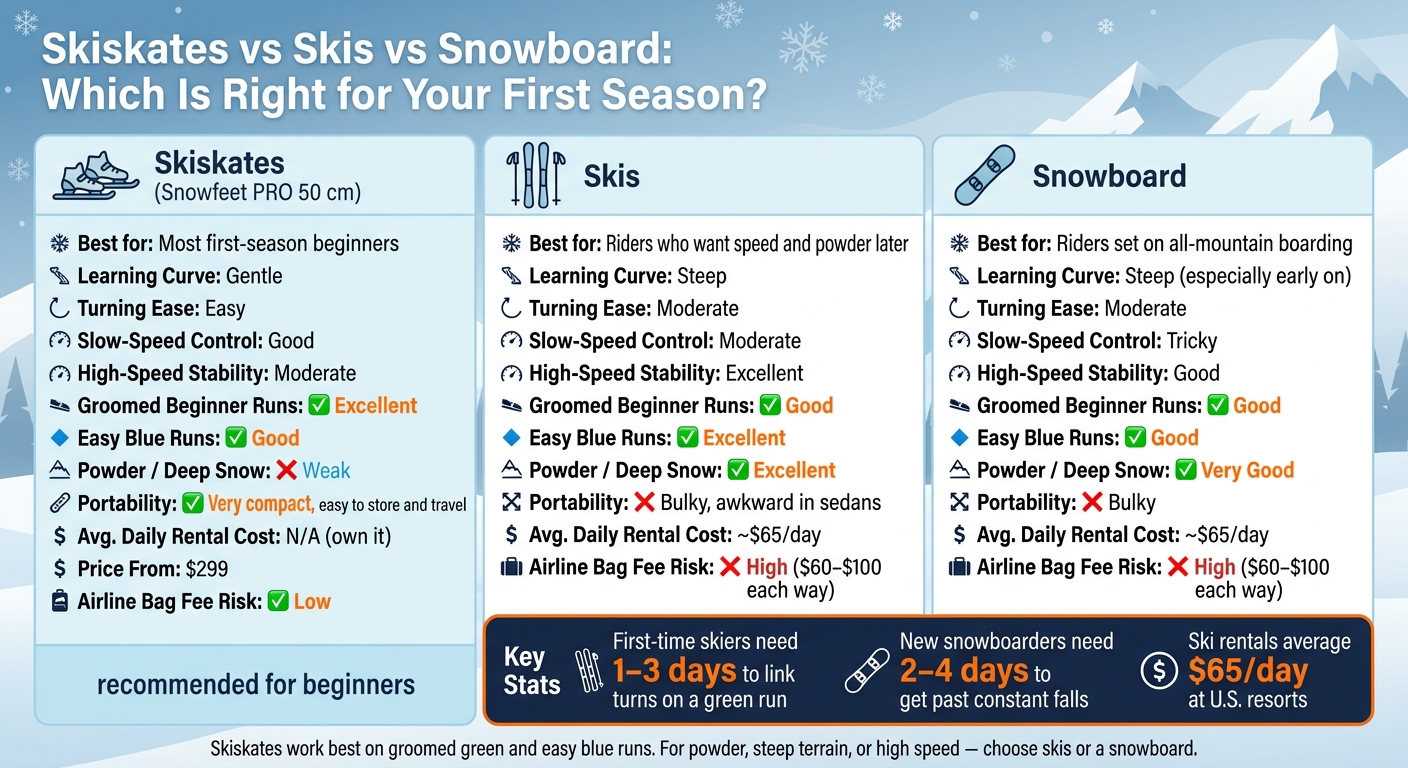
Skiskates contre skis et snowboard : guide du débutant sur l’équipement de sports d’hiver
Pourquoi de nombreux débutants peinent avec un équipement classique
Les skis et snowboards longs peuvent être plus difficiles à maîtriser dès le premier jour
Pour un pratiquant débutant lors de sa première saison, le premier jour se résume généralement à trois choses : tourner, s’arrêter et ne pas laisser la vitesse prendre le dessus.
C’est là que les skis et snowboards classiques peuvent sembler un peu impitoyables. Les petites erreurs d’équilibre prennent vite de l’ampleur. À ski, des spatules qui se croisent ou un transfert de poids hésitant peuvent envoyer un débutant dans la neige en un instant. En snowboard, les deux pieds sont attachés, ce qui ajoute sa propre courbe d’apprentissage. Et quand les chutes surviennent, elles se traduisent souvent par des poignets meurtris et un coccyx douloureux. Pas très amusant.
Les écoles de ski américaines estiment généralement qu’il faut 1 à 3 journées complètes avant qu’un débutant puisse enchaîner les virages sur une piste verte. Pour le snowboard, il faut souvent 2 à 4 jours simplement pour dépasser le stade où les chutes semblent constantes.
Les coûts cachés s’accumulent rapidement aux États-Unis
La piste n’est pas le seul obstacle. La facture peut aussi faire mal.
Une première configuration de ski aux États-Unis peut coûter des centaines de dollars avant même l’achat d’un forfait. Et la location ne résout pas toujours le problème. Une formule complète de location coûte en moyenne environ 65 $ par jour dans les stations américaines.
Donc, si vous ne faites que tâter le terrain, cela représente une dépense assez importante avant même de savoir si ce sport vous plaît.
La transportabilité compte plus que ne le pensent la plupart des débutants
Et puis il y a ce moment auquel on ne pense pas avant de se retrouver à lutter avec son équipement sur un parking.
Les skis longs et les snowboards sont difficiles à ranger, à charger et à transporter. Ils ne rentrent généralement pas dans la plupart des berlines, sauf si vous rabattez les sièges. Prendre l’avion peut également être compliqué, car les compagnies aériennes considèrent souvent les housses de ski comme des bagages volumineux. Les compagnies à bas prix comme Frontier et Spirit sont connues pour facturer 60 à 100 $ par trajet pour l’équipement de sports d’hiver.
C’est beaucoup de tracas supplémentaires pour un équipement que vous n’utiliserez peut-être que quelques fois, d’où l’intérêt d’examiner de plus près les options compactes.
Quand les skiskates valent le coup pour les débutants
Courbe d’apprentissage et contrôle sur pistes damées
Pour les débutants, les skiskates sont un choix judicieux lorsque la facilité de virage et le contrôle rapide comptent davantage que le fait de rester calme à grande vitesse. C’est le principal compromis.
Comme ils sont plus courts, les skiskates réagissent rapidement aux petits mouvements du corps. Ainsi, tourner, réduire sa vitesse et effectuer de petites corrections peuvent sembler plus directs. Pour un débutant nerveux lors de sa première saison sur une piste verte, cela peut être un vrai soulagement. Vous bougez un peu, et les skiskates réagissent immédiatement.
Si vous avez joué au hockey, fait du roller ou passé du temps sur des patins à glace, vous avez déjà une longueur d’avance. Vous comprenez probablement le contrôle des carres et les transferts de poids rapides, et cela se transpose généralement très bien. Ce type d’expérience peut raccourcir la phase d’apprentissage sur des skiskates. Les skis courts sont utilisés depuis longtemps pour aider les débutants à apprendre plus vite.
| Configuration | Courbe d’apprentissage | Facilité des virages | Contrôle à faible vitesse | Stabilité à vitesse élevée |
|---|---|---|---|---|
| Skis longs | Pentue | Modéré | Modéré | Excellent |
| Snowboard | Pentue, surtout au début | Modéré | Délicat | Bon |
| Snowfeet* Skiskates 44 cm | Doux | Très facile | Très bon | Limité |
| Snowfeet PRO 50 cm | Doux à modéré | Facile | Bon | Modéré |
Cela nous amène au point suivant : le confort. Et oui, il compte plus qu’on ne le pense.
Confort, options de chaussures et facilité de transport
Les chaussures de ski traditionnelles sont rigides à dessein. Cette rigidité aide à transmettre la puissance sur la neige, mais marcher avec peut être très pénible. Le parking ? Pénible. Les escaliers du chalet ? Peu pratiques. Transporter son équipement dans la neige fondue ? Personne ne s’amuse dans ces conditions :)
Les chaussures de snowboard sont plus souples et plus faciles à utiliser pour marcher, mais elles peuvent tout de même nécessiter une préparation supplémentaire.
Les formats Snowfeet* peuvent sembler globalement plus faciles à utiliser, car leur conception compacte fonctionne avec des chaussures moins encombrantes, selon le modèle. Cela peut rendre la marche, le rangement et les déplacements entre les pistes moins fatigants. Il ne s’agit pas seulement de confort dans le chalet. Il s’agit aussi de conserver son énergie pour skier réellement.
Les Snowfeet* sont plus faciles à transporter, à ranger et à emporter en voyage que des skis longs ou un snowboard.
Cependant, la praticité a ses limites. Ce sont la neige et le terrain qui dictent les règles.
Sécurité et pistes où les skiskates sont les plus efficaces
Sur les pistes débutants damées et les pistes bleues à faible pente, les skiskates sont dans leur élément. Ils permettent de changer rapidement de carre, de contrôler facilement sa vitesse et offrent une sensation plus tolérante à faible vitesse. C’est là que les débutants ressentent généralement le plus leurs avantages.
Mais il y a un piège. Les pistes damées conviennent bien, contrairement à la poudreuse et à la neige irrégulière. Une poudreuse profonde peut empêcher les carres des skiskates d’accrocher et de s’arrêter correctement. Ils conviennent également moins aux virages coupés agressifs, aux terrains techniques et pentus ou à une pratique très rapide, où une plateforme plus longue offre davantage de portance et de stabilité.
| Type de terrain | Skiskates (44–50 cm) | Skis longs | Snowboard |
|---|---|---|---|
| Pistes débutants damées | ✅ Excellent | ✅ Bon | ✅ Bon |
| Pistes bleues faciles | ✅ Bon | ✅ Excellent | ✅ Bon |
| Poudreuse / neige profonde | ❌ Faible | ✅ Excellent | ✅ Très bon |
| Neige non damée / variable | ❌ Non recommandé | ✅ Bon | ✅ Bon |
Ainsi, pour une première saison, les modèles Snowfeet* de 44 cm et 50 cm sont les principales options adaptées aux débutants. Ensuite, il s’agit moins de savoir si les skiskates peuvent convenir que de choisir la longueur adaptée à la manière dont vous souhaitez apprendre.
Quel modèle Snowfeet* choisir pour votre première saison
Skiskates Snowfeet* de 44 cm : idéaux pour l’agilité et une maniabilité plus proche du patinage
Les Skiskates de 44 cm sont l’option la plus rapide et la plus agile de la gamme. Ils réagissent vite et tournent avec très peu d’effort ; ils sont donc particulièrement adaptés si vous recherchez une glisse plus proche du patinage.
Cette réactivité rapide a toutefois un inconvénient. Ils sont moins stables que les PRO 50 cm, surtout lorsque vous travaillez encore votre équilibre et le contrôle des carres. Les 44 cm conviennent donc mieux aux débutants qui ont déjà une certaine expérience du skating et souhaitent effectuer de courtes descentes sur des pistes damées.
Le choix de la taille est simple :
- La version pour chaussures de ski convient aux pointures américaines 4,5 à 14,5
- La version pour chaussures de snowboard convient aux pointures américaines 6 à 14,5
Si vous souhaitez avoir un peu plus de marge d’erreur, le PRO 50 cm constitue le choix suivant le plus sûr.
Snowfeet* PRO 50 cm : le meilleur choix pour les débutants qui recherchent plus de stabilité
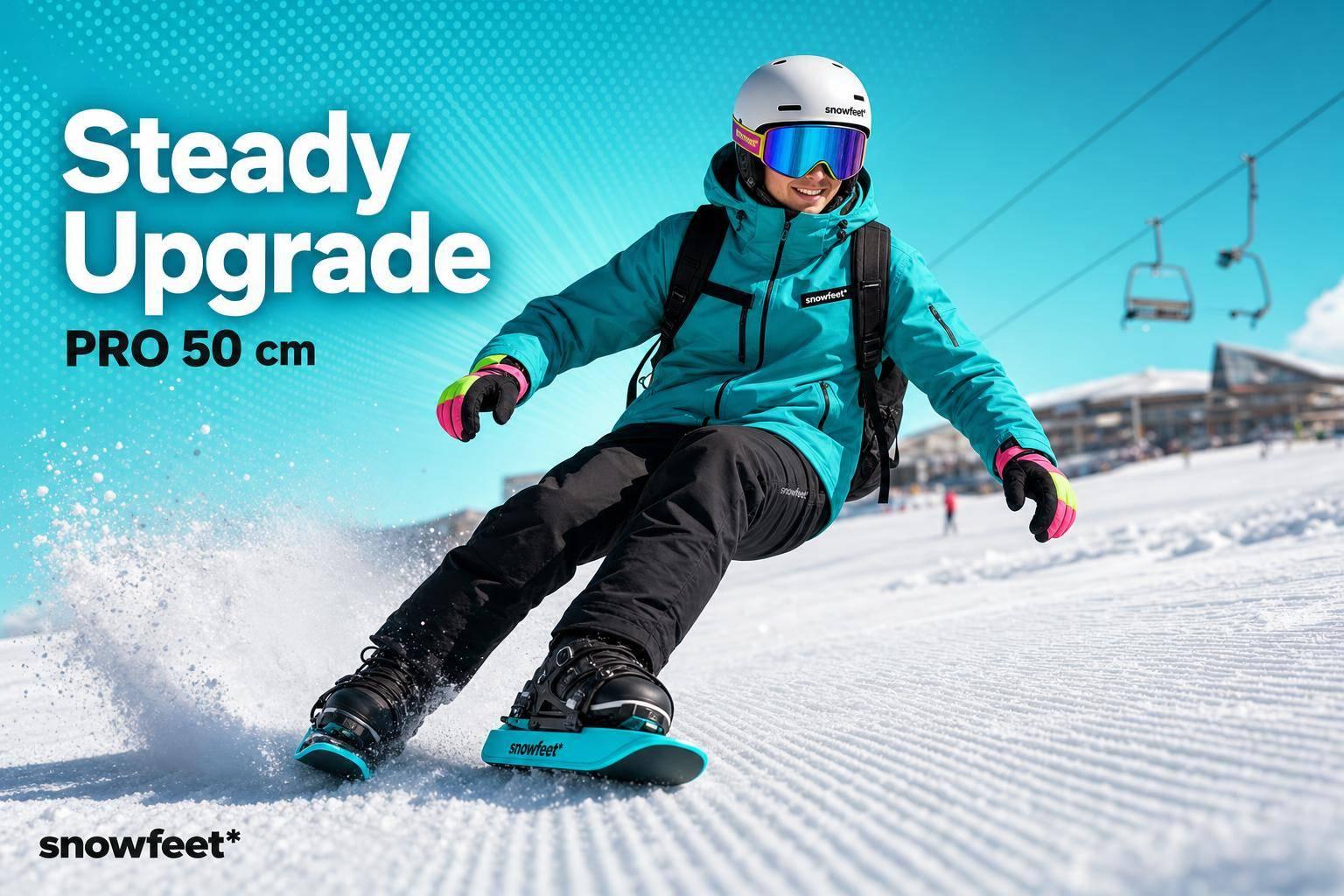
Le PRO 50 cm offre davantage de stabilité, ce qui compte beaucoup lors de votre première saison. Il est plus tolérant, ce qui vous aide à améliorer votre équilibre et votre contrôle. Il convient donc parfaitement aux pistes vertes et aux pistes bleues faciles. Vous bénéficiez toujours d’une installation simple, sans avoir à transporter l’encombrement des skis classiques.
Voici l’essentiel en bref.
| Option | Prix approximatif (USD) | Type de pratiquant idéal | Adéquation au terrain | Principal compromis |
|---|---|---|---|---|
| Snowfeet* Skiskates 44 cm | À partir de 460 $ | Débutant ayant de l’expérience en skating ; pratiquant privilégiant l’agilité | Pistes damées | Agilité maximale, mais sensations plus réactives à grande vitesse |
| Snowfeet* PRO 50 cm | À partir de 299 $ | La plupart des débutants en première saison | Pistes vertes et pistes bleues faciles | Plus stable et plus tolérant, mais un peu moins agile |
Les skis longs restent plus performants à grande vitesse et en poudreuse. Mais pour une première saison sur des pistes damées, Snowfeet* est l’option la plus simple et la plus facile à prendre en main pour la plupart des débutants. En résumé : choisissez le modèle de 44 cm si vous recherchez l’agilité, ou le modèle PRO 50 cm si vous privilégiez la stabilité.
sbb-itb-17ade95
Avis sur Snowfeet* : les skiskates en valent-ils la peine ? | Mini-ski | Patins à neige | Ski de skating | Ski court
Conclusion : les skiskates en valent-ils la peine pour votre première saison ?
Après avoir pris en compte la courbe d’apprentissage, le confort, le coût, la portabilité et le type de terrain, la réponse est assez claire : oui - les skiskates en valent la peine pour la plupart des débutants lors de leur première saison, s’ils prévoient de rester sur des pistes vertes damées et des pistes bleues faciles.
Ils sont particulièrement intéressants si la portabilité et un apprentissage rapide figurent en tête de vos priorités. Dans ce cas, Snowfeet* se démarque comme le meilleur choix pour une première saison. Compact, facile à transporter et à ranger, il est également simple à utiliser sur terrain damé.
Cela dit, il y a un point à garder à l’esprit. Ce produit fonctionne surtout sur le bon type de terrain. Si vous voulez plus de vitesse, de meilleures performances en poudreuse ou davantage de contrôle sur les pistes raides, les skiskates ne sont pas l’outil idéal. De longs skis ou un snowboard correspondront mieux à cet objectif.
Voici l’essentiel :
- Choisissez les Skiskates de 44 cm si vous voulez les sensations les plus agiles et les plus proches du patinage.
- Choisissez les PRO 50 cm si vous voulez plus de stabilité et davantage de tolérance. Pour la plupart des débutants, c’est le meilleur choix.
Ainsi, si votre objectif principal est un apprentissage facile et la facilité de transport, optez pour les Snowfeet*. Si vous recherchez une progression sur toute la montagne, choisissez des skis traditionnels ou un snowboard.
FAQ
Les Skiskates sont-ils plus faciles à apprendre que le ski ou le snowboard ?
Oui. Les Skiskates et les skis courts sont généralement plus faciles à apprendre que les skis traditionnels ou le snowboard.
Beaucoup de pratiquants se sentent à l’aise avec les Snowfeet* en une seule journée. Certains maîtrisent les mouvements de base en seulement cinq minutes.
Pourquoi ? Leur conception compacte et légère semble plus naturelle, surtout si vous avez déjà pratiqué le patinage sur glace ou le patinage en ligne. Il y a moins d’équipement à maîtriser, ce qui est appréciable :) Cela permet aux débutants de consacrer plus de temps à travailler leur équilibre et leurs mouvements, plutôt qu’à gérer un équipement encombrant.
Dois-je choisir les Skiskates de 44 cm ou les PRO 50 cm pour ma première saison ?
Tout dépend de l’endroit où vous pratiquez et de la sensation que vous recherchez.
Les Skiskates de 44 cm sont le meilleur choix si vous voulez un maximum de maniabilité, des sensations plus proches du patinage et un modèle facile à transporter. Ils excellent sur les pistes damées et dans les snowparks.
Les PRO 50 cm sont plus adaptés si vous voulez davantage de stabilité en glissant, des virages plus serrés et la possibilité d’explorer des pentes modérées.
Les deux s’utilisent avec des bottes d’hiver imperméables classiques ou des chaussures de snowboard. Et comparés aux skis traditionnels, ils sont plus faciles à contrôler.
Puis-je utiliser des Skiskates partout sur la montagne ou seulement sur les pistes damées ?
Non. Les Snowfeet fonctionnent le mieux sur les pistes damées, la neige compacte et les snowparks. Mais ce n’est pas toute l’histoire.
Vous n’êtes pas limité à ces seuls endroits. Leur petite taille convient également aux collines locales, aux pistes de ski de fond, aux zones de luge et même à votre jardin. Un peu comme le couteau suisse de l’équipement de neige :)
Un bémol : ils ne sont pas conçus pour la poudreuse profonde de plus de 4 pouces. Si la neige devient plus profonde et plus molle, les skis POWDER de 99 cm de Snowfeet sont un meilleur choix.











Laisser un commentaire
Ce site est protégé par hCaptcha, et la Politique de confidentialité et les Conditions de service de hCaptcha s’appliquent.