



















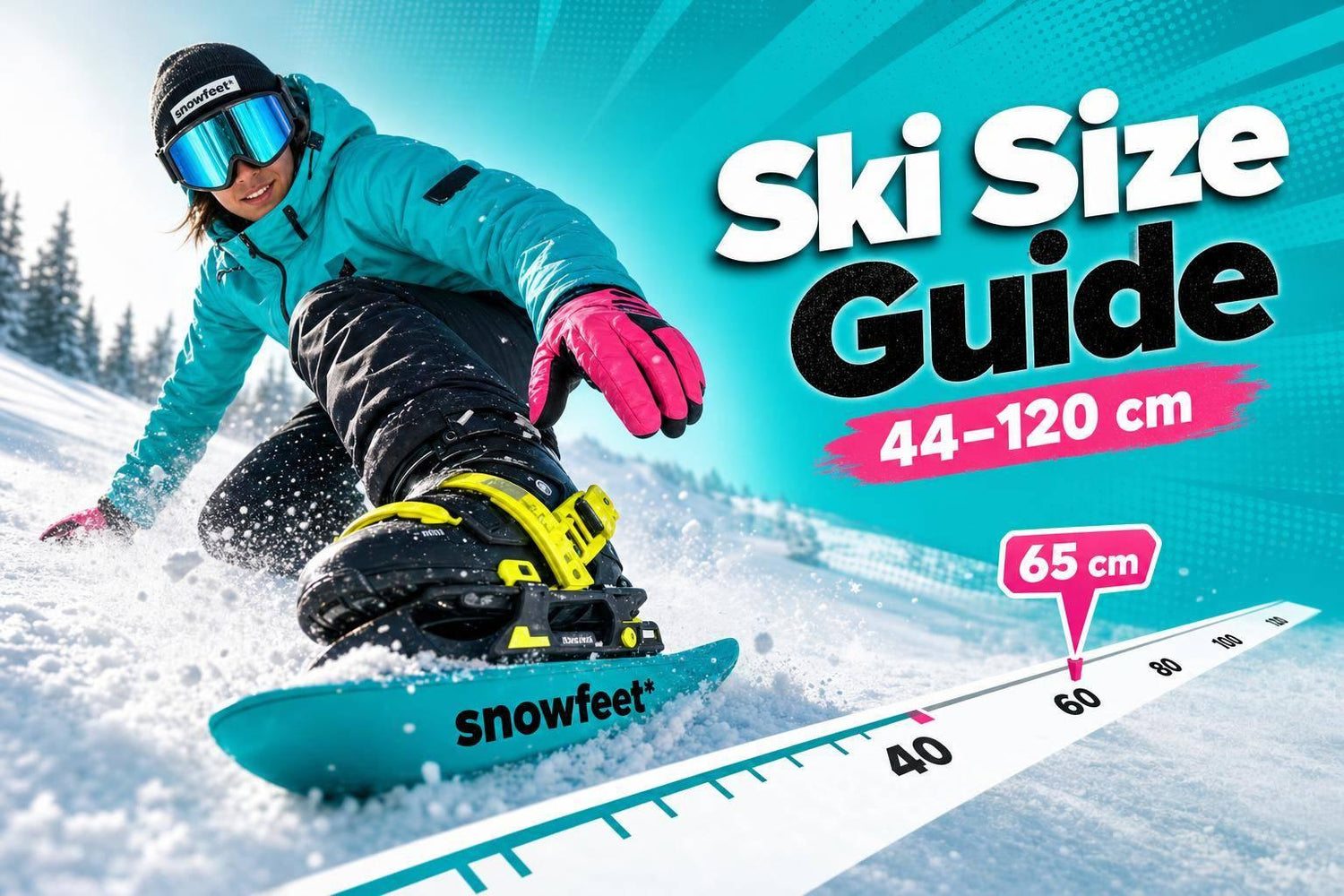
La plupart des skieurs peuvent choisir la bonne longueur de skis courts en moins de 2 minutes : optez pour 44–65 cm pour des virages faciles, quelques descentes dans le park et un rangement pratique ; choisissez 99–120 cm pour plus de soutien, des courbes plus fluides et davantage de contrôle lorsque la vitesse augmente.
Je choisirais la longueur des skis courts selon 5 éléments : le poids, le niveau, le terrain, la configuration des chaussures et la vitesse à laquelle vous aimez skier. La taille aide, mais ce n’est pas le facteur principal ici. Cette ancienne règle allant du menton au sommet de la tête ? Elle s’applique aux skis longs, pas à ceux-ci.
Voici la version courte :
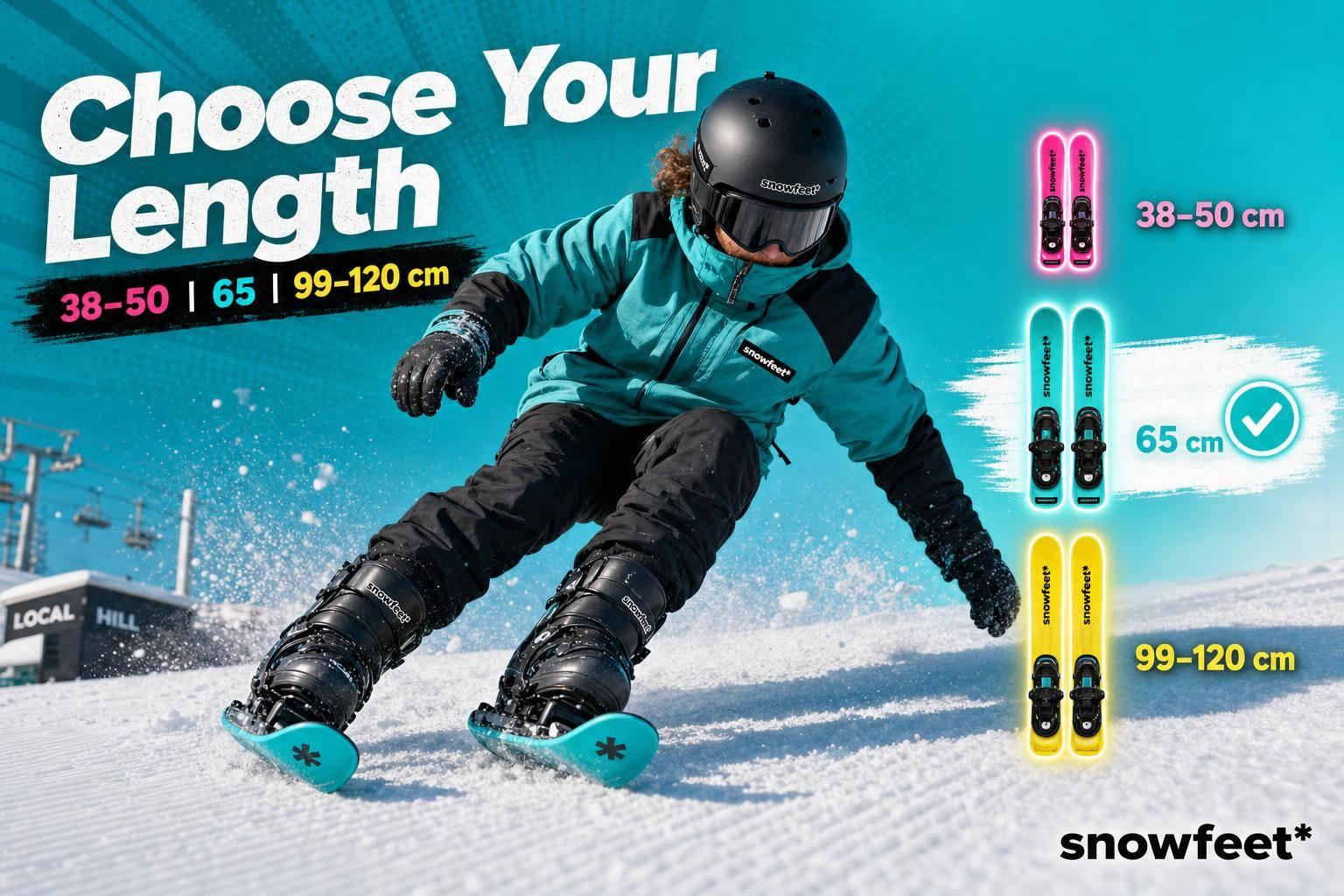
- 44 cm : idéal pour voyager, les pistes faciles et une sensation proche du skateboard
- 65 cm : idéal pour les débutants et les skieurs de park
- 99 cm : le meilleur choix polyvalent pour la plupart des skieurs en station
- 120 cm : idéal pour les anciens skieurs et ceux qui recherchent plus de stabilité à grande vitesse
- Si vous pesez environ 91 kg ou plus, vous vous sentirez souvent mieux avec des skis de 99 cm ou 120 cm
- Si vous restez sur des pistes damées et une neige dure, les longueurs plus courtes sont adaptées
- Si vous skiez sur une neige variable ou plus meuble, les skis courts plus longs sont généralement plus agréables
Un chiffre important : les skis adultes classiques mesurent généralement environ 150–190 cm. Même un ski court de 120 cm reste donc bien plus court qu’un équipement classique. C’est pourquoi ces skis offrent des sensations si différentes sur la neige — et pourquoi il est bien plus important qu’on ne le pense de choisir la bonne taille.
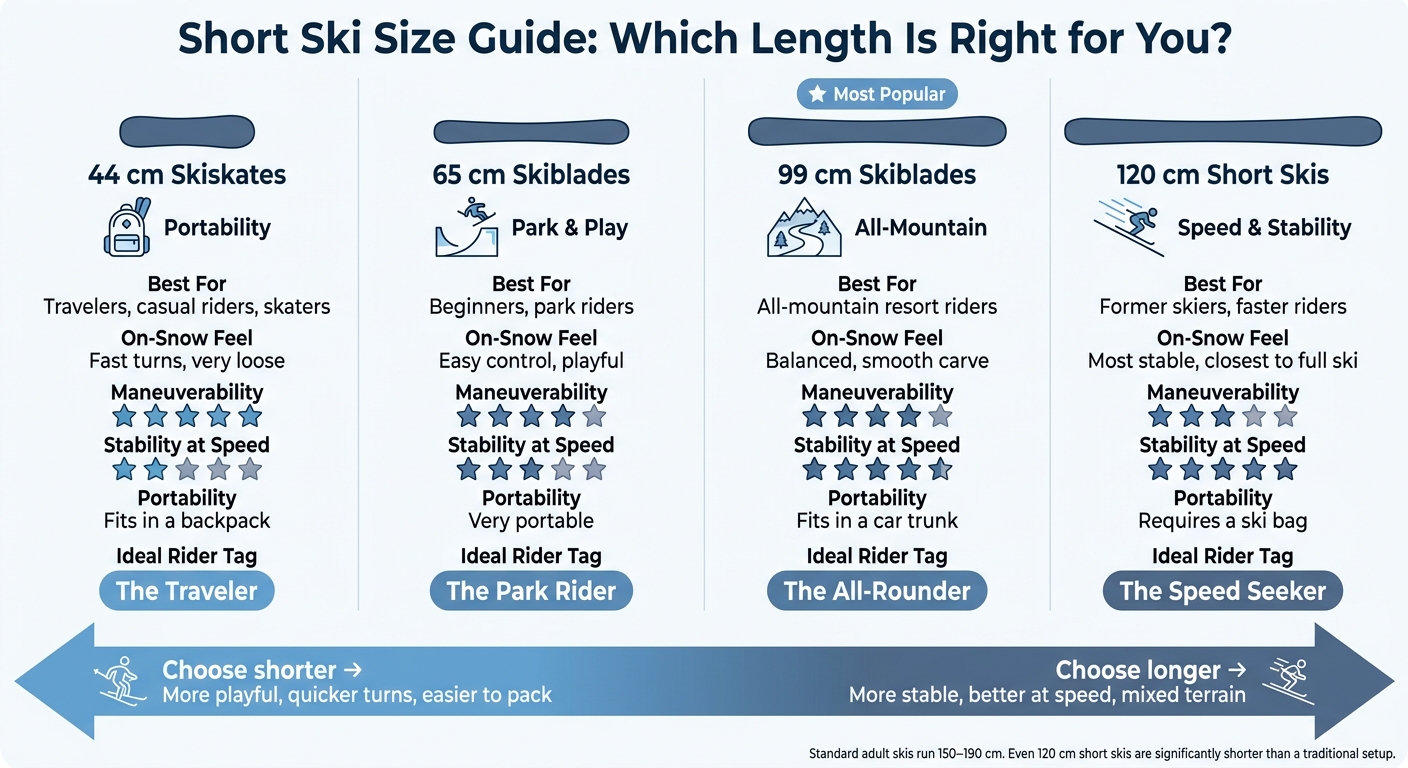
Guide des tailles de skis courts : quelle longueur vous convient ?
Un snowboardeur essaie Snowfeet* | Quel ski court Snowfeet* est le meilleur ? | Test des snowblades 44, 65 et 99
Comparaison rapide
| Longueur | Idéal pour | Sensation sur la neige | Principal compromis |
|---|---|---|---|
| 44 cm | Voyageurs, skieurs occasionnels, patineurs | Virages rapides, sensation très libre | Les moins stables à grande vitesse |
| 65 cm | Débutants, skieurs de park | Contrôle facile, sensation ludique, virages simples | Moins de soutien dans la neige irrégulière |
| 99 cm | Skieurs de station tout-terrain | Équilibre, glisse plus fluide, virages mieux maîtrisés | Moins compacts |
| 120 cm | Anciens skieurs, skieurs rapides | Les plus stables de ce groupe | Les moins maniables |
Si je devais simplifier encore : choisissez plus court pour plus de maniabilité, plus long pour plus de soutien. Cette seule règle vous mènera déjà très loin :)
Les 5 facteurs qui déterminent la bonne longueur de skis courts
Cinq éléments comptent le plus lorsque vous choisissez la longueur de skis courts : la taille, le poids, le niveau, le terrain et la configuration des chaussures. Prenez-les tous en compte et le choix devient bien plus simple.
Taille, poids et soutien
La taille vous donne un point de départ. Le poids compte davantage.
Un skieur plus léger — par exemple, 1,63 m et environ 59 kg — peut généralement utiliser un ski plus court tout en gardant une bonne maîtrise. Un skieur plus lourd mesurant 1,85 m et pesant 91 kg se sentira souvent mieux avec des skis de 99 cm ou 120 cm, car cette longueur supplémentaire répartit mieux le poids et offre davantage de soutien.
En termes simples :
- Les skieurs plus légers sont souvent mieux adaptés aux modèles de 44 cm ou 65 cm
- Les skieurs plus lourds sont souvent mieux adaptés aux modèles de 99 cm ou 120 cm
Niveau, style de glisse et terrain
Une fois la plage de tailles de base définie, adaptez-la à la façon dont vous skiez et à l’endroit où vous skiez le plus souvent.
Les débutants s’en sortent généralement mieux avec 44 cm ou 65 cm. Les skieurs plus rapides ou qui passent davantage de temps sur l’ensemble du domaine skiable sont généralement mieux adaptés aux modèles de 99 cm ou 120 cm.
Le terrain compte autant que le niveau. Les pratiquants de park optent souvent pour des skis plus courts, car ils sont agiles et faciles à faire pivoter. Les skieurs tout-terrain apprécient généralement les modèles de 99 cm ou 120 cm pour une glisse plus stable lorsque les conditions se dégradent.
Une règle simple :
- Utilisez 44–65 cm sur des pistes damées et de la neige dure
- Choisissez 99–120 cm pour une neige variable ou plus souple
Chaussures, fixations et conditions de neige
La configuration des chaussures permet de réduire rapidement les options. Les Snowfeet* Skiskates de 44 cm sont compatibles avec des chaussures de ski ou de snowboard, selon la configuration, ce qui en fait un choix très compact si vous recherchez des sensations proches du patinage sur la neige.
Les Skiblades et Short Skis offrent des sensations plus proches du ski alpin. Les modèles Snowfeet* de 120 cm sont plus performants avec des chaussures de ski si vous recherchez le maintien le plus sûr.
Utilisez le tableau ci-dessous pour adapter votre configuration à la longueur Snowfeet* appropriée.
| Facteur | Choisissez plus court (44–65 cm) | Choisissez plus long (99–120 cm) |
|---|---|---|
| Poids | Skieurs plus légers ou de corpulence moyenne | Skieurs plus lourds ou recherchant davantage de maintien |
| Niveau | Débutant ou occasionnel | Intermédiaire à confirmé |
| Terrain | Pistes damées, park, neige dure | Domaine skiable varié, neige travaillée, poudreuse légère |
| Configuration des chaussures | Chaussures de ski ou de snowboard | Chaussures de ski pour un maintien et un contrôle optimaux |
| Priorité | Transport facile, virages rapides | Stabilité, vitesse, maintien |
sbb-itb-17ade95
Les sensations de chaque longueur Snowfeet* et le profil auquel elle convient
Voici comment chaque longueur se comporte sur la neige, en commençant par la plus courte et en remontant.
Skiskates Snowfeet* de 44 cm et Skiblades de 65 cm
Les Skiskates de 44 cm réagissent davantage aux petits mouvements des chevilles et des hanches qu’à une forte pression prolongée sur les carres. Les virages sont donc rapides et serrés, plutôt que de longs arcs carvés. Ils sont très amusants sur les pistes faciles, pour les descentes courtes et pour tous ceux qui veulent la configuration qui tourne le plus vite et se transporte le plus facilement. Si vous poussez trop la vitesse, ils deviennent toutefois instables.
Les Skiblades de 65 cm donnent clairement l’impression de passer à la vitesse supérieure. Cette longueur supplémentaire offre davantage de contact avec les carres, ce qui permet de commencer à sentir de vrais virages carvés, plutôt que de simples pivots dérapés. Ils restent faciles à faire tourner et à utiliser en marche arrière, ce qui explique pourquoi les pratiquants de park les apprécient pour les petits sauts, les boxes et les descentes rapides.
Comparés au modèle de 44 cm, ils sont moins nerveux et vous laissent un peu plus de marge d’erreur lorsque vous faites une petite faute. Pour les débutants qui veulent aller au-delà de la piste pour débutants, le modèle de 65 cm offre un excellent compromis. Vous bénéficiez de suffisamment d’accroche en virage et de stabilité pour avoir davantage l’impression de skier, sans le facteur intimidant des grandes skis.
Si vous recherchez davantage de stabilité et une plus grande polyvalence sur la montagne, passez aux 99 cm.
Skiblades Snowfeet* de 99 cm et skis courts de 120 cm
Les Skiblades de 99 cm sont le choix le plus équilibré de la gamme. Ils carvèrent proprement sur pistes damées, gèrent mieux la neige variable que les modèles plus courts et restent suffisamment maniables pour les modules faciles du park, les petits sauts et les bosses naturelles de la station. Vous pouvez doser la pression sur les carres, garder votre trajectoire et skier à vitesse modérée sans effectuer sans cesse de petites corrections. Le POWDER 99 offre davantage de portance dans la neige souple. C’est le meilleur choix pour les skieurs qui veulent un seul ski court pour la plupart de leurs journées en station.
Les skis courts de 120 cm offrent les sensations les plus proches de celles des skis classiques. Ils conviennent aux skieurs qui recherchent une glisse plus stable à vitesse élevée. Ils filent droit, dessinent des courbes nettes et restent stables lorsque les modèles plus courts commencent à vibrer. L’inconvénient ? Ce sont les moins maniables du groupe, et vous aurez besoin d’un sac à skis plutôt que de les glisser dans un sac à dos.
Tableau comparatif : maniabilité, stabilité, usage au park, poudreuse, portabilité
Consultez le tableau ci-dessous pour une comparaison rapide.
| Skiskates de 44 cm | Skiblades de 65 cm | Skiblades de 99 cm | POWDER de 99 cm | Skis courts de 120 cm | |
|---|---|---|---|---|---|
| Maniabilité | La plus élevée | Très élevée | Élevée | Élevée | Modérée |
| Stabilité à grande vitesse | Faible | Modérée | Élevée | Élevée | Très élevée |
| Aptitude au carving | Limité | Modérée | Élevée | Élevée | Excellente |
| Le meilleur choix | Voyageurs, patineurs, pentes douces | Adeptes du park, débutants sur pistes vertes/bleues | Toutes pistes, niveau intermédiaire+ | Neige souple, conditions printanières | Anciens skieurs, vitesses élevées |
| Usage au park | Limité | Excellente | Bon | Bon | Modérée |
| Poudreuse légère | Le moins performant | Limité | Bon dans la neige poudreuse | Le meilleur de la catégorie des skis courts | Solide |
| Facilité de transport | Rentre dans un sac à dos | Très facile à transporter | Rentre dans le coffre d’une voiture | Rentre dans le coffre d’une voiture | Nécessite un sac à skis |
Étape par étape : comment choisir la longueur de vos skis courts
Utilisez les compromis ci-dessus pour réduire votre fourchette selon votre morphologie, votre niveau et votre terrain.
Étape 1 : mesurez-vous et évaluez votre niveau
Affinez maintenant les options avec deux critères simples : votre morphologie et votre façon de skier.
Commencez par votre taille et votre poids. Comparez-les ensuite aux exemples ci-dessous.
Pour évaluer votre niveau, basez-vous sur ce que vous pouvez faire sur la neige, et non sur l’étiquette que vous vous donnez :
- Débutant : virages sur pistes vertes, encore sensible à la vitesse
- Intermédiaire : virages parallèles sur pistes bleues, vitesse maîtrisée
- Avancé : à l’aise sur les pistes noires, neige variable, vitesses élevées
Une fois votre niveau défini et la fourchette établie, utilisez votre terrain de prédilection pour choisir la longueur exacte.
Étape 2 : associez votre usage principal à une longueur
Réfléchissez à l’endroit où vous passerez la majeure partie de votre journée en montagne. Cela facilite généralement beaucoup le choix.
- Skiskates de 44 cm - plaisir décontracté sur pistes faciles ; portabilité maximale
- Skiblades de 65 cm - débutants et adeptes du park recherchant un contrôle rapide
- Skiblades de 99 cm - pratique toutes pistes en station, niveau intermédiaire et supérieur
- Skis courts de 120 cm - pour ceux qui passent de skis longs ou skient à vitesse élevée
Choisissez plus court si vous voulez davantage d'agilité et une sensation ludique. Choisissez plus long si vous voulez plus de stabilité et de vitesse.
Tableau de décision : profils de skieurs et longueurs recommandées
Ces profils montrent comment la taille, le poids, le niveau et le terrain peuvent vous orienter vers une longueur de ski.
| Profil du skieur | Exemple de taille / poids | Niveau | Terrain principal | Longueur recommandée | Pourquoi |
|---|---|---|---|---|---|
| Débutant prudent | 5'5", 135 lb (165 cm, 61 kg) | Débutant | Pistes vertes et bleues faciles damées dans une station du Midwest, avec de la neige ferme produite par enneigement mécanique | 65 cm | Faciles à faire tourner et renforcent la confiance à faible vitesse |
| Skieur axé sur le park | 5'9", 155 lb (175 cm, 70 kg) | Intermédiaire | Modules, petits sauts, rails | 65 cm | Très agiles et faciles à faire pivoter |
| Voyageur disposant de peu d'espace de rangement | 5'7", 145 lb (170 cm, 66 kg) | Débutant à intermédiaire | Voyages avec bagage cabine vers des stations de la côte Est | 44 cm ou 65 cm | 44 cm se range dans les bagages ; 65 cm offre une plus grande polyvalence en station |
| Skieur de station tout-terrain | 6'0", 190 lb (183 cm, 86 kg) | Intermédiaire | Pistes bleues et noires damées dans les stations du Colorado ou de l'Utah | 99 cm | Assez stables pour suivre ses amis tout en restant maniables |
| Skieur expérimenté passant à des skis plus courts | 5'11", 185 lb (180 cm, 84 kg) | Confirmé | Pistes damées à vitesse modérée à élevée | 99 cm ou 120 cm | Stabilité plus familière ; 120 cm s'il skie rapidement ou sur des pistes raides |
| Parent skieur avec ses enfants | 5'6", 150 lb (167 cm, 68 kg) | Intermédiaire | Pistes bleues damées à vitesse modérée | 65 cm ou 99 cm | 65 cm pour effectuer des virages rapides autour des enfants ; 99 cm pour une glisse plus fluide |
| Skieur sportif | 5'8", 160 lb (173 cm, 73 kg) | Débutant à intermédiaire | Des descentes répétées sur une piste locale | 44 cm ou 65 cm | Légers, faciles à transporter, avec une sensation proche du skateboard |
Utilisez le tableau ci-dessus comme point de départ.
Choisir selon le type de skieur et points essentiels à retenir
Meilleurs choix pour les débutants, les skieurs de park, les voyageurs et les anciens utilisateurs de skis longs
Une fois la taille, le poids et le terrain pris en compte, le type de skieur permet généralement de trancher.
- Débutants et skieurs occasionnels : 65 cm
- Débutants plus lourds (environ plus de 200 lb) : 99 cm pour davantage de soutien sur neige ferme
- Skieurs de park : 65 cm
- Voyageurs : 44 cm, les plus faciles à ranger
- Anciens utilisateurs de skis longs : 99 cm ; choisissez 120 cm pour plus de vitesse et des pistes plus raides
Si vous hésitez entre des skis courts et des skis pleine longueur, ce tableau permet de visualiser facilement les compromis.
Tableau comparatif : Snowfeet* vs skis standard vs autres marques de skis courts
Les skis longs restent supérieurs sur deux points : les virages coupés à grande vitesse sur terrain raide et la neige poudreuse profonde. Mais pour la plupart des skieurs occasionnels en station, Snowfeet* est l'option la plus facile à apprendre, à transporter et à apprécier sur les pistes damées.
| Critères | Skis courts / skiskates Snowfeet* | Skis longs standard | Autres marques de skis courts |
|---|---|---|---|
| Courbe d'apprentissage | Très faible | Modérée à raide | Faible à modérée |
| Maniabilité | Excellente | Bonne à grande vitesse ; moins maniable dans les espaces exigus | Bonne à excellente |
| Stabilité à grande vitesse | Modérée (99 cm et 120 cm recommandés) | Excellente | Modérée |
| Performance en poudreuse | Fonctionne dans une neige légère et peu profonde | Idéal pour la poudreuse profonde et le hors-piste | Limites similaires |
| Facilité de transport | Exceptionnel | Mauvais | Bon |
| Utilisateur idéal | Skieurs occasionnels en station, voyageurs, skieurs de park, débutants | Experts, skieurs privilégiant la vitesse et les virages coupés, amateurs de poudreuse | Skieurs ayant des usages similaires à ceux de Snowfeet* |
Conclusion : la manière la plus simple de choisir la bonne longueur
Vous pouvez oublier les anciennes règles de taille allant du menton jusqu’au sommet de la tête. Elles étaient conçues pour les skis pleine longueur, les vitesses élevées et un type de glisse très différent. Pour Snowfeet*, la taille dépend davantage de votre façon de skier que de votre taille.
Voici la version simple : plus c’est court, plus c’est facile et ludique ; plus c’est long, plus c’est stable et adapté aux terrains variés.
Le modèle de 44 cm est le choix ultra-compact, semblable à des patins, lorsque la facilité de transport est la priorité. Le modèle de 65 cm est le juste milieu idéal pour les débutants et les adeptes du park qui recherchent un contrôle rapide et simple. Le modèle de 99 cm est l’option polyvalente par excellence. Il reste maniable, tout en offrant suffisamment de longueur pour les pistes bleues et les vitesses modérées. Le modèle de 120 cm procure les sensations les plus proches de celles d’un ski standard, avec davantage de soutien pour les virages coupés et plus de sérénité sur les terrains escarpés.
Alors, réfléchissez à l’endroit où vous allez skier, à la vitesse à laquelle vous aimez aller et aux sensations que vous recherchez sous les pieds. C’est ce choix qui compte vraiment.
FAQ
Comment choisir entre 65 cm et 99 cm ?
Choisissez 65 cm si vous voulez un ski rapide, facile à tourner et amusant à utiliser. C’est un choix judicieux pour les débutants, ainsi que pour les personnes qui passent beaucoup de temps à faire des figures ou à skier sur des bosses.
Choisissez 99 cm si vous recherchez un meilleur équilibre sur l’ensemble de la montagne. Cette longueur offre davantage de stabilité lorsque votre vitesse augmente et vous aide à vous sentir plus en confiance sur les terrains variés. Pour la plupart des adultes, les 99 cm constituent le choix le plus polyvalent et sûr.
Les skis courts conviennent-ils aux personnes de forte corpulence ?
Oui, les skis courts peuvent très bien convenir aux personnes de forte corpulence à condition de choisir une longueur offrant suffisamment de soutien et d’équilibre.
Pour les personnes de forte corpulence, Snowfeet* recommande des modèles légèrement plus longs, comme les skis courts de 120 cm. Ils offrent une surface de contact plus importante, ce qui améliore la portance et la stabilité à vitesse élevée, tout en conservant la sensation ludique et agile qui fait la réputation de Snowfeet*.
Quelle longueur offre les sensations les plus proches de celles des skis classiques ?
Dans la gamme Snowfeet, le modèle de 120 cm offre les sensations les plus proches de celles des skis standards. Vous profitez toujours de la maniabilité et de la facilité de transport des skis courts, avec davantage de stabilité, de vitesse et d’efficacité sur les pentes plus raides ou la neige difficile.
C’est un excellent compromis pour celles et ceux qui souhaitent retrouver des sensations plus familières, sans avoir à composer avec la taille des skis standards de 160 à 190 cm.











Laisser un commentaire
Ce site est protégé par hCaptcha, et la Politique de confidentialité et les Conditions de service de hCaptcha s’appliquent.