



















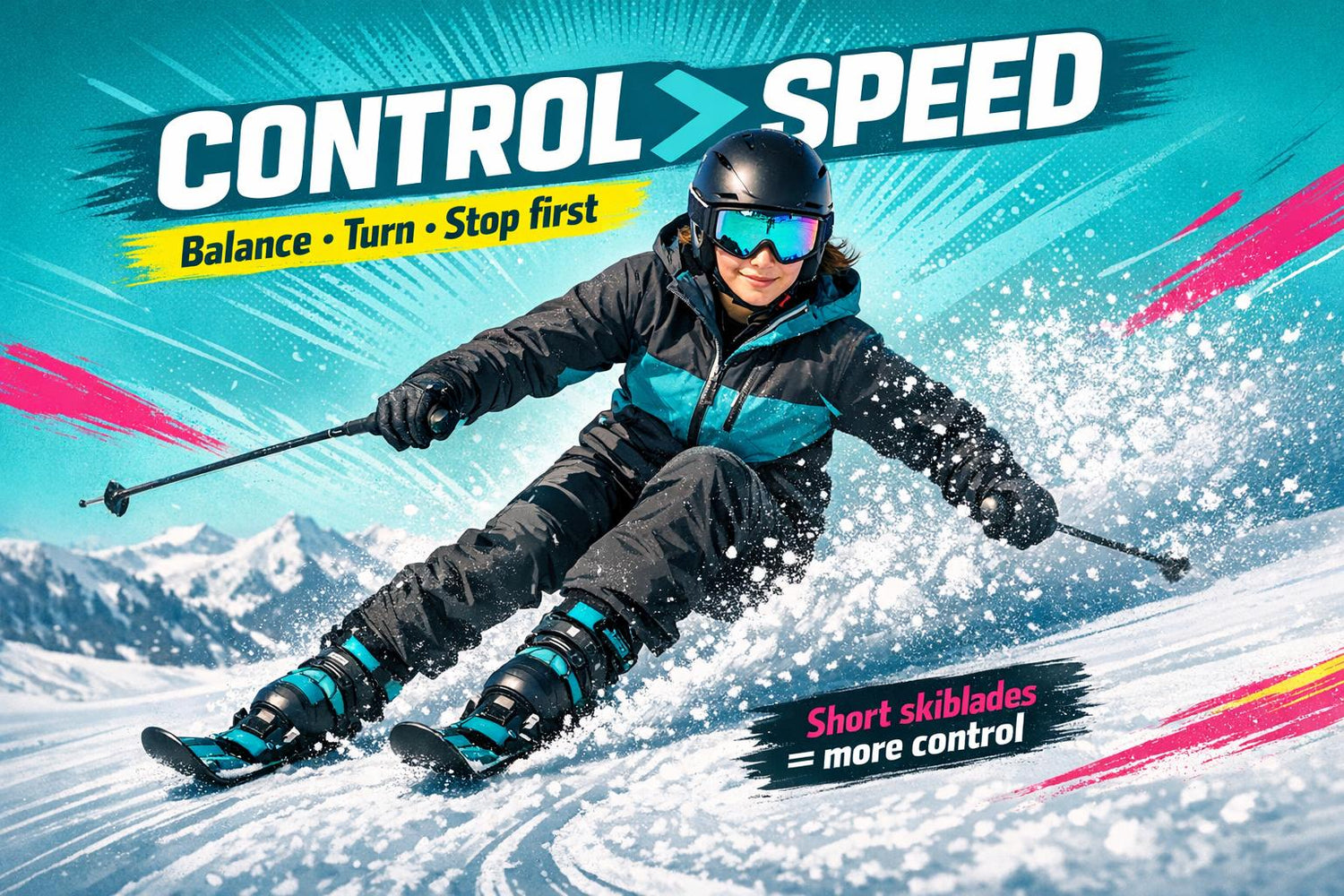
Lorsque vous apprenez à skier, le plaisir de la vitesse peut être tentant — mais c’est le contrôle qui vous maintient en sécurité et vous aide à progresser. Se précipiter vers la vitesse trop tôt entraîne souvent des chutes, de la frustration, voire des blessures. Concentrez-vous plutôt d’abord sur la maîtrise de trois fondamentaux : l’équilibre, les virages et les arrêts. Ces compétences constituent la base pour gagner en confiance et profiter des pistes.
Voici le point important : les skis longs peuvent rendre l’apprentissage plus difficile, car ils sont plus compliqués à manœuvrer à faible vitesse. Les options plus courtes, comme les Snowfeet Skiblades et les Skiskates, sont plus faciles à manier, ce qui simplifie les virages et les arrêts. Vous pouvez ainsi vous concentrer sur la technique plutôt que de lutter avec votre équipement.
Points essentiels :
- Le contrôle d’abord, la vitesse ensuite. Les débutants qui se concentrent sur le contrôle progressent plus vite et prennent davantage de plaisir.
- Des skis plus courts = un apprentissage plus facile. L’équipement Snowfeet (44–120 cm) offre une meilleure maniabilité et davantage de confiance aux débutants.
- La sécurité renforce la confiance. Savoir que vous pouvez vous arrêter et tourner en douceur réduit le stress et rend le ski plus agréable.
En résumé ? Maîtrisez d’abord le contrôle — la vitesse viendra naturellement. L’équipement Snowfeet peut contribuer à rendre ce processus plus fluide et plus amusant. :)
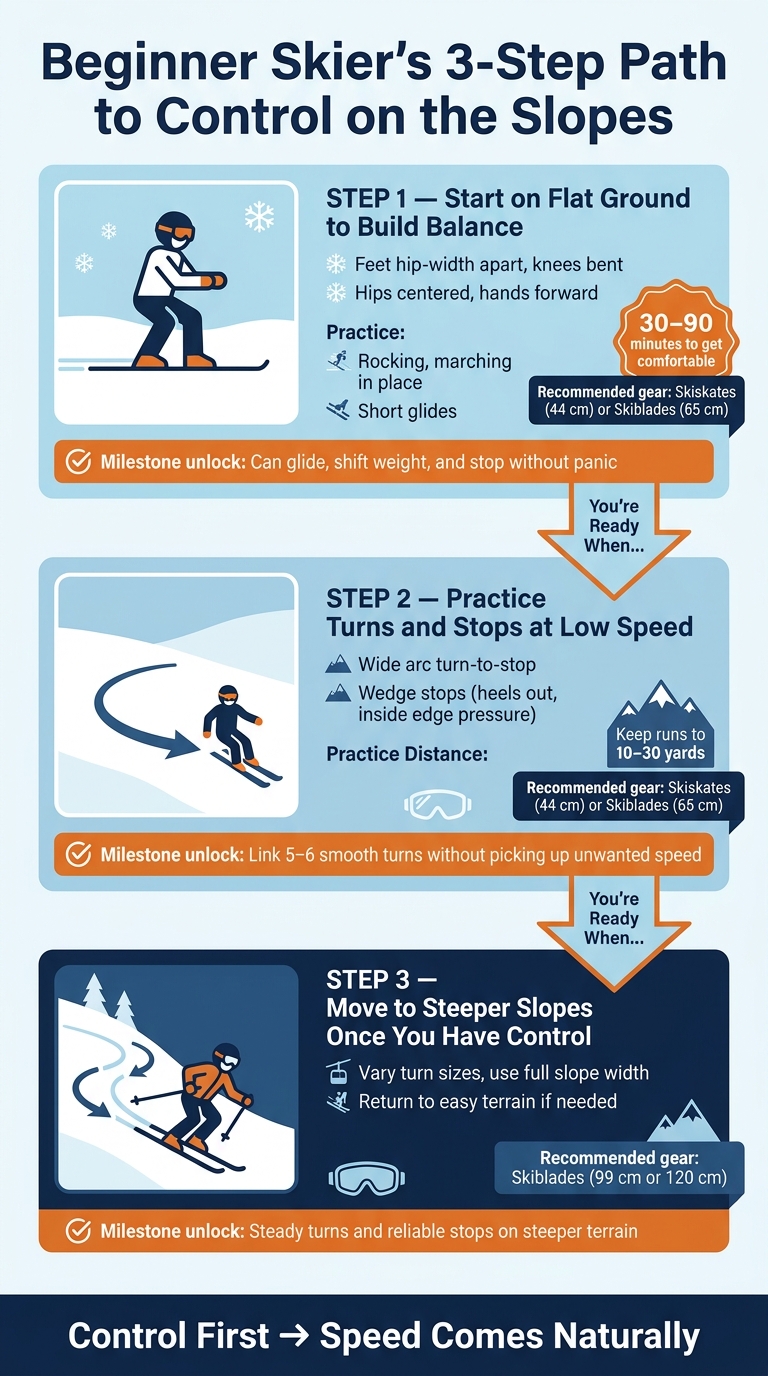
Le parcours en 3 étapes du skieur débutant pour maîtriser le contrôle sur les pistes
Pourquoi le contrôle est plus important que la vitesse pour les débutants
Ce que le contrôle signifie réellement pour les débutants
Pour quelqu’un qui débute, le contrôle repose entièrement sur l’équilibre, les virages maîtrisés et la capacité à s’arrêter exactement quand et où vous le souhaitez. Voyez cela comme skier à votre façon.
- Équilibre : Garder votre poids centré au-dessus de vos pieds vous aide à gérer les petites bosses sans chuter.
- Tourner : C’est vous qui dirigez, pas la piste. Vous décidez où vous allez.
- S’arrêter : Être capable de s’arrêter complètement — avant une file d’attente pour une remontée, un groupe de skieurs ou un enfant qui traverse soudainement votre trajectoire — est indispensable.
Maîtrisez ces trois compétences et vous contrôlerez la piste. De plus, elles constituent la base pour rester en sécurité et gagner en confiance au fil de votre apprentissage.
Comment le contrôle renforce la sécurité et la confiance
Soyons honnêtes : les pistes très fréquentées peuvent être intimidantes pour les débutants. Mais lorsque vous pouvez effectuer des virages fluides et vous arrêter de manière fiable, vous êtes non seulement plus en sécurité, mais aussi moins stressé. Les études montrent que de nombreuses blessures chez les skieurs débutants surviennent à cause d’une perte d’équilibre ou de l’incapacité à contrôler sa vitesse. En vous concentrant sur une technique régulière, vous réduisez ces risques.
Et voici le meilleur : une fois que vous savez que vous pouvez vous arrêter quand vous en avez besoin, votre confiance augmente considérablement. Au lieu d'avoir l'impression de simplement survivre sur la piste, vous commencez réellement à en profiter. C'est pourquoi le contrôle doit toujours passer en premier : il vous prépare à un apprentissage plus fluide et plus amusant.
Pourquoi vouloir aller trop vite trop tôt vous ralentit
Vous essayez d'aller vite avant d'être prêt ? C'est la recette de la frustration. Lorsque les débutants prennent trop de vitesse, ils se penchent souvent en arrière et se crispent. Cette « position en arrière » perturbe votre équilibre, réduit l'adhérence de vos carres et rend les virages presque impossibles. En bref, c'est exactement le contraire de ce dont vous avez besoin pour progresser.
Que se passe-t-il ensuite ? Davantage de chutes, plus de temps passé à se relever et de mauvaises habitudes qui ralentissent vos progrès. Pendant ce temps, le débutant qui se concentre sur des virages lents et fluides évolue déjà vers des pistes plus difficiles. Voici le secret : la vitesse vient naturellement une fois que vous maîtrisez le contrôle. Brûler les étapes ne fait que compliquer les choses à long terme. Des produits comme ceux de Snowfeet* peuvent aider les débutants à garder le contrôle tout en augmentant progressivement leur vitesse dans le confort.
Pourquoi les skis longs et les snowboards sont difficiles pour les débutants
La physique qui explique pourquoi les skis longs sont plus difficiles à manier
Les skis longs ont un rayon de virage plus important et un poids supplémentaire, ce qui les rend difficiles à contrôler pour les débutants. Ils exigent davantage d'élan et une technique plus précise pour effectuer des virages serrés et précis. À faible vitesse, les débutants ont souvent du mal à suffisamment fléchir le ski pour réaliser des virages plus serrés, ce qui rend l'équipement moins réactif à leurs mouvements. Cette résistance ralentit les ajustements rapides, ce qui peut être frustrant pour ceux qui maîtrisent encore leur équilibre.
Problèmes courants rencontrés par les débutants avec un équipement standard
La plupart des skis pour adultes mesurent environ 150 à 180 cm de long, ce qui signifie qu'une grande partie de la carre est en contact avec la neige. Pour les débutants, cela crée quelques difficultés :
- Arrêt : Appliquer correctement une pression sur les carres pour s'arrêter demande une maîtrise que les débutants sont encore en train d'acquérir.
- Virages : Les skis longs nécessitent de larges virages amples, qui occupent souvent la majeure partie de la piste.
- Contrôle de la vitesse : Ces virages larges peuvent laisser les skieurs orientés vers la descente plus longtemps que prévu, ce qui les fait accélérer rapidement.
Cette combinaison de difficultés peut rendre l'apprentissage plus ardu et moins agréable. C'est là que des options adaptées aux débutants comme Snowfeet* s'avèrent utiles.
« Ces skiblades sont incroyables à utiliser. Ils sont très faciles à contrôler, permettent de tourner rapidement et sont bien plus tolérants que les skis traditionnels. » - Brad Tolin
Comment les Snowfeet* se comparent-ils à l'équipement de ski standard

Snowfeet* propose une nouvelle approche du ski pour débutants en répondant aux difficultés courantes liées aux skis traditionnels. Avec des longueurs allant de 44 cm à 120 cm, les produits Snowfeet* sont nettement plus courts que les skis standards, ce qui les rend beaucoup plus faciles à manier à faible vitesse.
| Caractéristique | Skis traditionnels | Snowfeet* Skiblades et Skiskates |
|---|---|---|
| Virage | Lent à amorcer | Précis et réactif, même à faible vitesse |
| Arrêt | Nécessite une technique précise d’utilisation des carres | Plus facile de pivoter et de contrôler sa vitesse |
| Poids de rotation | Élevé : donne une sensation de lourdeur lors des mouvements rapides | Faible : permet des corrections rapides et naturelles |
| Récupération de l’équilibre | Plus difficile de retrouver son équilibre lorsque la vitesse augmente | Plus facile de rétablir son équilibre avant de tomber |
La longueur réduite des produits Snowfeet* diminue la longueur de carre en contact avec la neige ainsi que la résistance, ce qui les rend plus réactifs aux légers transferts de poids. Les débutants peuvent ainsi effectuer des virages plus serrés et mieux maîtrisés, sans avoir besoin d’aller vite ni de posséder des compétences avancées. En bref, Snowfeet* facilite l’apprentissage en vous accompagnant plutôt qu’en vous résistant.
Les skis courts sont-ils meilleurs pour les débutants ?
sbb-itb-17ade95
Comment les produits Snowfeet* aident les débutants à garder le contrôle
Les produits Snowfeet* sont conçus pour les débutants et offrent une alternative pratique aux skis traditionnels. Leurs caractéristiques uniques facilitent l’apprentissage et le rendent plus agréable.
Comment une longueur réduite facilite les virages et les arrêts
L’un des principaux avantages des produits Snowfeet* est leur longueur réduite. Les skis traditionnels pour adultes mesurent généralement entre 150 et 180 cm (environ 59 à 71 pouces), ce qui donne un grand rayon de virage d’environ 14 à 18 mètres (46 à 59 pieds). En revanche, les produits Snowfeet* mesurent seulement de 44 cm à 120 cm, avec une ligne de cotes plus marquée qui améliore la maniabilité. Cette différence change complètement la donne.
Sur les pentes douces, les skis plus courts permettent de tourner avec un minimum d’effort : un léger mouvement de la cheville ou de la hanche suffit. S’arrêter est également beaucoup plus simple. Avec moins de carre à gérer et moins d’élan, vous pouvez vous arrêter rapidement en élargissant votre position. Comparez cela aux skis plus longs, qui nécessitent souvent 30 à 50 pieds d’espace et une technique plus précise pour s’arrêter. Pour les débutants, cette facilité de contrôle peut faire toute la différence.
Caractéristiques de conception des produits Snowfeet* adaptées aux débutants
L’équipement Snowfeet* est conçu avec soin pour répondre aux difficultés courantes liées au matériel de ski traditionnel. Voici quelques caractéristiques qui le rendent adapté aux débutants :
- Les carres en acier offrent une adhérence fiable sur la neige damée. Comme les skis sont plus courts, cette adhérence reste maîtrisée et facile à gérer, ce qui vous aide à tourner en toute confiance sans craindre d’accrocher un carre et de perdre l’équilibre.
- La forme parabolique et la taille étroite rendent les virages naturels, car le ski vous aide à guider votre mouvement.
-
Sa construction légère réduit la fatigue et facilite la récupération en cas de perte de stabilité. Par exemple, les Skiblades de 65 cm avec fixations ne pèsent que 3,79 lb par paire, soit bien moins que des skis classiques. Comme l’a expliqué un utilisateur, Mike E. :
« Je craignais que les chaussures ne soient pas assez rigides pour les skis, mais cela n’a posé aucun problème. Elles sont confortables, faciles à contrôler, très agiles et ménagent les genoux et les chevilles grâce à leur légèreté. »
- La compatibilité avec les chaussures est un autre avantage majeur. La plupart des modèles Snowfeet* sont équipés de fixations réglables compatibles avec des chaussures d’hiver classiques ou des chaussures de snowboard. Cela évite d’avoir à acheter des chaussures de ski spécialisées et coûteuses, réduisant ainsi les dépenses et la complexité pour les débutants.
Ces caractéristiques font de Snowfeet* un choix accessible qui renforce la confiance de tous ceux qui débutent en ski.
La gamme de produits Snowfeet* pour les débutants
Snowfeet* propose une variété de modèles, chacun adapté à différents niveaux et préférences. Voici un aperçu des options adaptées aux débutants :
| Modèle | Longueur | Idéal pour les débutants |
|---|---|---|
| Skiskates | 44 cm | Virages ultra-serrés, sensation proche du patinage, idéaux pour les terrains plats et les petites collines |
| Skiblades | 65 cm | Arrêts et rotations rapides, parfaits pour les pistes vertes douces, le « juste milieu » idéal pour les débutants |
| Skiblades | 99 cm | Davantage de glisse et de stabilité, adaptés aux débutants confiants sur les longues descentes |
| Skis courts | 120 cm | Les plus proches des skis traditionnels, parfaits pour les débutants prudents qui souhaitent progresser |
Plus le ski est court, plus il est facile de tourner et de s’arrêter à faible vitesse. Les Skiskates de 44 cm sont parfaits pour ceux qui recherchent une agilité maximale, en particulier s’ils ont de l’expérience en hockey ou en patinage en ligne. Les Skiblades de 65 cm sont un choix populaire pour les débutants, offrant un excellent équilibre entre contrôle et stabilité. Pour ceux qui sont prêts à s’attaquer à de plus longues descentes, les modèles de 99 cm et 120 cm offrent davantage de glisse tout en conservant les avantages des skis plus courts.
Une approche étape par étape pour maîtriser votre équipement Snowfeet*
Apprendre à maîtriser votre équipement Snowfeet* demande de la patience et de la pratique. Se lancer trop rapidement sur des pentes raides est une erreur courante, mais en progressant graduellement, vous développerez les compétences et la confiance nécessaires pour affronter des terrains plus difficiles. Décomposons cela en trois étapes clés.
Étape 1 : Commencez sur un terrain plat pour développer votre équilibre
Commencez sur un terrain plat : pensez à la zone située au pied des pistes, ou même à un parking enneigé. Une fois votre équipement Snowfeet* chaussé, concentrez-vous sur une position équilibrée et dynamique : pieds écartés de la largeur des hanches, genoux fléchis, hanches centrées et mains vers l’avant. Entraînez-vous à effectuer de petits mouvements comme vous balancer d’avant en arrière, marcher sur place et faire de courtes glissades sur une pente douce.
La longueur réduite des Skiskates Snowfeet* (44 cm) et des Skiblades (65 cm) facilite cette étape. Ils sont faciles à prendre en main, réduisent le risque d’accrocher les carres ou de croiser les spatules et fatiguent moins les jambes que les skis traditionnels. La plupart des personnes peuvent se sentir à l’aise avec ces bases en 30 à 90 minutes. Une fois que vous pouvez glisser, transférer votre poids d’un côté à l’autre et vous arrêter sans paniquer, vous êtes prêt à travailler les virages et les arrêts.
Étape 2 : entraînez-vous aux virages et aux arrêts à faible vitesse
Ensuite, dirigez-vous vers une piste verte douce ou une pente équipée d’un tapis roulant. Ici, votre objectif n’est pas la vitesse, mais le contrôle. Vous devez maîtriser deux compétences essentielles : tourner quand vous le souhaitez et vous arrêter là où vous le souhaitez.
Commencez par vous entraîner à tourner pour vous arrêter. Guidez-vous dans un large arc jusqu’à ralentir naturellement. Ensuite, travaillez les arrêts en chasse-neige en écartant les talons et en exerçant une pression sur les carres intérieures. Gardez vos descentes courtes : 10 à 30 yards sont idéaux pour rester maître de vos mouvements. Concentrez-vous sur une seule compétence à la fois : virages à gauche, virages à droite ou arrêts. Une fois que vous pouvez enchaîner 5 à 6 virages fluides sans prendre de vitesse involontairement, vous avez franchi une étape importante.
Étape 3 : passez à des pentes plus raides une fois le contrôle maîtrisé
Lorsque vous maîtrisez les virages et les arrêts sur des pentes douces, il est temps de passer progressivement à un terrain plus raide. La transition est plus facile avec les Skiblades Snowfeet* (99 cm ou 120 cm). Leur longueur réduite offre davantage de stabilité et facilite les virages, tout en permettant plus de glisse et de vitesse que les modèles plus petits.
Lors de vos premières descentes sur des pistes plus raides, restez fidèle à vos habitudes : variez l’amplitude de vos virages, utilisez toute la largeur de la piste pour contrôler votre vitesse et n’hésitez pas à retourner sur un terrain plus facile si vous sentez que vous perdez le contrôle. La régularité est essentielle : si vous pouvez négocier des pentes plus raides avec des virages réguliers et des arrêts fiables, vous êtes sur la bonne voie.
| Étape clé | Vous êtes prêt lorsque… | Produit recommandé |
|---|---|---|
| Terrain plat → Piste débutant | Vous pouvez glisser, transférer votre poids et vous arrêter sans paniquer | Skiskates (44 cm) ou Skiblades (65 cm) |
| Piste débutant → Terrain plus raide | Vous pouvez enchaîner 5 à 6 virages maîtrisés et vous arrêter à la demande | Skiblades (99 cm ou 120 cm) |
Conclusion : maîtrisez d’abord le contrôle, puis accélérez
Le contrôle est la base du ski. Les débutants recherchent souvent la vitesse, mais ceux qui se concentrent d’abord sur le ralentissement progressent en réalité plus vite. Une fois que vous pouvez vous arrêter net et tourner sans effort, la montagne cesse d’être intimidante et devient un véritable terrain de jeu. Et cette priorité donnée au contrôle devrait guider le choix de votre équipement.
Les Skiskates Snowfeet* (44 cm) et les Skiblades (65 cm, 99 cm et 120 cm) sont conçus pour offrir un meilleur contrôle. Leur format compact aide à mieux gérer l’élan que les skis longs traditionnels, dont la vitesse peut sembler difficile à maîtriser. Les produits Snowfeet* vous permettent de vous concentrer sur l’amélioration de votre technique plutôt que de vous accrocher désespérément. Comme l’a expliqué Brad Tolin, un client vérifié :
« Ces lames de ski sont vraiment géniales à utiliser. Elles sont très faciles à contrôler, permettent de tourner rapidement et sont bien plus tolérantes que les skis traditionnels. »
Que vous vous dirigiez vers les pistes du Colorado ou du Vermont, maîtriser le contrôle est la manière la plus sûre et la plus judicieuse de progresser.
Une fois que vous maîtrisez le contrôle, tout le reste — comme la vitesse — se mettra naturellement en place. Snowfeet* vous offre les outils nécessaires pour construire des bases solides, afin que chaque mouvement soit maîtrisé et que chaque descente soit plus agréable.
FAQ
Comment savoir si je suis prêt à aller plus vite ?
Une fois que vous maîtrisez les bases — comme garder une position équilibrée, effectuer des virages fluides et vous arrêter avec assurance sur un terrain facile et damé — vous êtes prêt à accélérer. Assurez-vous d’être à l’aise avec les virages en chasse-neige ou parallèles et de pouvoir vous arrêter avec contrôle avant de passer à l’étape suivante. Vous vous sentez stable et maître de vos mouvements ? Il est peut-être temps de passer à la taille supérieure ! Passer de modèles plus courts, comme les Skiskates de 44 cm, à des modèles plus grands, tels que les Snowfeet Skiblades de 99 cm ou 120 cm, peut vous offrir davantage de stabilité et une glisse plus fluide, pour explorer les vitesses élevées en toute sécurité.
Les skiblades Snowfeet* sont-ils plus faciles à utiliser que les skis longs pour les débutants ?
Les skiblades Snowfeet* sont un excellent choix pour les débutants, car ils sont beaucoup plus faciles à manier que les skis longs traditionnels. Leur taille compacte, de 44 cm à 120 cm, facilite les virages et les arrêts, tout en améliorant l’équilibre et la stabilité. De plus, ils sont légers comparés aux skis longs, plus encombrants, qui mesurent généralement de 150 cm à 180 cm, ce qui réduit la fatigue des jambes. Cette conception aide les nouveaux skieurs à assimiler les bases plus rapidement et à se sentir plus en sécurité sur les pistes.
Puis-je utiliser Snowfeet* avec des bottes d’hiver classiques ?
Oui, de nombreux modèles Snowfeet, comme les Mini Ski Skates et les Snowfeet PRO, sont conçus pour être utilisés avec des bottes d’hiver imperméables classiques ou des bottes de snowboard. Vous pouvez ainsi éviter les lourdes bottes de ski encombrantes habituellement nécessaires avec des skis traditionnels. Assurez-vous simplement que vos bottes sont bien maintenues par les fixations réglables. Un ajustement bien serré garantit un meilleur contrôle et vous permet de transmettre vos mouvements avec fluidité à votre équipement Snowfeet.












Laisser un commentaire
Ce site est protégé par hCaptcha, et la Politique de confidentialité et les Conditions de service de hCaptcha s’appliquent.