




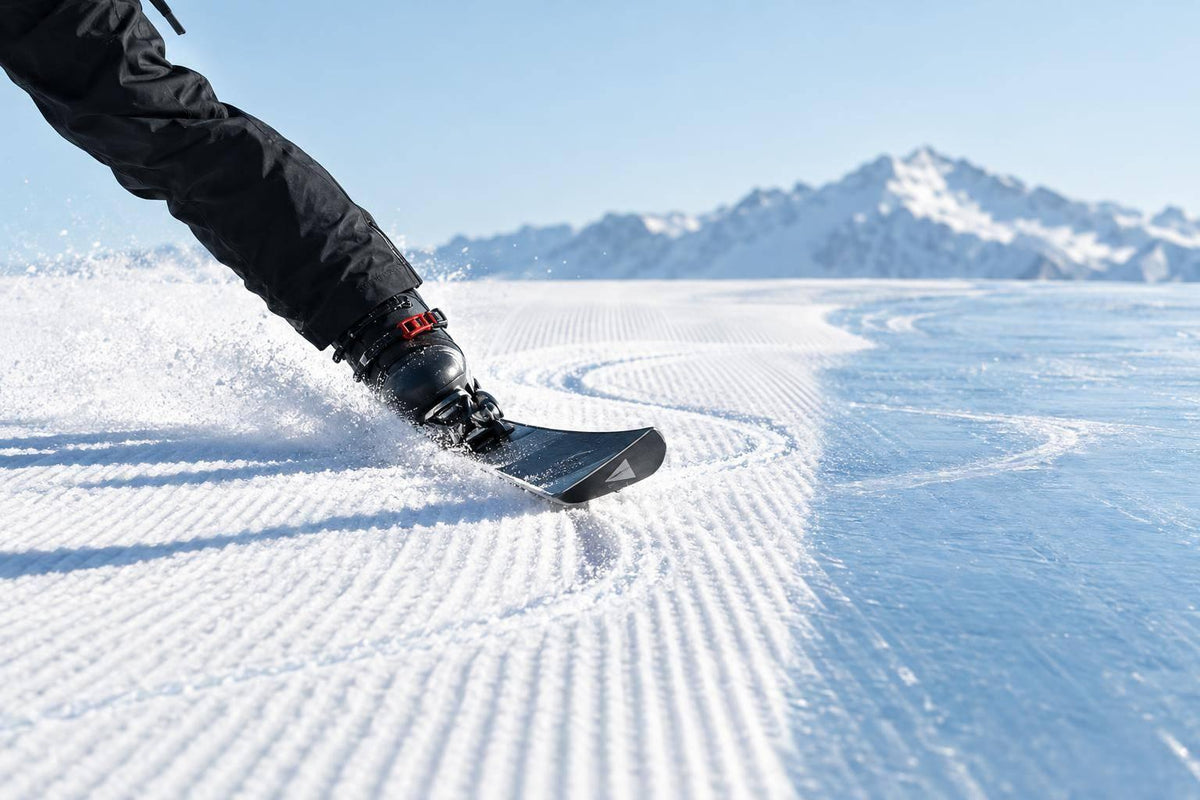
Yes - I’d pick POWDER 99 for groomers and soft snow, with short turns at moderate speeds. At 99 cm (about 39 inches), it’s compact, but it’s not my choice for fast carving or frequent ice. Start on an easy run and practice stopping before adding speed.
Here’s how I’d choose:
- POWDER 99: For mixed resort snow, short turns, and more support in powder.
- Snowfeet* 65 cm: For tricks and tight pivots, with less support for balance.
- Standard 99 cm: For mostly firm groomers and a more direct edge feel.
- Long groomer skis: For sustained speed and long carved turns.
The catch? Metal edges help on packed snow, but they don’t guarantee grip on ice. I’d keep them sharp, check boot and binding fit, and <u>set my pace for the hardest snow ahead</u>.
How POWDER 99 Handles Groomed Runs
Short Turns and Edge Grip
The Snowfeet* POWDER 99 turns fast. Its 6 m sidecut favors short, linked turns over long arcs. Your edge angle, pressure, speed, and snow conditions shape the path you ski. That makes POWDER 99 a better fit for mixed resort days than days spent only carving.
On firmer groomers, balance and edge control play a bigger role in how confident you feel.
Use smooth pressure and a centered stance. Don’t force sudden changes in direction. Metal edges help on packed snow, but ice calls for sharp edges. The graphite base adds glide, not grip. Check your edges before skiing firm snow, and have dull or damaged edges serviced.
Stability and Balance
That ease of turning comes with a trade-off. POWDER 99 gives you more front-to-back support for small shifts in balance than 65 cm skiblades. It feels more stable than those shorter blades, but still reacts more readily than a long carving ski.
Make your first runs about control, not speed. Keep your feet roughly parallel, and use small ankle and hip movements. Avoid leaning far forward to push the tips as you might on long skis.
Start at a moderate speed on a wide, easy green groomer. Practice stopping, then link basic turns before moving to faster terrain.
Snowboarder tries Snowfeet* | Which Snowfeet* Short Ski is the Best? | Snowblades 44, 65, 99 Review
Riding Soft, Firm, and Icy Groomers
POWDER 99 feels best on soft-to-firm groomers and is least forgiving on ice. Its wide platform supports softer snow, but harder surfaces call for more precise edge control. On resort laps, that difference matters: a run can shift from soft to firm in just a few turns.
Building on the short-turn feel and stability above, here’s how POWDER 99 responds as snow firms up.
| Surface | Feel | Speed | Turn style |
|---|---|---|---|
| Soft groomers | Stable and easy to pivot | Moderate for conditions | Controlled short turns |
| Firm packed snow | Less forgiving of imprecise technique | Conservative to moderate | Deliberate short-to-medium turns |
| Icy sections | Least forgiving, with limited grip | Slow enough for available stopping space | Smooth, controlled turns |
| Mixed resort snow | Responsive to changing texture | Set by the hardest section ahead | Adjust your line before surface changes |
Soft Groomers
The 15–12–15 cm tip/waist/tail profile - about 5.9–4.7–5.9 inches - gives you broad support on soft groomers. The compact shape also makes it easy to change direction.
Firm Snow, Ice, and Gear Checks
On firmer snow, sharp edges and line choice matter more than speed. Careful turns help you handle firm snow. Before an icy patch, slow down and pick a line with room to turn. Avoid sudden braking or excessive edging.
Keep your edges tuned and use wax matched to the snow temperature. Neither tuning nor wax will make POWDER 99 handle ice like a dedicated carving ski.
Before heading out, check the base, binding hardware, and binding condition. POWDER 99 uses ski-boot or snowboard-boot bindings - not regular winter shoes. Confirm boot compatibility, binding fit, and resort rules before you go.
sbb-itb-17ade95
POWDER 99 Compared With Other Skis
POWDER 99 vs. Skiblades and Long Groomer Skis
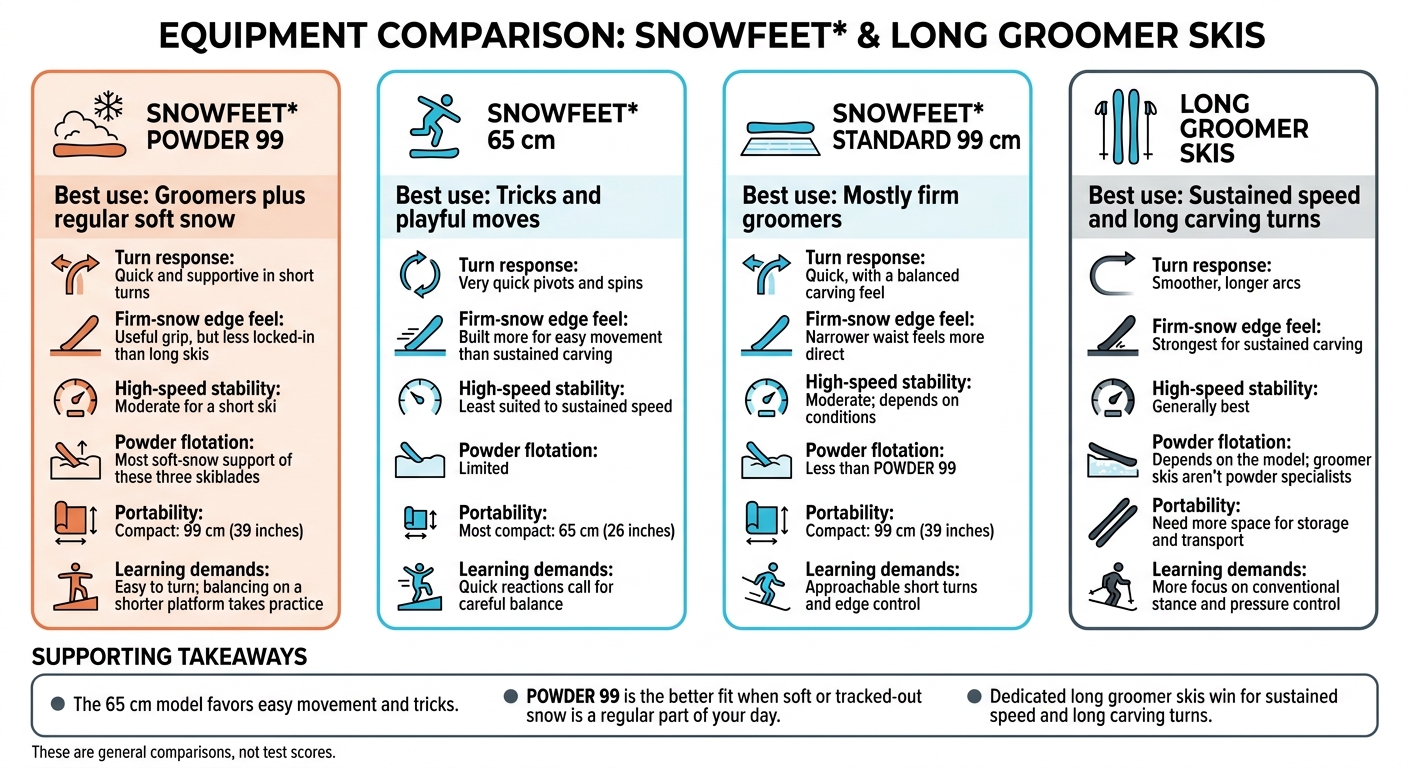
POWDER 99 handles groomers and powder for casual mixed-resort riding. Here’s how it stacks up against a narrower skiblade and a full-length groomer ski.
| Feature | Snowfeet* POWDER 99 | Snowfeet* 65 cm | Snowfeet* Standard 99 cm | Long groomer skis |
|---|---|---|---|---|
| Turn response | Quick and supportive in short turns | Very quick pivots and spins | Quick, with a balanced carving feel | Smoother, longer arcs |
| Firm-snow edge feel | Useful grip, but less locked-in than long skis | Built more for easy movement than sustained carving | Narrower waist feels more direct | Strongest for sustained carving |
| High-speed stability | Moderate for a short ski | Least suited to sustained speed | Moderate; depends on conditions | Generally best |
| Powder flotation | Most soft-snow support of these three skiblades | Limited | Less than POWDER 99 | Depends on the model; groomer skis aren’t powder specialists |
| Portability | Compact: 99 cm (39 inches) | Most compact: 65 cm (26 inches) | Compact: 99 cm (39 inches) | Need more space for storage and transport |
| Learning demands | Easy to turn; balancing on a shorter platform takes practice | Quick reactions call for careful balance | Approachable short turns and edge control | More focus on conventional stance and pressure control |
| Best use | Groomers plus regular soft snow | Tricks and playful moves | Mostly firm groomers | Sustained speed and long carving turns |
These are general comparisons, not test scores.
POWDER 99 vs. Snowfeet* 65 cm and Standard 99 cm
With groomer handling covered above, your usual snow helps narrow the choice.
The 65 cm model favors easy movement and tricks. Pick it when compact moves matter more than flotation. POWDER 99 offers more soft-snow support and a steadier ride around the resort.
The standard 99 cm model feels more direct on firm groomers. POWDER 99 is the better fit when soft or tracked-out snow is a regular part of your day, rather than an occasional detour.
POWDER 99 vs. Long Groomer Skis
Dedicated long groomer skis win for sustained speed and long carving turns. Their longer edges track more smoothly. If you want fast cruising or extended high-edge-angle turns, favor those skis. The size of the advantage depends on the model.
For most casual riders who want one compact pair for mixed conditions, Snowfeet* POWDER 99 is the better compromise. Its short length makes it easier to carry and store, while it still handles groomers well. The trade-off is less focus on pure carving in exchange for a playful pair that suits mixed days.
Conclusion: Can POWDER 99 Be Your Only Pair?
Yes - if you want one pair for playful resort riding at moderate speeds in mixed snow. It handles a range of conditions but gives up race-level carving.
Metal edges help on packed snow. Ice and long stretches at high speed still show the limits of a short ski.
Choose for Your Snow and Turn Style
POWDER 99 suits casual riders, intermediates, and snowboarders who want compact gear for short turns and mixed resort snow. Beginners should stick to gentle groomers and learn to stop before tackling steeper terrain.
For mostly firm groomers, choose narrower Snowfeet* skiblades. For racing, frequent ice, high speeds over long stretches, or long carving arcs, go with long groomer skis. POWDER 99 is the better all-around choice for playful mixed-resort riding and easy transport with one setup.
Before ordering, check the current specs and binding options at snowfeetstore.com. Match the binding to the boots you’ll use - not your shoe size.
FAQs
How should I adjust my technique when switching to POWDER 99?
Stay centered on the Snowfeet POWDER 99 and ride actively, especially in deep or dense snow. Small weight shifts start your turns. Don’t lean too far back - that can cause the tips to dive.
Turning and pivoting take less effort than on longer skis, but expect more chatter. Aim for controlled, nimble moves rather than high-speed charging. In variable snow, use your ankles to handle changes in terrain while keeping your weight centered.
How can I tell if my edges need tuning?
Your edges may need a tune-up if you lose precision or grip on icy or hard-packed snow. Snowfeet* POWDER 99 cm skiblades have durable steel edges for reliable carving and braking, but regular use will dull them over time.
Watch for these signs: turns feel less smooth, edges slip instead of holding, or stops feel less controlled. If you notice any of these, it’s time to have your edges sharpened.
When should I switch from POWDER 99 to long skis?
Consider long skis for fast runs on steep, icy terrain, deep, loose powder over 12 inches, or heavy snow that changes from turn to turn. They’re a good fit if you often ski above 30–35 mph or favor long, sweeping turns.
Full-length skis give you more stability, absorb more vibration, float better, and hold their line in tough, open-mountain conditions. Snowfeet POWDER 99 is still a playful, nimble choice for resort powder laps, trees, and side hits.











Jätä kommentti
Tämä sivu on suojattu hCaptcha-tunnistuksella, ja hCaptchan tietosuojakäytäntöjä ja käyttöehtoja sovelletaan.