



















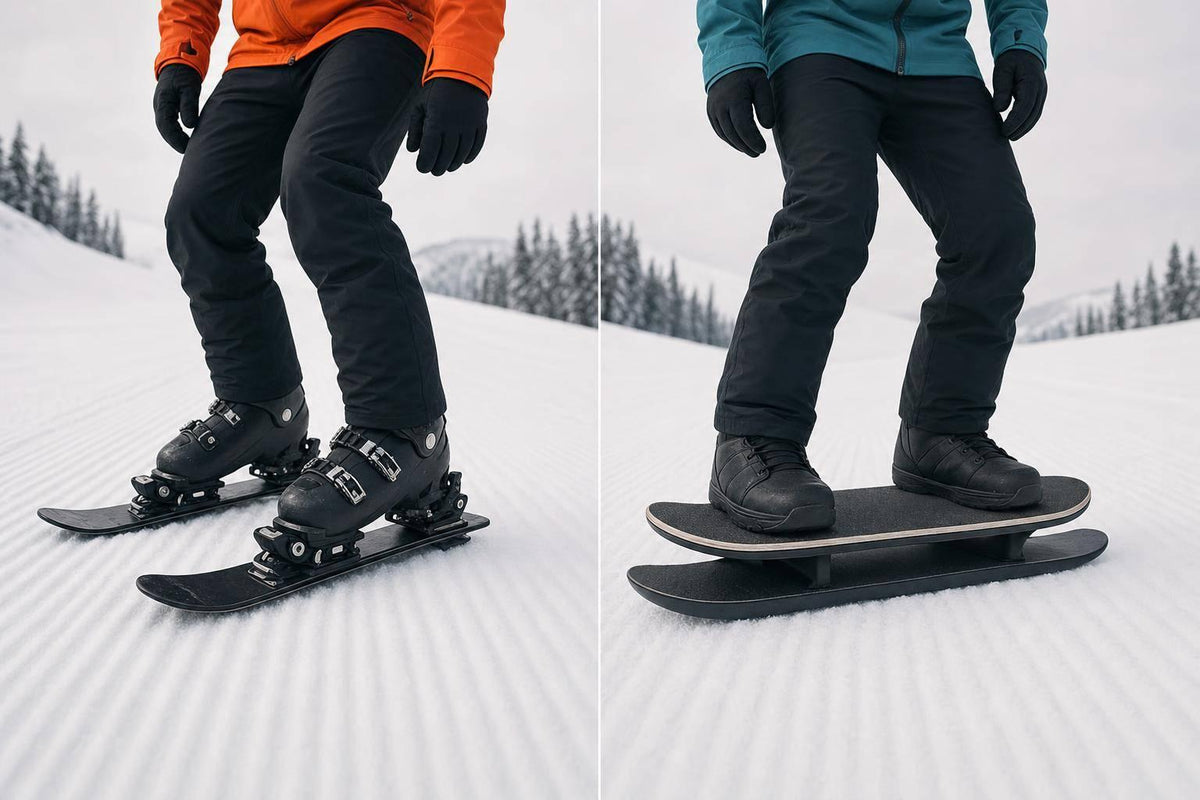
If I had to give one short answer: most people will have an easier, more useful time on skiskates than on a snowskate. That’s because skiskates usually give you more control, faster learning, and better odds at U.S. resort access.
Here’s the simple breakdown:
-
Pick skiskates if you want:
- easier turns and stops
- metal edges for groomed snow
- gear that may work at resorts
- a setup that can fit winter, snowboard, or ski boots, depending on model
-
Pick a snowskate if you want:
- a loose, skateboard-like feel
- short hill laps and trick sessions
- regular winter boots only
- a ride that takes more time to learn
A few numbers stand out right away:
- Many beginners get basic ski stops and turns in 1–2 days
- Snowboard-style learning often takes 3–4 days
- Snowfeet-style skiskates run from about 15–26 inches long
- Entry pricing starts around $190, while more resort-focused short skis can run $460+
So, if you want the best all-around pick, I’d lean toward 50 cm skiskates for most riders. If you want the closest thing to skateboarding on snow, a snowskate has that vibe - but it also comes with less grip and more work. Think of it like this: one is easier to drive, the other is more like riding a shopping cart down a snowy hill and hoping your knees stay cool :)
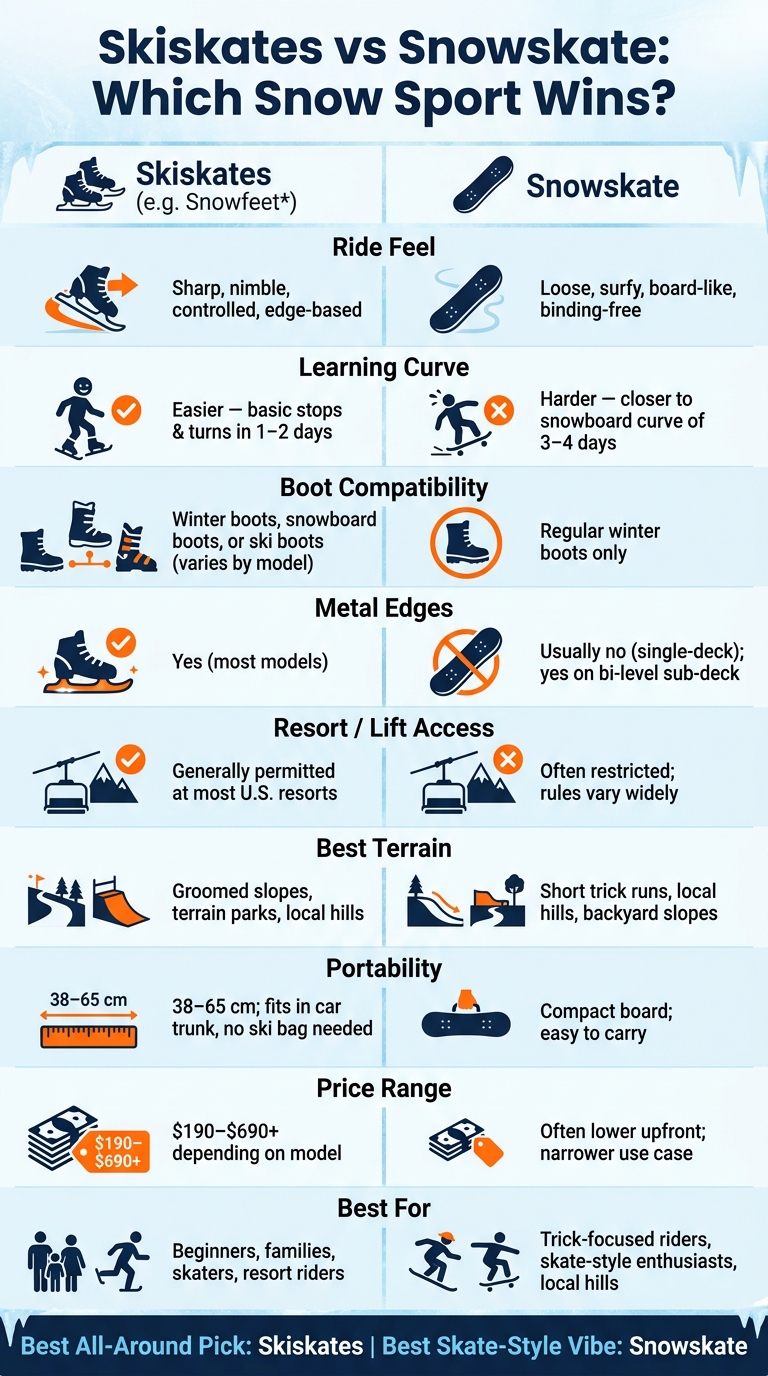
Skiskates vs Snowskate: Side-by-Side Comparison
Snowfeet* & Skiskates Complete Guide | All you need to know about Skiskating
Quick Comparison
| Option | Feel | Learning Curve | Boots | Resort Use | Best For | Price |
|---|---|---|---|---|---|---|
| Skiskates / mini ski skates | Sharp, nimble, more controlled | Easier | Varies by model | Often better odds | Beginners, families, skaters, park laps | $190–$690+ |
| Snowskate | Loose, surfy, board-like | Harder | Winter boots | Often more limited | Trick runs, local hills, skate-style riders | Often lower upfront |
My take: if you want one setup that works in more situations, go with skiskates. If you want a pure binding-free board feel and don’t mind the steeper learning curve, go with a snowskate.
If you want to watch each style before you buy, these help:
From there, it comes down to your boots, your hill, and how you like to ride.
How Each Sport Rides and How Hard It Is to Learn
How Snowfeet* ride feel changes by length
The shortest option, the 38 cm Snowfeet*, feels the most playful and skate-like. They turn fast, pivot with almost no effort, and make quick footwork feel natural. If you’ve done inline skating or played ice hockey, that feel clicks pretty fast. The catch? That small platform asks more from your balance, especially front to back.
Move up to the 50 cm PRO Ski Skates, and things calm down in a good way. The ride feels smoother, more stable at moderate speed, and easier to carve on. The 44 cm Skiskates stay in that same compact, skate-like lane, with edge control that feels sharp and responsive. Then at the 65 cm Skiblades end, you’re in short-ski territory, with a setup made for carving and park laps.
| Option | Ride Feel | Best For | Beginner Difficulty |
|---|---|---|---|
| Snowfeet* 38 cm | Playful, skate-like, quick | Skaters, freestyle, short runs | Moderate |
| Snowfeet* 44 cm Skiskates | Compact, precise, skate-like | Skaters, ski or snowboard boot users | Moderate |
| Snowfeet* 50 cm PRO | Smooth, stable, forgiving | All levels, carving, resort days | Easy–Moderate |
| Snowfeet* 65 cm Skiblades | Short-ski, carving- and park-ready | Carving and park laps | Moderate |
| Snowskate | Surfy, loose, board-like | Board-sport riders, tricks | Harder learning curve |
Why snowskating takes longer to pick up
Snowskating is binding-free, and that’s a big part of why it takes more time to learn. Your feet aren’t locked in, so the board can slip out if your weight drifts even a little off center. You have to stay stacked over the board, with bent knees, hips centered, and shoulders lined up. That sounds simple. On snow, it’s a whole different story.
Turning on a snowskate works more like skateboarding than skiing. You guide it with front-foot pressure and rear-foot steering, not with edges. And here’s the weird part for most beginners: a bit more speed often helps the board turn. That can feel backwards at first. Stopping is tougher too. You need to slide the board sideways, kind of like on a snowboard, but without bindings holding you in place.
For a sense of the learning curve, beginners usually need 3–4 days to stop and turn safely on a snowboard, compared with 1–2 days on skis. Snowskating lands closer to the snowboard side of that range, so most casual riders need more practice before it starts to click.
Which option fits your experience level
If you’re new or riding with family, the Snowfeet* 50 cm PRO is the clearest place to start. It’s the easiest one here to get along with. If you want a short-ski feel for carving and park laps, the 65 cm Skiblades make more sense.
The 38 cm and 44 cm models often feel natural for skaters and inline riders. The fast footwork and edge-based control feel familiar right away. If your goal is a loose, surfy, trick-focused ride, a true snowskate may be more your style. Just know it asks for more patience up front.
sbb-itb-17ade95
Boots, Resort Access, and Where You Can Use Each Option
Boots and bindings side by side
The first big difference is pretty simple: the boots you need.
Snowfeet* Mini Ski Skates and PRO models work with winter boots or snowboard boots. Skiskates 44 cm work with ski or snowboard boots. Skiblades 65 cm use ski boots. Snowskates are even simpler on paper, since most single-deck models don't use bindings at all.
That changes the whole feel of the day. If you already own winter boots, Snowfeet* Mini Ski Skates can be a lot easier to deal with. No ski boots. No stiff plastic shell. No rental counter drama.
The Mini Ski Skates fit US sizes 6–13, so families and casual riders who don't own ski boots can skip the rental line entirely. That's a major convenience advantage.
| Option | Boot Type | Binding Style | Metal Edges | Leash / Retention |
|---|---|---|---|---|
| Snowfeet* Mini Ski Skates (38 cm) | Winter or snowboard boots | Adjustable strap-on | Yes | Varies |
| Skiskates 44 cm | Ski or snowboard boots | Tool-free, non-release | Yes | Yes |
| Skiblades 65 cm | Ski boots | Adjustable non-release | Yes | Yes |
| Snowskate (single-deck) | Winter boots | None | Usually no | Varies |
| Snowskate (bi-level) | Winter boots | None | Yes (sub-deck) | Often required for lifts |
That boot setup doesn't just affect comfort. It also changes where you can ride and how much hassle comes with it.
How U.S. resorts and lifts treat each option
Short skis with bindings and metal edges - like the Skiskates 44 cm and Skiblades 65 cm - are generally treated like normal ski gear at most U.S. resorts. So, in most cases, they can load onto chairlifts without much trouble.
Snowskates are a different story. Resort rules can be all over the place. In many cases, metal edges and a retention device are the bare minimum. Snowfeet* lines up with those rules more often than most snowskates do.
Before you go, check the resort's equipment or safety policy page. Look for terms like:
- "permitted devices"
- "alternative equipment"
- "snowskates"
If the policy still feels fuzzy, call guest services. When you do, describe the gear by its features - length, metal edges, bindings, and leash or retention device - instead of only giving the brand name. That usually gets you a clearer answer.
So, yeah, resort access is a bigger plus for Snowfeet* than for most snowskates.
When a local hill beats a resort
For snowskating, a neighborhood hill or local park often makes more sense than a full resort. With no bindings, you're stepping on and off the board all the time anyway. On a short hill, that feels normal. Hike up, ride down, repeat. It's simple, fun, and it skips lift rules altogether.
Snowfeet* gear also works well on backyard slopes and local hills. But here's the extra piece: the metal edges and secure bindings can also get you onto resort groomers, terrain parks, and many chairlifts without the usual policy headache. Snowskates fit hike-up sessions. Snowfeet* can do that and still work at resorts and parks.
That range comes up again when you look at terrain, portability, and price.
Terrain, Portability, and Price
Where each option works best
Once boots and lift access are sorted, terrain usually becomes the deal-breaker.
Snowfeet* Mini Ski Skates (38 cm) work best on low- to mid-speed runs and local hills, where fast turns and easy control matter most. The 50 cm Snowfeet* lands right in the middle, which makes it a nice pick for mixed-use days. Move up to the 44 cm Skiskates or 65 cm Skiblades, and you get more stability on groomed snow. That makes them a better match for groomed resort slopes and terrain park features.
Snowskates play a different game. They’re built more for short, trick-focused runs where that loose, binding-free, board-like feel is the whole point.
Why Snowfeet* is easier to carry and travel with
At 38 to 65 cm, Snowfeet* models are small enough to toss in a car trunk, carry by hand, and pack for a trip without turning travel into a circus.
You don’t need:
- a roof rack
- an oversized ski bag
- airport check-in for bulky gear
That smaller size makes them easier to bring to hills, parks, and weekend trips. And let’s be honest: gear that’s easy to bring is gear that gets used.
What each price range actually gets you
Entry-level snowskates often cost less at first. That sounds great. But a lower price tag doesn’t always mean better value if the board only works well in one tight use case and may run into lift limits.
| Option | Approx. Price (USD) | Best Terrain | Portability | Value for Casual Riders |
|---|---|---|---|---|
| Snowfeet* Mini Ski Skates (38 cm) | $190–$290 | Local hills, short runs | Excellent | High - easy to use, easy to carry |
| Snowfeet* Skiskates (44 cm) | $460–$690 | Groomed slopes, terrain parks | Very good | High - resort-ready, works in more places |
| Snowfeet* Skiblades (65 cm) | About $590+ | Groomed runs, longer descents | Good | High - most ski-like feel |
| Snowskate (single-deck) | Often less upfront | Short trick runs | Good | Lower - narrower use, more lift restrictions |
Value comes down to one simple thing: how often will you use it?
A pair of Snowfeet* Mini Ski Skates used all winter can be a smarter buy than a cheaper snowskate that only feels right on one kind of run. That’s where the next choice comes in: the riding style each setup suits best.
Verdict: Which Option Fits Your Riding Style?
After looking at ride feel, learning curve, boots, terrain, and price, this comes down to one simple thing: how do you want to ride?
Best pick for beginners and families
If you're new to snow sports or heading out with kids, go with Snowfeet* 50 cm or Skiblades 65 cm. The longer base gives you more stability on groomed beginner and intermediate runs. That makes Snowfeet* the easier pick from day one.
Best pick for skaters and snowboarders
If you already skate or ride a snowboard, Snowfeet* 38 cm or 44 cm hit the sweet spot. They give you the closest Snowfeet* feel to skating. Snowskates get even closer to that pure skateboard feel, sure, but there’s a catch. They give up edge control to do it. And that trade-off shows up fast on hardpack, icy snow, or busy resort runs.
Bottom line
Snowfeet* works in more places and feels easier to control. If you want the simplest setup that can do more, Snowfeet* takes it. Snowskating still has its lane for experienced riders who want a binding-free, board-style ride most and are fine riding mainly parks or local hills where resort rules matter less. If that’s not your main thing, Snowfeet* gives you more fun in more places with less hassle.
FAQs
Are skiskates allowed at most ski resorts?
Yes, most U.S. ski resorts allow Snowfeet skiskates on their slopes and chairlifts.
Why? They have metal edges and are used in a way that’s close to regular skis. So in most cases, they fit standard resort safety rules.
There is one thing to watch for: some resorts require a safety leash for lift access. Snowfeet products include one, which helps.
Still, ski areas can be a little like weather in the mountains - you can’t assume they all play by the same rules. Policies vary, so check your resort’s equipment rules before you head out.
Which Snowfeet* length is best for beginners?
For beginners, _50 cm (Snowfeet PRO)_* is the best all-around place to start. It gives you more stability and support than the shorter options, but it still feels short, easy to handle, and beginner-friendly on mellow runs.
If you want the fastest, most skate-like turns, go with 44 cm. Just know it feels less stable at higher speed than 50 cm.
Can I use regular winter boots with skiskates?
Yes. Snowfeet skiskates work with regular winter boots, so you can skip rigid ski boots.
Regular winter boots feel best for walking around and taking easy, slow laps. They’re simple, comfy, and low-fuss. The tradeoff? You get less ankle support and less edge control than you would with snowboard or ski boots.
If you want more stability, especially on firm snow or when you start going faster, many riders switch to snowboard boots. They give you a more locked-in feel without making things overly complicated.











Jätä kommentti
Tämä sivu on suojattu hCaptcha-tunnistuksella, ja hCaptchan tietosuojakäytäntöjä ja käyttöehtoja sovelletaan.