




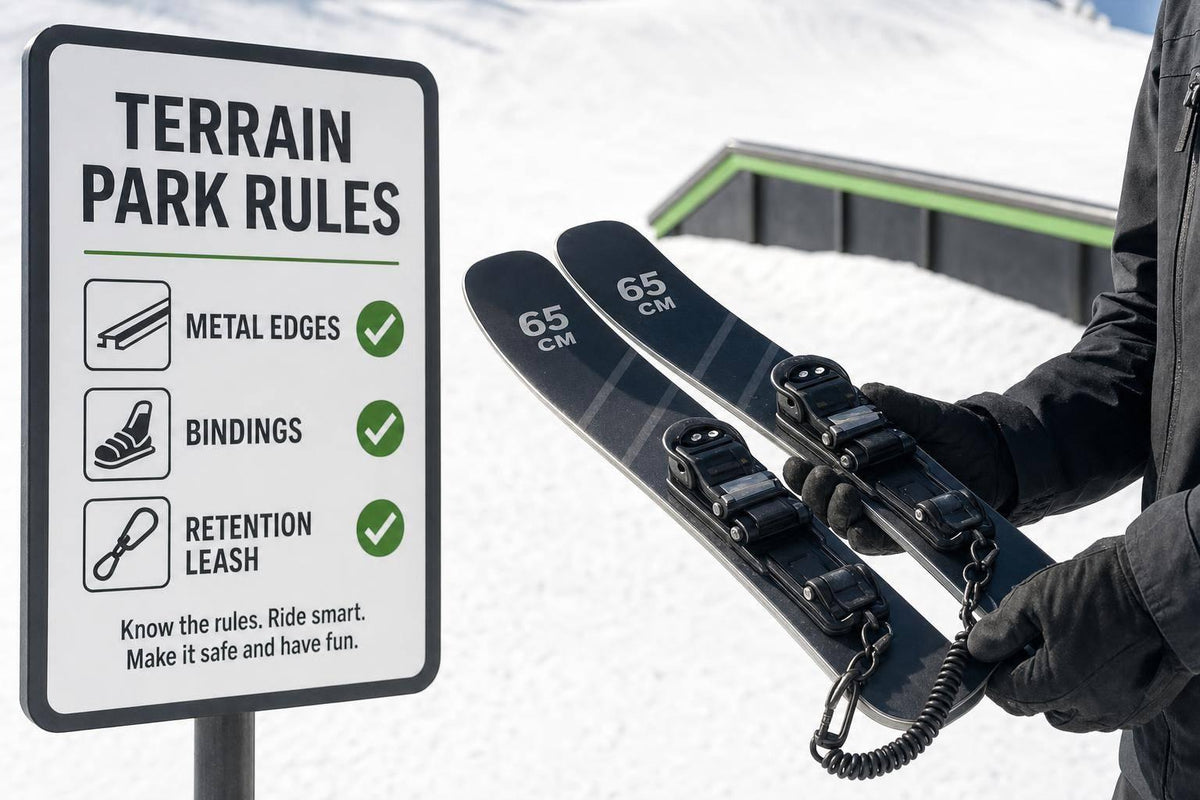
Yes - short skis are often allowed in U.S. terrain parks, but only if the resort says they are. That’s the whole game. One mountain may allow snowblades with metal edges and a leash, while another may ban skiskates or all short skis flat-out.
Here’s the short answer I’d give you in the shop:
- Check the resort’s gear rules first
- Park access is not the same as lift access
- Most resorts look for metal edges, bindings, and a retention system
- A 65 cm skiblade often gets a better shot than a 44 cm skiskate
- Staff on-site make the final call
A few resorts listed in the article show how mixed the rules can be:
- Alta: no short skis, no snow skates
- Stowe: Snowfeet Mini Ski Skates and snowskates not allowed
- Northstar / Big Bear / Telluride / Angel Fire: some short-ski setups allowed, usually with conditions
If you want the safest move, call the resort and give them the exact model, length, edge type, binding type, and whether it has a leash or brake. Don’t just say “short skis.” That’s like telling a mechanic, “Yeah, it’s a car.” Not enough info :)
My quick take: if you want a park-friendly option that still feels stable, 65 cm skiblades are the easiest middle ground for most riders. Shorter setups like 44 cm skiskates are more likely to hit gear-rule problems.
| Setup | Usual park access odds | What resorts tend to care about | Best fit |
|---|---|---|---|
| 44 cm skiskates | Lower | Metal edges, retention, device category | Tight moves, compact setup |
| 65 cm skiblades | Better | Metal edges, bindings, leash/brake | Most casual park riders |
| 99 cm skiblades | Often similar to ski-style rules | Edges, bindings, retention | More stable park laps |
Bottom line: don’t guess. Verify the rules, bring compliant gear, wear a helmet, and start small on your first lap.
For a quick look at park basics, these are worth a watch:
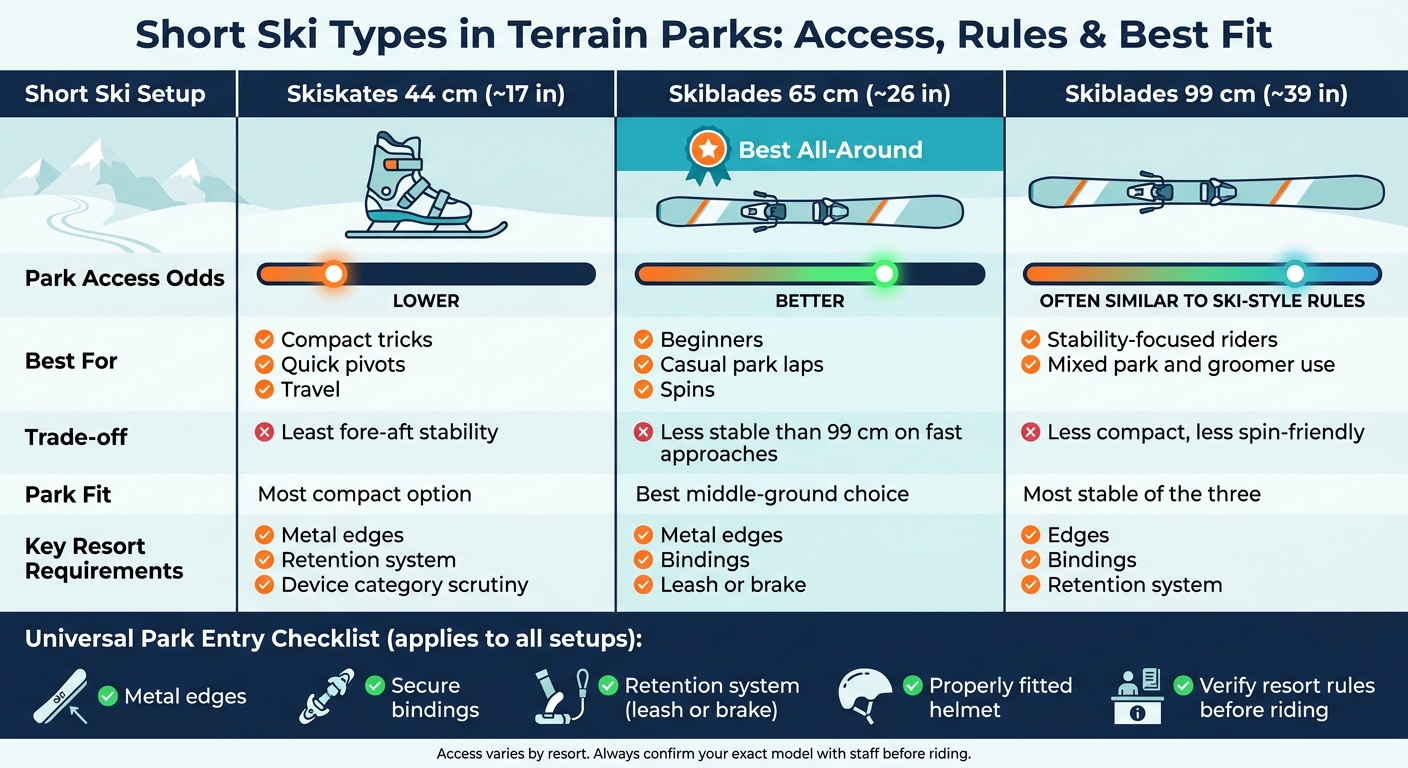
Short Ski Types in Terrain Parks: Access, Rules & Best Fit
How Resorts Decide Whether Short Skis Are Allowed in the Park
How Approval Varies by Resort
Resorts don’t use one blanket rule for short skis. They usually sort access by equipment type, lift, and park zone. So, two setups that look kind of similar can get very different answers.
The table below shows how a few U.S. resorts handle short skis and skiskates in practice. Use it as a starting point, then check your exact model before you ride.
| Resort | Snowblades | Snow Skates / Skiskates | Key Requirements |
|---|---|---|---|
| Northstar California Resort | Allowed with conditions | Allowed with conditions | Leash or ski brake required; skates also need metal edges |
| Big Bear Mountain Resort | Allowed with conditions | Restricted to specific lifts | Metal edges plus a leash or ski brakes |
| Telluride Ski Resort | Allowed with conditions | Restricted | Metal edges and a retention system; snow decks are allowed, but snow skates without metal edges or a retention device are not |
| Angel Fire Resort | Allowed with conditions | Allowed with conditions; some lift-specific limits | Metal edges and a retention device; some snowskate/snow deck use is limited to the Chile Express and Southwest Flyer detachable lifts |
| Stowe Mountain Resort | Not listed | Not allowed | Snowfeet Mini Ski Skates and snowskates are listed as not allowed |
| Alta Ski Area | Not allowed | Not allowed | Ski blades, snow/ski feet, and snow skates are prohibited; skis must have metal edges, retaining devices, and bindings that attach to alpine or Nordic boots |
The pattern is pretty clear: most resorts want metal edges and some type of retention system, like a leash or brake. But that still doesn’t mean every short ski setup gets a green light.
Some resorts allow short skis on the mountain and still say no in freestyle zones. That’s the part people miss. A 65 cm skiblade may be fine where a 44 cm skiskate is not, even at the same resort. In other words, access depends on the type of gear, not just length.
How to Confirm What Is Allowed Before You Ride
Start with the resort’s equipment, park, and lift rules. Then call the ticket office and give them the full setup, not a vague “short skis” label.
Share these details:
- Exact model
- Length
- Edge material
- Binding type
- Retention system
Ask about Snowfeet* Skiblades 65 cm, 99 cm, and Snowfeet* Skiskates 44 cm by name. That makes the answer a lot less fuzzy.
Once you’re on the mountain, show your actual setup to park staff or ski patrol before you drop in. They make the final call on-site, so the gear in your hands matters more than what you think the rule says. After that, the next step is what park staff check before they let you in.
What happens... when you take short skis to the park? 🧐😎
What Park Staff Typically Check Before Letting You In
At the park entrance, staff usually look at your gear and a few basic safety items. But there’s one big catch: if the resort doesn’t allow your device type, that decision beats everything else. So first, make sure your setup is allowed. Then comes the on-site gear check.
Equipment Checks: Edges, Bindings, and Retention Systems
Staff usually check for continuous metal edges, secure bindings, and a working leash or brake. Resorts like Big Bear Mountain Resort, Northstar California, Yawgoo Valley, and Frisco Adventure Park all spell out metal-edge rules for alternative sliding devices. If your device has plastic-only edges, there’s a good chance you won’t get in.
Bindings matter too. They need to be built for that device, attached well, and able to keep your boots or footwear connected during a fall. Staff may look to see if the bindings lock or close the way they should and whether any parts are cracked, bent, or loose. Big Bear Mountain Resort requires a leash or ski brakes for devices that need them, and the retention system must stay connected to the rider at all times. Frisco Adventure Park also bars homemade devices and gear without a self-stopping mechanism. So, yeah, duct-tape engineering usually doesn’t win points here.
Safety Checks: Helmets, Park Rules, and Rider Behavior
Staff also check whether you’re wearing a helmet that fits the right way. Some resorts make helmets mandatory. Spirit Mountain, for example, requires helmets for all terrain-park users. The National Ski Areas Association (NSAA) says to fasten the chin strap and make sure the helmet fits before you ride.
They’re not just looking at gear, either. Staff also watch how you ride. The NSAA’s Park SMART guidance stresses starting small, making a plan for every feature, looking before dropping, respecting other users, and knowing your limits. Spirit Mountain’s rules add that only one rider may use a feature at a time, and riders must wait their turn and call their start before going. Also: don’t ride closed features, and don’t stop on landings. That’s one of those rules that feels obvious until someone forgets.
Here’s the fastest way staff usually screen riders at the park entrance:
| Check | What staff look for | Example resorts with explicit rules |
|---|---|---|
| Metal edges | Continuous, undamaged metal edges on the sliding surface | Big Bear, Northstar, Yawgoo Valley, Frisco Adventure Park |
| Bindings | Purpose-built, fully functioning, no improvised hardware | Yawgoo Valley (locking bindings required) |
| Retention system | Working brake, leash, or equivalent attached to the rider | Big Bear, Northstar, Red Lodge Mountain, Frisco Adventure Park |
| Helmet | Properly fitted helmet | Spirit Mountain (mandatory); NSAA (strongly advised) |
| Behavior | One rider per feature; follow posted signs | Spirit Mountain, NSAA Park SMART |
sbb-itb-17ade95
Best Short-Ski Setups for Terrain Parks, Including Snowfeet* Options
Why Short Skis Work Well on Jumps, Boxes, and Rails
Short skis are easier to pivot and spin because there’s less ski sticking out past your boots. That shorter platform can feel more natural in the park, especially for casual laps, small tricks, and quick direction changes. If a resort allows them, they can be a fun park tool.
But let’s be real: short skis don’t do the work for you. Speed control, balance, binding security, and edge condition still matter just as much. Before your first run, check the takeoff, landing, snow coverage, closures, and rider traffic. A smart setup helps, sure, but park riding still comes down to good judgment and clean technique.
Snowfeet* 65 cm vs. 99 cm vs. 44 cm: Which One Fits Your Park Style
These three Snowfeet* setups each land in a different spot between quick handling and stability: Skiskates at 44 cm / ~17 in, Skiblades at 65 cm / ~26 in, and Skiblades at 99 cm / ~39 in.
| Setup | Length | Best for | Trade-off | Park fit |
|---|---|---|---|---|
| Skiskates | 44 cm / ~17 in | Compact tricks, quick pivots, travel | Least fore-aft stability of the three | Most compact option |
| Skiblades | 65 cm / ~26 in | Beginners, casual park laps, spins | Less stable than 99 cm on fast approaches | Best middle-ground choice |
| Skiblades | 99 cm / ~39 in | Stability-focused riders, mixed park and groomer use | Less compact; less spin-friendly | Most stable of the three |
For most beginners, 65 cm is the best all-around pick. It gives you a nice middle ground: easier to handle than a full-length ski, but not as twitchy as the shortest option.
Here’s the simple breakdown:
- Pick 44 cm if you want max portability and very quick pivots.
- Pick 65 cm if you want the easiest all-around park setup.
- Pick 99 cm if you want more stability on faster park laps.
These comparisons describe likely handling characteristics, not permission to enter a specific park. Always verify the resort's current equipment rules before riding.
When Longer Skis Make More Sense
Short skis work well in terrain parks, but they’re not the right tool for every day on the mountain. Longer skis do better at speed, on steep terrain, in icy snow, and on large jumps where edge hold and glide matter most.
If you spend a lot of time on open groomers, ski steeper runs, or land bigger features, a longer ski from a mainstream brand is the better call. It’s a bit like choosing between a nimble little hatchback and a truck: both have their place, but you probably don’t want the small one for heavy hauling.
For casual riders, occasional park laps, and anyone who wants a compact, portable setup, the Snowfeet* lineup makes more sense. You get less bulk than a full-length ski, with handling that fits tighter, lower-speed park riding.
Conclusion: Check the Rules, Bring the Right Gear, and Start Small
Yes, short skis are often allowed in terrain parks, but only if the resort says yes. And that part matters more than people think. One mountain may allow them with no issue, while another may limit them or say no. So, don’t assume your setup is good to go just because it worked somewhere else.
Check the resort’s rules first. Then confirm your exact setup before you head out.
Ask about your model by name. That gives staff a clear picture and helps you get a straight answer. In the end, staff make the call. If they approve your setup, they’ll check it again at the park entrance.
Bring gear that fits the resort’s rules:
- Metal edges
- Secure bindings
- A retention system, if the resort asks for one
- A properly fitted helmet
Once your gear passes the check, keep your first run small and controlled. No hero laps right away :) Start with easy features and work up from there.
Follow the NSAA's Park SMART approach and start small - build up feature by feature.
The short version: check the rules, bring compliant gear, and start small - Snowfeet* Skiblades 65 cm are the best all-around park choice for most casual riders.
FAQs
Can I use short skis in the park if they’re allowed on the lifts?
Usually, yes. If a resort lets you ride short skis on the lifts, they’ll often let you use them in the terrain park too.
That said, rules can vary by resort and may change during the season. A setup that’s fine in December might not be fine later on.
Your safest move is simple:
- Check the resort’s equipment or safety policies
- Contact guest services to confirm your exact setup works on both the lifts and in the park
It takes a minute, and it can save you a headache at the base area :)
What should I tell the resort before bringing my short skis?
Check the resort’s website for its equipment policy. You’ll usually find it under Safety and Conduct, Equipment Policy, or FAQ. If the wording feels fuzzy, reach out to guest services or ski patrol.
When you ask, be specific. Say you’re using Snowfeet* gear with metal edges, safety bindings, and a retention system like a leash or brake. Also ask about:
- length limits
- lift-specific rules
- whether a base-lodge equipment check is needed
If you can get the answer by email, even better. That gives you something in writing if there’s any mix-up at the resort.
Which Snowfeet* setup is best for beginner park laps?
For beginner park laps, the 65 cm Snowfeet Skiblades* are the best place to start. They hit a nice middle ground between quick movement and steady control, which makes small boxes and mellow rollers feel less scary than full-length skis.
The 44 cm Skiskates are quick and very responsive too, especially if you come from a skating background. But the 65 cm Skiblades give you a bit more surface area, and that helps soften landings while you build your park skills.











Jätä kommentti
Tämä sivu on suojattu hCaptcha-tunnistuksella, ja hCaptchan tietosuojakäytäntöjä ja käyttöehtoja sovelletaan.