



















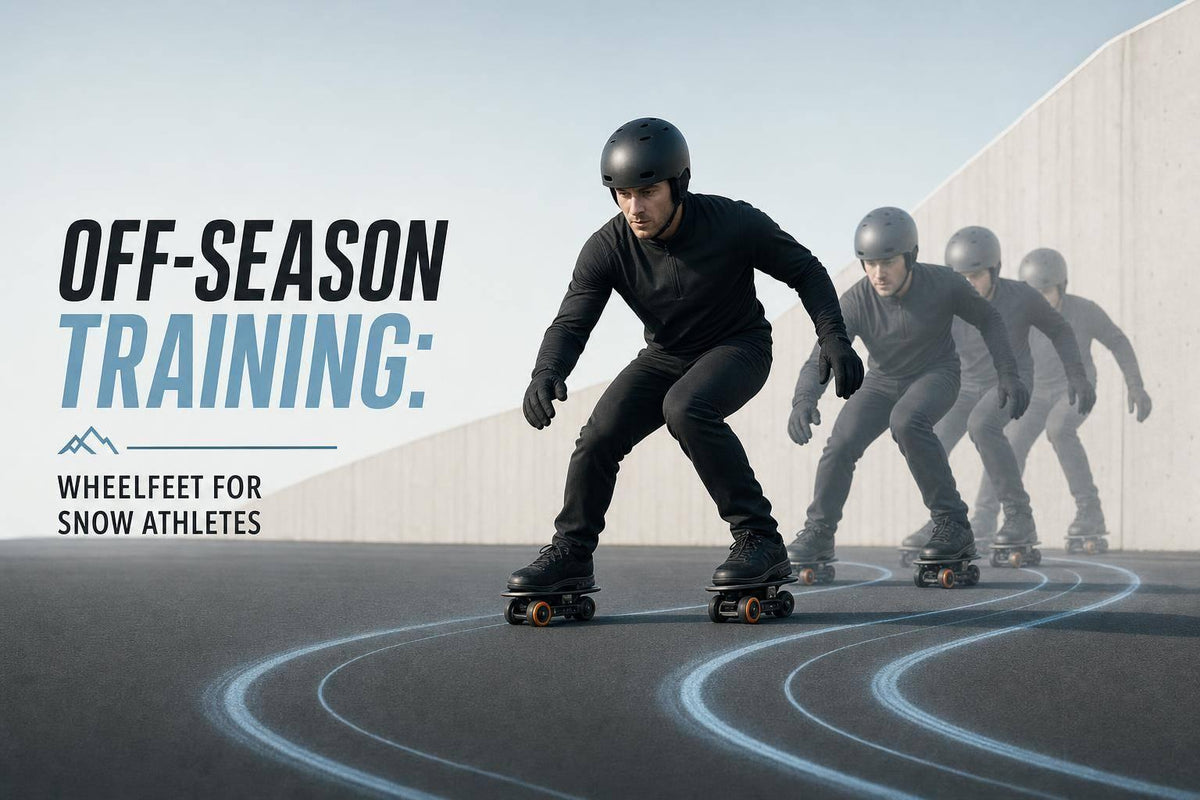
Yes - Wheelfeet can help you stay ready for winter. If you ride Snowfeet* Skiskates or Skiblades, they let you keep working on the 3 things that fade first in the off-season: balance, stance, and weight transfer.
Here’s the short version:
- What Wheelfeet help with: centered stance, side-to-side balance, rhythm, linked turns, and foot-to-foot pressure
- Who they help most: casual skiers, snowboarders, park riders, and Snowfeet* users
- What they don’t replace: snow feel, edge grip, powder, and braking on steep descents
- Best use case: dry-land practice before getting back on Snowfeet* Skiskates (44 cm) or Skiblades (65 cm, 99 cm, 120 cm)
A big reason this matters: coaches often point out that off-snow training can clean up body position fast. And for short-ski gear, being centered over your feet isn’t a small detail - it’s pretty much the whole deal.
So, I’d sum it up like this: Wheelfeet are a bridge to winter, not a replacement for snow. They help you keep your movement patterns warm, so your first day back doesn’t feel like Day 1 all over again :)
If you want the plain-English takeaway, here it is:
- Train on Wheelfeet for movement
- Use snow for feel and stopping
- Expect the biggest carryover on short Snowfeet* setups
That’s the heart of the article.
How Wheelfeet Mirror Snowfeet-Style Movement
Wheelfeet keep the same kind of movement alive between snow days. They let you practice the stance, balance, and turning patterns that Snowfeet* riders use on Skiskates and Skiblades.
Balance, Stance, and Weight Transfer
Wheelfeet don’t let you hang out in the back seat for long. If you want control, you have to stay centered over your feet. Emily Lovett, PSIA Cross Country Team Coach, says it well:
"Rollerskiing is a great way to work on [body position] because, to control the rollerski, you need to have your center of mass over the base of support. You can't get away (as easily) with being in the 'back seat' on rollerskis."
That forward, centered stance matters just as much on Snowfeet* Skiskates (44 cm) and Skiblades (65 cm, 99 cm, and 120 cm). On snow, those short setups respond best when your weight stays where it should be. Practice that off snow, and the switch back to riding on snow feels smoother and more natural.
Pressure Control, Turning, and Agility
Wheelfeet react to pressure, lean, and side-to-side weight shift. That’s a big deal. Side pushes, linked turns, and a low stance all train the same fast, snappy movement pattern Snowfeet* riders rely on.
Justin Arndt, PSIA Cross Country Team Member, points out that dry-land Snowfeet* work can show weak spots you might miss on snow:
"Roller skis mimic cross country ski technique, yet the two sports are different enough that you're sometimes able to spot inefficient habits in your technique that you never would have noticed on your snow skis."
For Snowfeet* Skiskates and Skiblades, that kind of feedback helps your ankles, knees, and hips work as a team in quick turns. It’s a bit like tuning your edges before a ski day - small fixes now can clean up a lot later.
Wheelfeet are strong for dry-land reps, but snow still gives you the surface feel that brings the whole movement together.
Dryland Skills You Can Actually Train on Wheelfeet
You can train these movement patterns on flat pavement. And yes, they carry over. Each sport just leans on Wheelfeet in a slightly different way.
Skiers and Cross-Country Skaters: Rhythm, Glide, and Linked Turns
For alpine skiers and Nordic skate-style riders, Wheelfeet work best for drilling the side-to-side push-off and glide cycle. It’s that steady rhythm: push, shift, balance, repeat. Simple on paper. A little humbling in practice :) But that’s the same weight transfer you need for skating and for linked turns on short skis like Snowfeet* Skiskates 44 cm.
Use Wheelfeet to rehearse push-shift-glide timing, a centered stance, and linked turns. You can also train speed control with controlled stops and step turns.
Snowboarders and Park Riders: Lateral Control and Quick Reactions
For snowboarders and park riders, the focus changes. It’s less about glide rhythm and more about lateral control. Side-to-side pressure changes and fast stance recovery carry over straight into sharper edge-to-edge reactions on Snowfeet* Skiblades 65 cm, 99 cm, and 120 cm.
Put your attention on quick toe-heel pressure changes and fast stance recovery. That translates into better board control and sharper Snowfeet* turns.
Snowfeet* Fans: A Clear Path Into Winter
If you’re new to Snowfeet* products, Wheelfeet give you a practical starting point. You can begin with Wheelfeet, move to Snowfeet* Mini Ski Skates or PRO, and then progress to Skiskates 44 cm and Skiblades in 65, 99, or 120 cm.
Each step uses the same core movement:
- Weight centered
- Ankles engaged
- Pressure applied with intent
Wheelfeet build the movement pattern. Snow still gives you the edge feel and surface feedback that finish the job.
sbb-itb-17ade95
What Wheelfeet Can and Cannot Replace
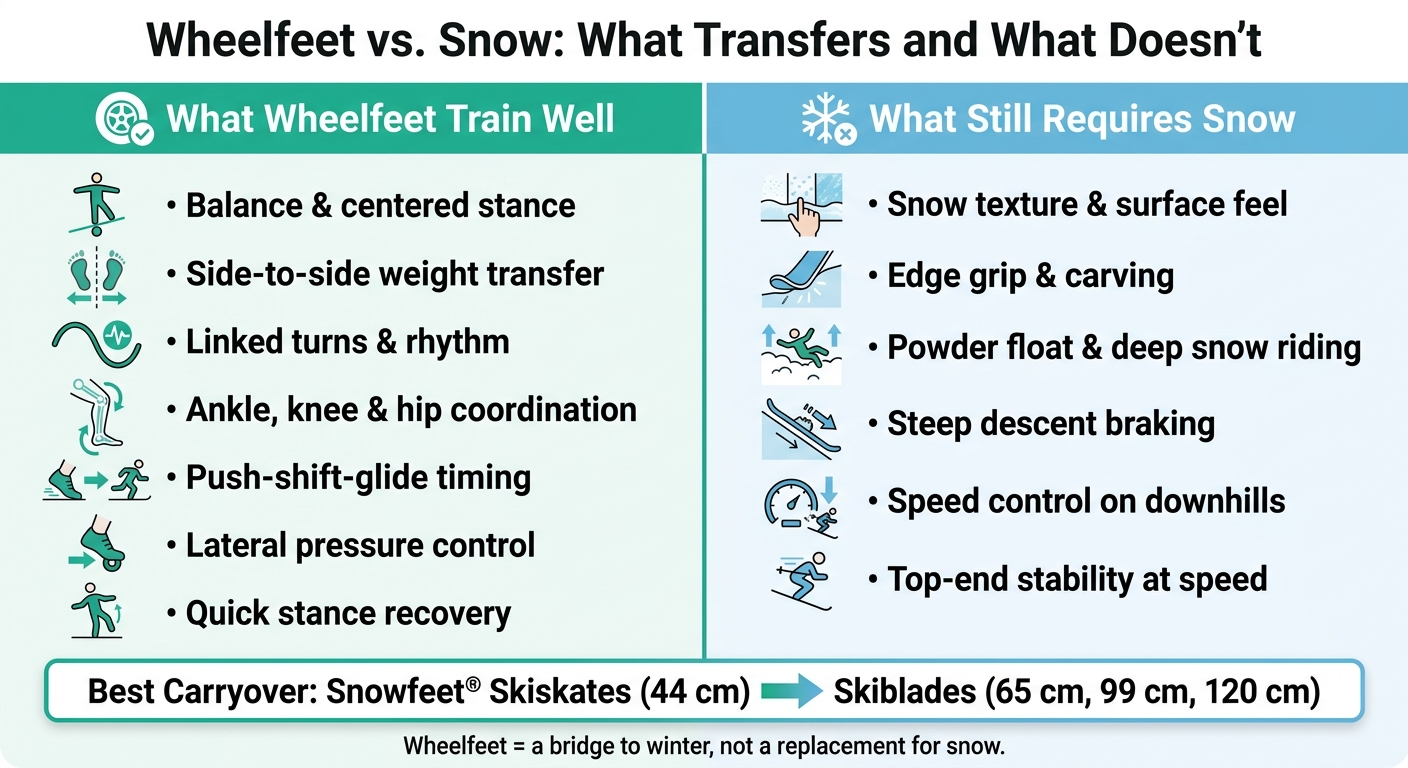
Wheelfeet vs. Snow: What Transfers and What Doesn't
Wheelfeet are handy for off-season reps. But they only cover part of what you need for snow.
What Transfers Well to Snow
Wheelfeet carry over best to balance, stance, timing, and fast weight shifts on short Snowfeet* gear. Since Wheelfeet are small and strap-on, they push you into the same athletic stance that works well on compact snow setups.
That matters more than it may seem. If your body position is off, snow tends to expose it fast. Wheelfeet can help keep those movement patterns sharp before winter shows up.
What Still Requires On-Snow Practice
Snow texture, edge grip, and powder float only happen on real snow. That gap can help you spot technique issues, but it also means snow teaches feel, grip, and speed control in a way wheels just can't.
Some things still need mountain time:
- Steep carving
- Powder riding
- Braking on descents
Braking is a big one. Snow edges give you direct speed control, while wheeled gear gives you little to none on steep downhills.
Long skis still win when it comes to top-end stability and deep powder. But for most casual riders, Snowfeet* products come with a shorter learning curve, better portability, and a more easygoing feel on groomed runs and in parks.
So, Wheelfeet work best as prep for Snowfeet* Skiskates and Skiblades - not as a stand-in for them.
Wheelfeet keep your movement patterns warm, sure. But they don't replace snow. They're more like a bridge into winter than a stand-in for a real snow day :)
Conclusion: Use Wheelfeet to Stay Ready for Snowfeet* Season
Wheelfeet won’t replace a day on the mountain. But they do help you keep the right movement patterns alive between seasons.
That matters more than it might seem. Balance, a centered stance, and turns are the big skills you can keep working on when there’s no snow around. And those are the same skills that matter most when you step back onto Snowfeet* gear. So if you’re a casual rider who wants to keep your body position sharp, Wheelfeet make a lot of sense.
For Snowfeet* users, that off-season practice tends to carry over first to Snowfeet* Skiskates (44 cm), then to Skiblades in 65 cm, 99 cm, and 120 cm. Snow still does the heavy lifting when it comes to speed, edge grip, and stopping.
Wheelfeet are a bridge, not a substitute.
FAQs
Are Wheelfeet good for beginners?
Yes. _Snowfeet Skiskates are beginner-friendly._*
Their short length makes them easier to turn and control. They also feel less intimidating than long skis, which is a big deal when you're just starting out. And because they're short, they can help you avoid common beginner problems like crossed tips.
According to Snowfeet*, many new users feel comfortable after a few hours. Basic skills are often learned in about 1–2 hours. If you want a bit more balance underfoot, the PRO/50 cm option adds extra stability for beginners.
How often should I train on Wheelfeet?
To stay sharp in the off-season, spend 15 to 20 minutes, 3 times a week, on edge-control drills. Hold each edge for 2 to 3 seconds. That extra pause helps build clean, precise movement instead of rushed turns.
Add 10 to 15 minutes of daily weight-shift drills on gentle slopes. It’s simple work, but it pays off big when you want smoother balance and better control.
For fitness, go with 30 to 45 minutes of hill repeats or carving laps. It’s a solid workout, and, let’s be honest, way more fun than staring at a treadmill wall :)
Which Snowfeet* model has the best carryover?
The 44 cm Skiskates feel the closest to skating. They give you the most direct transfer for edge control, quick pivots, and independent leg movement. That makes them the best match for hockey players and skaters who want that skate-like feel on snow.
If you want a bit more stability, go with the 50 cm PRO. It’s the next step up.
For general resort riding, if you still want that quick, skate-style response but with more familiar carving, the 65 cm Skiblades are the best all-around pick.












Jätä kommentti
Tämä sivu on suojattu hCaptcha-tunnistuksella, ja hCaptchan tietosuojakäytäntöjä ja käyttöehtoja sovelletaan.