



















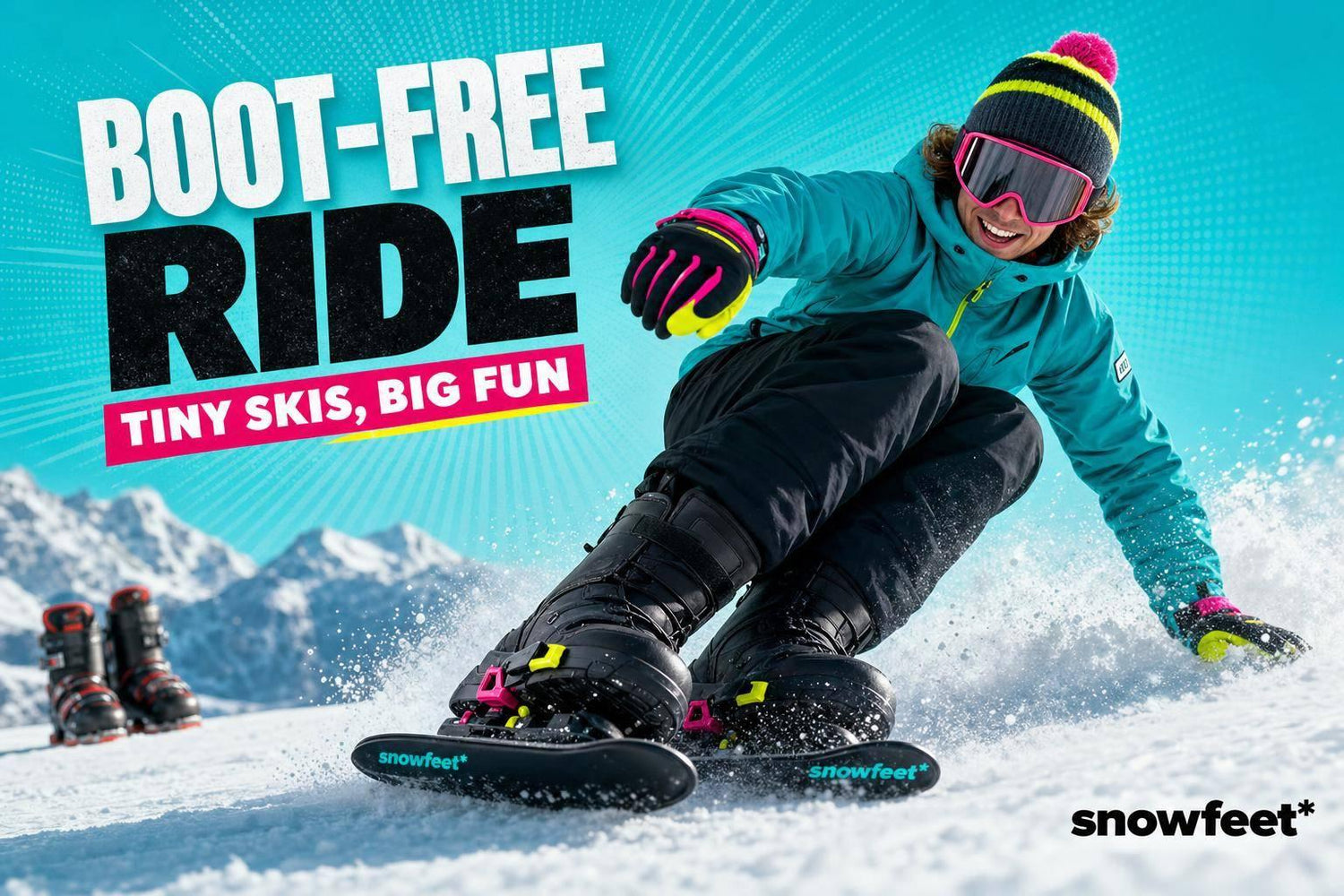
If you hate ski boots, I’d start with Snowfeet* PRO 50 cm. It works with regular winter boots or snowboard boots, starts at $299, fits in a backpack, and is one of the easiest ways to get on snow without the usual boot misery.
Here’s the short version:
- Best for regular winter boots: Snowfeet* Mini Ski Skates or PRO 50 cm
- Best for snowboard boot users: Skiblades 65 cm or 99 cm
- Best for a skate-like feel: Mini Ski Skates or Skiskates 44 cm
- Best for a more ski-like feel: Short Skis 120 cm
- Best for top speed and deep powder: full-length skis - but yes, that means ski boots
- Best non-ski option: snowboard with snowboard boots
The big trade-off is simple. Boot-friendly gear is easier to carry, easier to learn, and far more pleasant to walk in. Full-length skis still win for high speed, icy steeps, and deep powder. So if your main problem is, “My feet are done by lunch,” this is the kind of swap worth making.
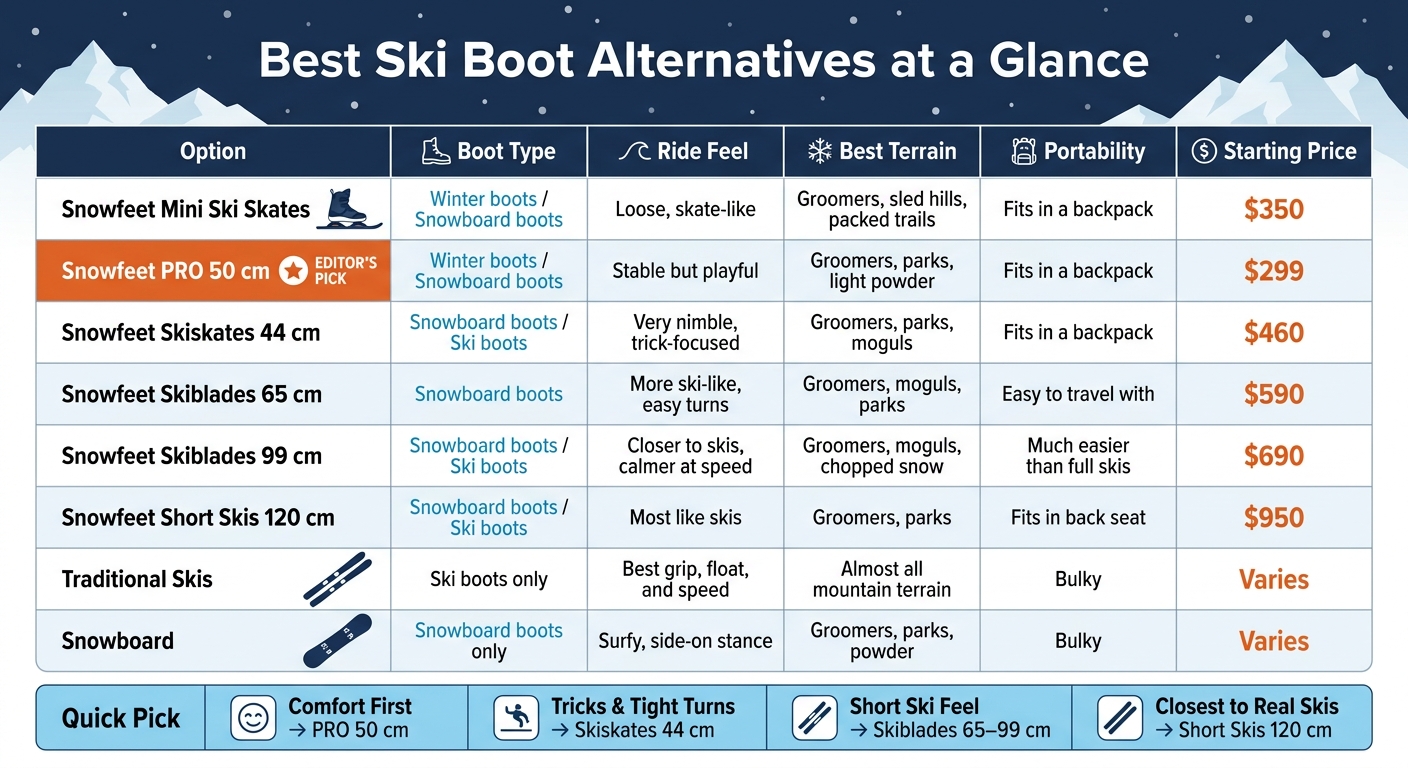
Best Ski Boot Alternatives: Side-by-Side Comparison Guide
The Most Affordable Ski Skate Gear?
Quick Comparison
| Option | Boots | Ride feel | Best terrain | Portability | Starting price |
|---|---|---|---|---|---|
| Snowfeet* Mini Ski Skates | Winter boots / snowboard boots | Loose, skate-like | Groomers, sled hills, packed trails | Fits in a backpack | $350 |
| Snowfeet* PRO 50 cm | Winter boots / snowboard boots | Stable but still playful | Groomers, parks, packed trails, light powder | Fits in a backpack | $299 |
| Snowfeet* Skiskates 44 cm | Snowboard boots or ski boots | Very nimble, trick-focused | Groomers, parks, moguls | Fits in a backpack | $460 |
| Snowfeet* Skiblades 65 cm | Snowboard boots | More ski-like, easy turns | Groomers, moguls, parks | Easy to travel with | $590 |
| Snowfeet* Skiblades 99 cm | Snowboard boots or ski boots | Closer to skis, calmer at speed | Groomers, moguls, chopped snow, parks | Much easier than full skis | $690 |
| Snowfeet* Short Skis 120 cm | Snowboard boots or ski boots | Most like skis | Groomers, parks | Back-seat friendly | $950 |
| Full-length skis | Ski boots only | Best grip, float, and speed | Almost all mountain terrain | Bulky | Varies |
| Snowboard | Snowboard boots only | Surfy, side-on stance | Groomers, parks, powder | Bulky | Varies |
What I like most here is the clear split:
- Want comfort first? Go with PRO 50 cm
- Want tricks and tight turns? Go with Skiskates 44 cm
- Want a short ski feel without ski boots? Go with Skiblades 65 cm or 99 cm
- Want the closest thing to skis? Go with Short Skis 120 cm
A few numbers stand out too. The PRO 50 cm has a 4.9/5 rating from 2,297 reviews. The Skiskates 44 cm also sit at 4.9/5, and several other models show 5.0/5 customer ratings. That doesn’t tell the whole story, of course, but it does show a lot of riders like the boot-friendly setup.
If you want a quick feel for how short skis and ski skates look on snow, these types of videos can help:
So, my take is simple: if comfort matters more than top-end speed, boot-friendly Snowfeet* gear is the better bet. Your feet stay happier, your setup gets smaller, and your day starts to feel like fun again instead of a battle with plastic foot clamps. :)
1. Snowfeet* Mini Ski Skates
Boot Compatibility
Snowfeet* Mini Ski Skates are the smallest option in the lineup, and yep, they’re also the easiest to throw in a bag and take anywhere. They strap right onto standard waterproof winter boots or snowboard boots, so you don’t need a full ski setup. The bindings are adjustable, which helps with fit. If you wear bulky size 12–13 US snowboard boots, check the strap length before you order.
On-Snow Feel
These feel a lot like ice skates on snow. They’re quick, easy to turn, and they hold well thanks to the metal edges. You also get a built-in heel brake, which helps with speed control when things start moving a bit too fast. Most riders get the hang of them pretty fast.
That said, this skate-like ride feels best on firm, packed snow.
Terrain
Snowfeet* Mini Ski Skates work best on:
- Groomed slopes
- Snow parks
- Sledding hills
- Packed hiking trails
Deep powder isn’t their thing. The short length can bog down and make the ride feel like work.
Portability
At 50 cm long, they fit into a backpack with little fuss. That’s a big plus if you travel a lot or just don’t want to lug around full-size skis. If you want the easiest entry point without dealing with ski boots, this is the most compact pick.
Snowfeet* Mini Ski Skates start at $350.
2. Snowfeet* PRO 50 cm
Boot Compatibility
The PRO 50 cm works with regular winter boots or snowboard boots. Its adjustable bindings fit most riders, and the snowboard-style baseplate gives you a more secure fit.
If you're riding slopes, snowboard boots give you more ankle support. For trails or smaller hills, winter hiking boots do the job just fine. One thing to watch: very bulky boots can press against the straps, so it’s smart to check the fit before you buy.
On-Snow Feel
The PRO 50 cm keeps that fun, skate-on-snow feel, but it gives you more stability and control than the Mini Ski Skates. So if you want more confidence without jumping into ski boots, this is a nice middle ground.
It also has a higher stance and a narrower shape, which makes edging easier. That helps you start turns and stop with more control. The added length helps too. Turns feel easier, stops feel less sketchy, and the ride feels more planted.
Put simply, the PRO sits between:
- The ultra-compact Mini Ski Skates
- The more turn-focused 44 cm Skiskates
If you want even more nimble control, the 44 cm Skiskates go smaller still.
Terrain
This model works best on groomed slopes and in snow parks, but it also handles packed trails, sledding hills, and light powder up to about 4 inches.
Deep powder? Not its thing. Steep icy runs? Also a pass. It likes snow you can trust.
Portability
At 20 inches long, the PRO 50 cm fits inside a standard backpack. It also comes with a waterproof bag, which makes carrying it around pretty easy.
The Snowfeet* PRO 50 cm starts at $299. It has a 4.9/5 rating across 2,297 reviews, with riders praising its portability and how easy it is to learn.
3. Snowfeet* Skiskates 44 cm
Boot Compatibility
If you want something smaller and more playful than the PRO 50 cm, the Skiskates 44 cm are the next step. For most readers, the snowboard-binding version makes more sense because you can skip ski boots. There’s also a ski-boot version with adjustable, tool-free bindings, safety leashes, and an anti-slip base for a secure fit.
On-Snow Feel
These feel a lot like ice skates on snow. They’re fast, easy to carve, and fun to spin, with metal edges that help you brake with confidence.
Compared with the PRO 50 cm, the Skiskates are shorter and more geared toward tricks. That shorter length gives them a snappy, playful feel. If you already skate, the learning curve is pretty short. Out of the boot-friendly picks covered so far, this one is the most nimble and trick-focused.
Terrain
They work best on groomed runs, snow parks, and moguls, especially on green and blue slopes. If you’re heading into deep powder or steep, icy terrain, these aren’t the top pick. In those conditions, most riders will feel better on one of the longer Snowfeet models.
Portability
At 44 cm, these fit in a regular backpack, which makes travel and storage super easy. That’s a big win if you hate lugging around bulky gear.
The trade-off is simple:
- Less float and stability than longer models
- Much more agility and trick-friendly handling
The Snowfeet* Skiskates 44 cm start at $460 and have a 4.9/5 rating across 123 reviews.
4. Snowfeet* Skiblades 65 cm
Boot Compatibility
If the 44 cm and 50 cm models feel a bit too much like skates, the 65 cm Skiblades are where things start to feel more like skiing. For most people, the snowboard-boot version makes more sense. It fits US sizes 6–14.5 and still gives you the big perk of Snowfeet*: you can walk around in comfort instead of clomping through the resort in ski boots.
On-Snow Feel
The 65 cm Skiblades sit in a nice middle zone. They blend the quick, playful feel of short skates with some of the calm and control you get from longer skis. They work with regular snowboard boots, feel more stable than the shorter models, and still stay fun in tight turns.
The wood core helps a lot here. It feels more planted than the PRO 50 cm, which gives the ride a smoother, more ski-like feel. So if you want more stability but don’t want to give up that easy, nimble ride, this model hits a nice balance.
Terrain
These 65 cm blades are made for groomed runs, moguls, and snow parks. Compared with the 99 cm and 120 cm models, they’re easier to throw into tighter turns and easier to manage on park features. The trade-off is simple: you get easier turning, but a bit less stability once the speed climbs.
Portability
They’re bigger than the 44 cm and 50 cm versions, but they’re still compact enough to travel with without much fuss. That makes them a smart pick for resort days and trips where you want gear that won’t be a pain to haul around.
If you want the next step up in speed and stability, the 99 cm Skiblades push more in that direction.
Starts at $590, with a 5.0/5 customer rating.
sbb-itb-17ade95
5. Snowfeet* Skiblades 99 cm
If the 65 cm blades feel a bit too much like skates, the 99 cm version lands in a nicer middle zone. You still get the short-ski feel, but with more calm and control.
Boot Compatibility
The 99 cm Skiblades don't work with regular winter boots. You'll need either snowboard boots or ski boots.
The snowboard boot version fits US sizes 6–14.5, and the ski boot version fits US sizes 4.5–14.5.
If you'd rather skip stiff ski boots, go with the snowboard-boot version. It's a smart pick for people who want more of a ski feel without the usual ski-boot pain.
On-Snow Feel
This is where the 99 cm model starts to feel much closer to an actual ski. It's more stable than the shorter Snowfeet* options, but still short enough to feel easygoing and simple to handle.
Riders often say the same thing: it's easy to control, quick edge to edge, and forgiving when the day gets a little messy.
"These ski blades are a blast to use. Super easy to control, quick to turn, and way more forgiving than traditional skis. They're great for carving and navigating crowded slopes without feeling bulky." - Brad Tolin
The wood core and steel edges help the ski stay planted. That said, full-length skis still do better once speeds climb.
Terrain
The 99 cm Skiblades are made for groomed slopes, snow parks, moguls, and chopped-up snow. They also do well on busy runs, which is a big plus when the mountain feels like a Saturday parking lot on snow.
If carving is high on your list, this is one of the best Snowfeet* picks. And if you want more stability but still don't want to jump to full-size skis, the 120 cm Short Skis are the next move.
Portability
At 99 cm, these are still much easier to carry than full-size skis. That's part of the appeal. You get more ski-like performance without lugging around a giant setup all day.
They're a nice middle ground for riders who want:
- better stability than mini blades
- easier transport than full-length skis
- a more ski-like ride without going all in
Starts at $690, with a 5.0/5 customer rating.
If you want a bit more stability and that extra ski-like confidence, the 120 cm Short Skis are the next step.
6. Snowfeet* Short Skis 120 cm
The 120 cm Short Skis are Snowfeet*'s longest and most ski-like option. If you want more stability but don't want to deal with ski boots, this is the best fit in the lineup.
Boot Compatibility
It comes in two versions: one for ski boots and one for snowboard boots. If you can't stand stiff ski boots, the snowboard-boot setup is the easy comfort-first choice.
On-Snow Feel
This is the most stable Snowfeet* model at speed, and it still turns more easily than full-length skis. That gap is the big selling point. You get closer to the steady feel of regular skis than with any other model here, but without the rigid boots that usually come with that ride.
Terrain
These work best on groomed runs and in snow parks. The shorter shape also helps a lot at resorts. In tight spots and crowded runs, they're easier to handle than full-size skis.
Deep powder? That's not where they shine.
Portability
At 120 cm, they can fit across the back seat of most cars. No roof rack. No circus act in the parking lot.
At $950, this is the top-end model in the Snowfeet* range. It also sets up the next comparison: this comfort-first snowboard-boot setup versus regular skis with snowboard boots.
7. Traditional Skis with Ski Boots
Traditional skis are still the performance benchmark. No surprise there. But they come with ski boots, and that’s the catch. You get strong downhill control, yet you also sign up for less comfort and more hassle.
Boot Compatibility
Traditional alpine skis need ski boots. Regular winter boots won’t work. Snowboard boots won’t work either.
That setup is precise and built for safety. But let’s be honest: ski boots are the exact pain point this article is trying to help you avoid.
On-Snow Feel
This is where traditional skis shine. They offer the best edge hold, speed stability, and powder float in this lineup.
Ski boots can feel stiff and awkward when you’re off the snow. On snow, though, that same stiffness is what gives you tight control and clean turns. It’s a bit like wearing a cast that suddenly turns into a steering wheel.
Terrain
Traditional skis handle almost everything best:
- Groomers
- Steep slopes
- Variable snow
- Powder
That makes them the performance pick, not the comfort pick.
Portability
Ski boots alone weigh about 3–5 kg (6.6–11 lb) before you even add skis.
So, yeah, the gear pile grows fast. More bulk. More bags. More hassle than boot-friendly Snowfeet* gear.
Traditional skis make sense if you ski often and care most about downhill performance. But if you can’t stand ski boots, they fix the wrong problem. That trade-off becomes a lot easier to size up in the pros-and-cons breakdown next.
8. Snowboard with Snowboard Boots
Snowboarding is the go-to pick for people who can’t stand ski boots. Snowboard boots are softer, easier to walk in, and way less punishing on your shins. You also get more say in the fit thanks to lacing systems like traditional laces, BOA dials, or speed laces. No hard buckles. No rigid shell digging into your legs.
That said, compared with Snowfeet*, you’re still signing up for a fixed-stance setup and a full set of gear.
Boot Compatibility
Snowboard boots only work with snowboard bindings. You can’t use regular winter boots, and they won’t fit ski bindings either.
That’s the big split from Snowfeet*: once you go with a snowboard setup, you lose boot choice.
On-Snow Feel
A snowboard feels loose, smooth, and surfy. Both feet are attached to one board, and you turn with heel-side and toe-side movement. It’s fun, but that sideways stance can take a few sessions before it starts to feel natural.
Over a full day, having both feet locked to one board can get tiring. That’s the trade-off. Snowfeet* gives you more leg freedom and asks for less of a commitment.
Terrain
Snowboards do well on groomed runs, terrain parks, and powder. But on icy or narrow trails, they can feel less exact than skis or short ski options. You don’t get the same independent leg movement, and that wider board underfoot can make tight spots feel a bit clunky.
Portability
A snowboard setup is still bulky. You’ll need storage space or a board bag. Snowfeet* gear, by contrast, is much easier to toss in a backpack and go.
Snowboarding solves the ski-boot problem. Snowfeet* solves the ski-boot problem without adding a bigger setup. That’s why snowboarding is the main non-ski comparison point in the pros-and-cons section next.
Pros, Cons, and Who Each Option Is For
Here’s the fast way to compare the most boot-friendly picks: comfort, stability, portability, and who each one fits best. If you want to skip the deep dive and get to the good stuff, this table makes it easy to match your boots, budget, and terrain.
| Item | Pros | Cons | Ideal user | Starting price |
|---|---|---|---|---|
| Snowfeet* Mini Ski Skates | Backpack-sized and boot-friendly | Less stable on steep terrain and in deep snow | Casual riders, families, kids | From $199 |
| Snowfeet* PRO 50 cm | Works with winter boots or snowboard boots, very agile, great value | Not suited for deep powder or high speeds | Beginners, hikers, casual resort riders | From $299 |
| Snowfeet* Skiskates 44 cm | Fast edge-to-edge, backpack-friendly, very agile | Slower than full skis, requires balance | Travelers, snowboarders, park riders | From $460 |
| Snowfeet* Skiblades 65 cm | Best for playful control and park use | Limited stability at speed | Kids, beginners, park-focused riders | From $590 |
| Snowfeet* Skiblades 99 cm | Easy to control, forgiving on crowded slopes, lightweight | Less stable at higher speeds than full skis | Casual resort riders, seniors, beginners | From $690 |
| Snowfeet* Short Skis 120 cm | Most ski-like Snowfeet* option | Least portable of the Snowfeet* lineup | Former skiers who want comfort | $950 |
| Traditional skis + ski boots | Maximum speed, edge hold, deep-snow flotation | Stiff boots, heavy gear, steep learning curve | Racers, advanced skiers, serious resort riders | Varies |
| Snowboard + snowboard boots | Comfortable boots, great in powder and parks | Both feet fixed to one board, bulky setup | Freestyle riders, powder enthusiasts | Varies |
The short version? Snowfeet* gives up some stability at high speed compared with longer skis. But it makes up for that with better comfort, easy packing, and a lower barrier to getting started.
Traditional skis still have the edge on steep runs, fast riding, and deep snow. If that’s your whole game, they’re hard to beat. But if boot pain has you grumpy before lunch, Snowfeet* starts to look pretty darn good :)
The next section turns this side-by-side look into a direct pick for beginners, travelers, snowboarders, and skiers who want less boot pain.
Which Option Should You Choose?
Start with your boot type. Then pick the level of stability you want.
If you plan to ride in winter boots, go with Snowfeet* Mini Ski Skates or PRO 50 cm. Both work with standard waterproof winter boots, so you can skip ski boots entirely. That’s a big win if you want less hassle and more comfort.
If you already own snowboard boots, your best picks are PRO 50 cm or Skiblades 65–99 cm. Want the most nimble feel on groomed runs? Choose Skiskates 44 cm. That quick, loose feel is a big reason many snowboarders like them more than a fixed board stance.
For casual resort riding, PRO 50 cm or Skiblades 65 cm make the most sense. They’re forgiving, more comfortable than ski boots, and easy to pack. Simple setup. Less lugging stuff around. Hard to hate that :)
Need top speed, better grip on ice, and powder performance? Go with traditional skis if steep terrain, ice, and speed matter more than comfort. If that trade-off sounds a bit rough, Short Skis 120 cm are the closest Snowfeet* option.
If you want the fast answer, this table makes it easy:
| Rider type | Best match | Why it works |
|---|---|---|
| Regular winter boot users | Snowfeet* Mini Ski Skates or PRO 50 cm | Lets you ride in standard winter boots and skip ski boots entirely |
| Snowboarders wanting a ski-like feel | Snowfeet* PRO 50 cm or Skiblades 65–99 cm | Keeps snowboard boot comfort while adding more stability than shorter models |
| Casual resort riders | Snowfeet* PRO 50 cm or Skiblades 65 cm | Forgiving, more comfortable than ski boots, and easy to pack |
| Riders who need traditional performance | Traditional skis with fitted ski boots; Short Skis 120 cm as a softer option | Keeps top-end control; Short Skis 120 cm reduce the boot hassle |
FAQs
Can beginners use Snowfeet* safely?
Yes - beginners can use Snowfeet* safely if they pick the right model.
For most first-timers, the 65 cm or 99 cm Skiblades are easier to learn on than the 44 cm Skiskates. Why? They give you more stability and a bit more room for error, which is nice when you're still getting your ski legs :)
A lot of people can learn the basics in as little as five minutes to one day.
For safety, wear sturdy, waterproof boots and make sure they’re fastened tightly in the bindings.
Do Snowfeet* work at all ski resorts?
Generally, yes - Snowfeet* gear can be used at ski resorts.
That’s a big part of the appeal. The gear is compact and light, so it feels like a simpler option than long skis. You also use your own winter boots or snowboard boots, which takes some of the hassle out of getting set up.
They tend to work best on:
- Groomed runs
- Terrain parks
- Moderate slopes
That said, there are spots where long skis still win. If you’re into racing, very steep terrain, or deep powder, traditional long skis and hard boots still have the edge in performance.
How do I choose between 50 cm, 65 cm, and 99 cm?
It depends on what matters most to you: portability, agility, or stability.
- 50 cm PRO: best if you want easy carry, easy comfort, and use with regular winter boots or snowboard boots
- 65 cm Skiblades: gives you more of a ski-like carve with quick, lively handling
- 99 cm Skiblades: the best all-around pick for most resort riders, with the most stability plus a nice balance of control and speed











Jätä kommentti
Tämä sivu on suojattu hCaptcha-tunnistuksella, ja hCaptchan tietosuojakäytäntöjä ja käyttöehtoja sovelletaan.