





Spring slush can turn a fun run into leg day fast. If I wanted the short answer, I’d put it like this: for most resort riders, a 99 cm short ski is the best mix of easy turns, low hassle, and enough support for soft afternoon snow. If the snow is wetter and deeper, I’d look at the 99 cm powder shape. If I ski faster or want a calmer ride, I’d go 120 cm.
Here’s the whole article in one glance:
- Snowfeet* Skiblades 99 cm: best for mixed spring resort days
- Snowfeet* Skiblades POWDER 99 cm: best for the wettest, softest snow
- Snowfeet* Skiblades 120 cm: best if I want more stability
- Conventional snowblades: fun on firmer morning snow, less fun in heavy slush
- Longer all-mountain skis: steadier in chop, but harder to turn and carry
- Full-length powder skis: most float, but often too much ski for normal spring laps
A few numbers stand out:
- 85 mm waist on the standard 99 cm
- 120 mm waist on the POWDER 99 cm
- 78 mm waist on the 120 cm
- 6 m to 8 m turn radius on the short Snowfeet models
- 15 m to 20+ m radius on many longer skis
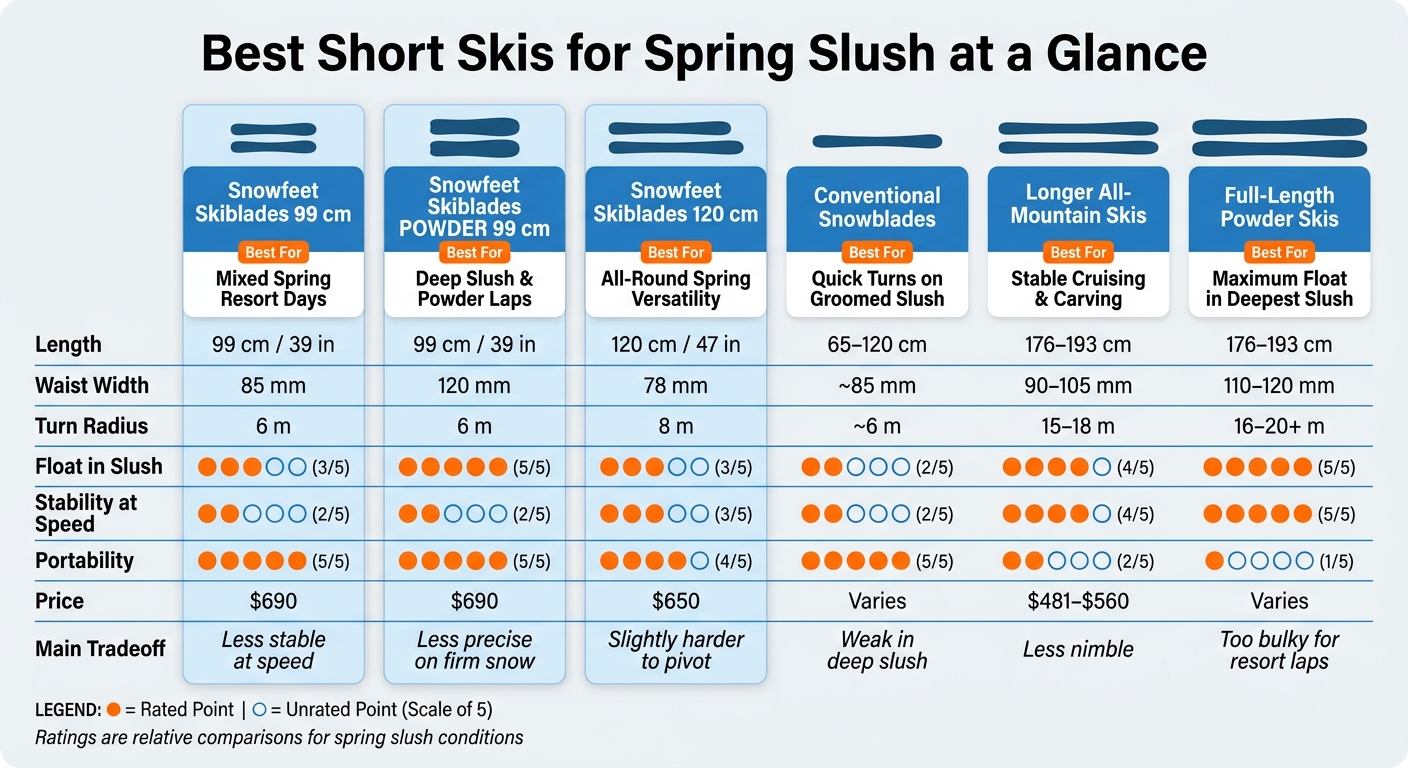
Best Short Skis for Spring Slush: Side-by-Side Comparison
Snowfeet* Snowblades | Skiboards | Skiblades | Short Skis - Complete Guide | All you need to know
Quick Comparison
| Option | Best use | Main tradeoff | Price |
|---|---|---|---|
| Snowfeet* Skiblades 99 cm | Mixed spring slush | Less stable at higher speed | From $690 |
| Snowfeet* Skiblades POWDER 99 cm | Wet, soft, deeper slush | Less sharp on firmer snow | From $690 |
| Snowfeet* Skiblades 120 cm | More stable short-ski ride | A bit less easy to pivot | About $650 |
| Conventional snowblades | Firm morning laps | Less support in heavy slush | Varies |
| Longer all-mountain skis | Mixed terrain, more speed | More work in tight turns | About $481–$560 in examples |
| Full-length powder skis | Deep soft snow | Bulky, slower feel on resort runs | Varies |
So, if you want easy control, short turns, and gear that won’t feel like a wrestling match in the parking lot, the short Snowfeet options make the most sense. If you want more float or more speed stability, move up in width or length.
1. Snowfeet* Skiblades 99 CM
The Snowfeet* Skiblades 99 CM are made for quick, controlled turns in spring slush and soft, uneven snow. They’re 39 inches long, with a 115/85/110 mm tip/waist/tail shape and a 6-meter turn radius. That setup works well when spring snow starts getting messy, with ruts, wet piles, and soft patches showing up halfway down the run.
Length and Stability
At 99 cm, these feel more planted than super-short skiblades. That said, there’s a trade-off. In heavy chop or at higher speeds, they lose some composure.
Keep your pace in check and they do well in slush. Push too hard in rough snow, and the short platform can get tossed around a bit. That’s just the deal with a shorter ski.
Width and Float
The 85 mm waist gives you enough surface area for shallow soft snow and forgiving spring slush, but this still isn’t a powder ski. Snowfeet says its short skis work best in light powder up to about 4 inches (10 cm).
If the snow gets deeper, the Snowfeet* Skiblades POWDER 99 CM makes more sense. That model has a 120 mm waist. So, use the standard 99 CM for spring slush, soft groomers, and shallow fresh snow. For deeper soft stuff, the POWDER 99 CM gives you a lot more float.
Turn Behavior
The 6-meter radius leans toward quick direction changes and short, easy turns, not long, fast carves. On a busy spring slope, that can be a big plus. Snow changes fast in those conditions, and a ski that snaps from turn to turn feels right at home.
Portability
At 39 inches, these are easy to carry, stash in a car, or store in a tight space. Nice perk if you hate wrestling with long skis in the parking lot :)
Bindings fit about US men's 4.5–14.5, based on setup. Just check the exact binding type before you order, since fit can vary.
| Spec | Snowfeet* Skiblades 99 CM |
|---|---|
| Length | 99 cm / 39 in |
| Tip / Waist / Tail | 115 / 85 / 110 mm |
| Turn radius | 6 m |
| Tip & tail rise | 5 cm each |
| Boot size range | US 4.5–14.5 (approx.) |
| Starting price | From $690 |
For softer spring snow, the next model adds more width while keeping that short-ski feel. That extra platform is the whole point of the POWDER version.
2. Snowfeet* Skiblades POWDER 99 CM
The standard 99 CM is built for fast, easy slush turns. The POWDER version shifts the feel a bit. You give up a little snap, but you get more float in soft, wet snow.
The POWDER 99 CM is 99 cm (39 in) long with a 150 mm tip / 120 mm waist / 150 mm tail, a 6 m turn radius, and 5 cm of tip and tail rise. That extra width is the big reason it floats better.
Length and Stability
The wider base gives you more support in soft snow. It also helps the ski stay calm over wet piles and uneven slush. This model leans more toward playful control than blasting through chopped-up snow at speed.
Width and Float
The 120 mm waist is the headliner here. It handles soft spring snow better than the standard 99 CM. In wet midday conditions, the wider platform helps the ski ride higher. If you want the 99 CM shape with more help in wetter, softer spring snow, this is the one.
And even with that added width, the short length still makes turns feel fast and easy.
Turn Behavior
The 6 m radius and deep sidecut make short, quick turns simple, while the camber helps on firmer patches. In slush, you can change direction fast around soft bumps and crowded runouts without locking into a long turn. The twin-tip shape also works for switch riding, which is a nice plus for park riders.
One small tip: stay centered. If you lean back in wet snow, the tips can dive.
Portability
Check the binding option before you order. It comes with ski-boot or snowboard-boot binding options, so make sure you pick the one that matches your setup.
| Spec | Snowfeet* Skiblades POWDER 99 CM |
|---|---|
| Length | 99 cm / 39 in |
| Tip / Waist / Tail | 150 / 120 / 150 mm |
| Turn radius | 6 m |
| Tip & tail rise | 5 cm each |
| Twin tip | Yes (forward + switch riding) |
| Starting price | From $690 |
Next: the 120 CM model for riders who want more stability without giving up short-ski control.
3. Snowfeet* Skiblades 120 CM
If the 99 CM models feel a bit loose in chopped spring snow, the 120 CM is the step up most casual riders want. It feels more like a regular ski than anything else in the Snowfeet lineup. You still get that short-ski vibe, but with a calmer, more planted feel in wet, soft snow.
Length and Stability
At 120 cm (47 in), this model gives you more edge hold and more carving stability than Snowfeet's shorter options. It uses camber with tip and tail rocker, which helps it release cleanly in uneven snow.
That matters a lot in spring. Once the snow gets chopped up and full of tracks, the 120 CM feels steadier and less twitchy than the shorter models.
Width and Float
The 109/78/99 mm shape sits right in the middle of the lineup. It’s wide enough to feel forgiving in spring slush, but still narrow enough to stay quick from edge to edge.
It handles soft spring snow and light powder better than the shorter models. But let’s keep it real: deep snow, or the extra-heavy wet stuff, is still better suited to a powder ski.
Turn Behavior
The 8 m radius leans into quick, tight turns on moderate slopes. The rocker also helps start turns in soft, uneven snow.
So, this ski lands in a nice middle spot. It’s quicker than full skis, but more settled than the 99 CM models. In spring slush, a smooth approach works best:
- Stay centered
- Add edge pressure bit by bit
- Don’t lean too far back
Wet snow can grab a short ski fast if you lose speed or get lazy with your stance. Yeah, spring snow has a way of humbling people :)
Portability
At 47 in, it’s still much easier to carry and store than full-length skis. It uses release ski bindings for roughly 26–36.1 mondo-point boots. Before you order, check Snowfeet’s current sizing and binding adjustment guide.
| Spec | Snowfeet* Skiblades 120 CM |
|---|---|
| Length | 120 cm / 47 in |
| Tip / Waist / Tail | 109 / 78 / 99 mm |
| Turning radius | 8 m |
| Tip / tail rise | ~5.5 cm / ~4.5 cm |
| Binding type | Release ski bindings |
| Price | $650 |
That balance makes it the clear middle pick before comparing Snowfeet* with conventional snowblades.
sbb-itb-17ade95
4. Conventional Snowblades
Conventional snowblades are short and easy to toss around. Most come in under 100 cm, though many fall within the 65–120 cm range. They also tend to be narrower, which gives them a quick, snappy feel on firmer snow.
That’s the good part.
On firm spring mornings, they’re fun and easy to steer. But once the snow gets wet, heavy, and chopped up, they start to show their limits.
Length and Stability
Their short length makes them nimble. That’s why a lot of riders like them for easy laps and quick turns.
But there’s a catch. Narrow, old-school blades sink more and can feel grabby in wet slush than Snowfeet’s wider Skiblades. In rough afternoon snow, they feel less planted, and that gets more noticeable as speed builds.
Width and Float
Width plays a big role in spring snow. One 99-cm blade example has 11.5/8.5/11 cm tip-waist-tail dimensions and a 6-meter turning radius.
On hard snow, that shape feels quick and fun. In deep or heavy slush, not so much. Narrow blades can sink or feel sticky when the snow gets thick. Snowfeet’s wider Skiblades deal with that same snow with more float and less drag. Wider, rockered skis also ride higher in slush and come out of turns with less hang-up.
Turn Behavior
A 6-meter turning radius is tight and reactive. That’s great for playful laps, small turns, and quick direction changes on mellow terrain.
On firmer spring snow, that quick feel works in your favor. In heavier, uneven slush, it can feel less forgiving. In plain English: fun in the morning, a bit twitchy by the afternoon.
Portability
This is where conventional snowblades win. They’re easy to carry, easy to pack, and don’t take much space.
Still, that doesn’t make up for weaker spring slush performance. They fit best on firm morning snow and easy resort laps, not late-day mash-potato conditions. Next to Snowfeet’s wider short skis, conventional snowblades feel more limited once the snow turns wet and heavy. That trade-off stands out even more when you put them beside longer all-mountain skis, which give up packability for more stability in spring slush.
5. Longer All-Mountain Skis
Compared with Snowfeet's short skis, longer all-mountain skis give up some quick, easy turning for a calmer ride in chopped-up spring slush. A 90–105 mm waist is a sweet spot for spring snow. You get more support and a smoother feel, but less snap. That’s why Snowfeet still fits most casual spring riders better.
Length and Stability
More length helps the ski glide over ruts, piles, and uneven snow without getting knocked around as much. When the slush gets deep in the afternoon, that added length can feel more planted and less twitchy.
The catch? Longer skis don’t like to pivot as fast. They take more effort to steer, and you’ll feel that most in tight turns or at slow speed.
Width and Float
A 95–105 mm waist gives longer skis more support in slush than narrow frontside skis, but they won’t feel as nimble as Snowfeet’s short shapes. Think of it like this: a bigger platform helps you stay on top of the mess, but it also asks for more input.
The Rossignol Sender Soul 102 has a 102 mm waist, a roughly 15–16 m turn radius, and a listed price of $481.00. The Nordica Enforcer 94 comes in at 94 mm underfoot with a roughly 16.5–17.5 m turn radius and a listed price of $559.93.
Narrower skis in the 85–95 mm range usually feel quicker on firm morning groomers, but they offer less support once the snow gets wet and heavy. In soft spring snow, that often means more support than a narrow ski, but less of the easy, playful feel Snowfeet offers.
Turn Behavior
Many adult all-mountain skis land in the 15–18 m turn radius range. That setup makes for smooth, steady turns through slush. But if you want to pivot fast at low speed, they ask for more work than a 99 cm skiblade.
So, yeah, they feel more stable. They just don’t snap side to side as fast.
Portability
Longer all-mountain skis are also less handy to carry, store, and toss in the car than Snowfeet Skiblades. That part matters more than people think. Spring laps are supposed to be easy, not a gear-wrangling workout :)
For most riders who want fun, simple spring runs, Snowfeet is still the better match.
If slush gets deeper and wetter, the next move is a full powder ski.
6. Full-Length Powder Skis
At the far end of the range, full-length powder skis are built for maximum float. That’s their thing. In deep spring slush, they stay up on top better than anything shorter.
But there’s a catch. You give up the easy, loose feel that makes short skis so fun in spring. Most resort riders want something that feels quick and simple. Full-length powder skis usually don’t. They often come in at 176–193 cm with 110–120 mm waists, and some are even wider.
Length and Stability
When the slush gets deep or chopped up, extra length can feel smoother and more planted. At speed, that’s a nice feeling. The ski tracks better and gets knocked around less.
The downside is pretty clear: they steer slower and like bigger turns. A full-length powder ski on a crowded resort run feels nothing like a short skiblade. One wants room. The other is happy to dart around people and patches of weird snow.
Width and Float
A 110–120 mm waist gives these skis enough float to ride over wet, heavy slush instead of punching through it. That width makes sense when the snow is deep enough to need it.
Once you go past 125 mm, things can get awkward when the surface firms up. The ski starts to feel clunky, kind of like wearing snowshoes in a parking lot. For resort skiers who split time between slush and hardpack, a 100–110 mm ski is often the more practical middle ground.
Turn Behavior
Powder skis usually come with a 16–20-plus-meter turn radius. That works well in open bowls where you can let them run.
On a busy resort trail, though, that shape is less fun. These skis aren’t made for quick, slow-speed pivots or playful little slashes between soft piles. Rocker helps start the turn, sure, but they still need more space and more input than a short skiblade.
Portability
This is one of the weak spots for casual spring laps. Full-length powder skis need a full-size ski bag or a rack, and they take up more room in storage.
They’re also heavier and bulkier. So if you want something easy to carry, toss in the car, and use for a laid-back slush day, short skiblades win this round pretty easily.
Next: the pros and cons of each option in spring snow.
Pros and Cons of Each Option in Spring Snow
Spring snow changes in a hurry. You can start the day on firm groomers and end up pushing through thick, wet slush by lunch. So, your pick should come down to two things: how deep the slush gets and whether you want snappy turns or more float.
Use this table to line up ski width and length with the way spring snow shifts through the day.
| Option | Main Pros | Main Cons | Best For |
|---|---|---|---|
| Snowfeet* Skiblades 99 cm | Fast pivoting; best for low-speed control | Less stable at speed; limited float in deep slush | Beginners, casual resort skiers |
| Snowfeet* Skiblades POWDER 99 cm | Best float of the short options | Still 99 cm; less precise on firm patches | Riders who prioritize soft-snow performance in a compact setup |
| Snowfeet* Skiblades 120 cm | More tracking and stability than 99 cm models | Slightly more effort to pivot; less portable than 99 cm options | Intermediate riders, faster resort skiers |
| Conventional snowblades | Quick turns, approachable at low speed | Flotation varies widely by model; weak in deep soft snow | Beginners, casual resort laps |
| Longer all-mountain skis | More stable in chopped slush, less nimble | Less portable; demands more technique | Skiers covering mixed terrain at higher speeds |
| Full-length powder skis | Maximum flotation in deep, heavy soft snow; stable at speed in deep snow | Too much ski for shallow resort slush; bulky on firm patches | Off-piste skiers in areas with frequent deep spring snow |
So, the best pick has less to do with brand and more to do with what you want out of slush: control, float, or easy carrying.
In spring slush, the tradeoff is pretty simple:
- Short skis give you quick control and easy turning
- Longer skis give you more float and more stability
From here, it’s about your main goal: maximum maneuverability, better float, or the most stable all-around spring ride.
Final Verdict: Which Short Ski Should You Buy?
After looking at float, stability, and portability, the answer is pretty simple: it comes down to how wet the snow is and how hard you like to charge.
The Snowfeet* Skiblades 99 CM is the best all-around pick for most riders on a mixed spring resort day. It fits that in-between zone well, where the snow changes through the day and you want something easy to carry and fun to ride. It’s currently listed at $690. Before you buy, check that the bindings are included and that they match your boot type.
If you’re heading out in the wettest spring slush, go with the Snowfeet* Skiblades POWDER 99 CM instead. It’s also currently listed at $690.
Want more stability but don’t want to jump all the way to a full-length ski? The 120 CM is the next move. It makes more sense for heavier riders, faster skiers, or anyone who wants a calmer ride at speed. Check the current product page for pricing.
Once you start skiing at higher speeds, getting into steeper terrain, or dealing with mixed conditions, longer skis make more sense. At that point, speed and deep snow matter more than portability, and short skiblades just aren’t the best tool for the job.
| Your situation | Best pick |
|---|---|
| Mixed spring resort days | Snowfeet* Skiblades 99 CM (~$690) |
| Wettest spring snow | Snowfeet* Skiblades POWDER 99 CM (~$690) |
| More stability, faster skiing | Snowfeet* Skiblades 120 CM |
| High-speed or variable terrain | Longer all-mountain skis |
| Deep snow or consistent powder | Full powder skis |
FAQs
Are 99 cm skiblades enough for spring slush?
Yes, 99 cm skiblades are a great pick for most resort riders in spring slush. They shine on slushy groomers and mellow terrain, especially if your style is more casual, playful, or park-focused.
That said, they’re not made for high-speed riding or for deep, heavy, rutted-up afternoon slush. In those conditions, longer skis feel more stable and give you more float.
If you’re heading into deeper soft snow, Snowfeet 99 cm POWDER* is the better call.
When should I choose the POWDER 99 cm over the standard 99 cm?
Choose the POWDER 99 cm for soft spring snow. It shines when conditions get deeper, wetter, and looser - think heavy slush, tracked-out afternoon mush, soft bumps, or off-piste “mashed-potato” snow.
The wider shape plus the rockered tip and tail help it ride higher and feel less hooky. That makes it more forgiving when the snow gets messy.
The trade-off? You’ll lose a bit of edge precision on firm morning corduroy.
Is the 120 cm model better if I ski faster or weigh more?
Yes - the 120 cm model is the better pick if you ski faster or weigh more.
It’s the most stable option in the Snowfeet* lineup, with a calmer, more planted feel and better high-speed stability than the 99 cm models.
It also gives you more front-to-back support and more surface area, which helps heavier riders a lot. The trade-off? It feels less playful and less quick to turn than the 99 cm versions.












Jätä kommentti
Tämä sivu on suojattu hCaptcha-tunnistuksella, ja hCaptchan tietosuojakäytäntöjä ja käyttöehtoja sovelletaan.