



















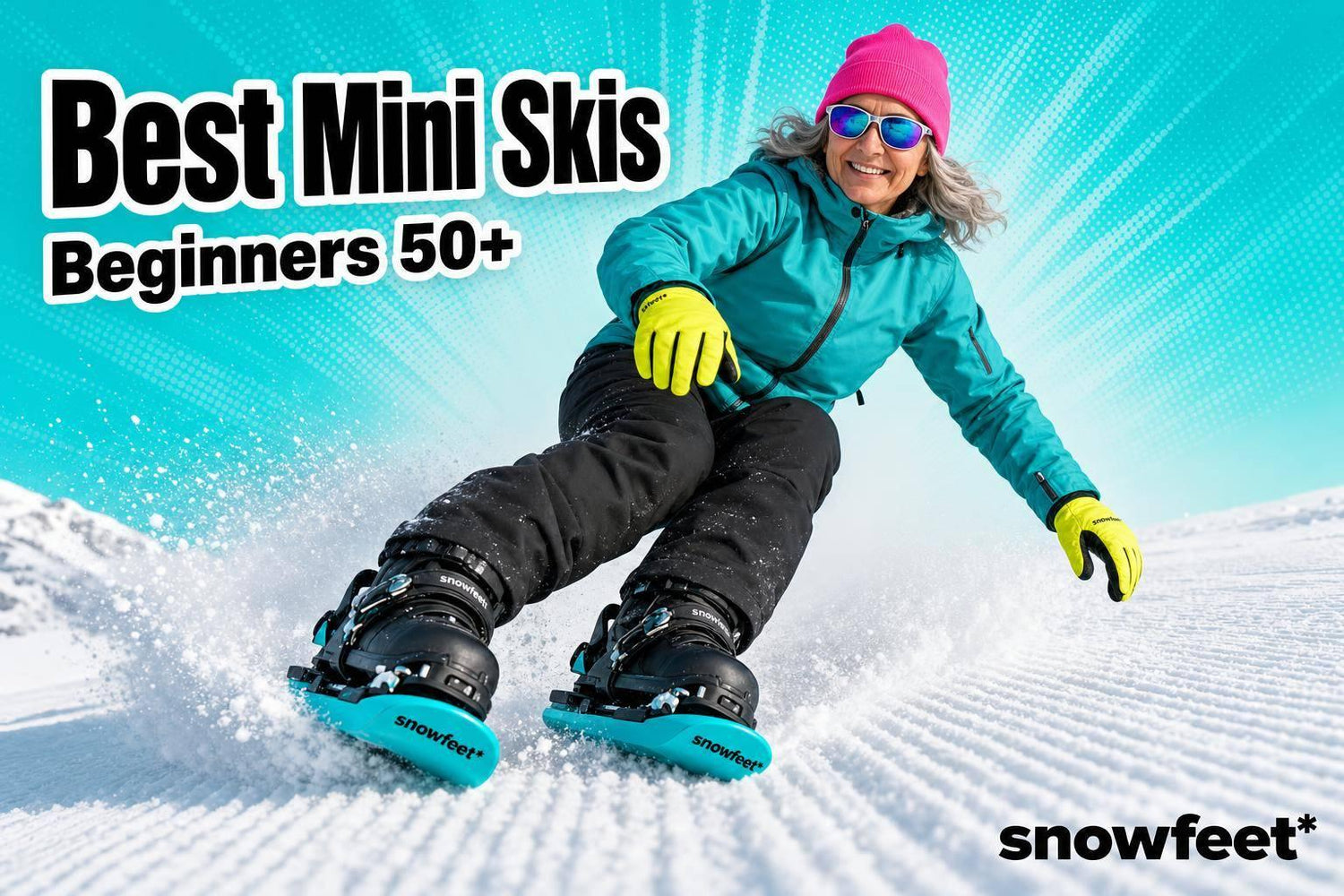
If you’re over 50 and new to skiing, shorter skis are often the easier place to start. In this lineup, the 99 cm Skiblades are the steadiest pick, the 50 cm PRO is the simplest all-around option, the 44 cm Skiskates suit skaters and sporty learners, and the 65 cm Skiblades sit right in the middle.
Here’s the short version:
- Most stable for cautious beginners: Skiblades 99 cm
- Best all-around first pick: PRO 50 cm
- Best for skaters or hockey players: Skiskates 44 cm
- Best middle-ground option: Skiblades 65 cm
- Price range: $299 to $690
- Mini ski length range here: 17.3 to 39.0 in
- Typical adult ski length: 59 to 71 in
That size gap matters. Shorter skis are lighter, less awkward to carry, and often less stressful on day one. They’re also less likely to cross over at low speed, which, let’s be honest, is one less way to surprise yourself :)
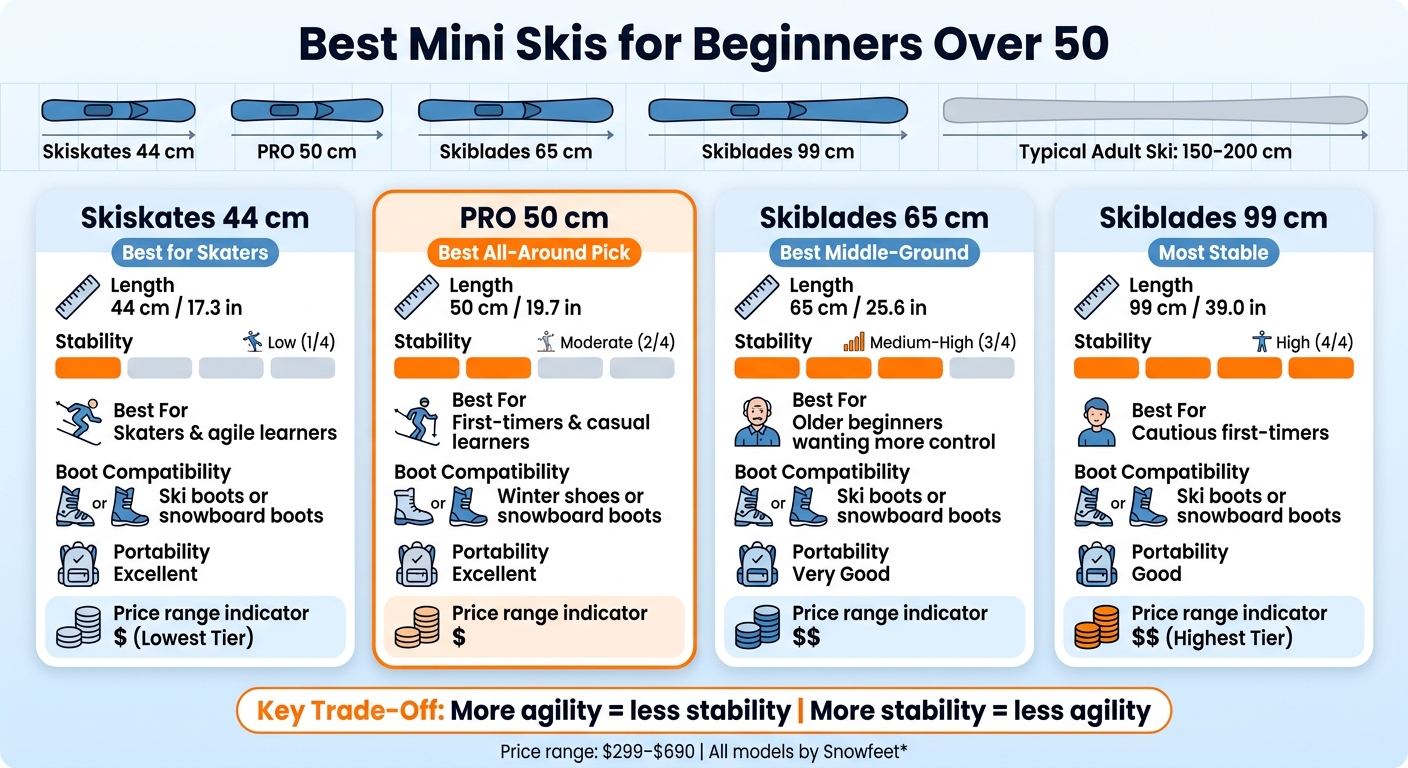
Mini Ski Comparison for Beginners Over 50
Short Skis vs. Long Skis
Quick Comparison
| Model | Best For | Stability | Boots | Size |
|---|---|---|---|---|
| Skiskates 44 cm | Skaters, agile learners | Low | Ski boots or snowboard boots | 17.3 in |
| PRO 50 cm | First-timers, casual learners | Medium | Winter shoes or snowboard boots | 19.7 in |
| Skiblades 65 cm | Beginners who want more support | Medium-high | Ski boots or snowboard boots | 25.6 in |
| Skiblades 99 cm | Cautious first-timers | High | Ski boots or snowboard boots | 39.0 in |
My take: if you want the calmest learning ride, go 99 cm. If you want the least fuss with boots and setup, go PRO 50 cm. If you already skate, the 44 cm may click fast. And if you want a middle step, the 65 cm makes a lot of sense.
Below, I break down which one fits which type of beginner best.
1. Snowfeet* PRO 50 cm
At 50 cm (about 20 in), the PRO gives you a bit more room under your feet than the 44 cm Skiskates, but it still stays short and easy to handle. That’s a nice sweet spot for first-time riders who want something simple for gentle, groomed terrain. If you want the smallest setup possible, the 44 cm Skiskates are one step shorter.
Stability at Beginner Speeds
That extra length over the 44 cm model helps at slow speeds. On an easy green run or a flat learning area, the 50 cm platform makes it easier to keep both feet lined up and catch yourself after small balance slips. For beginners, that can make those first runs feel a lot less awkward. The PRO is made from fiberglass-reinforced material, which helps it stay predictable without extra weight.
Turning and Stopping Control
The short shape makes turning feel quick and easy. It responds fast, which is fun, but there’s a small catch: if you get too jerky with your movements, it can feel a little twitchy. Smooth inputs work best. The metal edges and heel brake also help when it’s time to slow down or stop.
Boot Compatibility
You can use it with waterproof winter shoes or snowboard boots. The adjustable bindings fit US sizes 6–13 (EU 38–47).
Portability
At 20 in long, it’s easy to toss into a backpack and carry from the car to the slope. That alone is a big plus if you don’t want to lug around full-size skis. Next up is the even shorter 44 cm Skiskates, which make more sense if max compactness matters more than the added stability here.
2. Snowfeet* Skiskates 44 cm
At 44 cm (about 17 in), the Skiskates are super short skis made for fast, snappy turns. They feel a bit less steady than the 50 cm PRO, mostly because you have less ski under you. That’s part of the appeal, though. For cautious first-timers, they can feel less intimidating and easier to approach.
Stability at Beginner Speeds
The shorter platform asks for more from your body than the 50 cm PRO. You can’t just stand there and hope for the best :) A staggered stance helps a lot and gives beginners a steadier base on such a short ski.
The wood core and metal edges help on groomed snow too. They add grip, which makes the Skiskates feel more in control at slower speeds.
Turning and Stopping Control
This is where the Skiskates shine. The parabolic shape and narrow waist make them very easy to turn. They react fast, almost like they’re reading your mind.
For stopping, you use the metal edges in a hockey-style stop. Snowfeet says the learning curve is about 5 minutes. That short length gives them a playful feel and makes them easy to whip around, but they work best when you stay smooth and centered instead of relying on the ski to do the balancing for you.
Boot Compatibility
The Skiskates come in two binding versions:
- One for standard ski boots
- One for snowboard boots
If you want the most secure, locked-in feel, go with the ski-boot version. If comfort matters more, the snowboard-boot version may feel nicer.
The ski boot bindings fit US sizes 4.5–14.5 (EU 36–49), and the snowboard boot version fits US sizes 6–14.5 (EU 38–49).
If you want a bit more stability but still don’t want a full-length ski, the 65 cm Skiblades are the next step up.
Portability and Carry Weight
At 17 inches long, these can fit in a backpack with no drama. That tiny size makes them the easiest model here to pack, carry, and stash.
This model makes the most sense for riders who care more about compact size than extra platform length. The next model adds more length and a steadier, more ski-like feel.
sbb-itb-17ade95
3. Snowfeet* Skiblades 65 cm
At 65 cm, these skiblades sit right in the middle between super short and more ski-like. You get a bit more platform underfoot, which can make learning feel steadier, but they’re still short enough to turn without much fuss. If 44 cm sounds a little too tiny, this is the next step up.
Turning and Stopping Control
These skiblades are quick edge to edge on groomed runs. The short sidecut and narrow waist help them turn fast and steer with less effort. Metal edges also help with stopping and control, so you get solid grip without having to overthink your technique.
Boot Compatibility
The 65 cm Skiblades come with either ski boot bindings or snowboard boot bindings.
- Ski boot bindings fit US sizes 4.5–14.5 (EU 36–49)
- Snowboard boot bindings fit US sizes 6–14.5 (EU 38–49)
If you already ride in ski boots, the ski-boot binding option is the simple pick.
Portability and Carry Weight
The pair weighs 3.79 lb with ski bindings or 5.89 lb with snowboard bindings. At 26 inches long, they’re easy to carry to and from the slope. They’re compact enough for laid-back use, but they still feel more like skis than the shortest models in this lineup.
If you want more stability at speed, move up to the 99 cm Skiblades.
4. Snowfeet* Skiblades 99 cm
The 99 cm Skiblades are the next step up from the 65 cm model. They’re a good fit for beginners who want more stability and a feel that’s closer to skis. Snowfeet* made them for groomed runs and mellow resort terrain.
Stability at Beginner Speeds
At 99 cm, these skiblades give you more platform underfoot than the 44 cm or 65 cm models. You get better fore-aft balance too, which can make a big difference when you’re still getting used to stance and control.
They feel steadier than the shorter models, but they don’t snap around as fast. That’s the trade-off. Full-length skis still do better at high speeds. But for slow to moderate beginner speeds, the 99 cm length hits a nice middle ground between stability and easy handling.
That added length helps most when you’re learning how to manage speed and stay balanced on your edges. In plain English: they give you a bit more breathing room.
Turning and Stopping Control
The deep parabolic sidecut and metal edges help these skiblades turn fast and feel easier to steer than long skis. Stopping on groomed snow is also pretty manageable, which can help a lot when you’re new and don’t want every run to feel like a small adventure.
Verified buyer Brad Tolin summed it up well:
"Easy to control, quick to turn, and more forgiving than traditional skis... Only trade-off is at higher speeds, where longer skis still feel more stable."
This model has a 5.0/5 rating from 50 reviews.
Boot Compatibility
The tool-free adjustable bindings come in two versions:
| Binding Type | Compatible Boot Size (US) | Compatible Boot Size (EU) | Mondopoint (MP) |
|---|---|---|---|
| Simple Ski Boot | 4.5–14.5 | 36–49 | 22.5–32.5 |
| Snowboard Boot | 6–14.5 | 38–49 | - |
| If comfort matters most, the snowboard binding version is worth a look. It lets you ride in softer snowboard boots, which many people find more comfortable, while still keeping solid control. |
Portability and Carry Weight
At 99 cm, or about 39 inches, these skiblades are still much shorter than beginner skis, which are often 150 to 200 cm. That makes them easier to carry through parking lots, onto shuttle buses, and around the lodge. They’re also easier to stash in small cars, closets, and ski lockers.
So, while they give up a bit of the tiny, super-packable feel of the shorter models, they’re still way easier to carry and store than full-length beginner skis. And for many beginners, that extra steadiness is well worth it.
Pros, Cons, and Trade-Offs for Each Model
Here’s the side-by-side view:
| Model | Stability | Control | Boot Compatibility | Portability |
|---|---|---|---|---|
| PRO 50 cm | Moderate - more balanced than the 44 cm model, but less planted than the 65 cm or 99 cm options | Heel brake helps with stopping | Winter shoes or snowboard boots | Easy to pack |
| Skiskates 44 cm | Low - the most agile, but requires active front-to-back balance | Quick to turn, but less forgiving | Ski boots or snowboard boots | Smallest and lightest; very easy to travel with |
| Skiblades 65 cm | Moderate to high - the sweet spot between agility and control | Easy carving, with metal edges that make stopping manageable | Ski boots or snowboard boots | 65 cm / 26 in; lightweight at 5.89 lb per pair |
| Skiblades 99 cm | High - the most stable and forgiving of the four | Closest to traditional skis; intuitive turning with metal-edge stopping control | Ski boots or snowboard boots | 99 cm / 39 in; still far shorter than traditional skis |
Once you look at each model side by side, the pattern is pretty clear. Shorter models feel easier to carry, easier to pack, and a lot more nimble on snow. Longer mini skis give you more stability and a calmer ride.
That’s the trade-off in plain English: more agility usually means less stability, and more stability usually means giving up some quickness.
So, the big choice isn’t complicated. It comes down to how steady you want to feel, and how much maneuverability you’re happy to trade for that extra balance.
Next, use these trade-offs to match a model to your comfort level and learning style.
Which Model Should You Start With
Pick the model that fits your balance, boot setup, and how much support you want. If you want the short version, this table does the job fast.
| Model | Best For | Stability | Learning Curve | Portability |
|---|---|---|---|---|
| Skiskates 44 cm | Skaters or agile learners | Low | Fast if you already skate | Excellent - backpack-friendly |
| PRO 50 cm | Casual learners, first-timers | Moderate | Quick | Excellent - backpack-friendly |
| Skiblades 65 cm | Older beginners wanting control | High | Quick | Very good |
| Skiblades 99 cm | Cautious first-timers | High | Easiest | Good |
If you're a cautious first-timer, start with the Skiblades 99 cm. It gives you the most support underfoot, which can make those first few runs feel calmer and more predictable.
The PRO 50 cm is the easiest all-around choice. It has the simplest boot setup, plus a heel brake. That combo can make day one feel a lot less scary. Frankly, that matters.
If you already ice skate, inline skate, or play hockey, the Skiskates 44 cm will likely feel the most natural. You can usually get comfortable on them fast.
If 44 cm feels a bit too stripped-down, move up to 65 cm. You’ll get a steadier, more ski-like feel without jumping all the way to long skis. Snowfeet* says, "Little skis are lighter on your knees, and easier to control for any older skier, whose strength, knees and reflex speed is not what it once was." That’s a big reason the 65 cm model works well for older beginners who want more control.
One straight-up trade-off: long skis still do better at high speeds and across the whole mountain. But for most beginners over 50, Snowfeet* is still the better first pick. They’re easier to learn on, easier to carry, and a lot less intimidating than long skis.
FAQs
Are mini skis easier on the knees?
Yes. Mini skis are usually easier on the knees and ankles than long, old-school skis. Options like Snowfeet Skiblades are lighter and more responsive, so they take less effort to turn, stop, and control.
That lower weight can be a big win for older beginners. It can help cut fatigue and put less stress on the joints than heavier, bulkier gear.
Can I use my regular winter boots?
It depends on the Snowfeet* model.
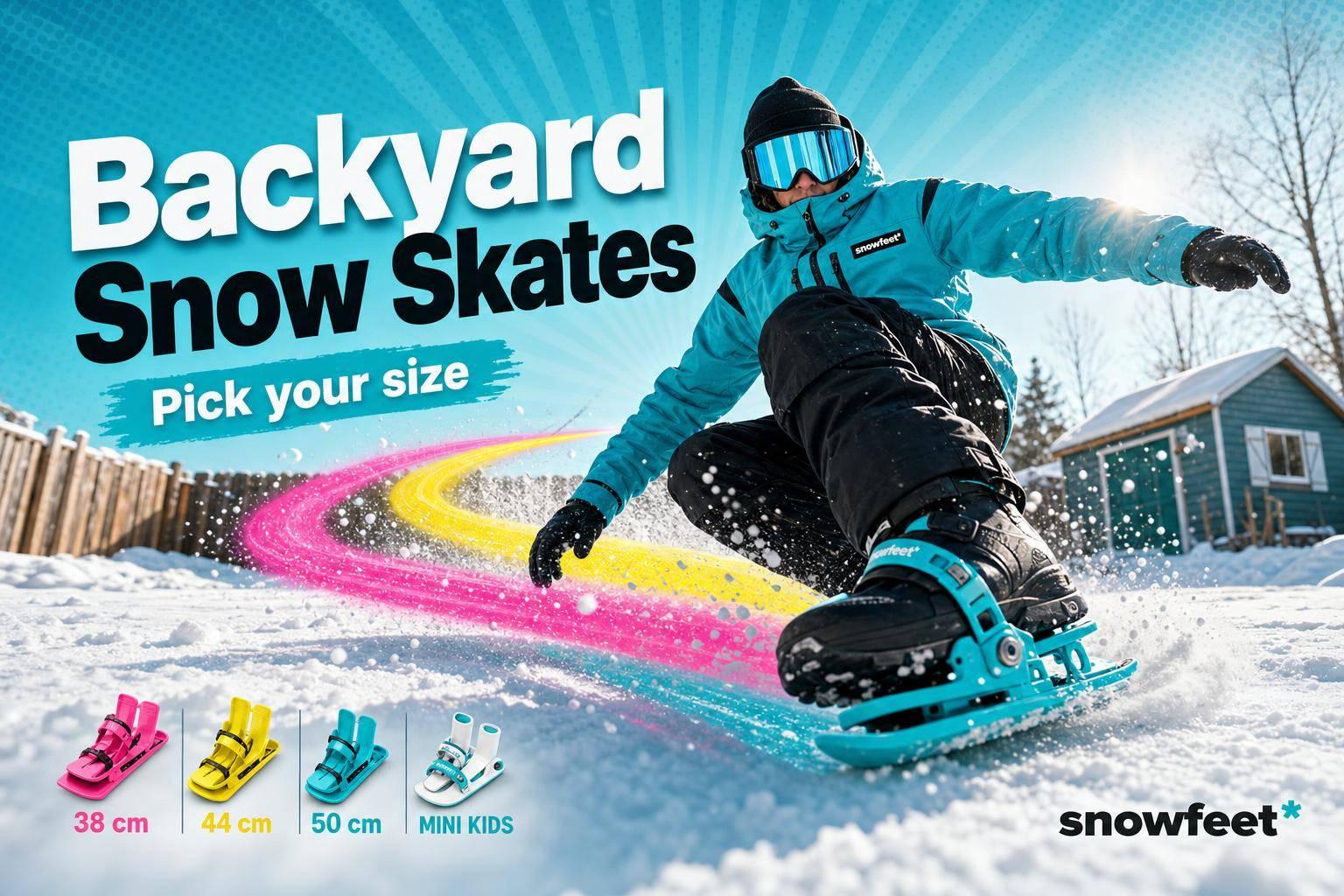
Regular winter boots work with the Snowfeet PRO 50 cm, plus the 38 cm and 50 cm models, because these use adjustable strap-style bindings.
They don’t work with Snowfeet* Skiskates 44 cm. That model needs ski or snowboard boots.
For the best fit, go with winter boots that have solid ankle support and a snug fit. If you plan to ride steeper terrain or groomed resort runs, snowboard boots give you better control.
Should I start with 65 cm or 99 cm?
It comes down to what you want from your first days on the snow.
65 cm Skiblades are easier to handle. They feel nimble, light, and more forgiving, which makes them a great pick if you want the smoothest start and the easiest learning curve.
99 cm Skiblades give you more stability, a more planted feel, and better edge control as your speed picks up. That makes them a better fit if stability is your top concern and you want something you can keep growing into.











Jätä kommentti
Tämä sivu on suojattu hCaptcha-tunnistuksella, ja hCaptchan tietosuojakäytäntöjä ja käyttöehtoja sovelletaan.