



















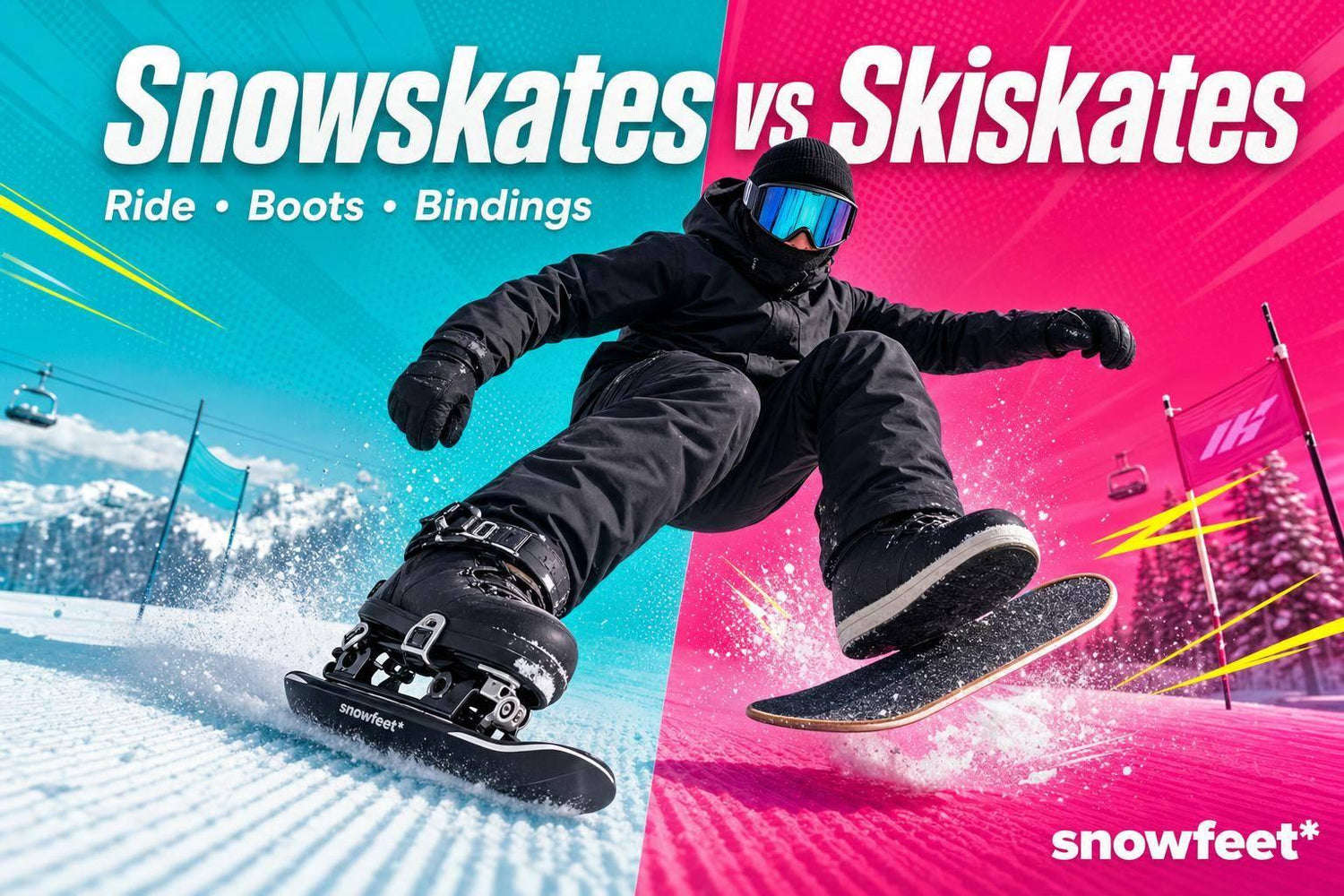
If you want tricks, get a snowskate. If you want control, lift access, and an easier first day, get skiskates. That’s the short answer.
Here’s the simple breakdown:
- Snowskates = bindingless, ridden in winter boots, loose feel, best for park laps and backyard hills
- Skiskates = short skis with bindings, more edge hold, better braking, better for groomers and resort runs
- Snowfeet* Skiskates 44 cm start at $460 and use ski or snowboard boots
- Longer Snowfeet* options like 50 cm and 65 cm add more stability
- Lift rules vary, but skiskates usually have fewer issues at U.S. resorts
A lot of riders in the U.S. want snow gear that fits in a trunk, doesn’t eat up the garage, and won’t beat them up on day one. That’s where these two come in. Both are small. Both are fun. But they ride very differently.
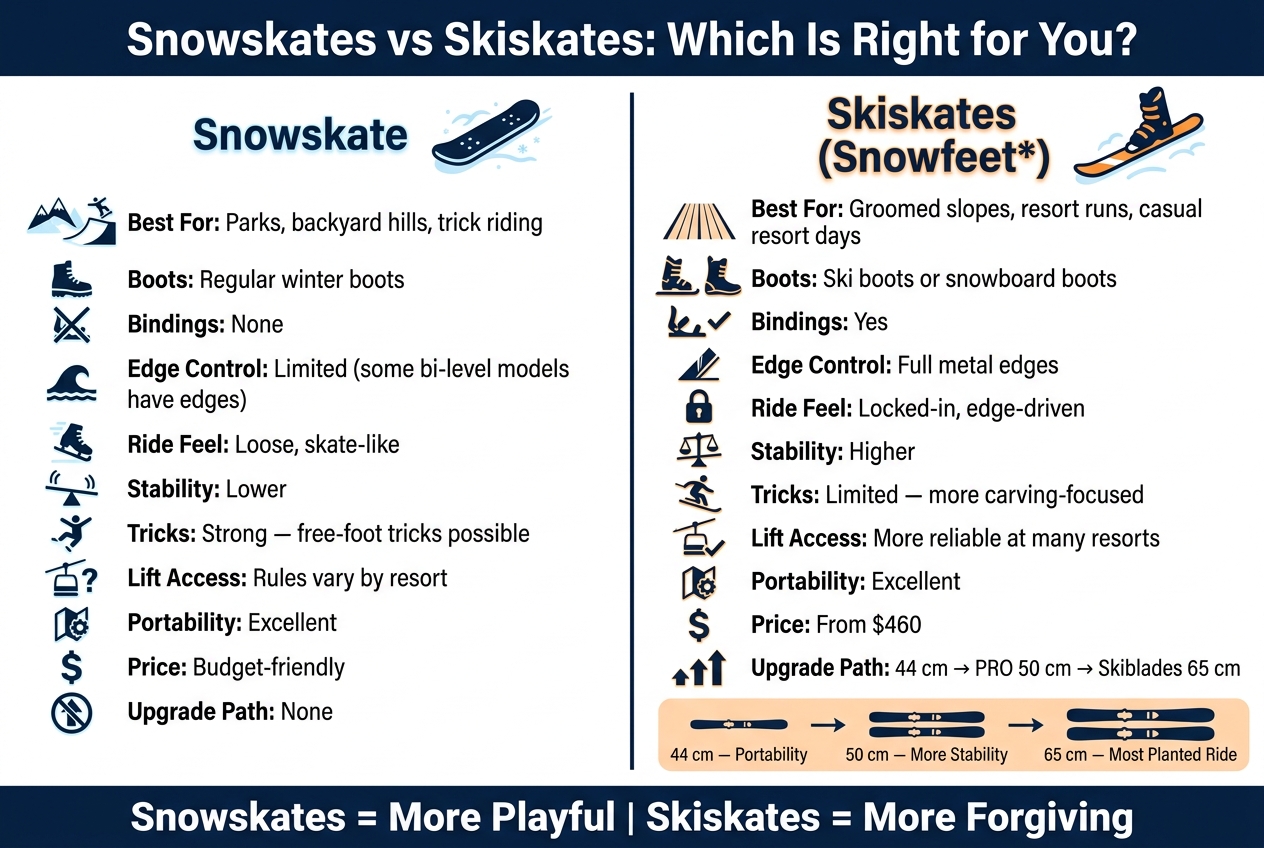
Snowskates vs Skiskates: Side-by-Side Comparison
Snowfeet* & Skiskates Complete Guide | All you need to know about Skiskating
Quick Comparison
| Gear | Best for | Boots | Bindings | Control | Resort use | Trick feel |
|---|---|---|---|---|---|---|
| Snowskate | Parks, small hills, skate-style riding | Winter boots | No | Lower | Limited at some resorts | Higher |
| Skiskates | Groomers, chairlifts, casual resort days | Ski or snowboard boots | Yes | Higher | Better at many resorts | Lower |
I’d put it like this: a snowskate feels like messing around with a skateboard on snow. A skiskate feels like a tiny ski setup that’s easier to carry and less of a headache to learn. For most casual riders, that means skiskates are the safer bet.
Here’s my take after reading the full piece:
- Choose snowskates if you care most about freestyle feel and don’t mind less stability.
- Choose Snowfeet* Skiskates 44 cm if you want a more planted ride and smoother learning.
- Move to 50 cm or 65 cm if you want more calm underfoot without going to full skis.
One stat-like takeaway jumps out from the article: Snowfeet* gives you 3 size paths - 44 cm, 50 cm, and 65 cm - so you can pick based on portability vs. stability instead of jumping straight to long skis.
If you want to see how short skis ride before you buy, these YouTube searches help:
So, if I were helping a friend at the shop, I’d say this: snowskates are more playful, skiskates are more forgiving. One is for goofing around and popping tricks. The other is for getting on the lift and having a smoother day. Pretty simple :)
What Are Snowskates and Where Do They Work Best?
A snowskate is a bindingless board for snow, and you usually ride it in regular winter boots. That free-foot feel is a big reason some people pick snowskates over short skis. It’s also the key thing that sets them apart from more locked-in gear like skiskates.
Bindingless Design, Regular Boots, and Skate-Style Control
Snowskates come in two main builds. Single-deck models use one grooved plastic or laminated deck with foam or rubber grip on top. Bi-level (two-deck) models pair a skateboard-style top deck with a ski-style base deck underneath. That lower deck often has steel edges, which helps the board hold better on groomed snow.
If you want more control, bi-level models are usually the better pick.
Both styles work with regular winter boots, which is part of the appeal. You can step on and ride without strapping in. Nice and simple. But there’s a catch: you get less ankle support, less edge control, and less stability on landings than you would with ski or snowboard boots. And yeah, that matters once the snow gets firm or the speed picks up.
Use a safety leash. Many U.S. resorts ask for one if you want lift access.
Best for Parks, Backyard Hills, and Trick Riding
Snowskates work best on short runs, terrain parks, backyard hills, park features, and small natural hits. That loose setup makes tricks like ollies, shuvits, and nose slides feel more natural, especially if you already have skate instincts. It’s the closest thing to taking your skate style onto snow without overthinking it.
Where things get shaky is speed. On long groomed runs or steeper resort terrain, the short running length and soft boots can lead to wobble and chatter that’s tough to keep in check. Single-deck models, in particular, are rarely allowed on chairlifts at U.S. ski areas. Bi-level models with steel edges and leashes usually have a better shot, but don’t just show up and hope for the best - check the resort’s equipment policy first.
Who Should Buy a Snowskate
Snowskates make sense for riders with good board-sport balance who want a trick-first, hike-lap setup. They’re at home on a local hill or a small park where you can take lap after lap and mess around a bit.
They’re not the best fit if your goal is to rack up vertical feet at a big resort all day.
If you want more control, easier resort use, and less wobble, skiskates are the better fit. For riders who want more control and easier lift access, Snowfeet* Skiskates are the next step.
sbb-itb-17ade95
What Are Skiskates and Why Snowfeet* Works for More Riders
Skiskates are short skis with bindings, steel edges, and a ski base. So they ride more like short skis than board-style snowskates. If snowskates feel a bit loose or slippery underfoot, skiskates fix a lot of that with bindings and ski edges. For most casual riders, that means more control and a setup that works better on actual resort terrain.
Snowfeet* Skiskates 44 cm: Short-Ski Build in a Skate-Sized Package
At 17.3 inches (44 cm), Snowfeet* Skiskates squeeze real ski construction into a small, travel-friendly size: wood core, steel edges, and a graphite/sintered base. That’s ski gear, just shrunk down.
Snowfeet* also gives riders a nice bonus: bindings for ski boots or snowboard boots, so you can use gear you already own. That’s a big plus if you don’t want to buy a whole new setup.
Once you’re strapped in, the ride feels more locked in. You get:
- stronger edge control
- steadier tracking
- easier braking
That’s a big step up from a bindingless snowskate, especially on firmer snow.
For riders who want a little more calm underfoot, Snowfeet* has longer options that still don’t hog space.
Snowfeet* PRO 50 cm and Skiblades 65 cm: More Stability, Still Easy to Pack
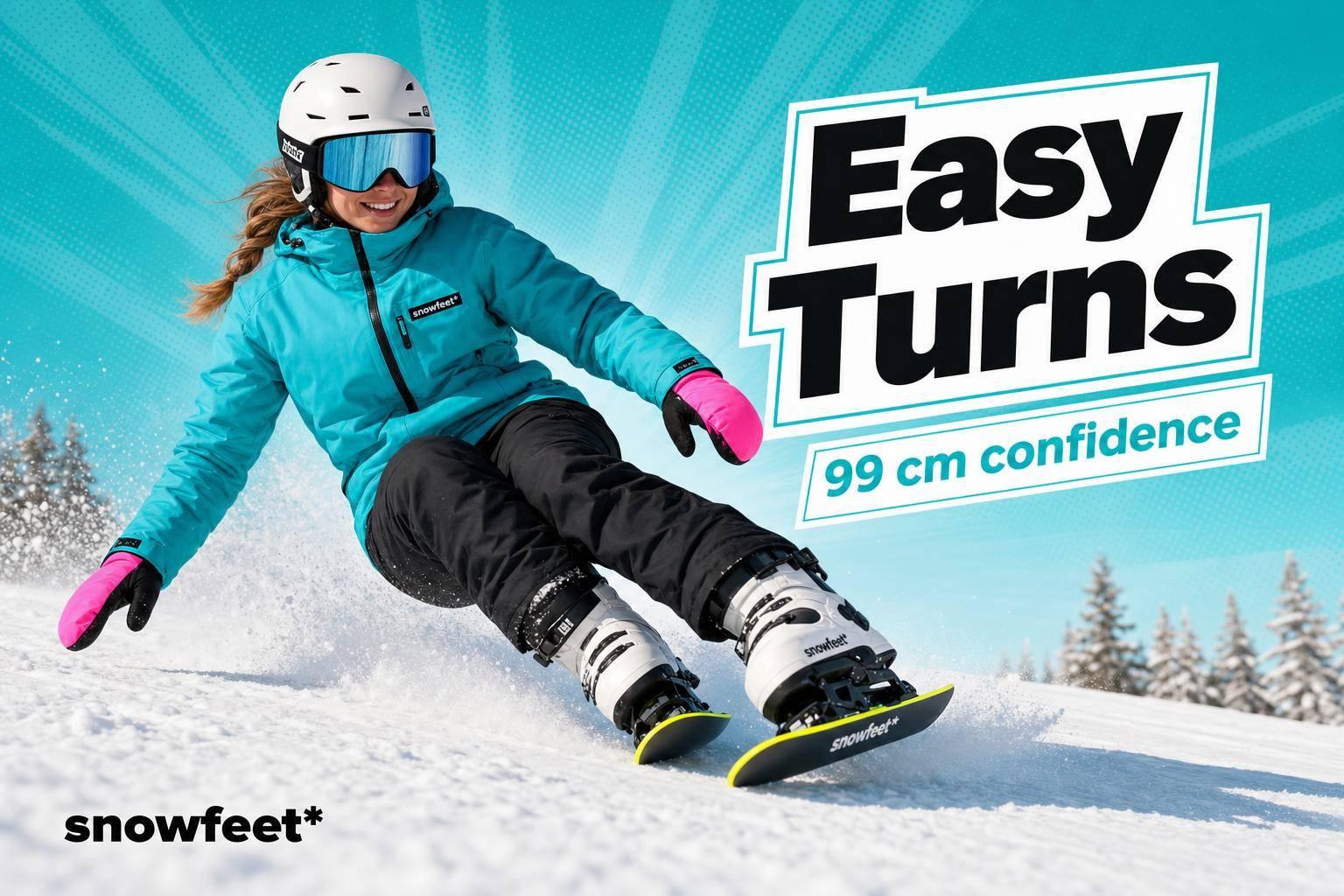
The three models work like a simple step-up system. Snowfeet* PRO 50 cm gives you more stability and smoother turn initiation. Skiblades 65 cm feel the most like skis, with better edge hold and a more planted ride.
Even so, all three are still easy to pack. They fit in a car trunk or a travel bag without much fuss. That’s part of the charm here - you get a ski-style ride without lugging around long skis like you’re moving furniture.
Best for Lifts, Groomed Slopes, and Fast Learning
That extra control changes where and how you can ride. Because Snowfeet* skiskates use bindings and steel edges, lift access is simpler at many resorts. You load, ride, and unload like a skier.
For most casual riders, Snowfeet* skiskates are easier to learn than snowskates. The bindings, edges, and short ski shape add control without making the gear feel bulky. And yeah, that matters a lot when you’re just trying to link turns instead of fighting your setup.
That trade-off shows up even more clearly in the side-by-side comparison below.
Snowskates vs Snowfeet* Skiskates: Side-by-Side Comparison
Use this comparison to pick the better fit: snowskates for trick-first riding, Snowfeet* Skiskates for control and resort use.
If you want the short version, it’s simple: snowskates lean toward tricks, while Snowfeet* Skiskates lean toward control.
Build, Boots, and Ride Feel
Snowskates are bindingless. That means you’re riding either a single rigid board or a two-deck setup with regular winter boots. No straps. No retention. That loose setup gives you a more skate-like feel, which is a big part of the fun.
Snowfeet* Skiskates go the other way. They use bindings, which means more control and better edge hold. You give up some of that loose, playful movement, but you get a more planted ride. Think of it like this: snowskates feel more like messing around at the skatepark, while Snowfeet* Skiskates feel more like carving with a small, nimble ski setup.
The table below shows the fastest differences to check before buying.
| Feature | Snowskate | Snowfeet* Skiskates 44 cm |
|---|---|---|
| Binding | None | Yes |
| Boot type | Regular winter boots | Ski boots or snowboard boots |
| Edge control | Limited; some two-deck models have edges | Full metal edges |
| Ride feel | Loose, skate-like | Locked-in, edge-driven |
| Learning curve | Steeper for beginners | Easier for most riders |
Terrain, Stability, Tricks, and Lift Access
This is where the gap gets pretty clear.
Snowskates do best in parks, backyard hills, and mellow features. The free-foot setup is just better for skate-style movement and trick riding. If your goal is to slash around, pop little features, and keep things playful, that setup has a lot going for it.
Snowfeet* Skiskates are much more at home on groomed resort runs. They give you better braking, better turn control, and better lift access because they ride more like skis. And yeah, that matters a lot if you want to spend the day on actual resort terrain instead of a little snow-covered hill behind the house.
| Factor | Snowskate | Snowfeet* Skiskates 44 cm |
|---|---|---|
| Best terrain | Parks, backyard hills, mellow slopes | Groomed slopes, resort runs |
| Stability | Lower - free foot requires more balance | Higher - bindings add control |
| Tricks | Strong - free-foot tricks possible | Limited - more carving-focused |
| Lift access | Rules vary by resort | More reliable at many resorts |
Portability, Price, and Overall Value
Both are compact, which is a big win. You can toss either one in the car without the whole roof-rack circus.
That said, Snowfeet* gives you more resort-ready performance in the same small package. Snowfeet* Skiskates start at $460, and that includes bindings, a wood core, metal edges, and a setup built for actual resort riding. That’s not nothing.
If you mostly ride a local park or backyard hill, a lower-cost snowskate might be enough. But if you want to ride chairlifts and carve groomers, Snowfeet* makes more sense. It’s the better pick for riders who want one compact setup that can handle a real ski day.
And if you want more stability without jumping to full-size skis, the PRO 50 cm and Skiblades 65 cm are the better long-term value.
| Factor | Snowskate | Snowfeet* Skiskates 44 cm |
|---|---|---|
| Portability | Excellent | Excellent |
| Starting price (USD) | Budget-friendly | From $460 |
| Resort usability | Limited | Strong |
| Upgrade path | None | PRO 50 cm → Skiblades 65 cm |
| Best value for | Trick riders, park sessions | All-around casual resort riders |
Next, match those trade-offs to how you ride.
Conclusion: Which One Should You Buy?
With the build, boots, terrain, and ride feel already laid out, the call gets pretty simple. It comes down to ride feel, terrain, and control.
If you're after skate-style tricks, park laps, and messing around on a backyard hill, a snowskate fits that lane well. The bindingless setup gives you a loose, board-like feel. That’s the whole point. But if that’s not your main focus, Snowfeet* makes more sense as an everyday pick.
For most casual riders, Snowfeet* Skiskates 44 cm are easier to learn, work on resort slopes, and pack without a hassle. If you ski, snowboard, or skate, they offer more control and more predictable edge control. You can also get them in ski-boot and snowboard-boot versions, which makes picking your setup pretty painless.
Want a little more board under your feet? The Snowfeet* PRO 50 cm gives you more stability while keeping that compact feel. Then the Skiblades 65 cm push things a bit further with a more planted ride, but without the bulk of full-length gear. So the lineup is easy to read:
- 44 cm for portability
- 50 cm for more stability
- 65 cm for the most planted ride
That range makes Snowfeet* easier to match to your skill level and how you like to ride.
Snowfeet* gives up some freestyle looseness, sure. But in return, you get more control and better resort use. If you want an easier learning curve, actual resort use, and simple travel, Snowfeet* is the better fit for most casual riders.
FAQs
Are skiskates easier for beginners?
Yes. Skiskates are often much easier for beginners than long, old-school skis.
The big reason is simple: they’re short. A compact setup like 44 cm Snowfeet Skiskates* makes it much less likely that you’ll cross your ski tips, which is one of the most common beginner mistakes. And if you’ve ever watched a new skier get tangled up and do that awkward little flop, you know why this matters :)
They also tend to feel more natural for a lot of people. Why? Because the movement is closer to ice skating or rollerblading. So if you’ve done either of those, the basics can click faster.
On top of that, they’re:
- Lightweight
- Easy to carry
- Compatible with standard winter boots or snowboard boots
That means less gear hassle and more time getting used to the fun part: sliding on snow.
Can I use skiskates on ski lifts?
Yes. Snowfeet skiskates are compact and portable, so they’re easy to handle when you’re getting on and off ski lifts.
Because they’re lightweight and work with your own footwear, they feel like a less bulky option than standard skis. That can make the trip from the base area to the lift - and then out onto the slopes - a lot smoother.
Which Snowfeet* size should I choose?
Choose based on your skill level and where you ride. If you’re new, or you want more of a skating-style feel on groomed slopes and in terrain parks, 38 cm Mini Ski Skates and 44 cm Skiskates make the most sense. They’re small, playful, and easy to get the hang of.
The 50 cm Snowfeet PRO sits in a sweet spot for beginners and intermediate riders. It works well as an all-around pick without feeling too twitchy or too bulky.
If you want more stability underfoot, look at the longer options. 65 cm Skiblades are great for carving. 99 cm Skiblades give you a nice mix of versatility with some help in light powder. And 120 cm Short Skis fit riders who are starting to move toward advanced all-mountain performance.











Deja un comentario
Este sitio está protegido por hCaptcha y se aplican la Política de privacidad de hCaptcha y los Términos del servicio.