





If you’re scared of long skis, go shorter. That’s the whole idea here.
I’d put it this way: if you want the smallest and least scary option, go with the Snowfeet* Skiskates 44 cm. If you want the most support underfoot from this group, pick the Snowfeet* Skiblades 65 cm. If you want the middle ground, the Snowfeet PRO 50 cm makes the most sense.
Here’s what matters most on day one:
- 44 cm (17.3 in): least ski in front of you, easy to pivot, less steady once speed builds
- 50 cm (19.7 in): sits between the other two for feel and support
- 65 cm (25.6 in): most surface underfoot, calmer feel on easy groomers
- All three are best on groomed beginner slopes
- None of them are built for deep powder, steep terrain, or high speed
- Boot fit matters a lot, and binding style changes by model
- The 44 cm model uses non-release bindings, so a helmet is a must
A lot of first-timers don’t need “more ski.” They need less hassle, less fear, and more control at slow speed. That’s where short skis can help. The catch is simple: as ski length drops, high-speed stability also drops. So, yeah, these can make the first few runs feel less intimidating, but they’re still a fit for mellow terrain.
Are Short Skis Better for Beginners?
Quick Comparison
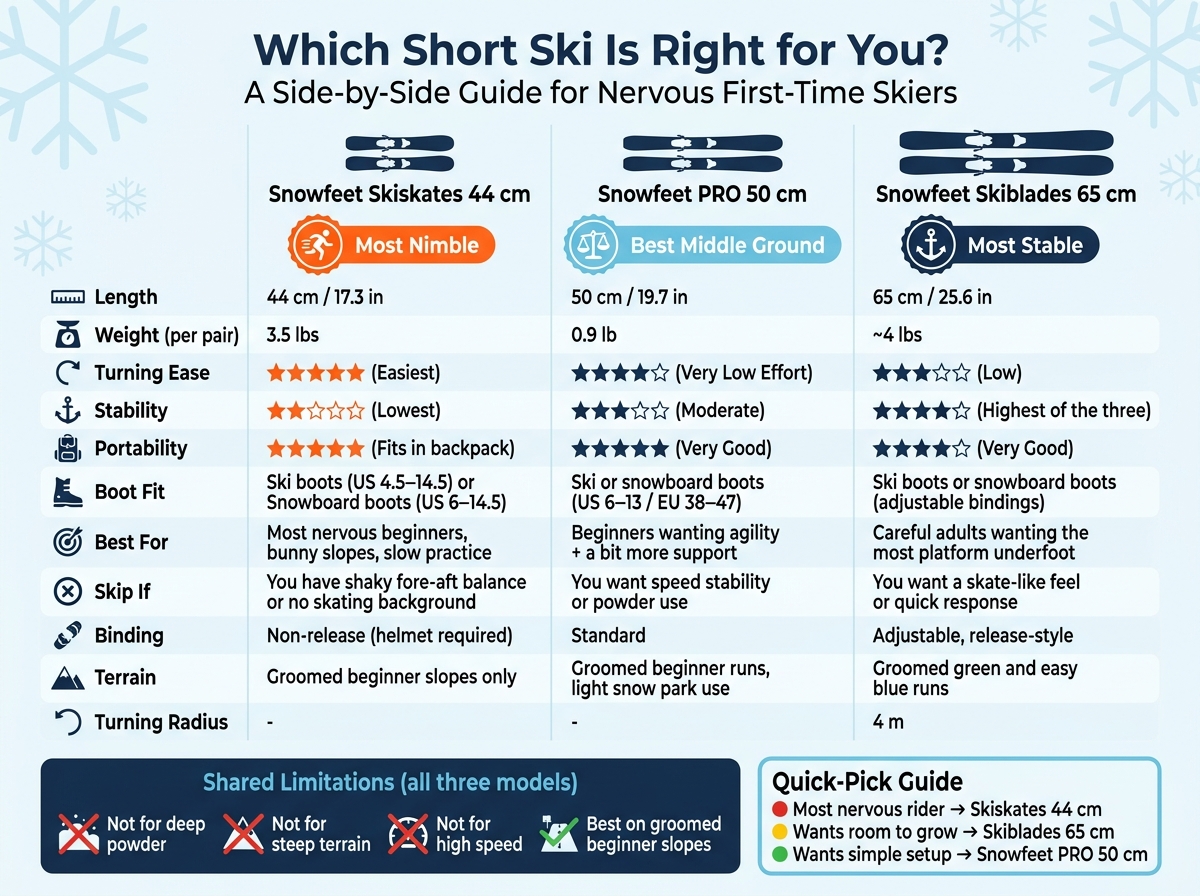
Short Ski Comparison for Beginners: 44cm vs 50cm vs 65cm
| Model | Best for | Main upside | Main trade-off | Best use |
|---|---|---|---|---|
| Snowfeet* Skiskates 44 cm | Most nervous first-timer | Small size, easy turning, about 3.5 lbs per pair | Least steady as speed builds | Bunny slopes, slow practice |
| Snowfeet PRO 50 cm | Beginner who wants balance | Mix of agility and a bit more support | Still limited at speed and in soft snow | Groomed beginner runs, light park use |
| Snowfeet* Skiblades 65 cm | Beginner who wants more platform | Most support of the three, 4 m turning radius | Less nimble than the shorter two | Groomed green and easy blue runs |
My short take: if you’re anxious, start with the model that matches your comfort level, not your ego :) Short skis can make that first day feel less like a wrestling match and more like actual skiing.
1. Snowfeet* Skiskates 44 cm
At 44 cm (17.3 in) long, Snowfeet* Skiskates are tiny compared with regular skis. And that changes the feel right away.
There’s less ski sticking out in front of your boot and less dragging behind you. So turning, pivoting, and changing direction can feel less scary than on full-length skis. For nervous first-timers, that matters a lot. These feel closer to controlling your feet than controlling a long pair of skis. One listing puts the weight at about 1.6 kg (3.5 lbs) for the pair, and they’re small enough to fit in a backpack.
Length & turning control
This short length makes quick direction changes feel natural, especially at slow speeds. That’s the big draw.
The catch? The movement feels a bit like skating, so it may take a few runs before it clicks. Not hard, just different.
Stability & forgiveness
Here’s the trade-off: the same short length that makes turning easy also gives you less front-to-back stability.
On groomed runs at low speed, they stay manageable. But once speed picks up, or the slope gets steeper, they can feel less steady. So for careful beginners, the upside is quick control. The downside is that they’re less forgiving if you get going faster than you meant to.
The bindings are non-release, so a helmet and other protective gear matter even more.
If you want a bit more stability but still want that short, beginner-friendly feel, the 50 cm PRO is the next step.
Boot compatibility
There are two binding versions:
- The ski-boot version fits about US sizes 4.5–14.5 (EU 36–49)
- The snowboard-boot version fits about US sizes 6–14.5 (EU 38–49)
These two versions do not swap. Your heel needs to sit firmly, with no side-to-side play.
Terrain & speed limits
Snowfeet recommends these for packed snow, groomed trails, and snow parks. User feedback also says they struggle in fresh powder, where the short ski can sink instead of float. The maker also lists icy conditions as a surface to avoid.
So, these are best for slow practice on easy terrain. Not for speed. Not for rough snow. Think of them like the bunny slope version of skiblades: fun, light, and easier to handle, but not built for charging down the mountain.
If you want more surface underfoot and a calmer ride, the 65 cm Skiblades sit closer to that middle ground.
2. Snowfeet* Skiblades 65 cm
The 65 cm Skiblades are the step up from the 44 cm Skiskates. At 65 cm (about 26 inches), they sit right in the middle of this lineup.
Length & turning control
These Skiblades have a 4 m turning radius, so they turn fast without needing big, sweeping arcs. That helps them feel direct and easier to handle, which is a nice plus for nervous beginners.
For a first-timer, that can mean:
- easier starts
- easier stops
- less panic in basic turns
They’re a better pick for skiers who want something calmer and a bit less twitchy than the 44 cm option. Snowfeet says the camber shape is made for "easy control and effortless carving." That said, keep your movements smooth. If you twist hard or lean too much, they can still feel quick.
Stability & forgiveness
The trade-off is simple: they feel less calm at speed than longer skis. But they’re much easier to pivot and carry. And honestly, that matters a lot when you’re new and don’t want to wrestle with full-size skis on every little slope or lift line.
Boot compatibility
The adjustable bindings fit ski boots or snowboard boots, so you can use the boot type you already own.
Terrain & speed limits
These work best on groomed beginner and intermediate runs at controlled speeds. They’re more stable than the 44 cm Skiskates, but they still do best when you keep your speed in check and stick to easy terrain.
If you want a shorter, more forgiving step down, the 50 cm PRO comes next.
sbb-itb-17ade95
3. Snowfeet PRO 50 cm
The Snowfeet PRO is 50 cm (about 20 inches) long. That puts it right between the 44 cm Skiskates and the 65 cm Skiblades. For a first-time skier, that’s a nice middle ground.
You get that short-ski feel, but with a bit more ski under your feet. In plain English: it feels calmer than the 44 cm Skiskates, but still more playful and easy to move than the 65 cm Skiblades.
Length & turning control
At 50 cm, the PRO turns fast with small, controlled movements. You don’t need huge body shifts or long sweeping turns. A little input goes a long way, which can feel less intimidating for beginners.
Stability & forgiveness
It’s less stable than a full-length ski once speed picks up. That part matters. But on slow, groomed runs, it stays pretty easy to handle and doesn’t feel like it’s fighting you.
Boot compatibility
It fits US sizes 6–13 (EU 38–47) and weighs about 0.9 lb per pair. So, yes, it’s light. Easy to carry, easy to pack, and easy to wear without feeling like you’ve strapped bricks to your feet.
Terrain & speed limits
In practice, this model works best on:
- Groomed beginner runs
- Snow parks
Skip deep powder, hard charging, and fast descents. It’s also not the best pick for aggressive carving. Think controlled fun, not all-out speed.
Side-by-Side: Control, Stability, and Real Trade-Offs
Here’s the cleanest way to look at it: each option gives you a different mix of easy turning, support, and how much gear hassle you want to deal with.
For nervous first-time skiers, that trade-off matters a lot. Some people want the easiest possible first run. Others want a bit more platform under them so they don’t feel twitchy.
| Option | Turning ease | Stability | Portability | Beginner-slope fit | Deep-snow limits | Setup simplicity |
|---|---|---|---|---|---|---|
| Skiskates 44 cm (17 in) | Lowest effort - quickest direction changes | Lowest at higher speeds | Excellent - fits in a backpack | Strong on mellow, groomed runs | Very limited | Ski or snowboard boots; US sizes 4.5–14.5 |
| Snowfeet PRO 50 cm (19.7 in) | Very low | Moderate - more stable than Skiskates, still compact | Very good | Good for cautious beginners wanting a little more support | Limited | Ski or snowboard boots; confirm fit before buying |
| Skiblades 65 cm (25.6 in) | Low - most platform of the three | Moderate - highest of the short options | Very good | Strong for beginners wanting easy turning with added support | Limited to moderate | Standard setup; check boot fit before buying |
| Traditional longer skis | Higher effort | Highest - tracks calmly as speed rises | Lowest | Good once fitted and taught | Best - most surface area | More involved; requires professional setup |
A quick heads-up: fit, snow conditions, speed, and boot setup can change how any of these feel on the hill. So, yeah, the chart helps a lot, but it’s not magic.
If you want the fastest match, use these rider profiles:
- Most nervous rider: Skiskates 44 cm
- Wants room to grow: Skiblades 65 cm
- Wants a simple setup: Snowfeet PRO 50 cm
Next: the pros and cons of each option in plain language.
Pros and Cons
For nervous first-timers, this table is the fastest way to see which model lines up with your comfort level.
| Model | Main confidence benefit | Biggest limitation | Ideal beginner profile | Skip if |
|---|---|---|---|---|
| Skiskates 44 cm (17 in) | Easiest to control at low speed | Smallest platform, so fore-aft balance takes more work | Beginner with skating experience who wants gear that's easy to carry | You have no skating background, or fore-aft balance feels shaky |
| Skiblades 65 cm (25.6 in) | Most support underfoot of the three | Less steady at speed and on rough snow than full-length skis; less responsive than shorter models | Careful adult who wants the most stable short-ski feel on groomed, low-speed runs | You care more about quick response or a skate-like feel than extra support |
| Snowfeet PRO 50 cm (19.7 in) | Nice middle ground between the smallest and longest options; fits both boot types | Limited in deep snow; less steady at speed | Beginner who wants a safer balance of agility and support on groomed terrain | You want speed stability, powder use, or a full-length ski platform |
Conclusion
After putting them side by side, it mostly comes down to one thing: how much stability you want under your feet. Pick the model that fits your comfort level.
Snowfeet* Skiskates 44 cm (17 in) are the top pick if you want the fastest, most nimble short-ski feel.
Snowfeet* Skiblades 65 cm (26 in) are the best all-around choice for nervous beginners who want more support without jumping all the way to full-length skis. They also work with both ski boots and snowboard boots.
Snowfeet PRO 50 cm (20 in) sits right in the middle. It’s a good fit for beginners who want a calmer ride than Skiskates, but don’t want to move up to the longest model.
For the easiest first day, stick to groomed beginner slopes. Traditional skis still come out on top for speed, powder, and steep terrain. Check your binding fit before you buy, and wear a helmet.
FAQs
Are short skis easier to learn on than regular skis?
Yes. Short skis are usually easier to learn on than old-school long skis.
Why? They’re lighter, smaller, and much easier to control.
That means a few big wins for beginners:
- They’re easier to turn
- They’re easier to stop
- They feel less scary on the snow
- They can help you avoid common beginner mistakes, like crossing your ski tips
Long skis do have one edge: they’re more stable when you’re going fast.
But let’s be honest - most beginners aren’t bombing down the hill at full speed on day one :) For most new skiers, Snowfeet* short skis give you the control and confidence you want right away.
Which Snowfeet* model is best if I have weak balance?
If balance feels a little shaky, the 99 cm Snowfeet Skiblades* are your best bet.
The shorter options, like the 44 cm Skiskates and 65 cm Skiblades, turn fast and feel playful. But they also ask more from you. You need to stay centered and active, or they can feel a bit twitchy.
The 99 cm Skiblades are more stable and more forgiving. That makes them the safest, most dependable place to start, especially if you're nervous and plan to ride on groomed resort runs.
Can I rent boots and use them with these short skis?
Yes. Many U.S. resort rental shops stock standard ski boots, so you can rent a pair and use them with Snowfeet short skis.
The boot you can use depends on the model and binding setup:
- Ski boots: Give you more stability and control. They’re the better pick if you want a firmer, more locked-in feel.
- Snowboard boots: Feel softer and more comfortable, which can make your first runs a bit more relaxed.












Deja un comentario
Este sitio está protegido por hCaptcha y se aplican la Política de privacidad de hCaptcha y los Términos del servicio.