



















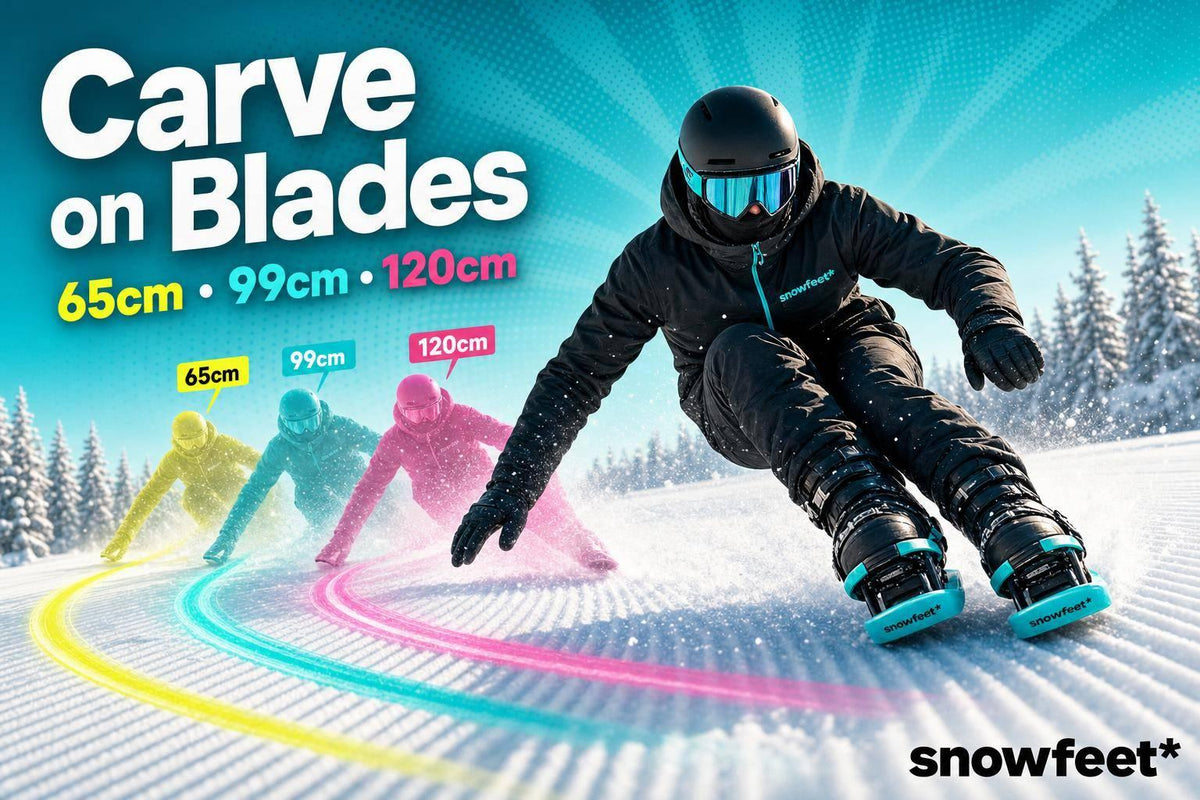
Yes - you can carve on skiblades. But the short answer is this: they work best on groomed runs, at low to medium speeds, and they get less stable as speed goes up.
If I had to boil the whole thing down, I’d say:
- 65 cm = playful, short turns, best for beginners and mellow cruising
- 99 cm = the best middle ground for most adults
- 120 cm = the steadiest pick if you want more grip and a more ski-like feel
- Long skis still win for high-speed carving and icy hardpack
So, if you want tight carved turns and an easy, fun ride, skiblades can do the job. If you want big GS-style arcs at speed, they’re not the right tool. That’s the trade.
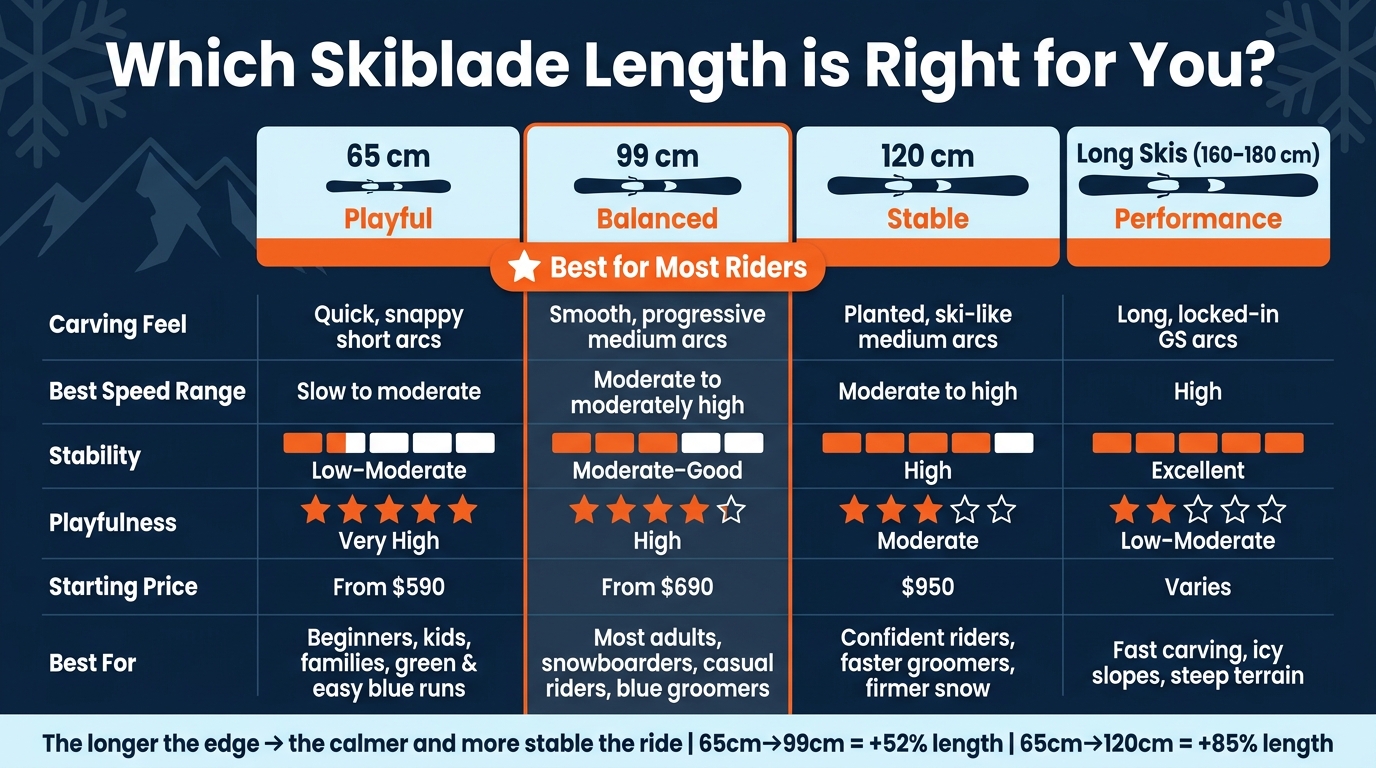
A simple way to think about it: the longer the edge, the more calm the ride tends to feel. Going from 65 cm to 99 cm adds about 52% more length, and 120 cm gives about 85% more length than 65 cm. On snow, you can feel that.
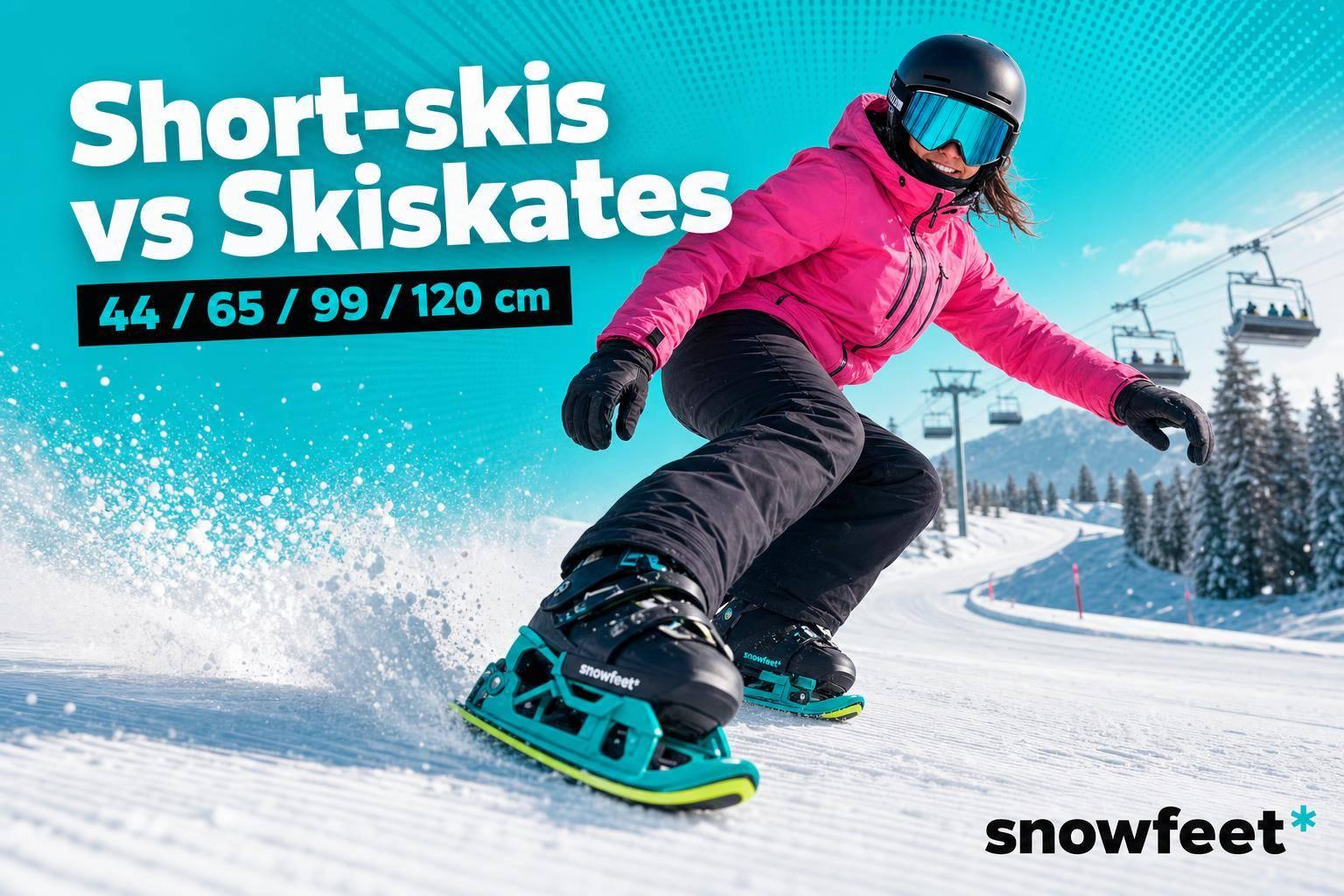
Skiblades for Carving: 65cm vs 99cm vs 120cm vs Long Skis
Snowfeet* Snowblades | Skiboards | Skiblades | Short Skis - Complete Guide | All you need to know
Quick Comparison
| Option | Carving Feel | Best Speed | Best Use |
|---|---|---|---|
| 65 cm | Tight, playful, short arcs | Low to medium | Beginners, families, green and easy blue runs |
| 99 cm | Smooth, balanced, easy to trust | Medium | Most riders, snowboarders, groomers |
| 120 cm | More planted, more ski-like | Medium to high | Faster groomers, firmer snow, stronger riders |
| Long skis (160–180 cm) | Long, locked-in arcs | High | Fast carving, icy slopes, steeper terrain |
My short take: if you’re unsure, go with 99 cm. It gives most people the best mix of edge hold, turn shape, and ease of use without feeling too loose or too demanding.
If you’re shopping by price, the article’s picks start at $590, move to $690, and top out at $950. So you’re not just picking a length - you’re picking how you want the turn to feel.
If you want a quick visual on carving with short skis, these help:
Bottom line: Yes, skiblades can carve. For most people, 99 cm is the safe pick, 120 cm is better if you ski faster, and 65 cm is best if you want a playful, low-speed ride :)
How carving feels on Snowfeet* 65 cm, 99 cm, and 120 cm
Snowfeet* carving feel changes mostly with length. Shorter models turn faster. Longer ones feel calmer and hold their line better. On groomed runs, that changes grip, stability, and the kind of turn you’ll want to make.
Snowfeet* Skiblades 65 cm: quick, playful, and easy to manage
The 65 cm skiblades move from edge to edge almost at once. That makes them easy to handle in tight spots and forgiving when you get a little off balance. For carving, they work best with short, fast turns, not long sweeping arcs.
On fresh groomers at a mellow pace, they hold up fine. But once speed climbs or you hit a firm, icy patch, edge grip falls off fast. At that point, smearing or pivoting the tails becomes your main speed-control move instead of clean carving. Green runs and easy blues at low to moderate speeds are where they feel best.
So, the 65 cm is great for quick, playful carving. Big, locked-in arcs? Not so much.
Snowfeet* Skiblades 99 cm: the best all-around carving option
At 99 cm, that extra edge length makes a big difference. The skis track through the turn instead of trying to pivot out of it. The sidecut helps you make short- to medium-radius carved turns that feel smooth and steady enough to link from top to bottom on a blue groomer.
They’re still compact, so they’re easy to deal with in lift lines or around other skiers. But they also give you enough platform to lean into the edge and feel it hold. The 99 cm can also feel more familiar to snowboarders because it tracks through turns instead of feeling twitchy.
This is the best all-around carving pick for most riders who want control without losing that Snowfeet* quickness. For casual riders, it hits the best balance of carving feel and control.
Snowfeet* Short Skis 120 cm: the most stable option for carving
The 120 cm is the most ski-like Snowfeet* option. It gives you better grip on firm morning groomers, and the longer platform tracks straighter at higher speeds. Turns shift into medium-radius arcs instead of tight, slalom-style snaps. It also rewards a committed, forward stance through the whole turn.
The tradeoff is simple: you give up some playfulness for more grip and stability. You can’t as easily hop, spin, or smear your way out of trouble like you can on the 65 cm or 99 cm. This length fits riders who feel good on steeper blue runs and mellow black runs and want more confidence from extra edge underfoot.
| Length | Carving Feel | Stability | Best Speed Range | Turn Style | Best For |
|---|---|---|---|---|---|
| 65 cm | Quick | Low–moderate | Slow to moderate | Short, snappy arcs | Beginners, casual riders, families |
| 99 cm | Smooth, progressive | Moderate–good | Moderate to moderately high | Short to medium radius | Casual riders, snowboarders, intermediates |
| 120 cm | Stable | High | Moderate to high | Medium radius, longer arcs | Confident riders, steeper groomers |
Next, compare this carving feel with longer skis and snowboards.
sbb-itb-17ade95
Skiblades vs. longer skis and snowboards for carving
Where longer skis still do better
Longer skis still have a clear edge in a few spots. They put more edge on the snow, which helps with grip and stability. On hard, icy groomers or when you're moving fast, a 170–180 cm ski holds a cleaner arc and feels more planted than any skiblade.
If you want long, GS-style turns, extra edge length still wins. So the point isn't whether skiblades can carve. They can. The point is where they beat long skis and where they don’t.
Where Snowfeet* skiblades are more practical and more fun
For most riders at U.S. resorts, mainly on groomers, Snowfeet* skiblades are the more practical pick. They turn faster, feel less intimidating, and are easier to get used to. That’s why 99 cm stands out as the most balanced choice when you stack Snowfeet* up against long skis.
Think about a busy Saturday run. People cutting across. Narrow gaps. Sudden line changes. That’s where Snowfeet* skiblades feel like a blast :) They’re quick, easy to move, and much less of a hassle than hauling around long skis.
| Longer Skis (160–180 cm) | Snowfeet* Skiblades | |
|---|---|---|
| Carving at Moderate Speed | Smooth, long arcs | Clean, compact turns |
| High-Speed Stability | Excellent | Moderate, with 120 cm best |
| Playfulness | Low–moderate | High |
| Portability | Poor | Excellent |
| Best Terrain | Groomed runs, high-speed carving | Groomed runs, smaller hills |
How snowboarders usually experience the switch to skiblades
For snowboarders, this tradeoff usually makes sense right away. Most adapt fastest to the 99 cm and 120 cm models. They’re stable enough to feel natural, but not so twitchy that every turn feels like a wrestling match.
The 65 cm is a different animal. It feels more skate-like, much faster underfoot, and it’s the least stable at speed. If you’re used to having a longer platform under you, that takes more time to dial in. And yeah, that matters a lot when you're picking between 65 cm, 99 cm, and 120 cm.
With that side-by-side view in place, the next move is to pick the Snowfeet* length that fits your carving style.
How to pick the right Snowfeet* length for carving
Now it’s time to match the length to your skill level, speed, and the kind of snow you ride most. The main tradeoff stays the same: shorter skiblades feel easier and more playful, while longer Snowfeet* models hold better when speed picks up and the snow gets firm.
Best pick for beginners, casual riders, and families
If you ski just a few days each season, the 65 cm is the easiest and lowest-cost way in at $590. It feels less bulky than full-length skis and works best on green runs and easy blues. The catch? It’s the least stable once you start going faster.
If you want a bit more control and room to improve, step up to the 99 cm. At $690, it gives you more confidence on blue runs and hits a nice middle ground between carve feel and control. Think of it as the “grow with it” option.
Best pick for snowboarders and intermediate riders
Snowboarders usually land on either 99 cm for agility or 120 cm for more stability.
The 99 cm at $690 keeps that quick edge-to-edge feel without feeling twitchy. If you like carrying more speed and want cleaner, longer arcs on faster groomers, the 120 cm at $950 makes more sense. It stays steadier through turns and grips firmer snow better. Intermediate skiers usually get used to 120 cm fast.
| Rider Type | Best Length | Starting Price |
|---|---|---|
| Beginner / nervous adult / family fun | 65 cm | From $590 |
| Casual rider / all-day groomer use | 99 cm | From $690 |
| Snowboarder adding a second pair of skiblades | 99 cm | From $690 |
| Intermediate / faster groomed runs | 120 cm | $950 |
Technique and conditions that help with carving
Carving goes best when you stay centered and roll onto the edge in a smooth way. Bend your knees and build pressure bit by bit instead of trying to force the edge all at once. That’s where people get thrown into sloppy turns, and yeah, it’s no fun.
On icy mornings, 120 cm grips better and helps stop that mid-turn washout. On softer afternoon groomers, all three lengths work well, with 99 cm hitting the sweet spot for most riders.
Conclusion: Picking the right Snowfeet* skiblade for your carving goals
After looking at all three lengths, the pick comes down to one thing: how you want the turn to feel. The big differences are speed, stability, and turn shape.
The 65 cm works best for beginners, kids, and low-speed turns that feel quick and snappy. The 99 cm gives most adults the best mix of edge grip, control, and portability on groomed runs. The 120 cm is the top pick for riders who want the most stable, ski-like carve.
Long skis still have the edge at high speed, in hard-charging carving, and on icy, steep terrain. But for most casual riders, Snowfeet* make more sense. They’re less intimidating, easier to handle, and still let you lay down clean carved turns without race-level skills.
Snowfeet* are also easy to carry, simple to store, and a lot less of a hassle on groomed runs. That’s a big deal if you want carving to feel fun instead of, well, like work :)
For most adults, 99 cm is the safest default. Go with 120 cm if you want more speed and stronger grip. Put in plain English: 65 cm for playful beginners, 99 cm for most riders, 120 cm for the most stable carve.
FAQs
Are skiblades good on icy runs?
Yes - Snowfeet* Skiblades do well on icy or hard-packed runs. Their tough build, metal edges, and quality wood core help them keep a solid grip and give you good edge control when the snow gets firm.
That said, their shorter length leans more toward agility than the locked-in feel you get from long skis. So if you hit an icy patch, you may need to tweak your technique a bit.
For the best mix of edge hold and stability, the 99 cm and 120 cm models are both great picks.
Can beginners learn to carve on skiblades?
Yes. Many beginners find carving on skiblades easier and faster to learn than on long skis.
Snowfeet skiblades are light and quick to respond, so they take less effort and tend to feel more natural right away. That matters a lot when you're new and still getting used to turns.
Many first-timers can learn basic carved turns in a few hours or within a single day. And the 65 cm model is a great pick for beginners because it helps with:
- balance
- control at lower speeds
- edge engagement
So, if you're starting out, skiblades can feel less like a wrestling match and more like, “Oh, I get it now.” :)
How do I choose between 99 cm and 120 cm?
Choose based on what matters more to you: nimble handling or more speed and edge hold.
The 99 cm Skiblades are the more flexible pick. They feel playful, quick to turn, and steady enough for groomers, moguls, and light powder. If you want one pair that can do a bit of everything, this is usually the safer bet.
The 120 cm Short Skis fit advanced riders who care more about carving, speed, and stability. They feel closer to regular skis, just in a shorter package.











Efterlad en kommentar
Denne side er beskyttet af hCaptcha, og hCaptchas Politik om beskyttelse af persondata og Servicevilkår er gældende.