



















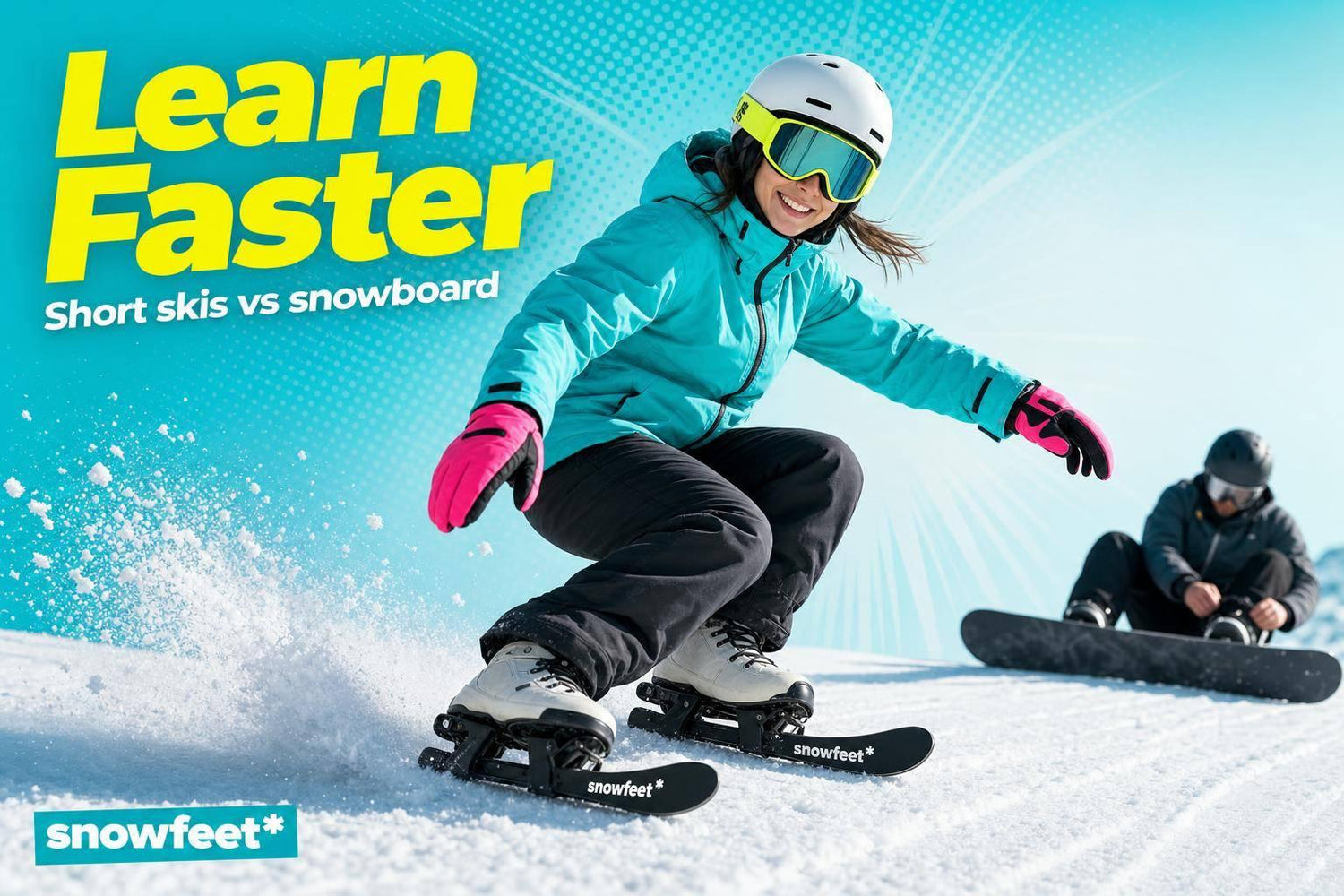
If you want the easiest start, I’d pick short skis. For most first-timers, they feel less awkward, give you more control on day one, and make lifts and stopping less of a circus act.
Here’s the short version:
- Short skis are easier for most beginners
- Snowboards often have a tougher first day
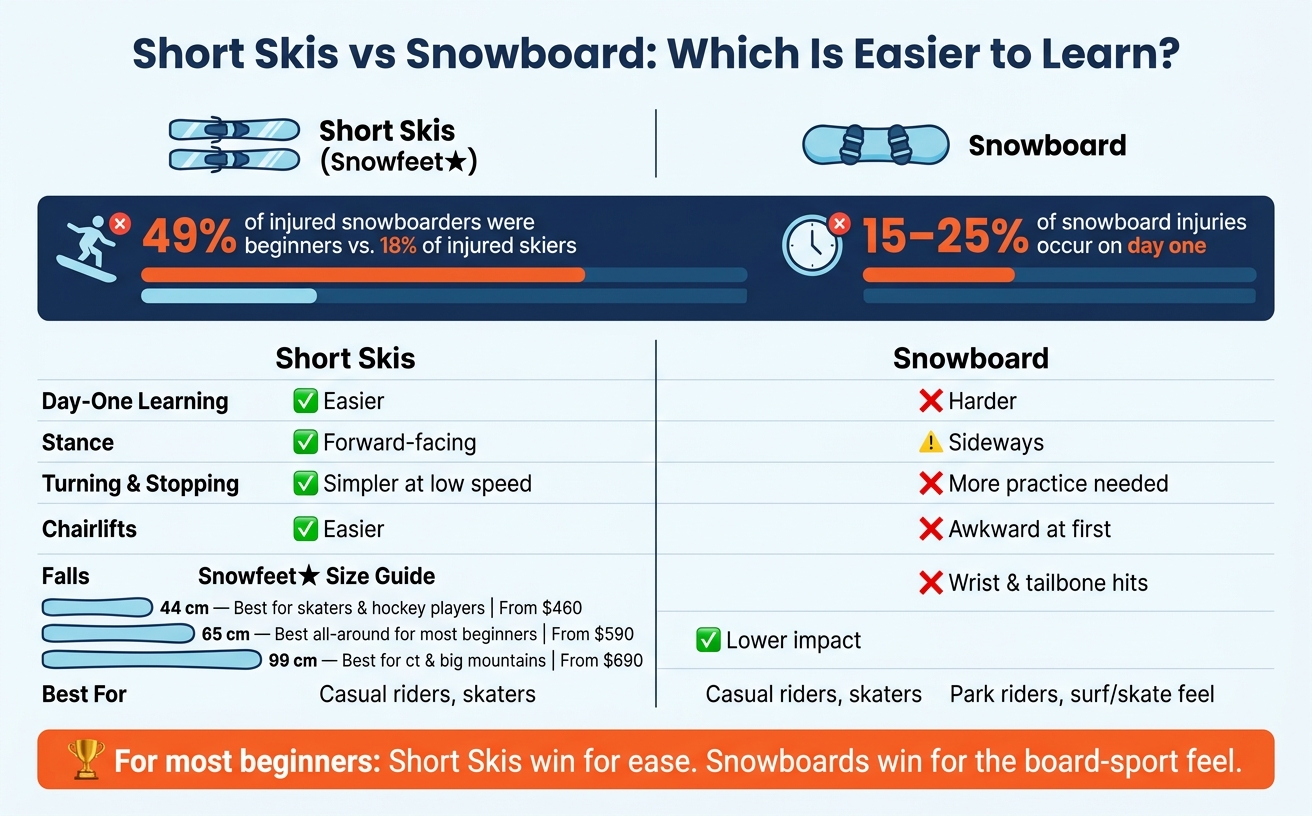
- 49% of injured snowboarders were beginners vs. 18% of injured skiers
- 15%–25% of snowboard injuries happen on day one
- 44 cm works best for skaters and hockey players
- 65 cm is the best pick for most beginners
- 99 cm gives more stability for cautious riders and bigger mountains
If you’re choosing between the two, I’d look at these things first:
- How natural the stance feels
- How easy it is to stop and turn
- How rough chairlifts will be
- How much time you have to learn
- What kind of terrain you want later
Short Skis vs Snowboard: Beginner Comparison Guide
Are Short Skis Better for Beginners?
Quick Comparison
| Factor | Short Skis | Snowboard |
|---|---|---|
| Day-one learning | Easier | Harder |
| Stance | Forward-facing | Sideways |
| Turning and stopping | Simpler at low speed | Takes more practice |
| Chairlifts | Easier | More awkward at first |
| Falls | Often lower impact | More wrist and tailbone hits |
| Best for | Casual riders, skaters, short trips | Park riders, surf/skate feel |
So, if you’ve got one weekend and want to get up and running fast, I’d go with short skis. If you want the sideways board feel and don’t mind a rougher start, snowboard still has its place.
A couple handy videos if you want a fast visual before you decide:
My simple take: short skis win for ease, while snowboards win for that board-sport feel. It just depends on what kind of first week you want :)
First-Day Learning Curve: Why Short Skis Usually Feel Easier
Balance, Stance, and Getting Moving
Short skis often feel more natural on day one. They let beginners make small balance fixes without feeling like both feet are locked onto one plank. For people with no board-sport background, a forward-facing ski stance tends to click faster than a sideways snowboard stance.
That gap gets even bigger for people who’ve spent time on inline skates, ice skates, or in casual hockey. The glide, the weight shift, and the feel of using edges can seem familiar right away. Snowfeet* Skiskates 44 cm are a good match for skaters who want the fastest jump from rink-style balance to snow.
Turning, Stopping, and First Runs
Short skis react to small leg and ankle movements, so low-speed steering usually feels simple from the start. Beginners can use a basic wedge to slow down and steer at the same time. On an easy green run, many first-timers on short skis can link a few basic S-shaped turns within a few hours. That’s a big early win.
Snowboards work differently. Stopping and turning both depend on edge control, which is a whole new movement pattern for most people. Day one on a snowboard often means a lot of time spent learning heel-side braking and basic toe-side turns. Short skis usually feel more forgiving because you can steer and brake with smaller movements that feel more familiar.
That early sense of control matters a lot when you need to stop, reset, and hop on a lift.
Chairlifts, Falls, and Early Confidence
Chairlifts are simpler on short skis because both feet stay forward and attached. You slide into the load area, sit down, and glide off at the top in a basic parallel stance. Clean and simple.
On a snowboard, one foot stays unstrapped during the lift ride. Then comes the unload: stand up, find your balance, and steer all at once. That’s a classic day-one wipeout moment, especially for kids and nervous adults.
Falls tend to look different too:
- Short-ski beginners often take lower-force falls, like a sideways slide or a sit-down.
- Snowboard falls more often lead to wrist, tailbone, and shoulder hits, which is why rental shops often suggest wrist guards and padded shorts for new snowboarders.
Once that first run stops feeling scary, the next gap shows up in how fast each setup helps beginners link turns and build confidence over the first week.
sbb-itb-17ade95
First-Week Progress: Snowfeet* Models vs. a Beginner Snowboard
By days 3–7, many snowboard beginners start to improve once edge control finally clicks. Until then, a big chunk of the week often goes to falls, stops, and those little "let me get back up again" moments. Short-ski riders often get to usable control sooner, which means more time spent riding and less time resetting. If you're on a ski trip with only a few days on snow, that kind of head start matters. The best Snowfeet* size comes down to one thing: how much balance help you want in your first week.
Snowfeet* Skiskates 44 cm: Best for Skaters and Playful Riders
The 44 cm Skiskates (starting at $460) are the shortest option in the Snowfeet* lineup, and that small size can be a big plus for riders with a skating background. A lot of rink skills carry over well to snow, like edge use, quick turns, and fast weight shifts. Because of that, the 44 cm model tends to click faster than other Snowfeet* options for this kind of rider. A former hockey player, for example, can often carve small S-turns on a green run by day 2 or 3 and start trying small features by the end of the week.
There is a catch, though. That short length can feel pretty lively if you've never skated before. The skis respond fast, which is fun when your reflexes are there, but it can also feel twitchy in chopped-up snow. If skating is not in your toolbox, the 65 cm or 99 cm Skiblades will usually feel calmer and easier to trust right away. For most first-timers, a bit more length just feels less jumpy.
Snowfeet* Skiblades 65 cm: The Best All-Around Pick for Most Beginners
The 65 cm Skiblades (starting at $590) hit the sweet spot for most first-week riders. They stay stable at beginner speeds without feeling bulky or awkward. On common U.S. green and easy blue groomers, many beginners can make slow, rounded turns and change their line around other skiers much more easily than on a snowboard, where week-one edge catches often drive people nuts.
A common result by the end of week one is simple: fewer falls and more control. And honestly, that feeling is what gets casual riders excited to come back the next day instead of calling it quits early. If you want a bit more steadiness underfoot, the 99 cm version is the next step up.
Snowfeet* Skiblades 99 cm: More Stability Without Long Ski Bulk
The 99 cm Skiblades (starting at $690) are a strong pick for nervous beginners, cautious adults, and parents riding with kids. The extra length helps smooth out small bumps, chopped-up snow, and shallow ruts that can feel shaky on shorter blades. By days 4–7, many riders on 99 cm Skiblades are handling slightly steeper pitches and longer runs with more comfort, without feeling like the skis are darting around under them.
Another plus: the 99 cm model still gives you that short-ski feel, but it can also make the jump to full-length skis easier later. That makes it a nice middle ground for riders who want more support now without going straight to long skis.
Short Skis vs. Snowboard: Pros, Cons, and Who Each Option Fits
After the first-day and first-week differences, this is the fast way to look at the main trade-offs.
| Factor | Short Skis (Snowfeet*) | Beginner Snowboard |
|---|---|---|
| First-day difficulty | Easier - forward stance feels natural | Harder - sideways stance takes real adjustment |
| First-week progress | Faster - most riders control green runs within a few sessions | Slower early - edge control can take several days to click |
| Portability | Very compact - fits in a trunk or closet | Bulkier - needs more storage space |
| Terrain fit | Best on groomed greens and easy blues | Better in parks and powder once skills develop |
The notes below show when a snowboard still makes sense and when Snowfeet* is the easier pick.
When a Snowboard Still Makes Sense
A snowboard is still a good choice for some riders. If you already skateboard, surf, or wakeboard, you’ve got a head start. Your body already knows the sideways stance, how to shift weight, and how edge pressure works. That carries over to snowboarding in a big way.
Snowboarding also makes sense if your main goal is terrain park riding. Think boxes, rails, jumps, and spins. Once riders hit the intermediate stage, snowboards can feel smooth and surf-like in powder and off-piste terrain. That feel is hard to match with any ski setup. If that’s what you want, go with a snowboard.
Where Snowfeet* Short Skis Work Better for Most Casual Riders
For many U.S. beginners - vacationers, parents, and people who hit the local hill once in a while - short skis cut out some of the biggest pain points. The forward-facing stance feels more natural right away. You can shuffle through the lodge, walk across flat spots, and get onto a chairlift without that one-footed wobble that throws off so many first-time snowboarders.
Snowfeet* 65 cm and 99 cm Skiblades are also much easier to pack than a full ski setup. If a family is flying into Colorado or Utah for a 4-day trip, that kind of simple, no-fuss setup can save a lot of hassle.
There’s also the confidence piece. It matters more than people think. When riders fall less and feel more in control, they’re more likely to come back the next day - and the day after that. For occasional riders, short skis often lead to a faster, smoother start.
That leaves the final decision: pick the setup that fits your goals, your budget, and your local hill.
Final Verdict: Picking the Right Option for Your Goals, Budget, and Local Hill
After the first day and first week on snow, the takeaway is pretty simple: for most U.S. beginners, short skis are easier than a snowboard. They feel more natural, they’re easier to stop on, and they make chairlifts way less awkward.
If you ride a smaller local hill in the Midwest or East, Snowfeet* Skiskates 44 cm (from $460) make a lot of sense for skaters, hockey players, and inline riders. That crossover feel is hard to miss. For most other beginners, Snowfeet* Skiblades 65 cm (from $590) are the safe bet and the default pick.
Heading to bigger Western mountains like Colorado or Utah? Then Snowfeet* Skiblades 99 cm (from $690) are the better move if you want more stability early on. Bigger terrain can feel like a lot at first, and that extra length helps settle things down.
Cost matters too. Beginner snowboard setups usually cost about the same as, or a bit more than, a similar short-ski setup. Storage matters just as much. Snowfeet* fits into a standard bag, which is a whole lot easier than hauling around bulky gear. If you live in an apartment, drive a small car, or just hate gear clutter, that’s a nice little win :)
Choose a snowboard if you want that surf-style sideways feel or if park riding is your main thing. Just know the learning curve is slower. If that’s the vibe you want, go for it. If not, short skis are the faster path to feeling comfortable.
For most casual riders, the 65 cm Skiblades are the best all-around pick.
FAQs
Are short skis easier if I’ve never skied or snowboarded before?
Yes. Snowfeet short skis are usually easier to learn than traditional skis or snowboards, especially for first-time riders.
The big reason is simple: they feel more natural right away. You face forward, and each foot moves on its own. That setup can make balancing, turning, and getting back in control a lot less awkward.
For many beginners, that means the first day feels way less intimidating. Some people start to feel comfortable after just a few runs or one full day. By contrast, long skis and snowboards often take weeks to get the hang of.
So, if you want something that feels less like a wrestling match and more like a fun first ride, Snowfeet can be a solid pick :)
Which Snowfeet* size should a beginner choose?
For absolute beginners, the 65 cm Skiblades are the best place to start. They’re short, easy to control, and the wood core helps them feel stable under your feet. That means turning and learning basic moves feels a lot more natural.
If you want a simple way to get into winter sports, or you just want something fun for the backyard, the 38 cm Mini Ski Skates and 50 cm Snowfeet PRO are also easy to handle. Once the basics click, you can step up to the 99 cm Skiblades.
Are short skis or a snowboard safer for day-one beginners?
Short skis like Snowfeet are often a safer, easier pick for day-one beginners than a snowboard. On a snowboard, both feet are fixed in a sideways stance. That can feel awkward right away and make balance tougher.
Snowfeet feel more natural because you face forward, not sideways. You can also move each foot on its own, which gives beginners a bit more freedom and control. And since they’re short, they’re easier to turn, stop, and recover with after a fall.
That matters a lot on your first day. When gear feels simpler, people tend to stay calmer, stay in control, and build confidence faster :)











Efterlad en kommentar
Denne side er beskyttet af hCaptcha, og hCaptchas Politik om beskyttelse af persondata og Servicevilkår er gældende.