



















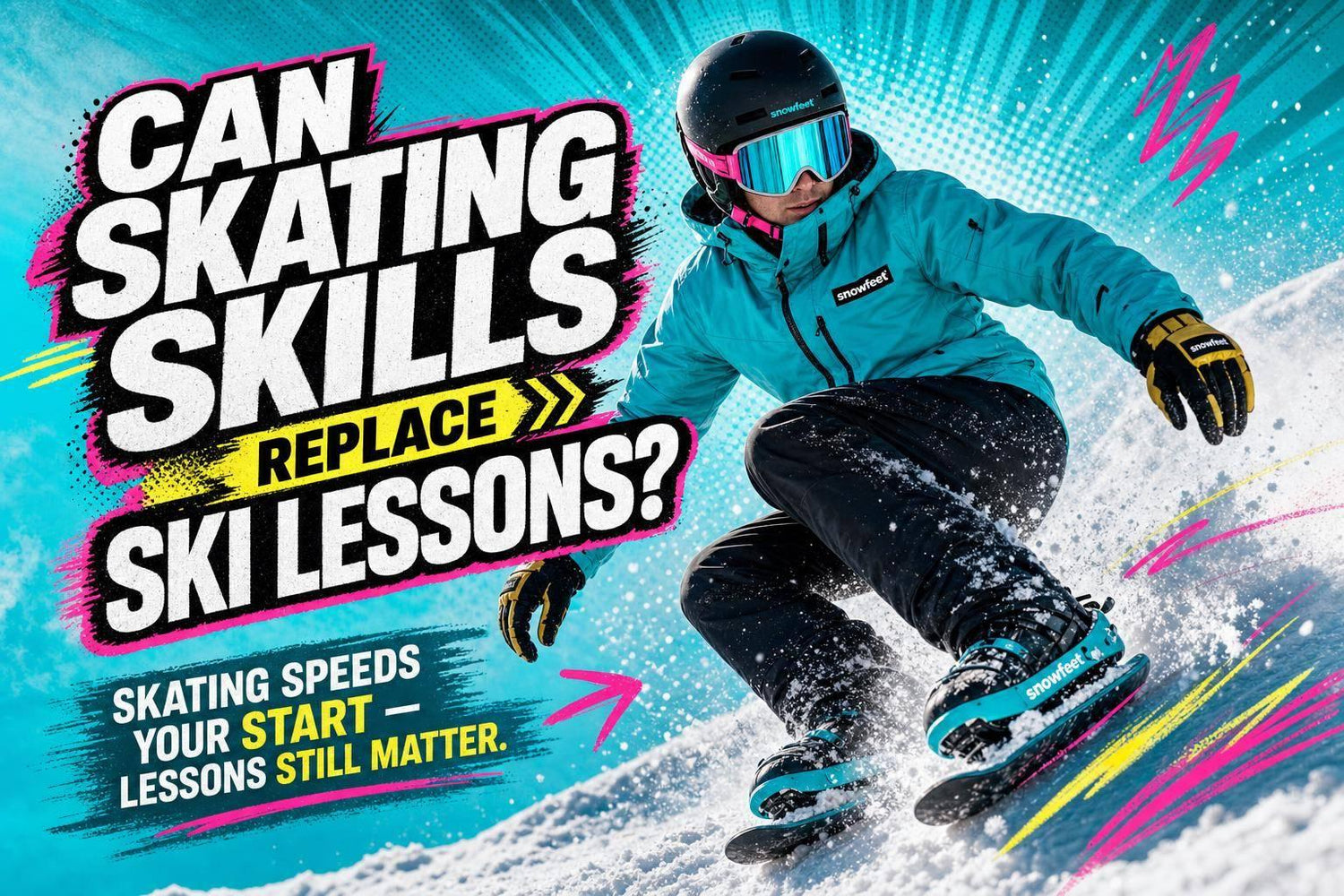
Short answer: no. But if you skate, you can learn snow sports much faster. In plain English, skating gives you a head start with balance, edges, stance, and side-to-side movement. That head start shows up most on short gear like Snowfeet*, not on long alpine skis or a snowboard.
Here’s the simple takeaway:
- Hockey players and strong skaters often pick up Snowfeet* Skiskates (44 cm) or Skiblades (65 cm) in 1–2 hours
- Casual skaters still do better with a short lesson, especially for stopping, lifts, and slope rules
- Long skis ask for more retraining because the platform is longer and less skate-like
- Snowboards share some edge feel, but the sideways stance throws many skaters off
- Even if you skate well, you still need snow-only skills like:
- speed control on hills
- chairlift use
- right-of-way rules
- how to stop without panic-braking
So, if I had to sum it up in one line, it’d be this: skating can cut your learning time, but it doesn’t replace at least a short intro lesson.
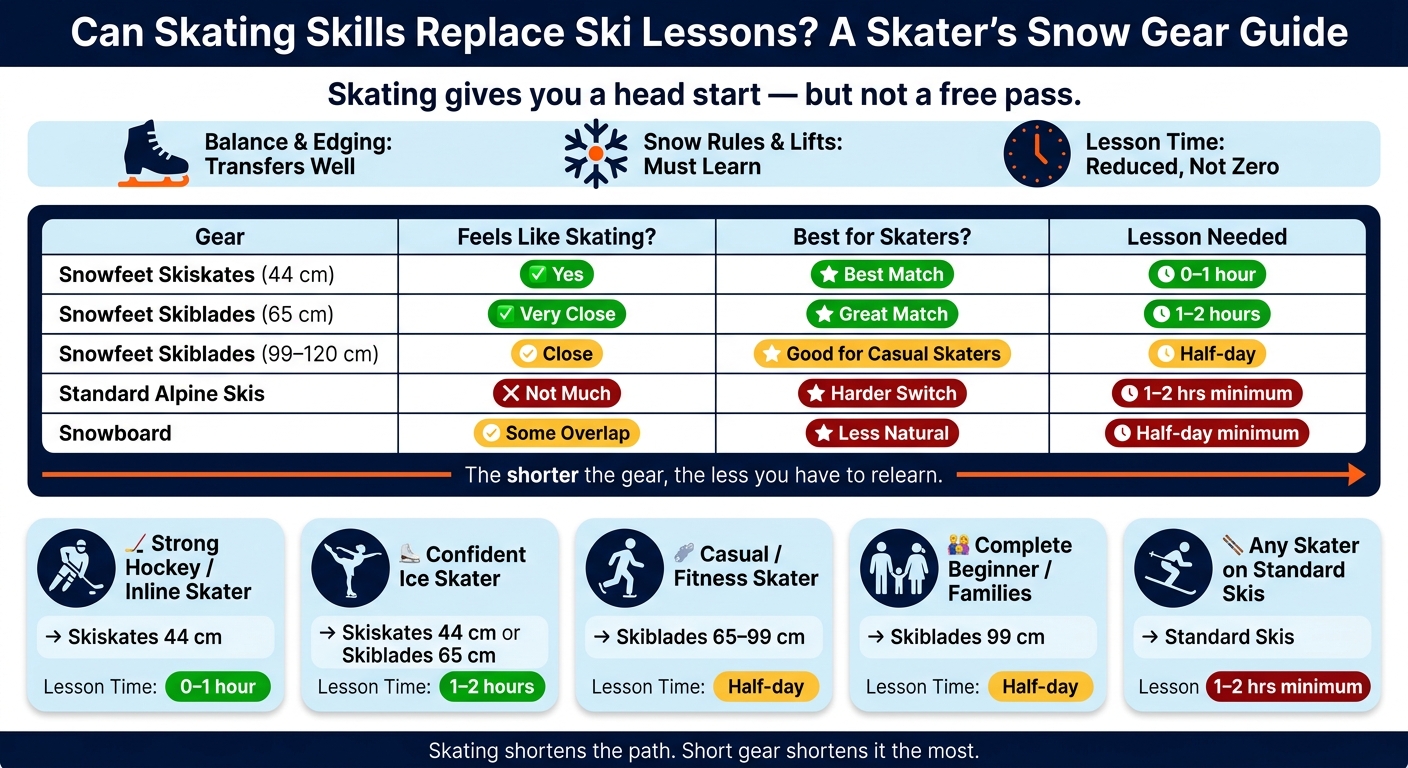
Skating Skills vs. Snow Sports: Gear & Lesson Time Guide for Skaters
Ski or Skate on Snow? With Snowfeet 65 CM, You Can Do Both.
Quick comparison
| Gear | Feels most like skating? | Best for skaters? | Lesson need |
|---|---|---|---|
| Snowfeet* Skiskates (44 cm) | Yes | Best match | 0–1 hour |
| Snowfeet* Skiblades (65 cm) | Very close | Great match | 1–2 hours |
| Snowfeet* Skiblades (99 cm / 120 cm) | Close | Good for casual skaters | Half-day for many people |
| Standard alpine skis | Not much | Harder switch | 1–2 hours minimum |
| Snowboard | Some overlap | Less natural for most skaters | Half-day minimum |
A good rule of thumb? The more the gear feels like skates, the less “starting over” you have to do. That’s why short snow gear often clicks fast for skaters. Still, snow has its own rules, and the mountain has a way of humbling people fast :)
How Skating Skills Carry Over to Skiing
Balance, Edging, and Body Position
Skaters already know a lot of the stance skiing asks for. You’re low, centered, with bent knees, loose ankles, and your weight over the middle of your feet. That alone makes the first day on snow feel less awkward and cuts down on those early balance errors.
Edging carries over well too, mainly on shorter gear. On _Snowfeet Skiskates (44 cm)_* and Skiblades (65–99 cm), small ankle and foot shifts can change direction fast, kind of like skating. The gear reacts right away. On long skis, the same idea still works, but it feels slower and asks more from your legs.
So, skating habits line up best with Snowfeet Skiskates* and Skiblades. They help less on long skis, where the movement pattern is still there but doesn’t click as fast.
Stopping and Turning Skills That Cross Over
Hockey players usually get the biggest head start here. A hockey stop feels a lot like stopping with Snowfeet Skiskates* or shorter Skiblades. The short platform pivots fast, and the edge feel is familiar. On long skis, most beginners learn a snowplow stop first, and that tends to feel less natural for skaters.
Inline skating crossovers can help with linked ski turns too. On _Snowfeet Skiskates (44 cm)_* and Skiblades (65–99 cm), that side-to-side rhythm often clicks fast because the short platform responds so quickly from edge to edge. On longer skis, those habits still help, but they won’t do all the work for you. You still need ski-specific movement.
Skating Skills vs. Ski Skills: Side-by-Side Comparison
Here’s how the overlap looks by skill and gear.
| Skill Area | Skating Version | Skiing Version | Transfer on Snowfeet* Gear | Transfer on Standard Long Skis |
|---|---|---|---|---|
| Stance & balance | Flexed ankles, centered weight, hip-width feet | Same cues: soft knees, weight over the middle of the skis | Very high - compact platform feels close to skates | Moderate - longer skis make fore-aft balance harder |
| Edging | Ankle roll and inside/outside edge pressure | Similar ankle and knee movements to set ski edges | Very high - short platform reacts quickly | Moderate - movements must be more progressive |
| Stopping | Hockey stop: pivot sideways, set edges, skid | Snowplow or parallel-style stopping | High - pivoting and skidding feel natural | Lower - wedge stopping feels less intuitive |
| Turning | Crossovers and edge-to-edge rhythm | Linked turns with weight transfer | High - turns can come together quickly | Moderate - same idea, but slower to feel natural |
| Speed control | Edge pressure and skidding | Edge angle and turn shape | High - short gear makes speed easy to manage | Lower - control takes more coaching and practice |
These skills can get you off the ground faster. But they only take you part of the way. Snow still has its own rules, and ski technique goes beyond what skating can teach on its own.
sbb-itb-17ade95
Where Skating Experience Stops Helping
Snow Techniques Beginners Still Need to Learn
The first big snow skill is the snowplow, or pizza wedge. You point the tips in and push the tails out. That puts pressure on the inside edges, creates friction, and slows you down. For skaters, this can feel weird right away. Why? Because you're slowing down by working against your motion. That's nothing like a T-stop or hockey stop.
Side-slipping and turn-shape speed control are new too. With side-slipping, you keep your skis across the hill, soften the edges, let the skis slide sideways, then add edge pressure to slow down or stop. There’s no clean skating match for that. Turn-shape speed control works in a similar way: you guide your turn across the slope and a bit uphill at the end, instead of waiting too long and slamming on the brakes. A lot of skaters try to brake late. On a steep run, that’s a bad habit.
Fore-aft balance on a slope is another spot where skating habits can get you in trouble. When speed picks up on a descent, many people lean back without thinking. On snow, that makes steering harder and takes pressure off the tips of your skis or skiblades. You want your shins pressing into the front of your boots, your hips centered, and your body making small corrections as the terrain changes.
On Snowfeet* Skiskates (44 cm) and Skiblades (65, 99, and 120 cm), the shorter platform makes it easier to stay centered, so those balance changes are smaller than they are on long skis. Still, you need them. That’s the point where skating carryover ends and snow-only control begins.
Safety, Lift Use, and Slope Rules
Once the challenge shifts from body movement to mountain rules, things change fast. The National Ski Areas Association's "Your Responsibility Code" sets the standard rules at U.S. resorts. The big one: the downhill skier has the right-of-way. You’re responsible for avoiding people below you, because they can’t see you coming. That’s the reverse of rink traffic, where people usually see each other.
Where you stop matters too. If you stop in the middle of a narrow trail, just below a rollover, or under a terrain park landing, you put yourself in a blind spot for people above you. Safer spots are on the side of the trail, where uphill traffic can see you.
Chairlifts bring their own little learning curve, too:
- Loading and unloading cleanly
- Using the safety bar
- Keeping your skis straight
Even strong, athletic skaters can get a lot from a short beginner lesson here. It helps with resort rules, lift use, and avoiding those ugly last-second stops on terrain that still feels new. These limits are less of a hassle on short Snowfeet* gear, but they don’t go away.
Snowfeet* vs. Standard Skis and Snowboards: Best Gear for Skaters
If you already skate, you’re not starting from scratch. But your gear still makes a big difference. It can keep that natural feel - or make you relearn more than you need to.
Why Snowfeet* Feels Most Like Skating
Snowfeet* keeps both feet independent and pointed forward, so the stance feels much closer to skating. Snowfeet* Skiskates (44 cm) and Skiblades (65, 99, and 120 cm) are also much shorter than standard skis, which makes them feel more familiar right away. For a lot of skaters, Snowfeet* is the shortest path from the rink to snow.
Another plus: many Snowfeet* models work with regular winter shoes, snowboard boots, or ski boots. That means you can skip some of the bulky feel that comes with full alpine ski setups. They’re also much easier to carry and stash than long skis.
On snow, the movement pattern clicks fast. Quick edge-to-edge shifts and hockey-stop-style braking feel natural. Since the setup is shorter and lighter, it can also be easier on your legs.
How Standard Skis and Snowboards Compare for Skaters
Standard skis are a different beast. Their extra length adds more leverage, which means slower response and wider turns. That’s a far cry from the quick pivots most skaters are used to. Skaters also have a habit of leaning back when speed picks up, and on long skis, that’s a problem. You need to stay more forward, and that takes some retraining.
Snowboards do share some edging basics, but the sideways stance usually feels less natural to skaters than Snowfeet*.
That’s a big part of why people often need fewer lessons with Snowfeet*.
Snowfeet* vs. Standard Skis vs. Snowboards: Comparison Table for Skaters
| Feature | Snowfeet* (Skiskates / Skiblades) | Standard Alpine Skis | Snowboard |
|---|---|---|---|
| Learning curve for skaters | Low - movements mirror skating closely | Moderate - long platform adds lag and slower turns | Higher - sideways stance is unfamiliar |
| Balance similarity to skating | High - forward stance, independent feet | Moderate - stance is similar but leverage differs | Low - rotated stance changes everything |
| Edge control familiarity | High - quick edge-to-edge like skates | Moderate - edging works but turns are wider | Moderate - concept is similar, execution differs |
| Stopping and turning ease | High - hockey stops and slides work well | Moderate - snowplow and parallel stops feel new | Lower - heel-side and toe-side stops take practice |
| Portability | Fits in a backpack | Typically requires a ski bag or roof rack | Typically requires a board bag or roof rack |
| Typical lesson need | Often shorter, and sometimes unnecessary on easy terrain | Recommended for most beginners | Strongly recommended for first-timers |
Snowfeet* helps skaters make the jump to snow with less friction. If your goal is steep powder or fast carving, standard skis or a snowboard may fit those conditions better. But if you want to get comfortable fast, Snowfeet* keeps more of your skating habits intact. So, yeah, skaters often need less instruction with Snowfeet* - just not zero.
That difference can shape whether a formal lesson still makes sense.
Do You Still Need Lessons? A Direct Answer and Gear Guide
The key issue isn’t whether skating helps. It does. The key issue is how much instruction you still need on the gear you pick.
Skating shortens the learning curve most on short Snowfeet* gear, but it doesn’t erase the need for snow-specific basics. That gap shows up most clearly on short Snowfeet* gear, where skating habits carry over best.
Who Can Learn Quickly With Little Instruction
The fastest learners aren’t just the people with good balance. They’re the people using the most skater-friendly gear.
Strong hockey players, confident ice skaters, and experienced inline skaters tend to adapt fastest on short Snowfeet* gear. On Snowfeet* Skiskates (44 cm) or Skiblades (65 cm) on groomed green runs, this group can often get moving and begin linking controlled turns within the first hour or two.
Still, even strong skaters should plan for at least a 1-hour intro session. That time should cover:
- how to stop fast on snow
- how to load and unload chairlifts with short gear
- basic slope rules, like right-of-way and where not to stop
Who Should Still Book a Formal Lesson
Casual skaters, complete beginners, and families with kids should book a formal lesson. Beginners on standard skis or a snowboard still need formal instruction for speed control and fall prevention. In many cases, a short group lesson is enough.
Athletic adults can get fooled here. You may feel solid and coordinated, but if you plan to head straight to steeper runs, it’s smart to pause and rethink going solo. Fitness can hide real gaps in speed control and fall-prevention technique.
Skater Type, Best Gear, and Lesson Time: Quick Reference Table
Use the chart below as a quick guide for how much lesson time each type of skater usually needs.
| Skater Type | Best Snowfeet* Model | Lesson Needed |
|---|---|---|
| Strong hockey / inline skater | Skiskates 44 cm | 0–1 hour (safety & lifts) |
| Confident ice skater | Skiskates 44 cm or Skiblades 65 cm | 1–2 hours |
| Casual / fitness skater | Skiblades 65 cm or 99 cm | Half-day |
| Complete beginner / families with kids | Skiblades 99 cm | Half-day |
| Any skater on standard skis | Not the best fit | 1–2 hours minimum |
| Any skater on a snowboard | Not the best fit | Half-day minimum |
Skating shortens the path. Snowfeet* shortens it the most.
FAQs
Can hockey players skip ski lessons?
Not for alpine skiing in the usual sense. Hockey players do bring over some handy skills, like balance, edge control, and feeling at ease at speed. But long, heavy skis are a different beast. They ask for sport-specific moves, and some of those can clash with skating habits.
With Snowfeet Skiskates or Skiblades, the switch feels much more natural. Their compact 44 cm to 120 cm size is closer to ice skates, so hockey players can lean on muscle memory and glide and stop with less of that awkward learning curve.
What Snowfeet* gear is easiest for skaters?
For skaters, the easiest move to snow is the Snowfeet 44 cm Skiskates*. Their short length feels much closer to ice skates or inline skates, so things like balance, quick weight shifts, agility, and edge control carry over with less of that awkward learning curve.
That’s the big win here. They don’t feel huge or clunky. Compared with standard skis, they’re light, quick to react, and easy to handle. You can also use them with regular winter boots or snowboard boots, which keeps the setup simple. As a result, first turns and stops tend to feel more natural right from the start.
What snow skills don’t transfer from skating?
Skating gives you a nice head start with balance, edge control, and lower-body stability.
But snow is its own beast.
It doesn’t react like ice or pavement. So even if you’re solid on skates, a few things will feel a little off at first.
You’ll need to:
- rely less on hard side-to-side pushes
- control drift with small pressure changes instead of trying to muscle through the slide
- keep your upper body quieter
- get used to turns that feel more delayed and shaped, not as instant as skating
That last part trips people up a lot. On skates, the response can feel quick and sharp. On snow, the turn builds more gradually. It’s less “snap” and more “arc.” Once you feel that rhythm, things start to click.











Efterlad en kommentar
Denne side er beskyttet af hCaptcha, og hCaptchas Politik om beskyttelse af persondata og Servicevilkår er gældende.