



















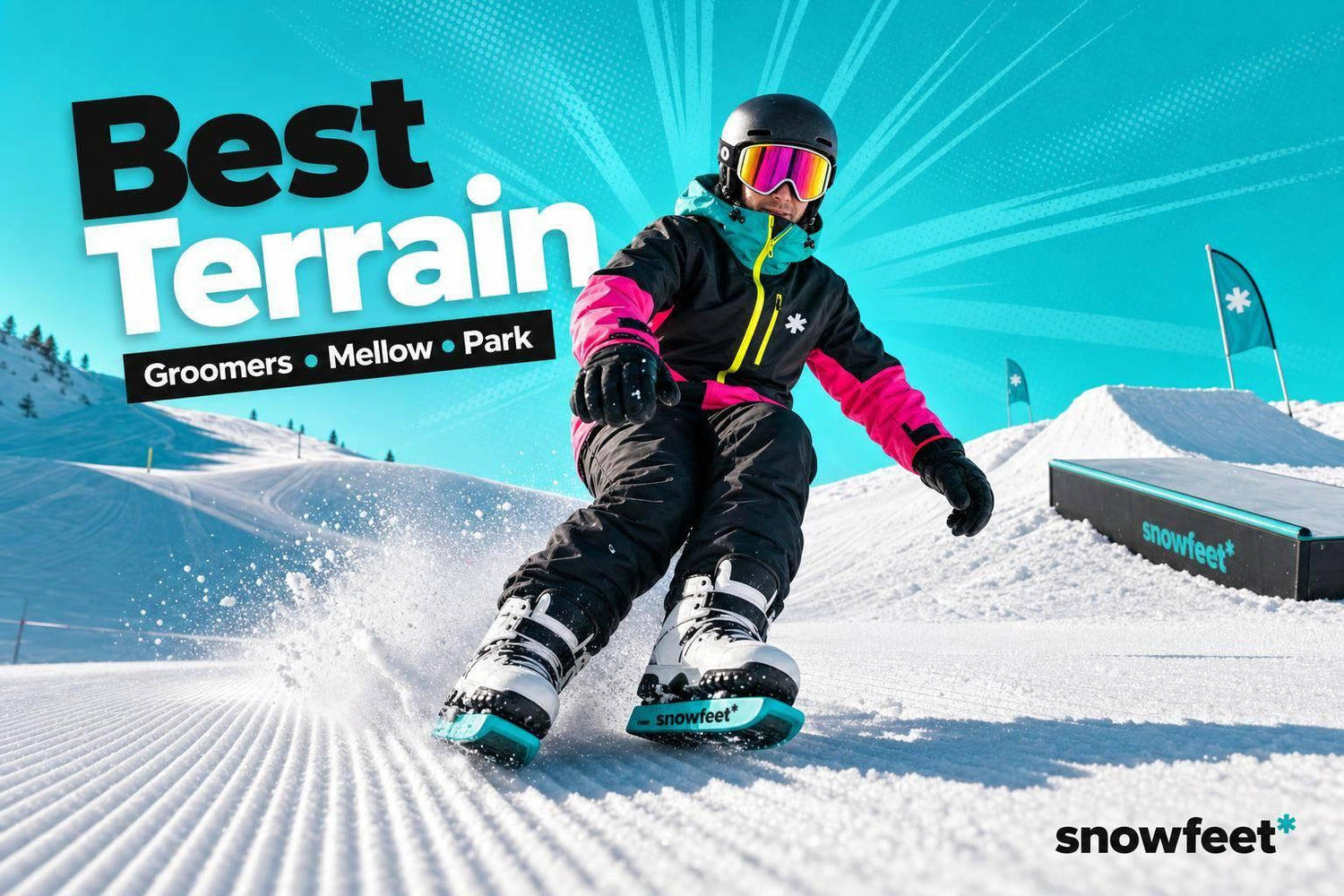
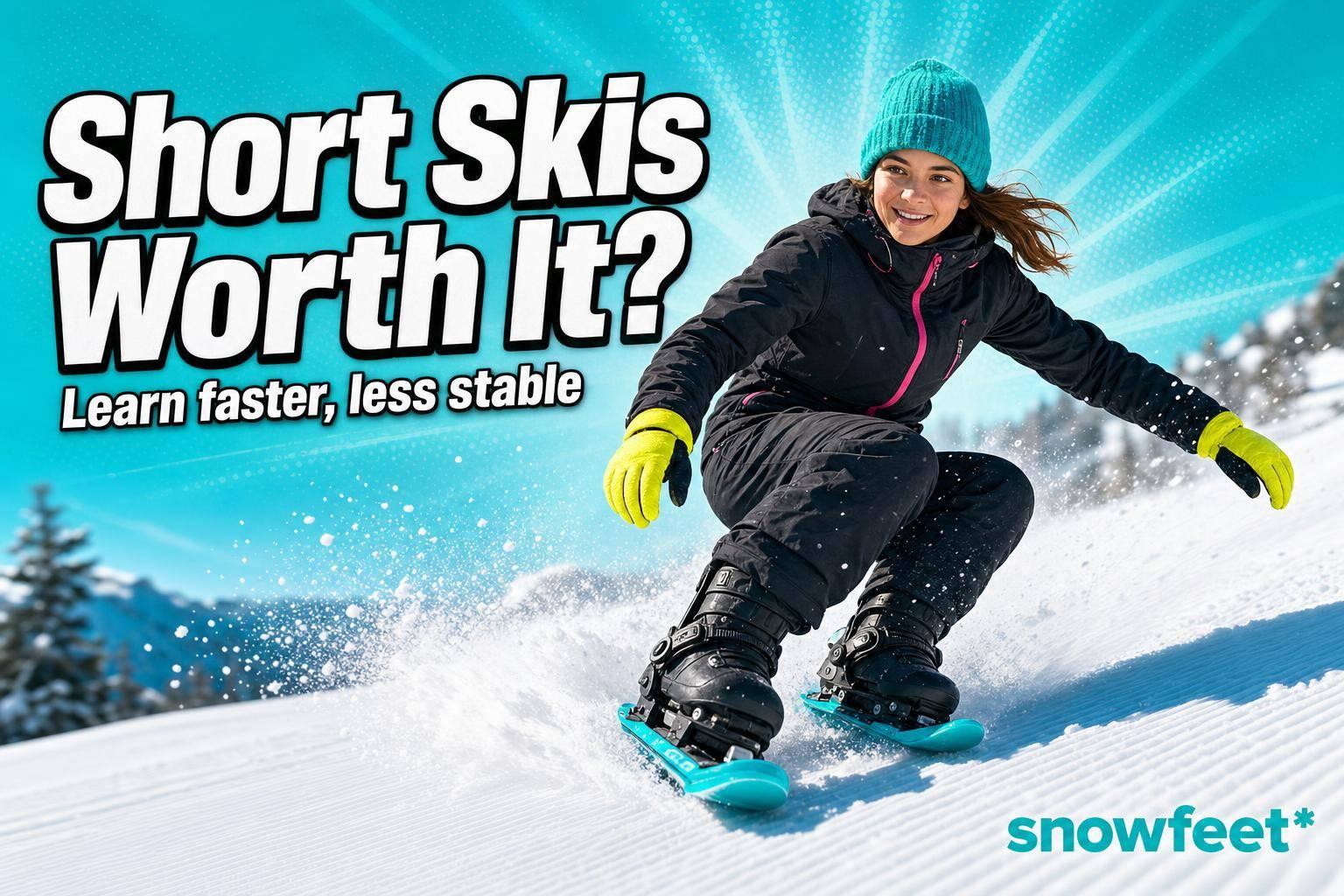
Skiskates work best on groomed snow, mellow slopes, and small park features. If you ride green runs, easy blue runs, short local hills, or park laps, they make a lot of sense. If you want deep powder, steep long runs, or high-speed charging, they don’t.
Here’s the short answer:
- Best snow: groomed corduroy, hard-packed snow, and slightly soft snow
- Best slopes: green runs, mellow blue runs, learning areas, and small hills
- Best use: short turns, easy stops, side hits, rails, boxes, and portable resort fun
- Less ideal: powder deeper than about 4 inches (10 cm), choppy refrozen snow, and steep black runs
-
Best lengths by terrain:
- 38–44 cm: small hills, easy groomers, learning zones
- 65 cm: faster groomers and park laps
- 99 cm: mixed resort terrain and medium jumps
- 120 cm+: longer runs and more speed
So, if your ski day looks like groomers, park laps, and messing around with friends, skiskates fit. If your day looks like powder hunting and bombing steep faces, go longer.
A few numbers tell the story. Most downhill skis are about 150–180 cm long. Skiskates are often just 38–44 cm. That tiny platform turns fast and stops fast, but it gives up stability and float. That’s the trade.
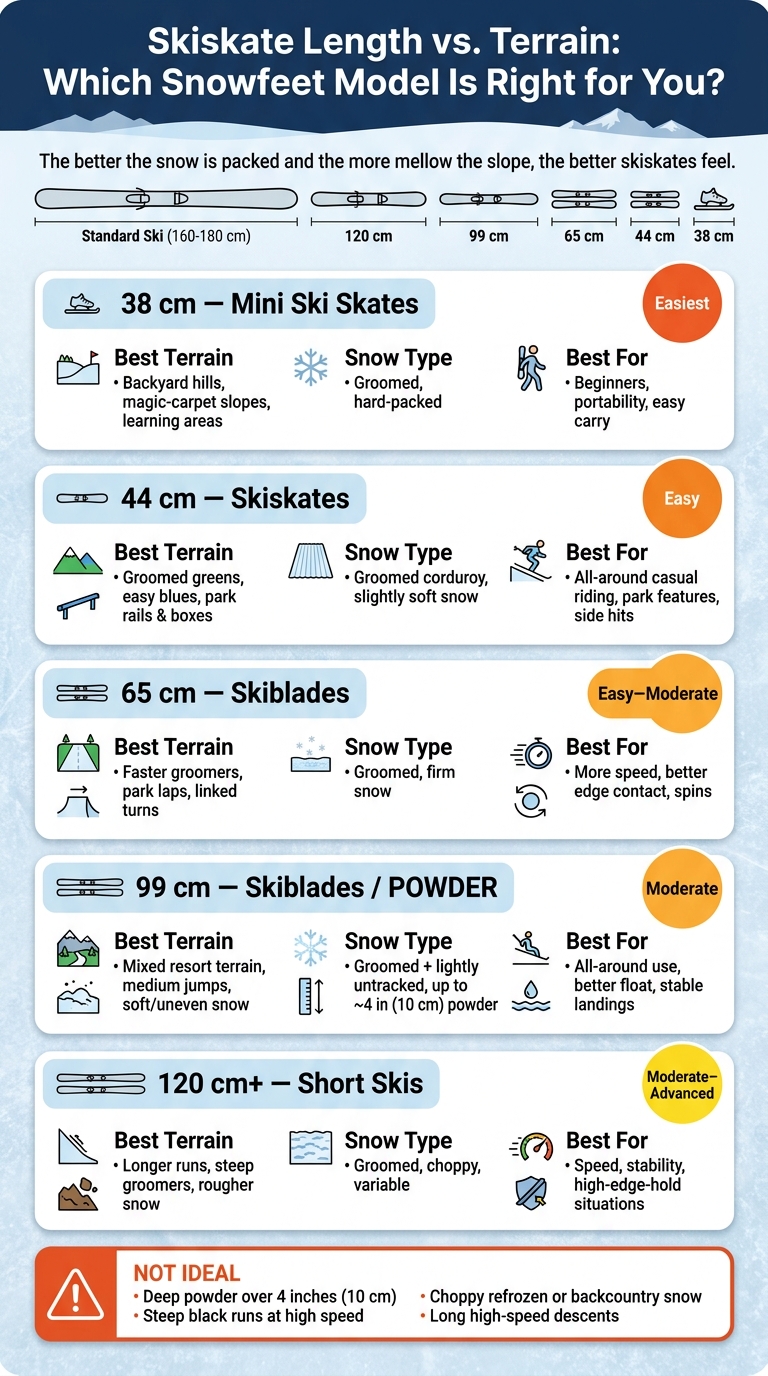
Skiskate Length vs. Terrain: Which Snowfeet Model Is Right for You?
Snowboarder tries Snowfeet* | Which Snowfeet* Short Ski is the Best? | Snowblades 44, 65, 99 Review

Quick comparison
| Terrain | Best skiskate length | How it feels |
|---|---|---|
| Learning area, small hill | 38 cm, 44 cm | Easy to turn, easy to carry |
| Groomed green and easy blue | 44 cm | Best all-around pick |
| Faster groomers | 65 cm | More calm, more edge contact |
| Park rails, boxes, side hits | 44 cm, 65 cm | Light and playful |
| Medium jumps | 99 cm | Better support on landings |
| Soft or rough near-resort snow | 99 cm, 120 cm | More float and stability |
| Deep powder, steep long runs | 120 cm+ or full skis | Skiskates start to struggle |
If I had to sum it up in one line: the better the snow is packed and the more mellow the slope, the better skiskates feel. Nice and simple :)
For a visual feel, these YouTube searches can help:
What Makes Terrain Work Well for Skiskates
Snow Surface: Groomed, Hard-Packed, and Slightly Soft Snow Work Best
Snow texture matters more than anything else here. Groomed corduroy - that ridged snow left behind by snowcats - is the sweet spot for skiskates. It gives those short edges enough bite, so turns and stops feel steady instead of sketchy.
Hard-packed snow also works well. Ice? You can ride it, but it’s not very forgiving. With such a short base, there’s not much room for mistakes. Miss your edge a bit, and the snow lets you know right away.
Slightly softened snow is also a nice match. It puts a thin, forgiving layer on top of the firm base, which makes the ride feel playful without causing you to sink. A light dusting over groomed snow can be fun too. But once fresh snow gets deeper, longer skis start to make a lot more sense. That’s why groomed runs, mellow hills, and small features tend to be the best fit.
Slope Shape: Mellow to Moderate Pitch Is the Best Fit
Green and mellow blue runs are where skiskates feel most at home. You get enough pitch to keep moving, but not so much that speed takes off before your short edges can keep up. It’s a much nicer setup for learning and for just having fun.
Wide, open groomers with simple lines work best. They give you space to make quick turns and stay in control without spending the whole run fighting speed. That’s a big part of the appeal: less survival mode, more playful riding.
Steep black runs are a different story. They build speed fast and force constant braking, which gets tiring in a hurry.
Rider Goals: Control, Tricks, and Portability Over Top Speed
A lot of this comes down to what kind of day you want.
If you’re learning, a gentle green run with soft groomed snow gives you a calm place to practice turning and stopping without dealing with runaway speed. If you want to hit small features or side hits, a mellow blue with rollers and small park features gives you a nice mix of momentum and control. And if portability is part of the draw, local hills and smaller resorts often make the most sense.
In short, skiskates shine in places where learning, control, and playful riding matter more than top speed. Skiskates are best for quick turns and moderate-speed control. That terrain-to-goal match leads straight into which Snowfeet* length fits best.
sbb-itb-17ade95
Best Terrain for Skiskates and Which Snowfeet* Length to Choose
Groomed Resort Runs, Mellow Hills, and Learning Areas
If you're riding groomed resort runs, learning areas, or mellow hills, this is where skiskates feel right at home. The Snowfeet* Skiskates 44 cm are the best all-around pick for this kind of terrain. They’re easy to control on groomers, easy to carry, and don’t feel like a lot to manage.
Want something even smaller? The Snowfeet* Mini Ski Skates 38 cm are a fun pick for backyard hills, magic-carpet slopes, or anyone who wants the most portable setup possible. Toss them in the car and go. Simple.
If you plan to ski faster groomers, the Snowfeet* Skiblades 65 cm are the next move. They give you more tracking and more edge contact, but still stay short and nimble. They also deal with slightly rougher groomed snow better than the 44 cm model.
Terrain Parks, Side Hits, and Playful Resort Features
In the park, short gear starts to shine in a different way. It’s less about basic control and more about spins, side hits, and quick little moves. Shorter lengths make spins, buttering, and fast edge changes easier on boxes, rails, and side hits.
That’s why the Snowfeet* Skiskates 44 cm and Snowfeet* Skiblades 65 cm are the best match for small jumps and park features. They feel light, quick, and playful.
If you're stepping up to medium jump lines, the Snowfeet* Skiblades 99 cm make more sense. They give you more stable landings and track more smoothly when speed picks up. And yeah, that extra support matters once jumps get bigger.
Short Slopes and Light Ungroomed Snow Near the Resort
Small local hills and mellow light ungroomed snow near the resort are a good match for the shorter models. This works best in shallow, lightly tracked snow close to the resort. The 38 cm and 44 cm models are ideal here. They’re easy to carry, easy to use, and great for quick laps when you don’t want to lug around full-size skis.
When the snow gets softer or the terrain gets rougher, it’s smart to size up. The Snowfeet* Skiblades 99 cm or Snowfeet* Short Skis 120 cm fit better in those conditions. Their larger surface area helps keep you from sinking, and they handle uneven snow with more stability.
| Terrain | Best Snowfeet* Length | Best fit |
|---|---|---|
| Groomed greens & easy blues | 38 cm, 44 cm | Most maneuverable; easiest to learn on |
| Faster groomers, linked turns | 65 cm | More edge contact, calmer tracking |
| Park rails, boxes, side hits | 44 cm, 65 cm | Low swing weight; quick edge changes |
| Medium park jumps | 99 cm | Better tail support on landings |
| Short local hills, light ungroomed snow | 38 cm, 44 cm | Portable, easy to carry |
| Softer or uneven near-resort terrain | 99 cm, 120 cm | More surface area, better stability |
Once snow gets deep, rough, or fast, the shorter models start to make less sense, and the longer Snowfeet* options take over.
Terrain Where Skiskates Are Less Ideal
Deep Powder, Deep, Fresh Snow, and Rough Backcountry
Skiskates start to struggle when the snow gets deep or the terrain gets rough. Snowfeet* says skiskates work best on packed or groomed snow, not deep powder. Their sweet spot is up to about 4 inches (10 cm) of powder. Go deeper than that, and the 38–44 cm models tend to sink and get tougher to control.
If you want a small setup that can handle softer or lightly untracked snow, Snowfeet* POWDER 99 cm or Skiblades 99 cm make more sense. You still get that short-ski feel, but with more surface area to help you stay up on the snow instead of fighting it every turn.
For serious backcountry travel, though, it’s a different game. Variable snow, wind-affected patches, and deep untracked lines can get messy fast. In that kind of terrain, dedicated powder skis or touring skis still have the edge. That’s just what they’re built for.
Long, Steep, High-Speed Runs and Choppy Refrozen Snow
Once runs get longer, speed and stability start to matter a lot more. Very short skiskates are made for quick turns and playful riding, not for holding a line at high speed. On long, steep runs, they can feel twitchy in a hurry. Add choppy refrozen snow or deep ruts, and yeah, things get sketchy.
If your day is mostly about steep, fast terrain, Snowfeet* Short Skis 120 cm, 130 cm, or 140 cm are a better fit. They give you more tracking and more stability. And if that’s the kind of terrain you ride most of the time, long skis still do that job better. They’re made to stay stable at speed and handle rough snow with less drama.
If your terrain falls somewhere between those two ends, the next section breaks down which Snowfeet* length makes the most sense.
How to Pick the Right Snowfeet* Model for Your Usual Terrain
Terrain-to-Model Match: 38 cm, 44 cm, 65 cm, 99 cm, and 120 cm+
Once you know the kind of snow and slopes you ride most, picking the right length gets a lot easier. The short version: go shorter for easy terrain and lower speeds. Move up in length when your runs get faster, rougher, or more open.
For parks and side hits, the 44 cm Skiskates and 65 cm Skiblades are a sweet spot. They give you enough stability for landings, but still feel quick for spins and rails.
If you ride mixed resort terrain and dip into softer snow now and then, the 99 cm Skiblades make more sense. You get more float and better edge hold, which helps when conditions aren’t perfect.
If your main thing is speed and stability on longer groomers, go with 120 cm+.
Here’s the tradeoff in plain English: compact skis are easy to carry and easy to control, but they give up some powder float and high-speed stability.
Snowfeet* vs Traditional Skis and Other Short-Ski Brands
For most casual riders, the main call is simple: does your terrain fit Snowfeet* better, or do you need a longer setup?
Snowfeet* stands out in the compact snow category because it gives you more size choices and better portability. That matters more than people think. A setup you can toss in a backpack is a lot different from hauling around full skis in the parking lot. Big difference on a cold morning :)
Here’s how Snowfeet* stacks up against older short-ski brands:
| Feature | Snowfeet* | Older Short-Ski Brands (Bigfoot, Figl, Salomon Snowblades, ODR) |
|---|---|---|
| Length options | 38 cm to 120 cm+ | Mostly 60–80 cm |
| Best terrain | Groomed runs, parks, mellow hills | Groomed runs, firm snow |
| Portability | High - fits in a backpack | Medium |
| Learning curve | Very fast | Fast |
| Deep powder | Limited | Limited |
To be clear, long skis and snowboards still beat skiskates in deep powder and at high speed. That’s the job they were built for. But Snowfeet* does a great job on groomed terrain, in parks, and on mellow slopes. And that’s where a lot of casual riders spend most of their time anyway.
Conclusion: Skiskates Work Best Where Most Casual Riders Already Ride
Skiskates work best on the terrain many casual U.S. riders already know well: groomed runs, mellow slopes, small hills, and terrain parks.
If that sounds like your usual weekend, Snowfeet* is likely the better fit.
A simple way to think about it:
- 38–44 cm for the easiest ride and top portability
- 44–65 cm for park laps and playful riding
- 99 cm for more all-around use
- 120 cm+ for more speed and better stability
Start with the snow you ride most. Then match the length to that terrain. That’s the whole game.
FAQs
Are skiskates good for beginners?
Yes. Skiskates are a solid pick for beginners because they feel intuitive, stay light on your feet, and are easy to carry around. That matters more than people think - lugging long skis through a parking lot is nobody’s idea of a good time :)
Compared with long, standard skis, Skiskates are usually easier to learn. A lot of first-time riders start to feel comfortable on them within minutes, which is a pretty nice way to start.
For beginners, shorter models tend to work best:
- 38 cm Mini Ski Skates: great for easy control on bunny hills and beginner areas
- 50 cm Mini Ski Skates: another good choice for new riders who want a simple, easy-to-handle setup
- 65 cm Skiblades: give you more stability while still feeling more forgiving than long skis
If you’re brand new, think of it like this: shorter options make things feel less intimidating and easier to manage while you learn the basics.
How much powder can skiskates handle?
Snowfeet Skiskates (44 cm) are at their best on groomed runs, snow parks, and packed snow. That’s where they feel quick, fun, and easy to control.
In powder, they can handle light conditions up to 4 inches (10 cm). So, if there’s a small fresh layer on top, you should still be fine.
Deep, untouched powder is a different story. Their short size just doesn’t give you enough float, so you’ll sink more than you’d want. If you plan to ride in deeper snow or head into mixed backcountry terrain, Snowfeet 99 cm or 120 cm models make a lot more sense.
Which Snowfeet* length should I choose?
Choose based on your skill level, the terrain you ride, and whether you want to wear regular winter boots or ski/snowboard boots.
- 44 cm Skiskates: best if you want something easy to carry, a skate-like feel, groomed slopes, terrain parks, and laid-back riding
- 65 cm Skiblades: a good pick for beginners and tricks
- 99 cm Skiblades: a solid all-mountain choice
- 120 cm Short Skis: best for taller or heavier riders, with more stability at speed and a feel that’s closer to regular skis











Efterlad en kommentar
Denne side er beskyttet af hCaptcha, og hCaptchas Politik om beskyttelse af persondata og Servicevilkår er gældende.