



















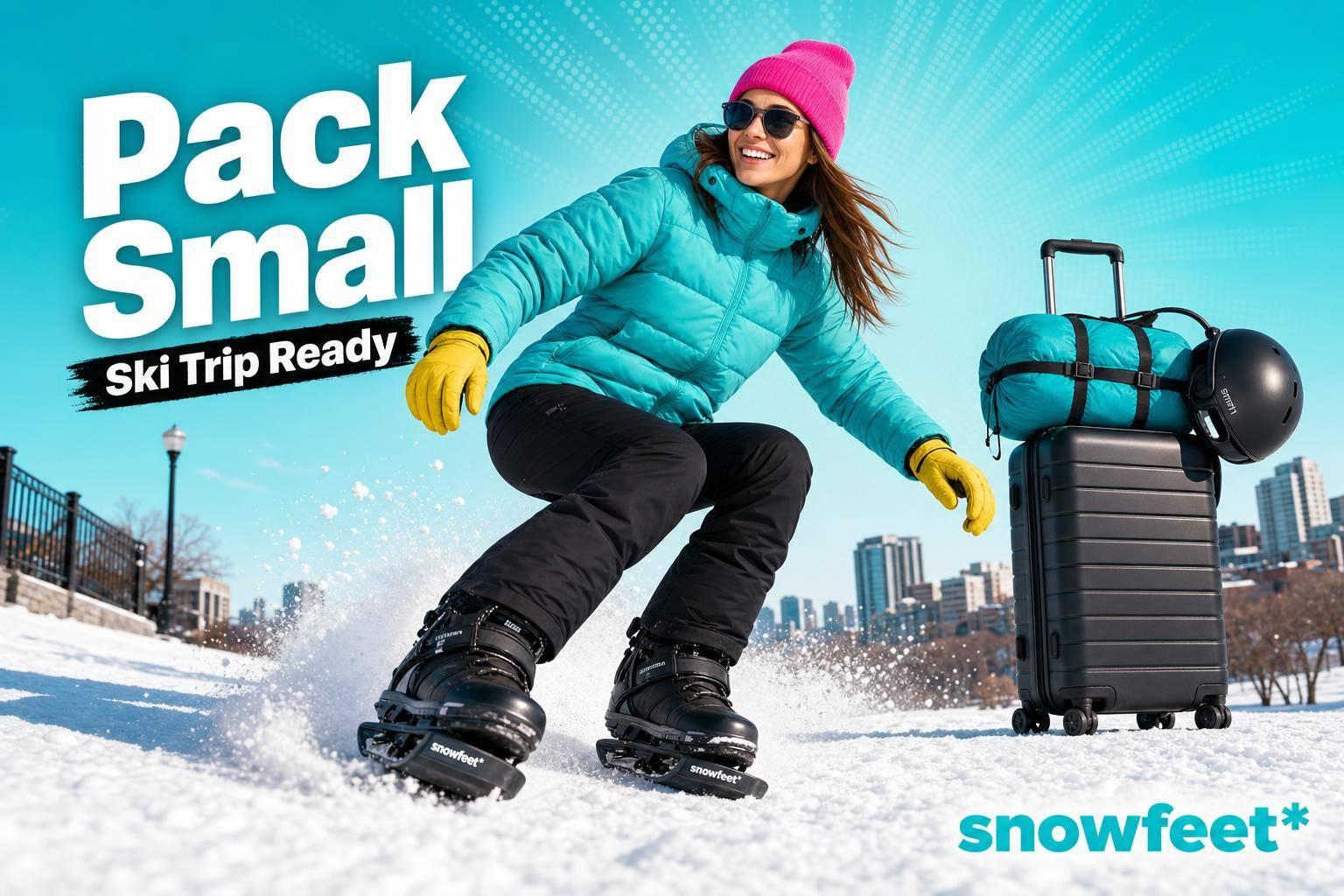
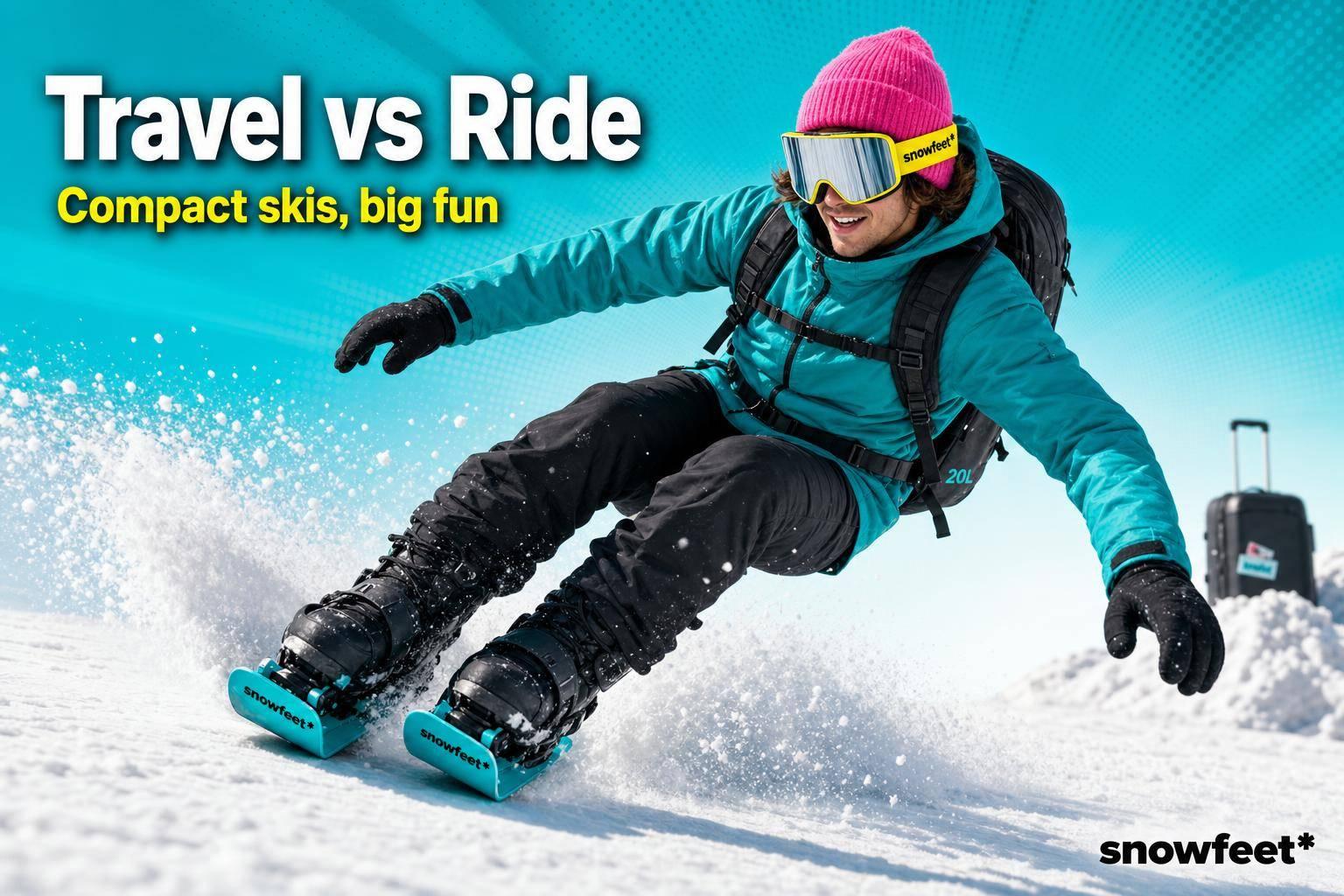
If I want the shortest answer: Snowfeet* beats standard skis for travel. Full skis are usually 150–190 cm (about 5–6.5 ft), while Snowfeet* models run from 38 cm to 65 cm (15–26 in). That means less bulk, less airport pain, and a much better shot at fitting your gear into a backpack, carry-on, duffel, or small car.
Here’s the simple breakdown:
- Best for carry-on travel: Mini Ski Skates (38 cm) at $190
- Best small option with more support: PRO Ski Skates (50 cm) at $299
- Best middle pick: Skiskates (44 cm) at $460
- Best compact option with the most ski-like feel: Skiblades (65 cm) at $590
- Best for speed, steep runs, and powder: Standard skis
And that’s the trade-off in plain English:
- Shorter gear = easier to pack
- Longer gear = more control on snow
- Standard skis = best ride, worst to haul around
For a lot of backpackers, weekend travelers, and road-trippers, that makes Snowfeet* the better fit. You give up some high-speed stability, but you skip the giant ski bag, roof rack drama, and the “why is this thing longer than my couch?” problem :)
Snowboarder tries Snowfeet* | Which Snowfeet* Short Ski is the Best? | Snowblades 44, 65, 99 Review
Quick Comparison
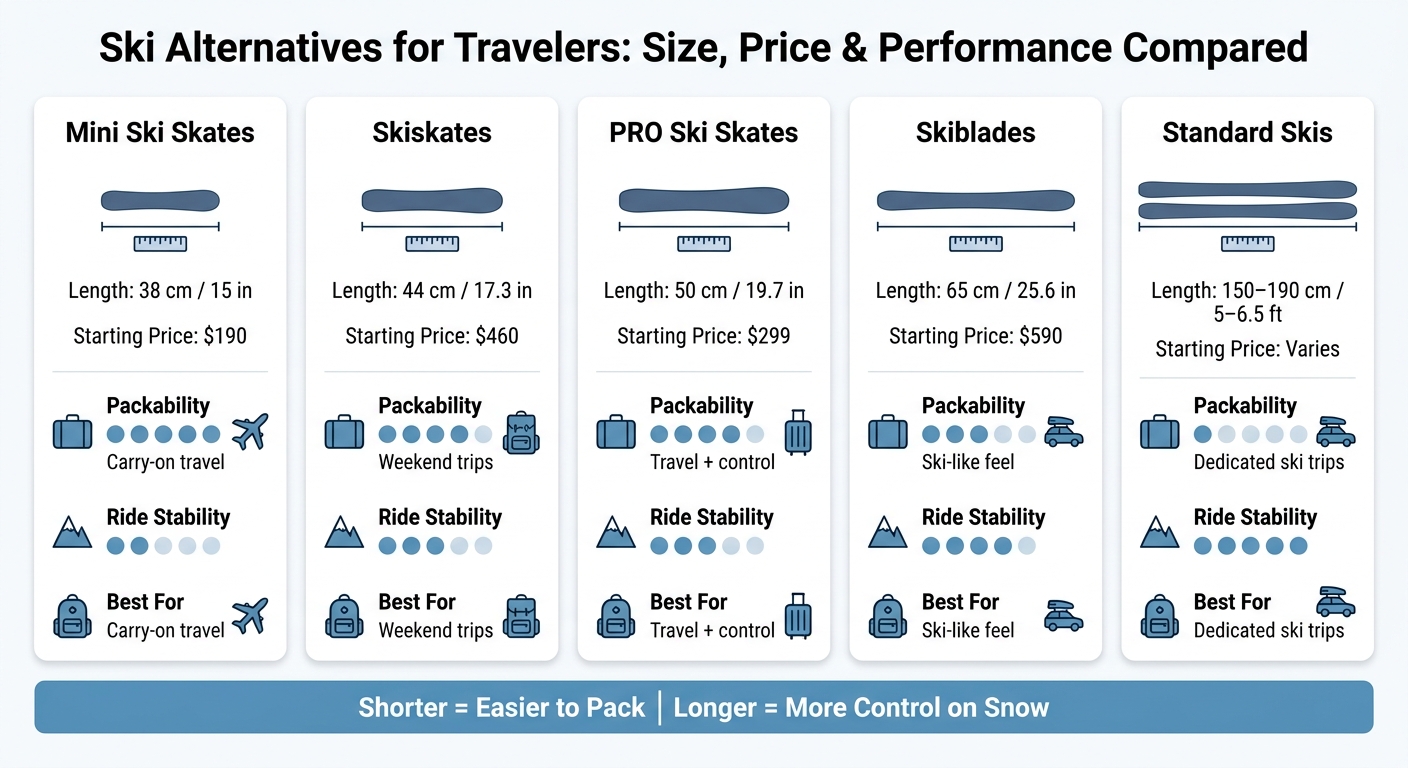
Ski Alternatives for Travelers: Size, Price & Performance Compared
| Option | Length | Starting Price | Best For | Main Trade-Off |
|---|---|---|---|---|
| Mini Ski Skates | 38 cm / 15 in | $190 | Carry-on trips, one-bag travel | Least stable at speed |
| PRO Ski Skates | 50 cm / 19.7 in | $299 | Travel with more support | Still short for steep, icy runs |
| Skiskates | 44 cm / 17.3 in | $460 | Weekend trips, local hills | Not as calm at higher speed |
| Skiblades | 65 cm / 25.6 in | $590 | Most ski-like compact ride | Bigger to pack than other Snowfeet* models |
| Standard Skis | 150–190+ cm / 5–6.5 ft | Varies | Full ski trips, powder, speed | Bulky and harder to travel with |
A few points stood out to me from the article:
- U.S. checked bag fees often start around $30 for the first bag and $40 for the second, each way.
- Full ski setups can also bring oversize baggage issues.
- The 38 cm model can fit in a backpack.
- The 65 cm model is still short enough for many duffels or suitcases.
- Resort rules can vary, so it’s smart to check before you go.
So, if I’m packing light, I’d lean toward the 38 cm Mini Ski Skates or 50 cm PRO Ski Skates. If I want more downhill feel without dragging full skis through an airport, I’d look at the 65 cm Skiblades.
For most travelers, the best ski alternative isn’t “the one that skis best.” It’s the one you’ll want to bring in the first place.
1. Snowfeet* Mini Ski Skates (38 cm)
Pack Size
At 38 cm (about 15 in), the Mini Ski Skates are the smallest Snowfeet* option. That’s the big selling point.
They slide into a carry-on or a 40–45 L backpack without much fuss. Together, they take up about the same space as a pair of hiking boots. You can fit them along the side of a carry-on suitcase and still have room left for clothes and outerwear.
By contrast, alpine skis and poles are a whole different beast. They’re long, awkward, and a pain to haul around. That small size is why these work so well for pack-light trips.
Transit Practicality
These pack neatly for flights, train rides, buses, and small cars. That makes them a smart pick for people bouncing between airports, hostels, and resorts.
If your trip involves lots of moving parts, less gear is a big win :) And with these, you’re not wrestling with a ski bag every step of the way.
Ride Stability
The short platform feels quick and easy to turn. At low to moderate speeds, they’re simple to handle and a lot of fun.
The trade-off is stability. Compared with the 50 cm and 65 cm models, they give you less fore-aft support. On rough, icy, or bumpy terrain, that shorter base can feel less steady. A centered stance and short, controlled movements help make up for it.
Trip Fit
For carry-on-only trips, short laps, and laid-back snow days, the 38 cm Minis make a lot of sense.
They work with winter boots or snowboard boots, which means you can pack less and walk around town in the same pair. That’s handy. Starting at $190, they’re a solid choice if pack size matters most. If you want more stability for steeper runs, the 50 cm PRO Ski Skates are the next move.
2. Snowfeet* PRO Ski Skates (50 cm)
Pack Size
At 50 cm (about 19.7 in), the PRO Ski Skates are 12 cm longer than the 38 cm Minis. That may not sound like much on paper, but on snow, you feel it. They still fit in a backpack, yet they ride with a steadier feel than the 38 cm model.
Transit Practicality
These are easy to carry on flights, trains, and buses. That’s a big plus on multi-leg travel, where bulky gear can turn into a headache fast. They’re small enough to move around with ease, but long enough to feel more secure than the Minis.
Ride Stability
The 50 cm platform is steadier than the 38 cm Minis and still easy to pack. That extra length gives you a more stable feel on groomed runs and local hills, which can help you relax and enjoy the ride more. It hits a nice middle ground: easier riding without giving up the compact size that makes travel simple.
Trip Fit
The PRO Ski Skates are a strong match for weekend road trips, train-to-slope getaways, and city-to-mountain travel where you want real fun without hauling serious gear. They work with ski boots or snowboard boots, starting at $299. So, if you want more support than the 38 cm model but still want gear that’s easy to carry, these make a lot of sense. If you want something even longer for more glide and control, the Skiskates and Skiblades are up next.
3. Snowfeet* Skiskates (44 cm)
Pack Size
At 44 cm (17.3 in), Skiskates sit right in the sweet spot. They feel more stable than the 38 cm Minis, but they’re still way easier to pack than standard skis.
A pair fits diagonally inside a typical carry-on suitcase, with space left for boots and clothes. You can also strap them to the outside of a 40 L hiking backpack, and they won’t poke up above your head like some awkward yard sale setup :) If you want more control than the 38 cm Minis without jumping to the bulk of the 65 cm Skiblades, this is the balanced pick.
Transit Practicality
The 44 cm length fits into standard luggage with little fuss, which helps you skip the pain of checking a full ski bag. That alone can make travel feel a lot less annoying.
The fixed bindings help too. You’ve got fewer loose parts to keep track of, which is nice when you’re rushing through an airport or stuffing gear into a car trunk. Price starts at $460.
Ride Stability
That 44 cm platform gives you more snow contact than the 38 cm Minis, and you feel it. On groomed green and blue runs, the ride feels steadier and less twitchy.
In chopped-up afternoon snow, you can still snap short turns and stop without much drama. But let’s be honest: once speeds climb or the slope gets steep and icy, they won’t feel as planted as the 65 cm Skiblades. So these make more sense on groomed runs at moderate speed. If you want more calm when things get fast, the 65 cm Skiblades have the edge.
Trip Fit
Skiskates hit a nice middle ground for carry-on flyers and weekend travelers who want slope fun without hauling bulky gear. They’re small enough to travel with, but they give you more control than the tiniest options.
Here’s the simple breakdown:
- Want the smallest setup? Look at the 38 cm or 50 cm models.
- Want more stability? Move up to the 65 cm Skiblades.
- Want the middle option? The 44 cm Skiskates make the most sense.
If more glide and a steadier ride matter most, the 65 cm Skiblades are the next comparison.
sbb-itb-17ade95
4. Snowfeet* Skiblades (65 cm)
Pack Size
At 65 cm (25.6 in), Skiblades are the longest Snowfeet* option in this lineup. But let’s keep that in perspective. Standard adult skis are usually 150–185 cm, so these come in at about one-third to two-fifths the length of normal skis.
That’s a big cut in size. They’re still much easier to pack than full skis, and that changes the travel game. You can fit them in a trunk or a duffel without much drama, though they still won’t slide into most backpacks. Pricing starts at $590.
Transit Practicality
This is where Skiblades make life a lot easier. Shorter gear means less mess, less awkward hauling, and fewer “how am I supposed to carry this?” moments. You can skip the roof rack, ditch the long ski bag, and move through stations, stairs, and small cars with far less hassle.
For flights, though, don’t assume they count as carry-on. In most cases, you’ll still need to check them. It’s worth checking your airline’s baggage size rules before heading out. For road trips and train travel, on the other hand, they’re pretty easy to carry and stash away.
Ride Stability
Here’s where the 65 cm length starts to shine. That extra length gives you more edge contact, smoother turns, and better control at speed than the 38 cm, 44 cm, or 50 cm models. On groomed runs, they feel much closer to actual skiing, with steadier turns and better edge hold.
They’re still not a full swap for regular skis in every situation. If you’re going very fast or skiing deep powder, standard skis still win by a fair margin. But for groomed runs, moderate slopes, and day trips, Skiblades give you the closest compact-ski feel in a package that’s still easy to travel with.
Trip Fit
Skiblades make sense if you want something that feels closer to real skis without dealing with full ski logistics. They’re a strong pick for weekend ski trips and short vacations when luggage space is tight, but you still want a familiar downhill ride.
The trade-off is pretty simple:
- Smaller Snowfeet* models are easier to pack
- Skiblades give you more stability and control
- Standard skis still make more sense if speed and powder are your main focus
If you want the closest compact option to a real ski feel, Skiblades land right in that sweet spot. They don’t pack as small as the shorter models, sure, but they give you more confidence once you’re on the snow. That’s often the deal people are happy to make :)
5. Standard Skis
Pack Size
Standard skis are the opposite of the compact Snowfeet* options above. You give up easy packing, but you get top-end on-snow performance.
Most full-length alpine skis measure 150–190+ cm - about 5 to 6.5 feet - based on your height, skill level, and the terrain you ride. They’re long, stiff, and they don’t fold. So, yeah, getting them from place to place can be a bit of a chore.
You’ll need a ski bag, and they’re awkward in airports, hotels, and train stations. They won’t fit in a backpack, a carry-on, or most car trunks unless you fold the seats down.
Transit Practicality
Flying with standard skis usually means checking a ski bag, and that often comes with extra airline fees. Trains aren’t much fun either. On road trips, you’ll often need a roof rack, a ski box, or a big vehicle.
In plain English: they travel like ski gear, not like casual luggage.
Ride Stability
This is where standard skis shine.
Their longer length gives you better edge hold, more stability at speed, and stronger performance on groomers, crud, and powder. That’s why they’re still the benchmark for downhill performance. If your trip is built around skiing, they still earn their spot.
Trip Fit
Standard skis make the most sense for dedicated ski vacations - the kind where you’re staying at a resort for a few days and skiing is the whole point. They work best if you already travel with full ski gear and don’t mind hauling it all.
For weekend getaways, last-minute snow days, or trips where skiing is just one part of the plan, they’re a tougher sell. The gear is heavy, airline fees can stack up, and the trip gets harder before you even click into your bindings.
For dedicated ski vacations, standard skis still fit the classic ski-trip setup.
Next: a quick side-by-side look at portability, ride feel, and travel convenience.
Pros and Cons at a Glance
Here’s the fast, no-fuss comparison of the five options. Put them side by side, and the trade-offs jump out pretty fast.
| Option | Best Advantages | Biggest Limitations | Best Traveler Profile |
|---|---|---|---|
| Snowfeet* Mini Ski Skates (38 cm / ~15 in) | Smallest and easiest to carry; fits in a backpack or carry-on | Less stable at higher speeds; best on gentle slopes | Carry-on-only weekend traveler |
| Snowfeet* PRO Ski Skates (50 cm / ~20 in) | More stable than the 38 cm model while staying backpack-friendly | Less stable than longer skis on steep or icy terrain | Flyer with one checked bag who wants more control on groomed runs |
| Snowfeet* Skiskates (44 cm / ~17 in) | Maneuverable middle ground; fun for skaters and inline skaters | Limited in deep powder; check resort policies in advance | Road-tripper or train rider who wants spontaneous snow sessions |
| Snowfeet* Skiblades (65 cm / ~26 in) | Most ski-like feel in the Snowfeet* lineup; better edge hold and versatility | Longer packed length; needs a checked bag or duffel | Resort day traveler who wants a familiar ski feel without full-length gear |
| Standard Skis (about 150–180 cm / ~5–6 ft) | Best stability at speed; strongest performance in varied conditions | Bulky; requires checked baggage or oversize handling | Dedicated ski vacationer staying multiple days at a resort |
A few quick takeaways:
- Mini Ski Skates are the easiest to travel with. Toss them in a backpack and go.
- PRO Ski Skates give you a bit more control without turning your packing plan into a mess.
- Skiskates sit in that fun middle zone, especially if you already like skating.
- Skiblades feel closest to regular skis, but they take more room.
- Standard skis still win for speed and mixed conditions, though they’re a pain to haul through airports.
One thing you don’t want to miss: check resort rules before you go. Some resorts restrict very short boot-mounted devices.
Price matters too. Snowfeet* options run from $190 for Mini Ski Skates up to $590 for Skiblades. Standard skis often end up costing more once you add boots, poles, and a ski bag.
Next: which option fits your travel style best.
Final Pick by Travel Style
Pick based on how you travel and how you want the ride to feel.
Flying light? Go with Mini Ski Skates (38 cm). They’re the best fit for airline travel. If you want a touch more stability without giving up packability, PRO Ski Skates (50 cm) are still easy to bring along.
Taking trains, buses, or traveling with one pack? Mini Ski Skates (38 cm) fit best. They’re small, simple to carry, and don’t turn your trip into a gear-hauling mission.
Heading to a local hill or chasing a last-minute snow day? Skiskates (44 cm) are the sweet spot for quick car trips. If you want more of that carving feel on steeper runs, move up to the Skiblades (65 cm).
Just starting out? Start with Mini Ski Skates (38 cm) or Skiskates (44 cm). Shorter gear is easier to turn, stop, and control at low speeds. That makes the first few days a lot less intimidating. Stick to gentle, packed slopes while you get comfortable.
Want the most ski-like ride? Pick the Skiblades (65 cm). They give you the closest thing to a ski feel while still staying compact.
| Travel Style | Best Pick | Starting Price |
|---|---|---|
| Airline travel | Mini Ski Skates (38 cm) | $190 |
| Backpacker with one pack | Mini Ski Skates (38 cm) | $190 |
| Local hills and spontaneous days | Skiskates (44 cm) | $460 |
| Beginner-friendly fun | Mini Ski Skates or Skiskates | $190–$460 |
| Most ski-like ride while still compact | Skiblades (65 cm) | $590 |
For most backpackers and casual travelers, Snowfeet* is the practical choice: smaller, easier to carry, and more fun to travel with than standard skis.
FAQs
Do I need ski boots for Snowfeet*?
No. Most Snowfeet* products, including Mini Ski Skates and Snowfeet PRO, work with your regular waterproof winter boots or snowboard boots.
That means you can skip buying extra boots and avoid hauling more gear around. Nice and simple :)
Some larger models, like Skiblades or certain Skiskates versions, can also work with ski or snowboard boots if you want more stability. But they’re not required.
Are Snowfeet* allowed at every ski resort?
Snowfeet* products are allowed at nearly all U.S. ski resorts because they include metal ski edges, which helps them meet common safety rules.
That’s a big deal. Many resorts check for this kind of feature before they allow gear on the slopes.
Their small size is another plus. Since you use them with standard winter boots, they’re an easy, travel-friendly option compared with full-size skis at most destinations.
Which Snowfeet* size is best for beginners?
For beginners, the Mini Ski Skates in 38 cm and 50 cm are the easiest place to start. They’re simple to turn, easy to handle, and a great fit for learning on bunny hills.
If you want something that feels a bit closer to regular skiing - but in a shorter, less intimidating size - the 65 cm Skiblades are also a strong pick.
Across the board, all of these options are agile, easy to control, and simpler to learn on than long skis.











Efterlad en kommentar
Denne side er beskyttet af hCaptcha, og hCaptchas Politik om beskyttelse af persondata og Servicevilkår er gældende.