



















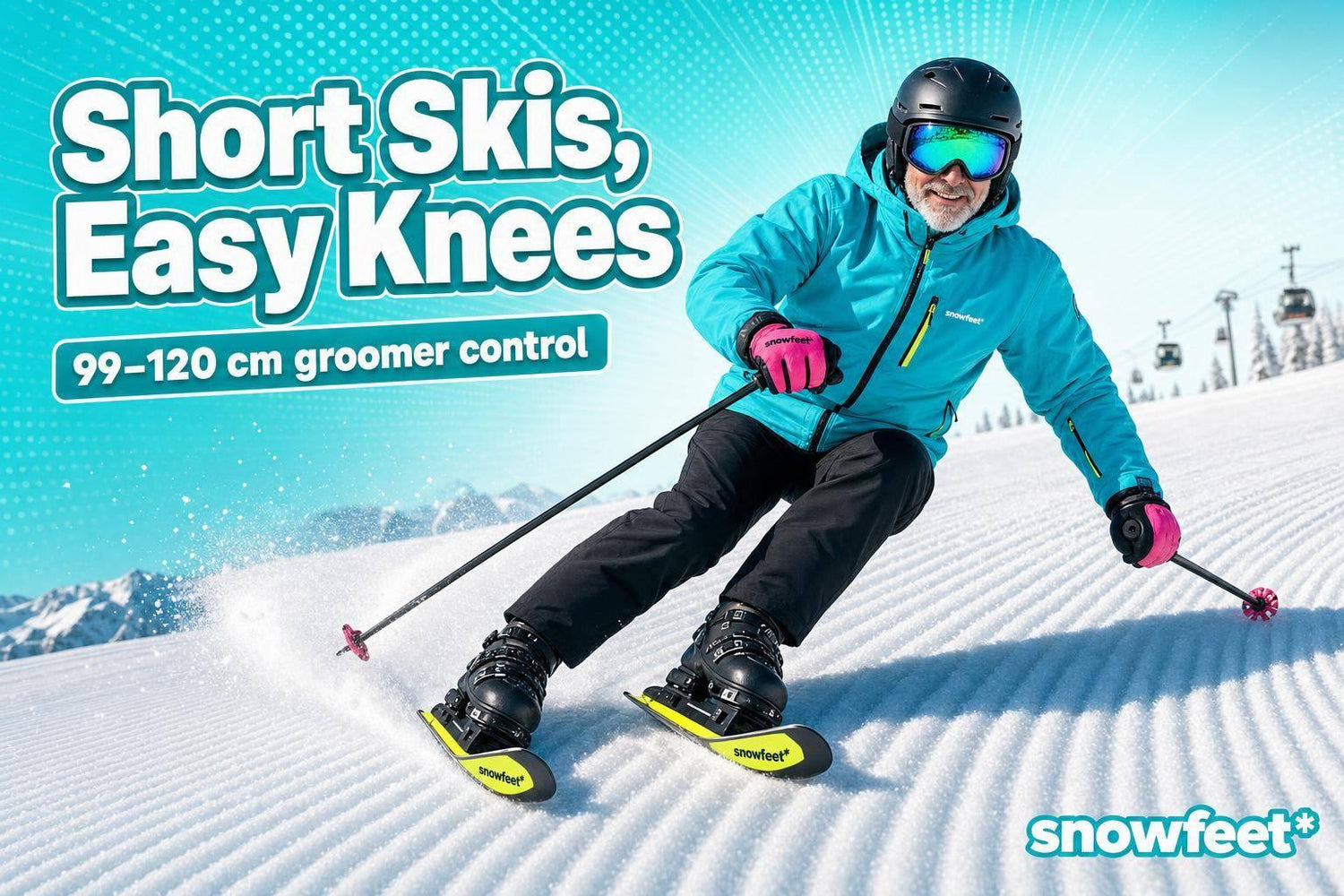
If your knees complain before lunch, ski length matters. My short take: for most older resort skiers, 99 cm skiblades or 120 cm short skis hit the best middle ground between lower knee load, easy turns, and enough calm on groomers.
Here’s the simple version:
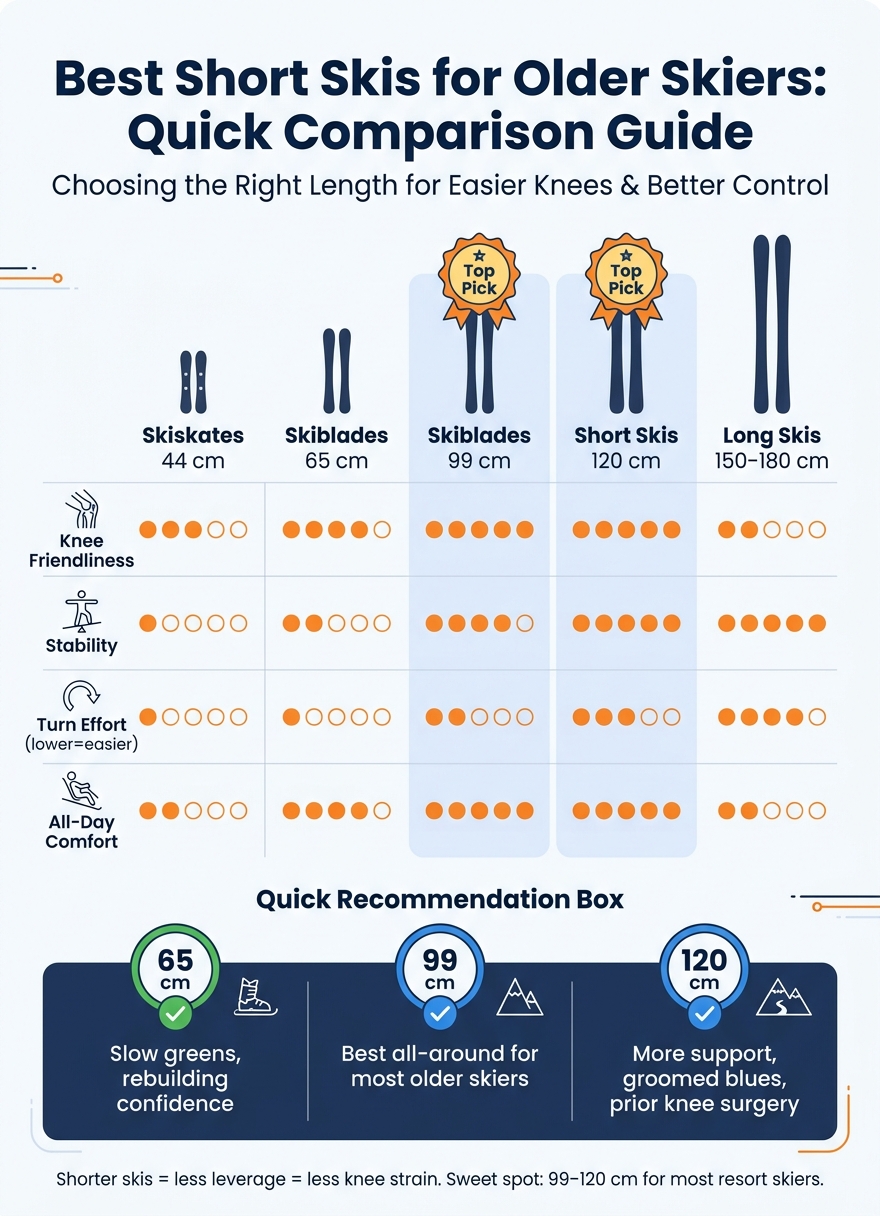
- 44 cm skiskates: fun, light, and easy to swing around, but not for all-day skiing
- 65 cm skiblades: a nice pick for slow green runs and getting confidence back
- 99 cm skiblades: my top all-around choice for many older skiers
- 120 cm short skis: the best bet if you want more support and a more familiar ski feel
- 150–180 cm full-size skis: more calm at pace, but more work on the legs and knees
- Bigfoot/Figl, Salomon-style snowblades, and ODR ski skates: useful reference points, but most older skiers will likely have an easier time on the Snowfeet* options listed above
One sports medicine source cited in the article says shorter, shaped skis with shorter tails can make turning easier and cut knee strain. That lines up with what many skiers feel on snow: less ski length often means less leverage, less twisting force, and less fatigue by the last run.
If I had to make this easy:
- Pick 65 cm if you ski slow and want simple turns
- Pick 99 cm if you want the best mix of ease and control
- Pick 120 cm if you want more support, more calm, and groomer-focused days
Best Short Skis for Older Skiers: Quick Comparison Guide
Best Skis for the Elderly? | Are Short Skis Better for Older Skiers?
Quick Comparison
| Option | Best For | Knee Friendliness | Stability | Turn Effort |
|---|---|---|---|---|
| Snowfeet Skiskates 44 cm* | Short, playful laps on easy groomers | Medium | Low | Very low |
| Snowfeet Skiblades 65 cm* | Greens, easy blues, lower confidence skiers | High for short sessions | Low-Medium | Very low |
| Snowfeet Skiblades 99 cm* | Most older resort skiers | High | Medium-High | Low |
| Snowfeet Short Skis 120 cm* | Groomed blues, calmer skiing, more support | High | High | Low-Medium |
| Long skis 150–180 cm | Faster skiing and mixed snow | Medium-Low | Very high | Medium-High |
| Bigfoot/Figl 60–80 cm | Low-speed fun | Medium | Low | Very low |
| Salomon-style snowblades 75–99 cm | Old-school short-ski feel on groomers | Medium | Medium-Low | Low |
| ODR-style ski skates | Firm groomers and niche use | Low for full days | Low | Low |
So, if you want the short answer: go shorter to cut effort, but not so short that the ski feels nervous for the way you ride. For many older skiers, that sweet spot is 99 cm or 120 cm. Simple :)
If you want a bit of visual help before you buy, these YouTube searches can help:
1. Snowfeet* Skiskates 44 cm
At 44 cm (17 in), Skiskates are the shortest Snowfeet* option. They turn with very little effort and keep leverage low under your feet. For some older skiers, that lighter feel can be easier on the knees. The trade-off is simple: you give up some calmness at speed.
Knee Strain
Because the platform is so short, there’s less leverage underfoot. That makes Skiskates feel light, quick, and easy to guide. If you want less knee stress and don’t want to muscle your turns, that can be a nice match.
Stability at Speed
These are made for agility and control, not for bombing straight down the hill. At slow to moderate cruising speeds, they feel stable and responsive. Push the pace, though, and the short platform can start to feel less planted. So, they make more sense for relaxed laps than fast, wide-open runs.
Turn Effort
This is where Skiskates shine. Their super short length makes them very maneuverable and gives them a skate-like feel, which many former hockey players and inline skaters tend to like. One thing matters a lot: stay centered over the skis. If you lean back, they can feel twitchy and put more load on your knees.
Terrain Fit
Skiskates work best on gentle to moderate groomed runs where you can keep things smooth and relaxed. They’re less fun on steep, icy, or chopped-up terrain, and they feel less secure as speed climbs. Most resorts allow them if they have metal edges and standard bindings.
Official Snowfeet* listings show Skiskates 44 cm starting at $460, with pricing based on the binding setup. If you want more stability and a bit more range on the mountain, the 99 cm or 120 cm Snowfeet* models are the next step.
If you want a little more stability but still want easy turning, the 65 cm Skiblades are the next size up.
2. Snowfeet* Skiblades 65 cm
At 65 cm (26 in), the Snowfeet* Skiblades land right between tiny skates and full skis. They’re a step up from the 44 cm Skiskates, and you can feel it fast. They ride with a calmer, more ski-like feel, but they still turn with very little effort. With a 4 m sidecut radius and a shape made for quick direction changes, this model leans toward snappy turns, not bombing downhill at top speed.
Knee Strain
Because they’re short, they don’t put as much leverage on your legs. That means less twisting force in turns than you’d get from full-length skis. For older skiers, or anyone whose legs fade early, that can be a nice break.
Stability at Speed
They feel more settled than the 44 cm Skiskates. Still, they won’t feel as planted as the 99 cm or 120 cm models once speed picks up. So, if you like a calm ride but don’t want a long ski, this sits in a middle zone.
Turn Effort
This is where the 65 cm Skiblades shine. They’re very easy to start and finish in a turn. Small movements usually do the job. That’s a big plus for skiers with less leg strength, slower reaction time, or lower confidence. They also make a lot of sense in tight spots, like narrow groomers or busy runs where fast direction changes matter.
Terrain Fit
They work best on groomed runs and mild bumps. The metal edges help them hold on firmer snow, and the graphite bases help them glide better.
They cost about $490 and weigh 3.8 lbs per pair with ski bindings. That’s much lighter than a full ski setup.
If you want a bit more stability without going all the way to full-length skis, the 99 cm Skiblades are the next move.
3. Snowfeet* Skiblades 99 cm
At 99 cm (about 39 in), the Snowfeet* Skiblades hit a sweet spot for older skiers. You get the best mix of stability and easy turning. This is the first Snowfeet* model that gives you solid support underfoot without feeling like a full-length ski. Put simply, it sits right between the quick, nimble short blades and the more planted 120 cm model.
Knee Strain
The 99 cm length feels more settled than the 44 cm and 65 cm models, but it’s still much shorter than standard skis. That shorter length means less leverage and less stress through the knee joint. The main thing? Keep your edging smooth and gradual. Sudden edge changes can twist the knee.
Stability at Speed
At normal resort speeds, the 99 cm feels stable and under control. It has enough length to calm things down, but not so much that it starts to feel like a chore. If you ski FAST on a regular basis, longer skis still give you more straight-line support.
Terrain Fit
These work best on groomed runs, mainly blue and black terrain. That’s where they feel the most at home.
If you want more help in soft snow, Snowfeet* also makes a Powder 99 cm version. It has:
- A wider profile for more float
- A parabolic shape to help in softer conditions
- A cambered base for edge grip
If you want more support for faster skiing or rougher snow, the 120 cm model is the better next step.
4. Snowfeet* Short Skis 120 cm
At 120 cm (47 in), this is the longest Snowfeet* model, and it feels the most like a regular ski. If you want a calmer ride on the hill but still like the easy turning of short skis, this is the Snowfeet* pick that makes the most sense.
Knee Strain
That 120 cm length gives you more running surface underfoot, so your weight spreads out better. On rough or mixed snow, that helps the ski track in a smoother way. The soft flex and sidecut also help the ski enter turns without asking as much from your knees.
There’s one big tip here: go with slightly slower, rounded turns instead of quick, sharp ones. If you force very tight turns with a high edge angle, you can send more leverage into the knees. Think smooth arcs, not snap turns. Your knees will thank you :)
Stability at Speed
At cruising speed, the 120 cm version feels steadier than the 99 cm model. That said, it still won’t feel as planted as a full-length ski once speeds climb. You get more edge contact, which helps on medium-radius turns and gives you better grip on somewhat firmer snow.
That extra calm can also help with fatigue over a full day. You’re not working as hard to keep things under control, and that matters more than people think. It lands in a nice middle ground between quick skiblades and regular skis.
Terrain Fit
These skis shine on groomed green and blue runs, and they do a solid job in light chopped-up snow too. The added length helps them cross small ruts and move through loose snow piles with less drama than shorter blades. The shorter tail also makes them easier to pivot, which can save you when you get a little off balance.
Where they start to hit their limit is pretty clear:
- Deep powder
- Heavy crud
- Big moguls
In those conditions, the tips can dive, and the ski gets bounced around more than a longer, wider all-mountain ski would. If the hill gets steeper, faster, or more mixed, full-length skis still hold the upper hand. And if you want more speed stability or a more standard ski feel, the next comparison is full-length skis.
sbb-itb-17ade95
5. Traditional Long Skis
Full-length skis are the baseline here. They give you the most stability, but they also ask more from older knees. Longer skis create more torsional load, which can increase ACL risk in turns and rotational falls. That’s the trade-off: as ski length goes up, knee strain tends to go up too.
Compared with Snowfeet's shorter models, full-length skis feel calmer in one main situation: smooth snow and moderate speed. On firm blue or easy black runs at moderate to fast speeds, they feel more planted and show less chatter. For older skiers who still enjoy cruising, that steady feel can be a nice plus.
The catch? Longer skis take more work to turn. You feel it most at low speeds and in tight spots, where quick direction changes matter. And this isn’t just a short-ski sales pitch - even within standard skis, going shorter helps. Programs for older skiers found that shorter traditional skis, around 150–160 cm, improved balance, control, confidence, and fatigue without giving up stability in bumps and powder.
Full-length skis still do a good job on groomers, mixed snow, and moderate off-piste terrain. But over a full day, they ask for more effort. For older skiers who want a more relaxed, lower-strain day on the mountain, that extra terrain range may not pay off. Snowfeet-style short skis cover the resort terrain most people use, with less load on the knees.
For a shorter, easier-turning option, the next comparison is Bigfoot/Figl.
6. Bigfoot/Figl Short Skis
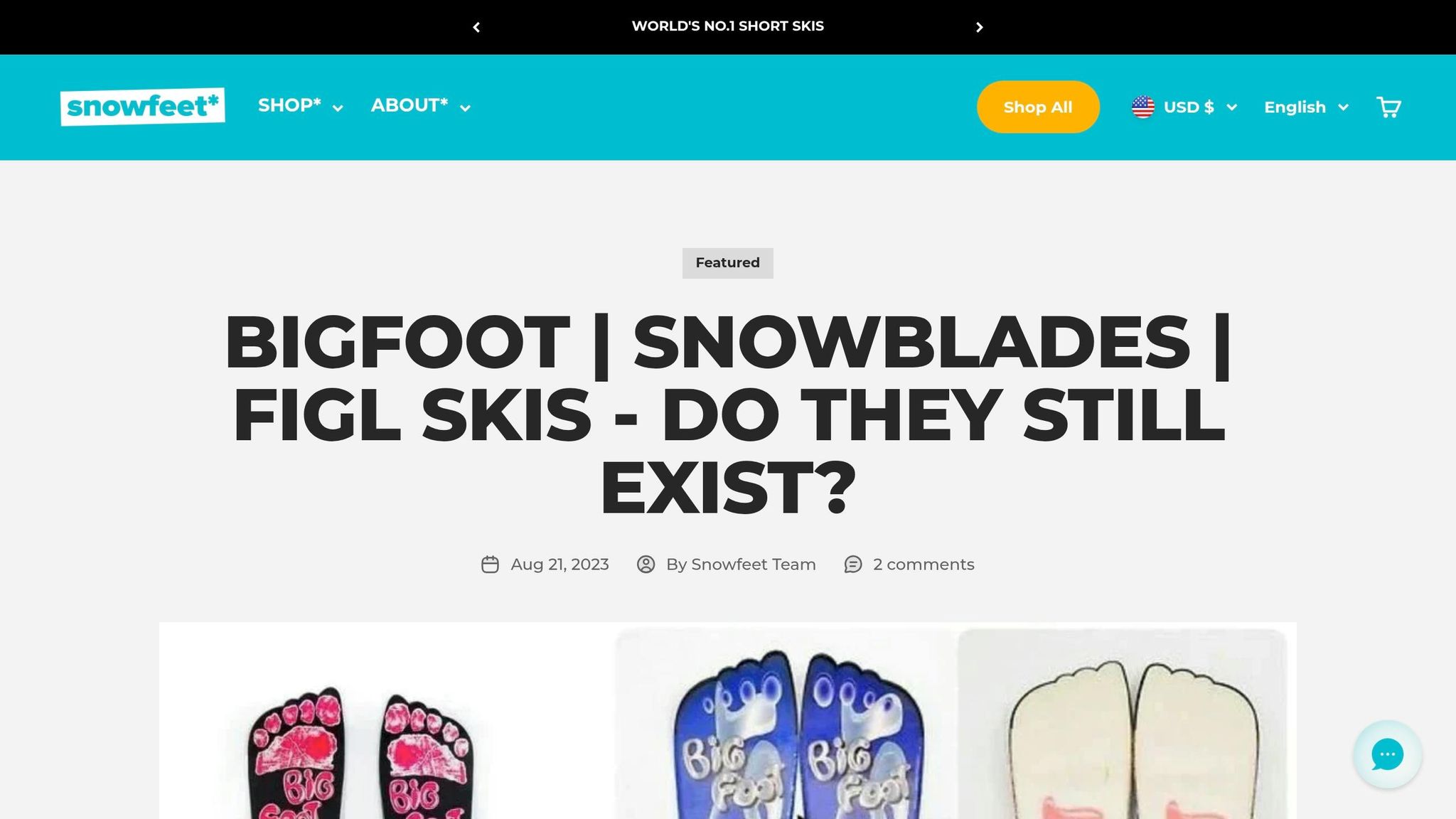
Next up: Bigfoot/Figl short skis.
Compared with Snowfeet* options, Bigfoot and Figl sit in the older short-ski camp. Think of them as more of a retro reference point now than a go-to modern setup. They usually come in at about 60 to 80 cm (24–31 in), and their deep sidecut helps make carved turns easier at lower speeds. That’s why older skiers still bring them up when they start looking at shorter skis.
Knee Strain
Shorter skis create less leverage, so they can feel easier on the knees during slow, controlled skiing. That part is a plus.
But Bigfoot-style skis come with a catch. They can pull into a turn on their own, mainly on harder snow. If one hooks up out of nowhere, you get a sharp edge catch and a twisting force that can put stress on the knee. For cautious skiers - or anyone who feels a bit shaky now and then - that’s not great.
Stability at Speed
This is where Bigfoot/Figl skis start to show their ceiling.
With less ski on the snow and less support from tip to tail, they can feel twitchy on faster groomers, uneven snow, or steeper slopes. Fun at mellow speeds? Sure. Calm and planted once things pick up? Not so much.
Older skiers will usually feel best on these at low to moderate speeds and on easy terrain.
Turn Effort and Terrain Fit
Turning is easy. Almost too easy, in a way.
That light, quick pivot is the main draw. Bigfoot-style skis can be a blast for short turns, quick direction changes, and playful laps on groomers. They feel nimble, kind of like driving a tiny car in a tight parking lot - super easy to swing around.
The downside is control. It’s harder to hold a smooth carve with the same consistency, and these skis don’t do well in chopped-up snow or mixed conditions. Once the surface gets messy, things can get a little sketchy.
Compared with Snowfeet* Skiblades, Bigfoot/Figl skis feel less polished and less predictable for older riders. Snowfeet* gives you clearer size options, better balance, and more control. For most casual skiers, that makes Snowfeet* the better pick.
If you want more stability than any short ski can give, the next comparison is full-length skis.
7. Salomon-Style Snowblades
Salomon-style snowblades are the old-school short-ski reference point for many older skiers. Models like the Snowblade, SB9, and PR7 usually measured about 90–99 cm (35–39 in) and came with deep sidecut plus bindings that worked with ski boots. In terms of size and use, they’re closer to the Snowfeet* 99 cm and 120 cm models than to full-length skis, but they have more of that classic, throwback feel.
Knee Strain
Here’s the catch: damping is the weak spot. The foam core and narrow platform soak up less vibration on firm snow, so rough hardpack can feel harsher on your legs. On soft groomers, that’s often fine. Hit choppy hardpack or crud, though, and knee strain climbs fast.
Stability at Speed
At low to moderate speeds, these snowblades feel solid on green runs and easy blue groomers. Push the speed up on steeper blues or faster sections, and the short running length starts to chatter and feel twitchy. And it happens sooner than with Snowfeet* 99 cm and 120 cm.
Turn Effort and Terrain Fit
The deep sidecut helps a lot with steering, but these are less forgiving than Snowfeet* when your stance gets sloppy. You need to stay centered. Lean too far back or too far forward, and they’ll let you know in a hurry.
They make the most sense on groomed green and blue runs. In deep powder, heavy crud, or long mogul sections, they’re a tougher ride. The short, narrow platform doesn’t give you much float, and it can start to feel tiring and a bit unpredictable.
That’s the big reason Snowfeet* 99 cm and 120 cm tend to suit most older casual skiers better: you still get that easy-turning feel, but with steadier balance and less punishment when your stance drifts.
If you want something even shorter and more skate-like, the next comparison is ODR-style ski skates.
8. ODR-Style Ski Skates

ODR-style ski skates are another ultra-short pick. In size, they’re closest to Snowfeet* Skiskates 44 cm. But when it comes to where and how you can use them, they don’t match the same range. These skates use a one-piece boot-and-ski setup with steel edges, and they stay in a narrow, control-first lane.
Knee Strain
The small build looks easy on the body, but that doesn’t mean it feels easy after a few runs. User reports mention more leg and foot fatigue than you might expect from something this short.
Stability at Speed
ODR skis top out sooner than full-size skis. One user said they start to feel unstable at around 30–35 mph. That may be fine for mellow cruising. Push past that, though, and their limits show up fast.
Turn Effort and Terrain Fit
They do fine on firm groomers, which is where they make the most sense. But the boot-ski design gives them a tighter use case than Snowfeet*. They’re not made for high speed or powder, so they fit controlled runs better than hard-charging all-mountain skiing.
For many older skiers, Snowfeet* Skiskates 44 cm hit a better middle ground. You still get that easy-turn feel, but with a setup that works in more situations. Compared with Snowfeet* Skiskates 44 cm, ODR-style ski skates offer less range for older recreational skiers.
That limited range sets up the real trade-off for older skiers: easy steering versus all-around comfort.
Pros and Cons for Older Skiers
After the detailed breakdown above, this table puts the trade-offs side by side. For older skiers, the choice often comes down to comfort vs. speed confidence. Match ski length to your knees, balance, and the pace you like.
| Skiskates 44 cm | Skiblades 65 cm | Skiblades 99 cm | Short Skis 120 cm | Traditional Long Skis | Bigfoot/Figl | Salomon-Style Snowblades | ODR-Style Ski Skates | |
|---|---|---|---|---|---|---|---|---|
| Biggest advantage | Ultra-light, playful, low-speed fun | Compact, easy pivoting, low intimidation | Good balance of control and easy turning | Stable at moderate speed, confident carving | Best at speed and edge grip | Very easy turning, low-speed fun | Quick turns, gentle on knees at moderate pace | Agile, compact, precise stops on hardpack |
| Biggest drawback | Twitchy on hard snow, limited edge grip | Nervous at higher speeds, limited rough-snow stability | Less grip on ice than traditional skis | More thigh and knee effort in deep or heavy snow | Heavy, hard to pivot at low speed, more tiring | Chattery on hardpack, poor at speed | Loses composure on icy or fast runs | Very limited range; tiring over a full day |
| Best for knee sensitivity | ❌ Too demanding for all-day groomer use | ❌ Better for short sessions than full days | ✅ Strong choice - smooth turns, low swing weight | ✅ Strong choice - predictable, less defensive movement | ⚠️ Works if technique is solid and length is conservative | ⚠️ Lacks damping and edge grip of modern short skis | ⚠️ Decent, but less refined than Snowfeet* options | ❌ Not suited for full-day skiing with knee pain |
| Best for confidence | ✅ Great for gentle slopes, low-speed relearning | ✅ Easy progression from green to easy blue runs | ⚠️ Good, but slightly more commitment needed | ✅ Familiar ski feel, easier than full-length skis | ⚠️ Only if technique is already solid | ⚠️ Fun but can feel unpredictable on harder snow | ⚠️ Approachable, but less refined than Snowfeet* options | ⚠️ Niche feel; not ideal for rebuilding general ski skills |
| Best for faster resort skiing | ❌ Not designed for speed | ❌ Feels unstable past slow speeds | ⚠️ Handles moderate speeds, not high | ✅ Best Snowfeet* option for speed-oriented older skiers | ✅ Best at speed and edge grip | ❌ Chattery and unstable at speed | ⚠️ Handles moderate resort speeds only | ❌ Not intended for faster resort skiing |
Snowfeet* Skiblades 99 cm and Short Skis 120 cm cover the widest range for older skiers. They offer easier turns, solid stability, and less knee strain than long skis. If you want a setup that feels easier without feeling sketchy, those two sit in the sweet spot.
Final Recommendation
For most older U.S. resort skiers, Snowfeet* Skiblades 99 cm or Short Skis 120 cm are the best picks. They tend to feel easier on the knees, more steady on groomed blue runs, and more forgiving when you're getting your rhythm back. If you spend most of your day on mellow green runs, 65 cm Skiblades can be a fun, low-stress choice.
The big thing isn’t just ski length. It’s how you turn. Smooth, rounded turns are usually kinder to the knees than sharp, rushed movements. And once fatigue kicks in, call it. Pushing into hard terrain when your legs are cooked is a bad bargain.
Use this quick guide if you want the short path to the right length.
| Rider Type | Knee Sensitivity | Typical Terrain | Best Snowfeet* Length |
|---|---|---|---|
| Cautious beginner or late-life learner | Mild | Greens, slow zones | 65 cm Skiblades |
| Returning intermediate, moderate fitness | Occasional soreness | Blue groomers, easy bumps | 99 cm Skiblades |
| Confident older skier, prior knee surgery or significant knee issues | Significant | Blues, groomed runs only | 120 cm Short Skis |
| All-mountain skier, still fit, high speed | Mild to moderate | Blues, blacks, mixed conditions | 120 cm Short Skis |
For most older casual skiers, the 99 cm and 120 cm Snowfeet* models are the strongest all-around options.
That said, longer standard skis are still the better call if you ski steep black runs, move at higher speed, or spend time in mixed off-piste snow. For a strong, skilled skier, that extra steadiness can be easier on the knees than trying to control shorter skis in rough terrain.
If you’re not sure, demo first. Start with the more stable length.
FAQs
How do I choose between 99 cm and 120 cm skis?
Pick based on what matters more to you: quick, nimble turns or more planted, stable skiing.
The 99 cm Skiblades are the best middle-ground pick. They feel balanced on the snow and work well for carving, light powder, and fast direction changes. If you want one option that does a bit of everything, this is the safe bet.
The 120 cm Short Skis feel closer to regular skis. They give you more stability when your speed picks up, and they do better in deeper snow. At the same time, they still feel less clunky than standard 160–180 cm skis.
Are short skis really easier on bad knees?
Yes. Short skis are usually easier on the knees and other joints than long skis. The main reason is simple: they create less leverage in turns, so there’s less mechanical strain on your body.
Snowfeet* models are also lightweight, which helps a lot. They support a more natural, upright stance, and that can take some pressure off the knees, hips, and lower back. On snow, that often means turns feel quicker, smoother, and less like your legs are getting into an argument with the mountain :)
Should I demo short skis before buying?
Generally, no. Snowfeet short skis are built to feel natural from the start, so most people get the hang of them in a day. Some click with them in as little as five minutes.
Compared with long skis, they’re lighter, easier to control, and much simpler to turn and stop. That takes a lot of the pain out of the learning curve and makes those first runs feel a lot less intimidating.











Zanechte komentář
Tento web je chráněn službou hCaptcha a vztahují se na něj Zásady ochrany osobních údajů a Podmínky služby společnosti hCaptcha.