



















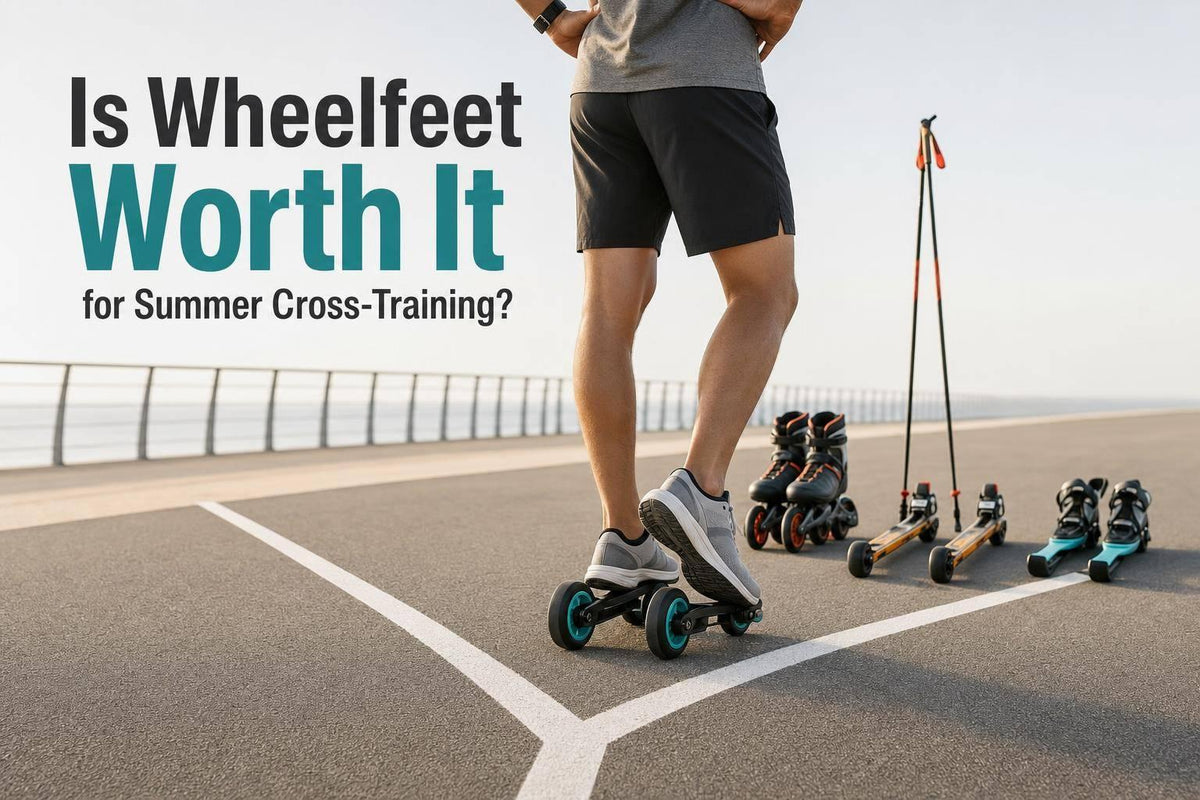
Short answer: usually no. At $199, I’d only pick Wheelfeet if you want portable balance drills on smooth pavement. If you want better cardio, go with inline skates. If you want XC ski carryover, go with roller skis. If you want more snow feel and a small setup, Snowfeet* makes more sense for most riders.
Here’s the fast take:
- Wheelfeet: best for short balance sessions, not long workouts
- Inline skates: best mix of cardio, edging, and price
- Roller skis: best for serious Nordic training
- Snowfeet*: best for casual alpine skiers and snowboarders who want more time on snow
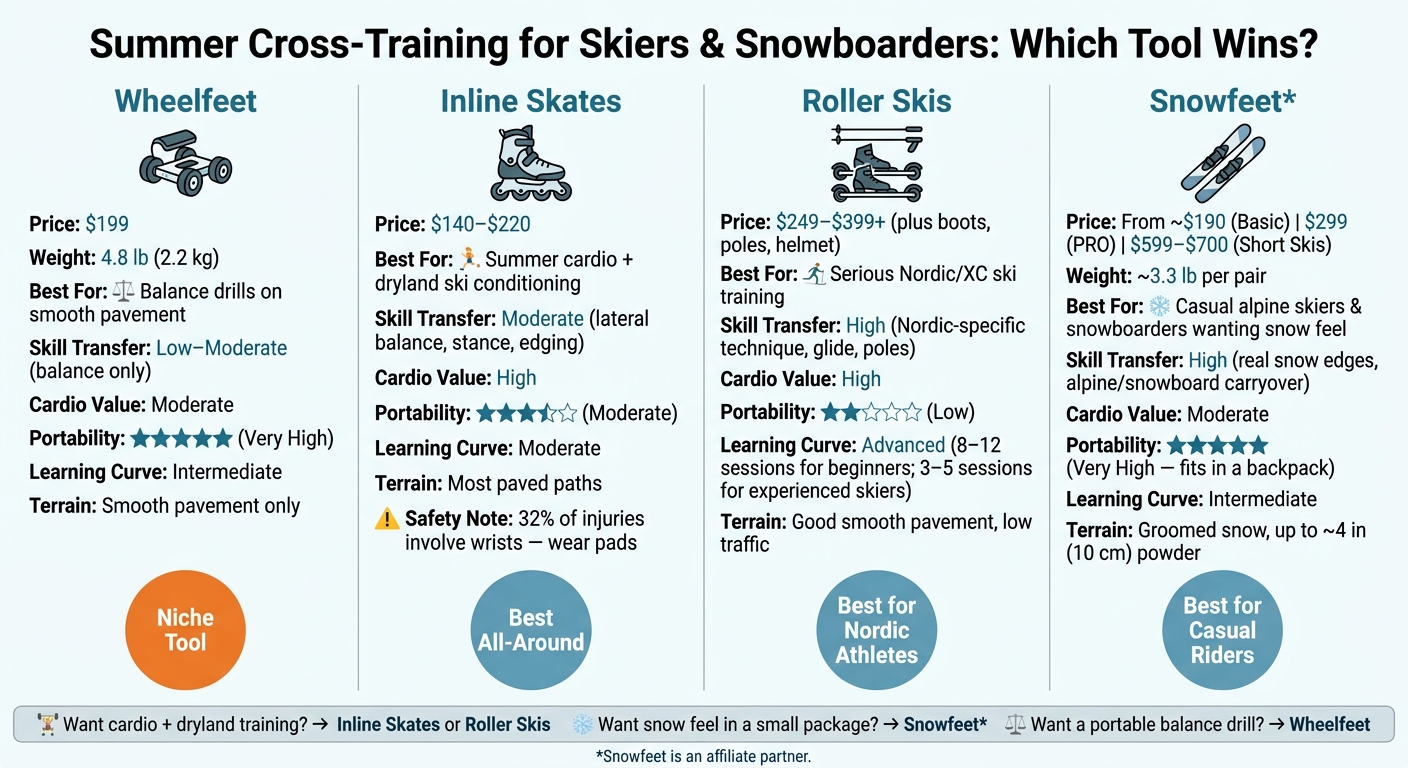
A few numbers tell the story:
- Wheelfeet: $199, about 4.8 lb
- Inline skates: about $140–$220
- Roller skis: about $249–$399+
- Snowfeet*: about $190 and up
- Inline skating injuries: 32% involve the wrist, so pads matter
Wheelfeet vs Inline Skates vs Roller Skis vs Snowfeet: Summer Cross-Training Comparison
Wearable Skates | Roller Blades | Skate on Shoes | Wheelfeet | Non-electric
Quick Comparison
| Option | Best for | Main upside | Main downside | Price |
|---|---|---|---|---|
| Wheelfeet | Balance drills | Small, easy to carry | Weak ski feel, smooth pavement only | $199 |
| Inline skates | Cardio + dryland ski work | Good leg work and edge-like movement | Needs clean pavement | $140–$220 |
| Roller skis | Nordic skiers | Closest match for XC technique | Hard to learn, route limits, more gear | $249–$399+ |
| Snowfeet* | Casual winter riders | On-snow edge feel in a small package | Needs snow access | $190+ |
If I had to sum it up in one line, it’d be this: Wheelfeet is a niche tool, not the best all-around summer cross-training buy. It has a place, sure, but for most people, one of the other three options will give you more use for the money.
If you’re curious what that means for your own setup, here’s my plain-English take:
- Pick Wheelfeet if you want a small balance trainer
- Pick inline skates if you want summer fitness and skill work
- Pick roller skis if you train XC with purpose
- Pick Snowfeet* if you want more direct winter carryover without hauling big gear around
So, yeah, Wheelfeet isn’t bad. It’s just for a pretty small group of riders :)
1. Wheelfeet
For winter athletes, the main payoff here is balance work, not true ski technique. Wheelfeet helps with balance and side-to-side weight shift, but it doesn’t copy real edging or carving pressure. So, yeah, it can help you stay a bit sharper in the off-season, but it’s not going to feel like skiing.
It works best on smooth pavement, flat paths, and empty lots. At about 4.8 lbs (2.2 kg), it straps over your shoes, so you don’t have to deal with a separate boot. That’s a nice plus if you want something small and easy to carry. But let’s be honest: spec claims only go so far. Once the ground gets rough or uneven, Wheelfeet becomes a poor pick outside smooth pavement.
You’ll feel it in your quads, calves, and stabilizers. That said, it’s better for short drills than long workout sessions. Think quick balance practice, not a big summer cardio day.
At $199, Wheelfeet makes sense only if you have smooth space to practice and want a portable balance tool. If ski-like carryover matters more than portability, Snowfeet* is the better off-season buy. And if you want more glide, better speed control, and a stronger all-around summer workout, inline skates are the next move.
2. Inline Skates
Inline skates have been part of off-season ski training for years. A lot of ski programs even build ski drills right into skating sessions. So if you want a pavement option that feels closest to skiing, this is it.
The catch? You need the right surface. And you need to feel at least somewhat at home on wheels.
Skill Transfer
Inline skates carry over well to skiing because they train a lot of the same stuff: edging, outside-foot pressure, ankle mobility, and dynamic balance. The movement pattern is close enough to make a difference.
It’s not snow, of course. But it’s one of those dryland tools where you can feel the link pretty fast.
Terrain and Portability
Inline skates work best on clean, flat pavement. Cracks, sand, water, and loose debris can make wheels slide, so your route matters a lot.
They’re compact and easy to bring along, which is nice. But that portability only helps if you’ve got smooth pavement nearby. If your local roads look like a patchwork quilt, skating can turn into more hassle than fun.
Conditioning Demand
From a fitness angle, inline skating gives you low-impact cardio and works the quads, hamstrings, glutes, and core. That makes it a solid conditioning tool, not just a balance drill.
There is a safety piece here too. Falls happen, and wrist guards plus elbow pads matter. That’s not just caution-talk either; wrist injuries alone make up 32% of inline skating injuries.
Cost and Value
Fitness inline skates usually cost $140 to $220. That can be a smart buy, but only if you have smooth pavement you can count on and enough skating comfort to use them often.
If not, they can end up sitting in the garage next to that one camping chair everyone forgot about.
If you want a closer snow feel with less dependence on a full skate setup, the next option changes the equation.
sbb-itb-17ade95
3. Roller Skis
Roller skis are the most ski-specific summer training tool on this list. That’s the big upside. It’s also the catch.
If you’re a serious Nordic skier and want to keep your technique sharp, roller skis make a ton of sense. Compared with Wheelfeet and inline skates, they feel much closer to actual skiing. But they’re also less flexible for casual use. If ski carryover is your main goal, they do the job. If not, they can feel like a lot of gear for a pretty narrow purpose.
Skill Transfer
This is where roller skis shine.
You use the same boots and bindings you use on snow, so you can train classic diagonal stride, double poling, and skate technique with almost the same movement pattern. That’s a big reason competitive Nordic skiers and biathletes use roller skis as a standard off-season tool. They help keep timing and technique from getting rusty between winters.
And this isn’t just coach talk.
One youth-ski study found that preseason roller skiing, paired with upper-body strength work, improved diagonal stride technique when athletes got back on snow.
So, if your goal is snow-specific practice, roller skis are about as close as summer gear gets.
Terrain and Portability
Here’s the less fun part: roller skis are picky.
They need smooth pavement. Cracks, gravel, and random road debris can make them unstable in a hurry. Most models also don’t come with integrated brakes, which means you need good route judgment and solid braking skill before you head out. No winging it on a steep bike path and hoping for the best :)
They are light enough to carry to a training spot, which helps. Still, this is purpose-built gear. You take them out for a session, train, and head home. They’re not the kind of thing most people grab for casual cruising or mixed-use workouts.
Conditioning Demand
Roller skiing is hard work, in a good way.
It can come close to the aerobic load of actual skiing, especially during classic or double-poling sessions that hit the upper body, core, hips, and legs hard. Skate roller skiing also drives strong leg and glute work because you’re balancing and pushing from one leg at a time.
It’s one of those workouts where you can feel the whole chain working together.
That said, the learning curve is no joke. Beginners with no cross-country background usually need 8–12 sessions to get basic fluency on flat ground, and about a full season to build sound technique. Even skiers with experience often need 3–5 sessions before they feel mostly in control.
So yes, the workout is great. But you do have to earn it.
Cost and Value
Mid-range roller skis usually cost about $249–$399. Premium and race-focused models can hit $400–$500+. Then pile on boots, poles, a helmet, and protective gear, and the total climbs fast.
Here’s the short version:
- Best for: committed skiers who train often
- Harder to justify for: casual cross-trainers who want more than one use case
For dedicated Nordic athletes, the spend can make sense. For most people, though, roller skis ask for a lot of money, skill, and route planning in exchange for gear you’ll use in a pretty specific way.
That narrow use case is exactly where Snowfeet* starts to look more practical for most off-season riders.
4. Snowfeet* Products
Snowfeet* lets you train on snow, which is a big deal. You get real edge feel without dragging around full-length skis or dealing with bulky gear. If roller skis are the closest thing to Nordic skiing, Snowfeet* is the simpler snow option for riders who want less stuff and more fun.
Skill Transfer
Snowfeet* mini ski skates, skiblades, and short skis help train balance, edging, and pressure control on actual snow. That matters. Since you're using real edges on snow, the feedback helps more with alpine skiing and snowboarding than Wheelfeet or inline skates can. Roller skis still come out on top for race-specific Nordic technique, but Snowfeet* makes more sense for most casual skiers and snowboarders in the off-season.
So, if your goal is general winter progress, Snowfeet* fits better than dryland race prep.
Terrain and Portability
Snowfeet* works best on groomed slopes, snow parks, and easy resort terrain. The official FAQ says it can handle powder up to about 4 in (10 cm). At about 3.3 lb per pair, the mini ski skates fit in a backpack and work with winter or snowboard boots.
That’s the trade-off in plain English: you give up some all-terrain use, but you get real-snow practice in a MUCH smaller package.
Conditioning Demand
Snowfeet* leans more toward short, skill-focused sessions than long cardio workouts. If you want sustained endurance work, roller skis and inline skates do more of that.
Cost and Value
| Product | Price (USD) |
|---|---|
| Snowfeet* Basic mini ski skates | ~$190 |
| Snowfeet* PRO ski skates (50 cm) | From $299 |
| Short skis (130/140 cm) | $599.90–$699.90 |
Entry-level options start at about $190, which puts them in the same general price range as Wheelfeet and some roller ski frames.
For casual riders, this is where Snowfeet* starts to shine a bit. It’s fun, easy to carry, and still gives you useful time on snow without the gear headache that comes with roller skis. :)
Pros and Cons by Training Style
Here’s the fast read across all four options. Each one has a place. The big thing is simple: pick the one that matches your training goal.
This table turns the item-by-item breakdown into a quick best-for-what guide.
| Criteria | Wheelfeet | Inline Skates | Roller Skis | Snowfeet* |
|---|---|---|---|---|
| Skill transfer (alpine/snowboard) | Low–moderate - balance only | Moderate - lateral balance, stance | Low - Nordic-specific | High - snow-specific feel |
| Skill transfer (Nordic/XC) | Low | Low–Moderate | High - technique, glide, poles | Low |
| Learning curve | Intermediate | Moderate | Advanced | Intermediate |
| Terrain flexibility | Smooth surfaces only | Most paved paths | Good pavement, low traffic | Snow surfaces; best with winter access |
| Portability | Very portable | Moderate | Least portable | Very portable |
| Cardio/endurance value | Moderate | High | High | Moderate |
| Balance & edging focus | High | Moderate | Low (glide and line control, not edging) | High |
| Braking ease | Harder - requires skill | Easier on most models | Hardest - technical skill needed | Moderate - technique-dependent |
| Cost level | Mid-range (~$199) | Budget to mid | Mid to high | Mid-range to premium (~$199–$950) |
A simple way to read this: if you care most about cardio and dryland training that lines up with racing, the scale leans toward inline skates or roller skis. If you want a small setup with more of that snow feel, it leans toward Snowfeet*.
For alpine skiers and snowboarders, inline skating is the top cardio pick in this group. It gives you solid endurance work and helps with stance and side-to-side balance too. Not a perfect snow match, sure, but it gets the heart pumping. And, well, that counts for a lot.
Wheelfeet is more of a niche tool. It works for short balance drills on smooth pavement, but it falls off once you want longer sessions, rougher ground, or anything close to a true on-snow feel.
Snowfeet* makes the most sense for riders who want snow-specific progress in a setup that’s easy to carry and stash. That’s the draw. Small gear, more snow-like movement, less compromise in feel.
That trade-off is what the final verdict gets into next.
Final Verdict: Is Wheelfeet Worth It?
After looking at balance, edging, portability, and training value, Wheelfeet lands in a pretty small lane. At $199, it makes the most sense if you want a portable drill for pavement.
Best for: Advanced skiers and competitive snowboarders who already do off-season training and want a compact balance drill on smooth pavement. It’s a focused balance tool, not a full training setup.
Not worth it for casual skiers and snowboarders who want easy summer cardio or simple skill carryover. If you only get a handful of snow days each winter, Wheelfeet’s learning curve and surface limits can eat up the payoff. Add a helmet and pads, and the total cost climbs fast for something you might use once in a while.
Better alternative: Snowfeet* is the better pick for most casual riders. You get actual snow practice, a shorter learning curve, and more direct carryover to winter. Starting at around $199, it offers more ski-specific value than a wheeled balance tool. Put simply, you’re practicing on snow, not trying to mimic it on pavement.
Quick rule: choose Wheelfeet for balance drills, Snowfeet* for snow carryover.
| Rider Type | Wheelfeet Verdict | Better Fit |
|---|---|---|
| Casual alpine skier | Not worth it | Snowfeet* |
| Advanced/expert skier | Niche choice - useful add-on | Wheelfeet + inline skates |
| Ski racer / highly structured training athlete | Not worth it | Roller skis |
| Recreational snowboarder | Not worth it | Snowfeet* |
| Park/freestyle snowboarder | Maybe - balance and reactivity focus | Inline skates or Snowfeet* |
| Casual fitness skater | Not worth it | Inline skates |
FAQs
Can beginners use Wheelfeet safely?
Yes, but only if you set them up the right way and go in with the right expectations.
Wheelfeet work best on smooth, flat pavement like quiet paths or empty parking lots. That’s your sweet spot. Not cracked sidewalks. Not wet pavement. And definitely not a crowded walkway full of dog leashes, scooters, and surprise toddlers.
If you’re just starting, learn braking and stopping first. That’s the part that trips people up most. Going is fun. Stopping? That’s where things get real.
A few basics matter right away:
- Non-electric models are usually easier to learn.
- A secure fit makes a big difference.
- Protective gear is a must: a CPSC-certified helmet plus wrist, knee, and elbow pads.
Skip rough pavement, wet ground, and crowded sidewalks. Those can turn a short practice session into a long story you didn’t want to tell.
Do Wheelfeet actually help skiing or snowboarding?
No. Wheelfeet are built for paved city surfaces like sidewalks and bike paths, so they won’t help with skiing or snowboarding.
For snow-based cross-training, Snowfeet* products are the better fit. They’re made for groomed slopes and resort runs, with the edge control, stability, and stopping power winter sports need.
When is Snowfeet* a better buy than Wheelfeet?
Snowfeet* is the better pick for pretty much anything on snow. Wheelfeet, on the other hand, is built for urban pavement, so its use is much narrower.
If you want to ride slopes, groomed runs, or terrain parks, go with Snowfeet*. That’s the kind of place it’s made for. Wheelfeet won’t do well there, and it could even get damaged.
Snowfeet* also gives travelers and resort riders more room to play. It’s compact, easy to carry, and a lot less bulky than full-size skis. At the same time, it still offers a stable, performance-focused ride, which is a pretty sweet combo :)











اترك تعليقًا
This site is protected by hCaptcha and the hCaptcha Privacy Policy and Terms of Service apply.