



















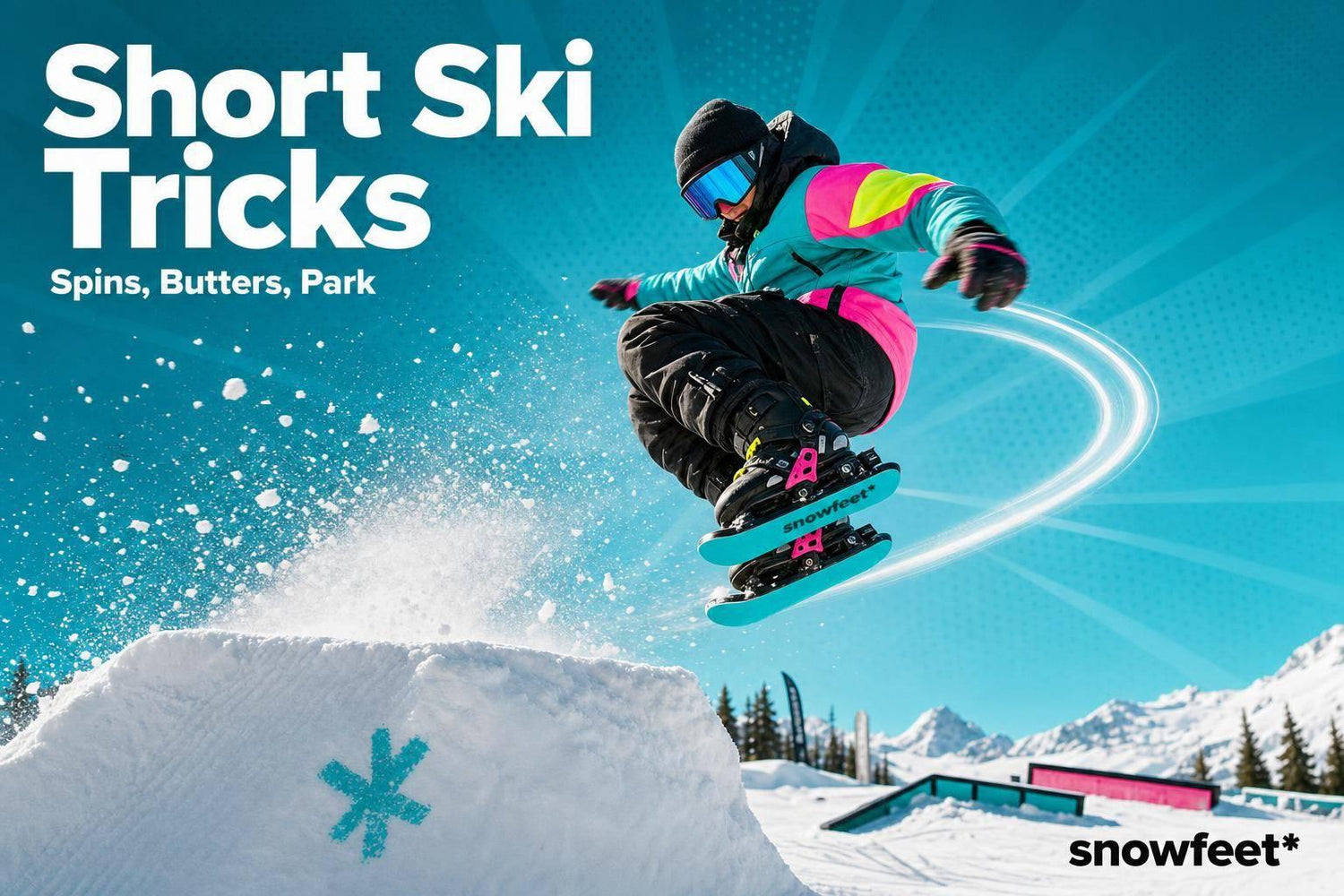
Yes - you can do tricks on short skis, and in many cases they feel easier to throw around than full-length skis.
If I had to sum it up fast, here’s the deal:
- 44–50 cm short skis are best for butters, flat spins, balance drills, and tiny hops
- 65–99 cm is the best zone for 180s, 360s, side hits, switch riding, and small park laps
- 120 cm gives you more landing support and control for faster runs and medium jumps
- The trade-off is simple: shorter skis spin easier, but longer skis feel steadier
- Short skis are fun for groomers, backyard hills, and small terrain parks
- They are not the top pick for deep powder, high-speed charging, or big jump lines
So, if you want a playful setup for small tricks, short skis make a lot of sense. The sweet spot for most riders is 65–99 cm. That range gives you a lighter feel without giving up too much support on takeoff or landing.
A few fast facts from the article:
- 44 cm Skiskates start at $299
- 50 cm PRO models start at $460
- 65 cm Skiblades start at $590
- 99 cm models start at $690
- 120 cm short skis start at $950
My short take? If you want your first 180, your first box slide, or just a ski that feels playful on groomers, short skis can be a blast :) If you want to go bigger and faster, more length still helps.
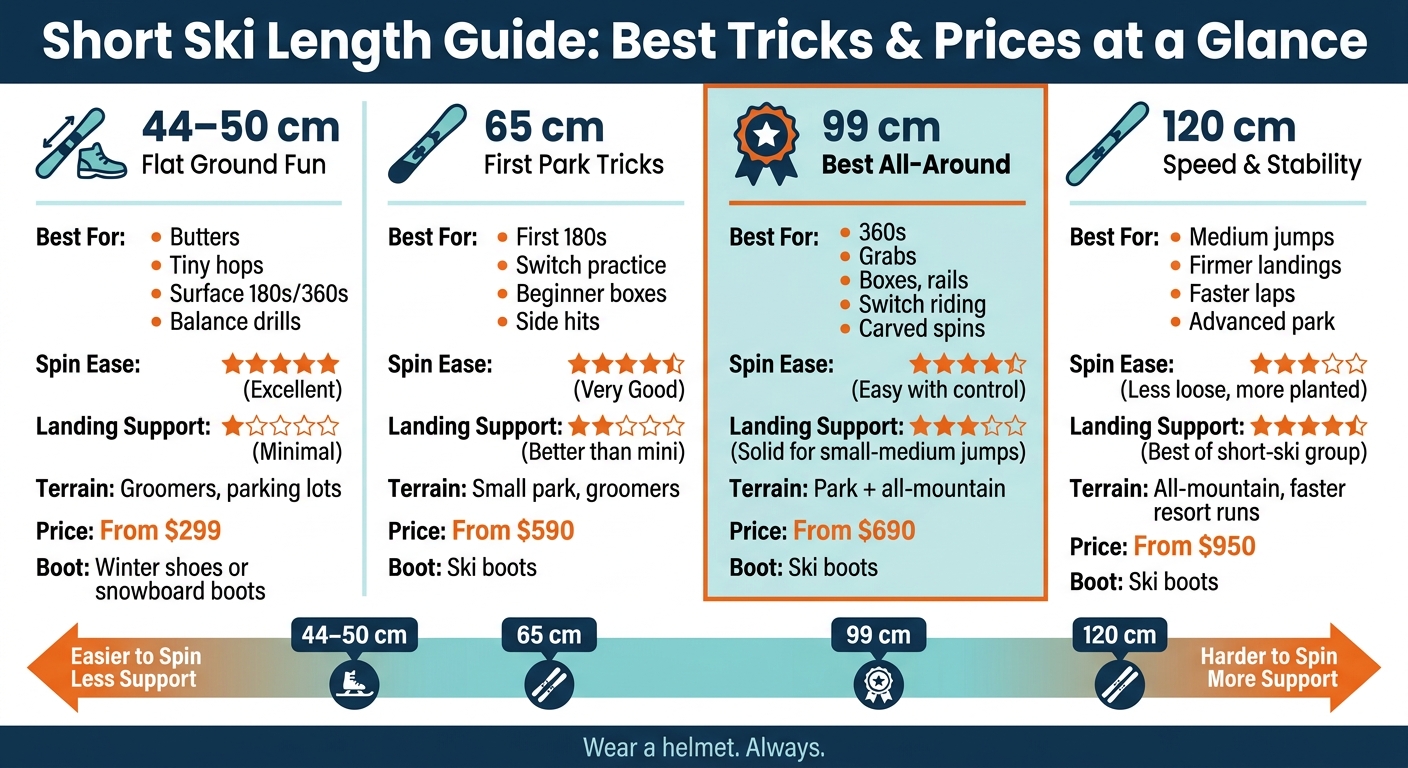
Short Ski Length Guide: Best Tricks & Prices at a Glance
Snowboarder tries Snowfeet* | Which Snowfeet* Short Ski is the Best? | Snowblades 44, 65, 99 Review
Quick Comparison
| Length | Best Use | Trick Feel | Landing Feel | Best For |
|---|---|---|---|---|
| 44–50 cm | Flat ground, mellow groomers | Very easy to spin | Very little support | Butters, tiny hops, surface 180s/360s |
| 65 cm | Small park use, side hits | Easy to spin | Better than mini skis | First 180s, switch practice, beginner boxes |
| 99 cm | Park + resort mix | Easy with more control | Solid for small to medium jumps | 360s, grabs, boxes, all-around use |
| 120 cm | Faster laps, medium features | Less loose, more planted | Best of the short-ski group | Medium jumps, firmer landings, more control |
If you’re choosing one setup, I’d keep it simple:
- Pick 44–50 cm for flat-ground fun
- Pick 65 cm for first park tricks
- Pick 99 cm for the best all-around trick setup
- Pick 120 cm if you want more support at speed
And yeah - wear a helmet. Short skis are fun right up until they remind you who’s in charge.
For a quick visual on short ski tricks, these YouTube searches can help:
That’s the whole picture up front: short skis work for tricks, but the best length depends on how fast you ride, how big you jump, and how much support you want under your feet.
Why Short Skis Are Easier for Spins, Butters, and Playful Riding
Short skis feel more playful because there’s less ski to swing and press. You’ve got less material in front of and behind your boot, so the skis are easier to spin and easier to load into a press. That’s why spins, butters, and small hops tend to feel simpler on short skis.
Lower swing weight makes spins easier
The more ski you have around your boot, the more work it takes to rotate. A shorter ski needs less effort to come around than a full-length ski. So, a small pop and a quick shoulder turn can be enough for a 180. That fast, easy movement is a big part of why short skis feel playful instead of technical.
You feel the same thing with butters. When you shift your weight onto the tip or tail of a short ski, it doesn’t take much to get the ski to press. It bends into the move fast, even at moderate speeds on a mellow groomer.
Short skis are less intimidating for beginners
Short skis also feel less intimidating, which matters a lot when you’re learning. People tend to try spins, hops, and switch turns sooner when the skis feel compact and easy to handle. In plain terms, short skis give beginners a lower-friction way to learn tricks on groomers and in small parks. That often means riders go from basic turns to playful moves in fewer sessions.
Here’s how the three categories stack up for trick riding
| Feature | Skiskates (44–50 cm) | Skiblades (65–99 cm) | Long Skis (160+ cm) |
|---|---|---|---|
| Spin Ease | Excellent | Very Good | Moderate |
| Stability at Speed | Low | Moderate | High |
| Landing Support | Minimal | Moderate | High |
| Park Use | Flatland tricks and jibbing | All-around park use | Big air and large jumps |
That trade-off is the whole game. Each short-ski length leans toward a different trick style, so the list of best moves shifts with ski length.
sbb-itb-17ade95
Which Tricks Work Best at Each Short-Ski Length
Length is the main thing to watch, but it’s not the whole story. Flex, width, bindings, terrain, and your skill level all shape what a short ski can do. Still, length sets the tone. Here’s the practical breakdown so you can match ski size to the tricks you want to do.
| Length | Flat Ground | Small Jumps | Boxes and Easy Rails |
|---|---|---|---|
| 44–50 cm | Flat-ground spins, butters, balance drills | Tiny hops and straight-air grabs | Short, wide beginner boxes at low speed |
| 65 cm | Basic 180s/360s and switch practice | 180s, side hits, and simple grabs | Beginner boxes with straight slides and basic presses |
| 99 cm | Carved 360s, switch practice, and butters | Small to medium jumps with 180s/360s and grabs | Longer boxes and simple rails with spins on/off |
| 120 cm | Strong carving and advanced flat-ground tricks | Medium jumps with confident landings and stable grabs | Medium-length boxes and rails at moderate speed |
44–50 cm: surface spins, butters, and small jumps
At 44–50 cm, you don’t need much to get things moving. A small pop and a shoulder turn can be enough for a 180° or 360° on flat ground. That’s part of the fun. These little skis feel playful right away.
The tradeoff is simple: you get very little front-to-back support on takeoff and landing. So, this length is best for flat-ground tricks, butters, balance work, and tiny hops. Think parking-lot-style messing around, not jump laps. If you take them into the park, stay on wide, short beginner boxes at low speed and skip narrow rails or anything past mellow hops.
65–99 cm: the best range for small park tricks and all-around fun
This is the sweet spot for riders who want tricks and enough support for small features. It’s the range where short skis start to feel less like a novelty and more like a legit park toy.
At 65 cm, basic 180s, simple 360s off side hits, switch practice, and beginner boxes are all on the table. You can move around, try stuff, and not feel like the skis vanish under you the second you leave the snow.
At 99 cm, things calm down in a good way. Landings feel more forgiving. Carved 360s come around cleaner. Switch riding tracks in a more predictable way. That extra length gives you more room to work with, which helps a lot when you start linking tricks or taking on small park features with more speed.
120 cm: more stability for stronger riders and bigger park laps
At 120 cm, you get a larger platform, and that matters once jumps get bigger. On medium jumps, that extra length helps absorb landing impact better than shorter models, which can feel twitchy or loose underfoot.
Carving into features at normal resort speed feels more controlled here. Switch landings on medium-sized jumps also feel more secure, which is a big deal when you’re trying to stomp clean landings instead of fighting to stay centered.
On boxes and easy rails, 120 cm skis also give you more edge length for firmer grip and smoother slides at moderate speed. So, if you want short skis that still feel steady on stronger park laps, this is the length that starts to bridge the gap into the Snowfeet* model choices below.
Best Snowfeet* Models for Learning Tricks
Here’s how the Snowfeet* lineup lines up by length, with U.S. starting prices and the kind of riding each model fits best. If you're picking between spins, park laps, or more stability at speed, this table makes the choice a lot easier.
| Model | Best For | Boot Compatibility | Terrain | Price (US) |
|---|---|---|---|---|
| Skiskates 44 cm | Flat-ground spins and butters | Winter shoes / Snowboard boots | Groomers | From $299 |
| PRO 50 cm | Playful riding and small jumps | Winter shoes / Snowboard boots | Groomers | From $460 |
| Skiblades 65 cm | Entry-level park features | Ski boots | Park / Groomers | From $590 |
| Skiblades 99 cm / POWDER 99 cm | All-around park tricks and resort runs | Ski boots | All-mountain / Park | From $690 |
| Short Skis 120 cm | Faster laps and bigger park landings | Ski boots | All-mountain | From $950 |
Snowfeet* Skiskates 44 cm and PRO 50 cm for first spins and playful sessions
The 44 cm Skiskates work with winter shoes or snowboard boots, so you don’t need ski boots. That’s a big plus if you want to start with flat-ground spins, butters, and mellow freestyle on groomed snow without buying extra gear.
The PRO 50 cm gives you a bit more control, which helps with small hops and tighter turns. Neither model is made for repeated park laps, but if your goal is surface tricks and playful runs on groomers, both are a blast :)
Snowfeet* Skiblades 65 cm and 99 cm for park progression
This is where you start getting enough support for beginner park features. The 65 cm Skiblades use ski boots and are the first park-focused option in the lineup. They’re built for basic 180s, first boxes, and switch practice on small features.
The 99 cm Skiblades are the best all-around pick for tricks and regular resort riding. They’re stable enough for moderate jumps and switch landings, which ties back to that balance between spin ease and landing support. At the same time, they’re still short enough that spins don’t feel like work. If you want one pair for park laps and normal resort runs, this is the practical choice.
Snowfeet* POWDER 99 cm and Short Skis 120 cm for powder float and speed stability
The POWDER 99 cm costs the same as the standard 99 cm Skiblades, starting at $690, but it has a wider shape for softer, ungroomed snow. You still get trick-friendly performance on groomers, plus more float when the snow gets heavy or chopped up. If your home mountain gets mixed conditions, that extra width can be a smart move.
The Short Skis 120 cm are the most stable option in the lineup. They give you more support on faster runs and bigger park landings, though you give up a bit of that easy spin feel shorter models have. That added length starts to matter once you’re going faster, hitting bigger features, and want more confidence on the way down.
Limits, Safety, and How to Pick the Right Model
Even the best short-ski setup has its limits. Short skis shine for tricks and playful riding, but they don’t replace long skis in every case.
When long skis still make more sense
Long skis still come out on top for high speed, big jumps, and steep terrain. The extra edge contact helps keep things stable as speed builds. With short skis, things can start to feel chattery and tougher to control once you’re moving fast.
On very large jumps, a longer ski gives you more platform for a clean landing. In deep powder, long skis float better too. Short skis sink more and take more effort to handle.
If you’re an advanced rider going after pro-level features, long skis are still the better pick. Snowfeet* 99 cm and 120 cm models are a great add-on for fun and trick-focused days, but they aren’t made for that kind of high-impact, high-speed riding.
So, the right length comes down to two simple things: how fast you ski and how big the features are.
Use this quick comparison to match your setup to the terrain and pace:
| Situation | Choose Snowfeet* Short Skis | Choose Long Skis |
|---|---|---|
| Speed | Low to moderate speeds | High-speed skiing, racing |
| Trick style | Spins, butters, small to medium park features | Large jumps, halfpipe, competition park |
| Terrain | Groomers, small parks, light to moderate soft snow | Deep powder, steep faces, icy big-mountain runs |
| Rider profile | Beginners to intermediates, fun-focused riders | Experts, speed-focused, advanced freeride/park |
Always wear a helmet when trying tricks, no matter what ski length you use. Short skis react fast, which is fun... right up until it isn’t :) Learn controlled stops before you head into park features.
How to choose the right Snowfeet* model
Pick 44–50 cm for flat-ground tricks, 65 cm for your first park features, 99 cm for the best all-around trick setup, and 120 cm if you want more stability as speed goes up.
FAQs
Are short skis good for beginners learning tricks?
Yes. Short skis are a great pick for beginners who want to learn tricks. Their smaller size makes them easier to control and turn than long skis. That means new riders can feel more at ease and start working on basic moves like spins, small jumps, and rail slides without feeling like they’re wrestling a pair of planks.
Snowfeet* models like the 65 cm Skiblades are especially beginner-friendly. They give you a stable platform, but still feel playful and quick on snow. They’re light, responsive, and a lot less intimidating than long skis.
Which short ski length is best for park tricks?
For park tricks, the 65 cm Snowfeet Skiblades are the top pick. They’re short, nimble, and easy to throw around, which helps a lot with quick moves, tight turns, spins, and all that fun park stuff.
The twin-tip shape also makes a big difference. It gives you more control when riding backward, hitting rails, and stomping jump landings without feeling off balance.
The 99 cm Skiblades sit in the middle. They give you more stability for bigger jumps and cleaner carving, so they’re a nice option if you want a bit of both. But for pure park riding and tight control, the 65 cm model is the better fit.
Can short skis handle powder or bigger jumps?
Long skis still have their place. A lot of riders like them in deep powder or on huge jumps.
But Snowfeet* has solid options too.
The Snowfeet 99 cm POWDER* model comes with a wider waist, which helps it float better and gives you more support in deep snow.
For jumps, many advanced riders will still lean toward 120 cm skis for more stability on bigger features. That said, the 65 cm and 99 cm models work great for freestyle progression. They’re easier to move in the air, which can help with mid-air tweaks and smoother landings.











اترك تعليقًا
This site is protected by hCaptcha and the hCaptcha Privacy Policy and Terms of Service apply.