



















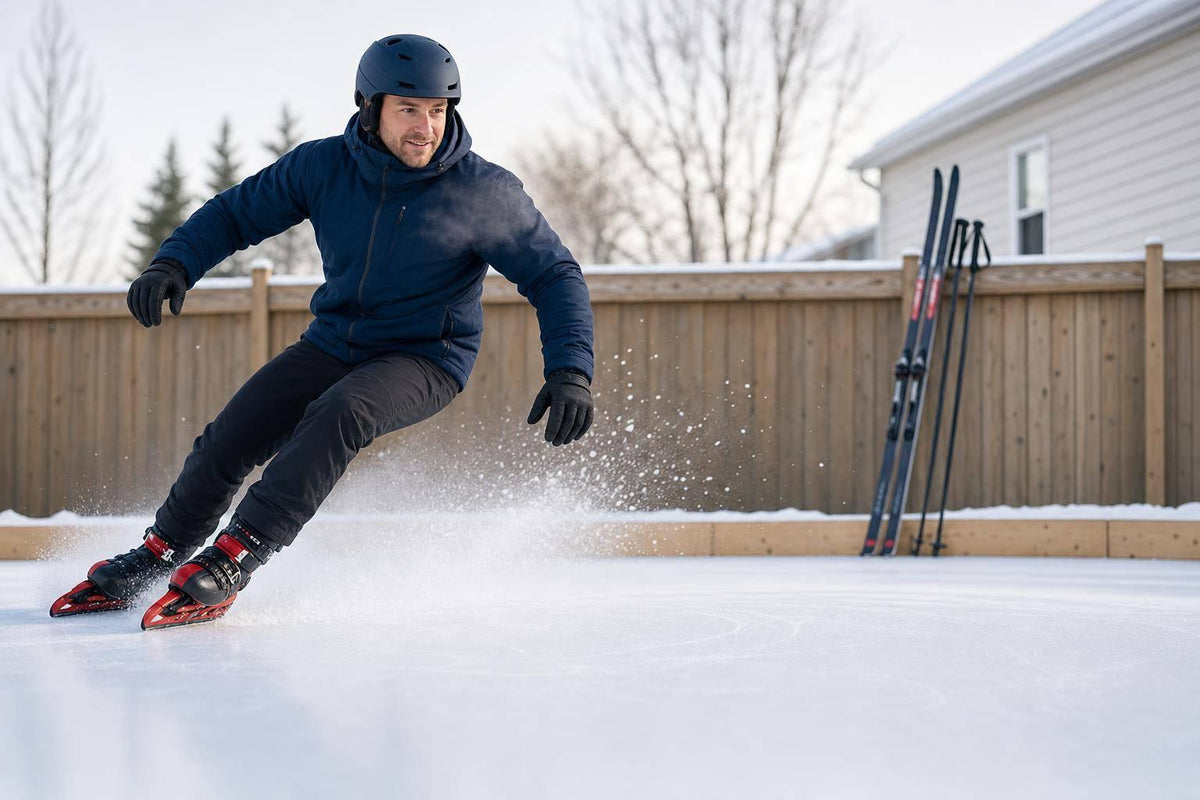
If your rink is only 20 x 40 ft to 30 x 60 ft, skiskates make more sense than full skis. On small backyard ice, I’d pick short gear for one plain reason: it’s easier to turn, stop, and stay in control when space is tight.
Here’s the short version:
- Skiskates work better for small, flat rinks
- Short skiblades can work if you have a bit more room
- Full skis are a poor match for most backyard setups
- Beginners, kids, and parents will usually feel more steady on shorter gear
- Boot setup matters too: some skiskates work with ski boots, snowboard boots, or even winter shoes
The numbers tell the story. A Snowfeet* Skiskate is 44 cm (about 17 in.) long. A full ski is often 150 cm+ (about 59 in.+). That’s a huge gap on a rink where boards, fences, and other people are always close by. And when backyard ice sits around 15°F to 32°F, short gear is often simpler to handle.
Snowfeet* & Skiskates Complete Guide | All you need to know about Skiskating
Quick Comparison
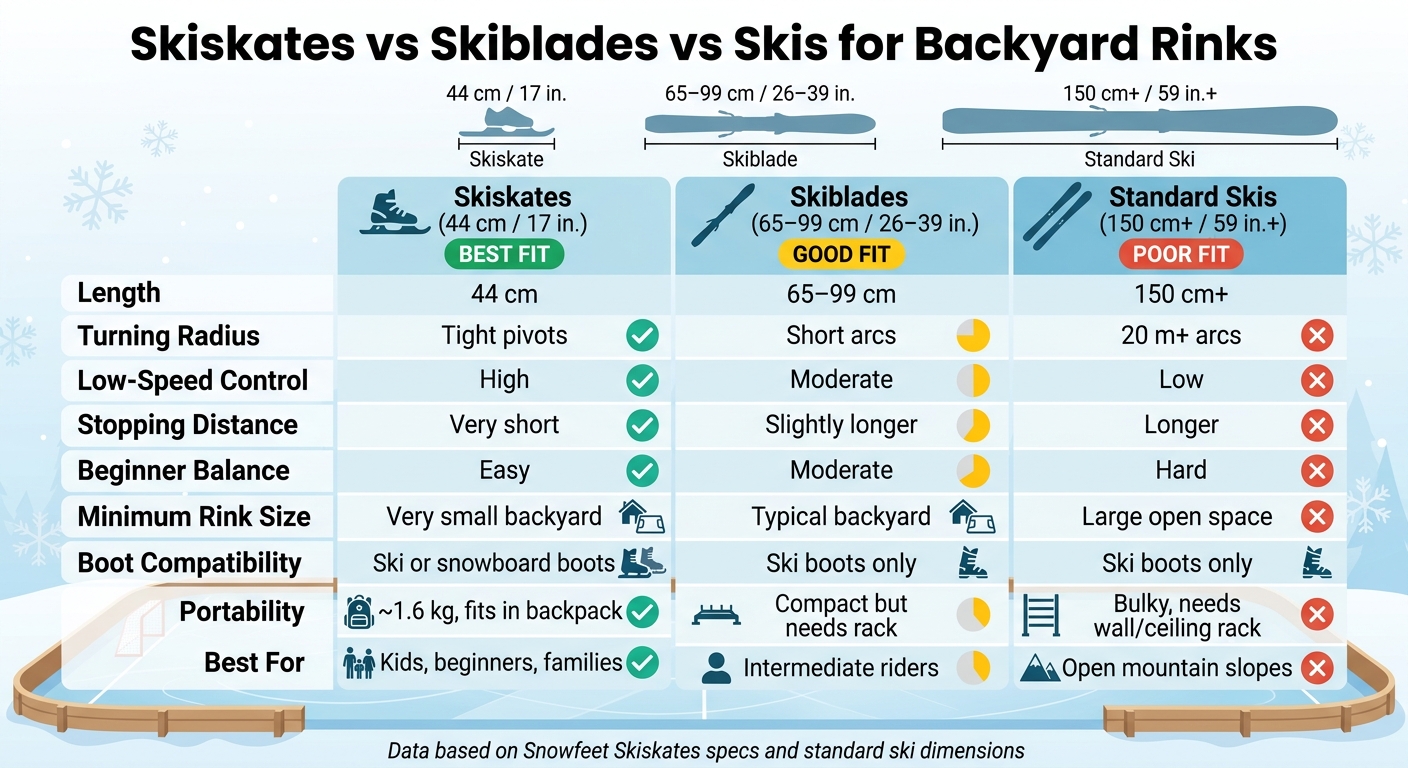
Skiskates vs Skiblades vs Skis: Backyard Rink Comparison
| Gear | Best for | Main upside | Main downside | Fit for backyard rink |
|---|---|---|---|---|
| Skiskates (44 cm / 17 in.) | Kids, beginners, casual riders | Tight turns, short stops, easy storage | Less glide than longer gear | Best fit |
| Skiblades (65–99 cm / 26–39 in.) | Riders who want more glide | More ski-like feel | Needs more room | Good fit |
| Skis (150 cm+ / 59 in.+) | Open slopes | More stable at speed | Hard to use in tight space | Poor fit |
So, if you want the simple answer: for frozen backyard rinks, I’d go with skiskates over skis almost every time. They suit the space better, feel less awkward at low speed, and make family sessions a lot more fun than dragging mountain gear onto a small patch of ice. Kind of like using a bike in a driveway instead of trying to park a bus there :)
If you want a quick look at how skiskates ride, these videos can help:
- Snowfeet official YouTube
- Skiskates riding videos on YouTube
Skiskates vs Skis: Key Differences for Small Icy Spaces
The size gap jumps out the second you step onto a short, flat rink. Snowfeet* Skiskates are 44 cm (about 17 in) long. A standard adult ski is often 150 cm or more. That extra length helps on slopes. On a backyard rink, it usually makes things tougher to control.
Snowfeet* Skiskates are made as a compact mini ski. Standard skis are made for downhill speed and groomed mountain terrain, with long edges and a shape that leans toward wide arcs instead of fast, tight pivots.
How Snowfeet* Skiskates handle tight turns and quick stops
On a small rink, turning radius is the big deal. Short gear turns faster because less edge stays in contact with the ice. Snowfeet* Skiskates let you switch direction fast with very little side-to-side space, kind of like a quick hockey-style pivot. Long skis need a lot more room to come around. Skiskates fit the space a backyard rink gives you.
Stopping works the same way. The shorter edge reacts fast, so small ankle movements can be enough to stop. That matters when kids, boards, or fences are close by.
Where standard skis work and where they fall short
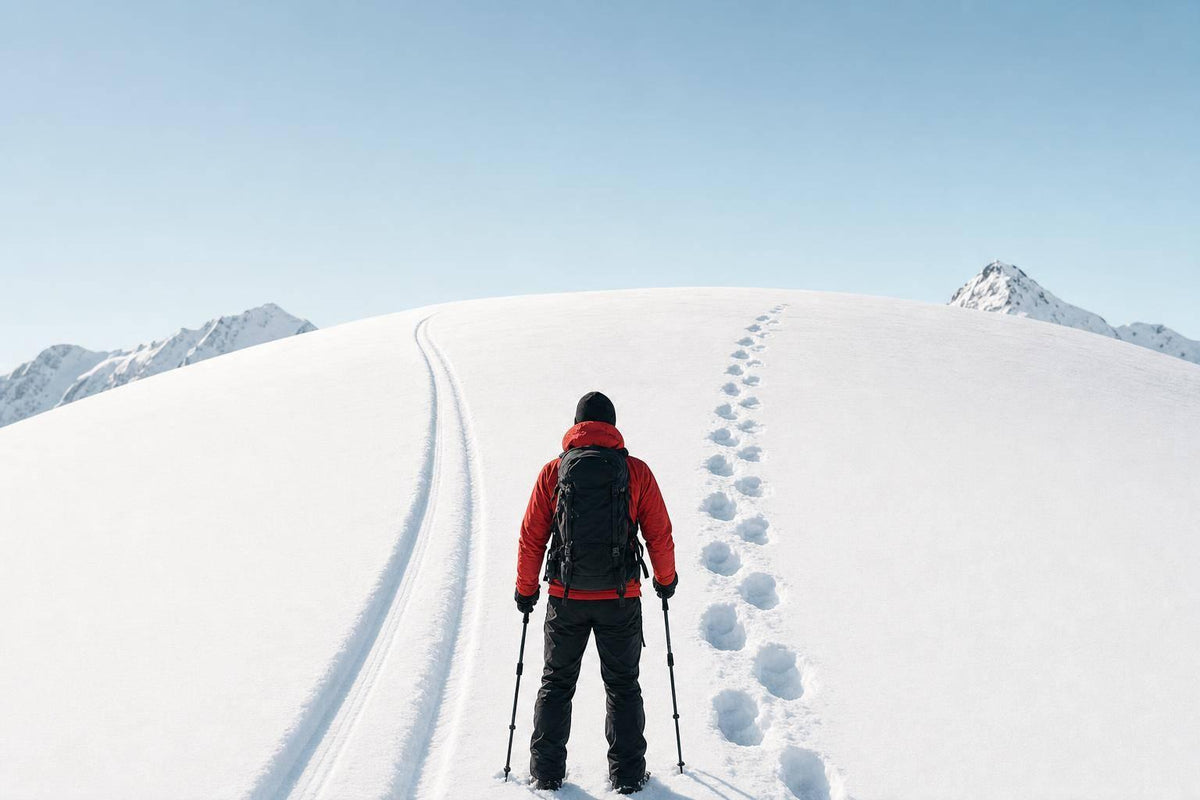
Long skis do their best work on open slopes, where speed, stability, and flotation matter. Those are big pluses. They just don’t help much on a backyard rink.
On flat, tight ice, those same strengths turn into drawbacks. At the low speeds common on a home rink, long skis can feel slow to react and tough to steer. Near boards, fences, or other skaters, the odds of clipping something go up fast. There’s no downhill drop to build momentum, and there isn’t enough room to finish the kind of arc a long ski is built for. That’s why they’re a poor match for flat backyard ice.
Here’s the practical difference at a glance.
| Feature | Snowfeet* Skiskates (44 cm) | Standard Skis (150 cm+) |
|---|---|---|
| Turning radius | Tight pivots possible | 20 m+ for comfortable arcs |
| Low-speed control | High - responsive at backyard speeds | Lower - made for higher speeds |
| Space needed | Fits small backyard rinks | Needs open, longer terrain |
| Boot compatibility | Ski or snowboard boot versions | Ski boots only |
| Chance of bumping boards or people | Lower | Higher |
For backyard use, the tradeoff is pretty simple: more length helps on mountains, while less length helps on ice you can use at home.
sbb-itb-17ade95
Head-to-Head Comparison: Maneuverability, Safety, Space, and Gear
What the table shows for beginners and families
The earlier section covered the basic size gap. Here’s how that gap shows up in actual backyard use.
| Feature | Snowfeet* Skiskates (44 cm) | Short Skiblades (65–99 cm) | Standard Skis (150+ cm) |
|---|---|---|---|
| Maneuverability | Best - tight pivots and hockey-style turns | Good - short arcs, but needs more space than skiskates | Poor on small rinks - wide arcs and limited pivoting |
| Stopping distance | Very short with basic edge control | Slightly longer; simple wedge stops still work | Longer; advanced technique needed |
| Beginner balance | Feels familiar and easy to learn | Moderate | Harder - built for slopes and speed |
| Minimum rink size | Very small backyard rink | Typical backyard rink | Large open space; poor fit for most backyard rinks |
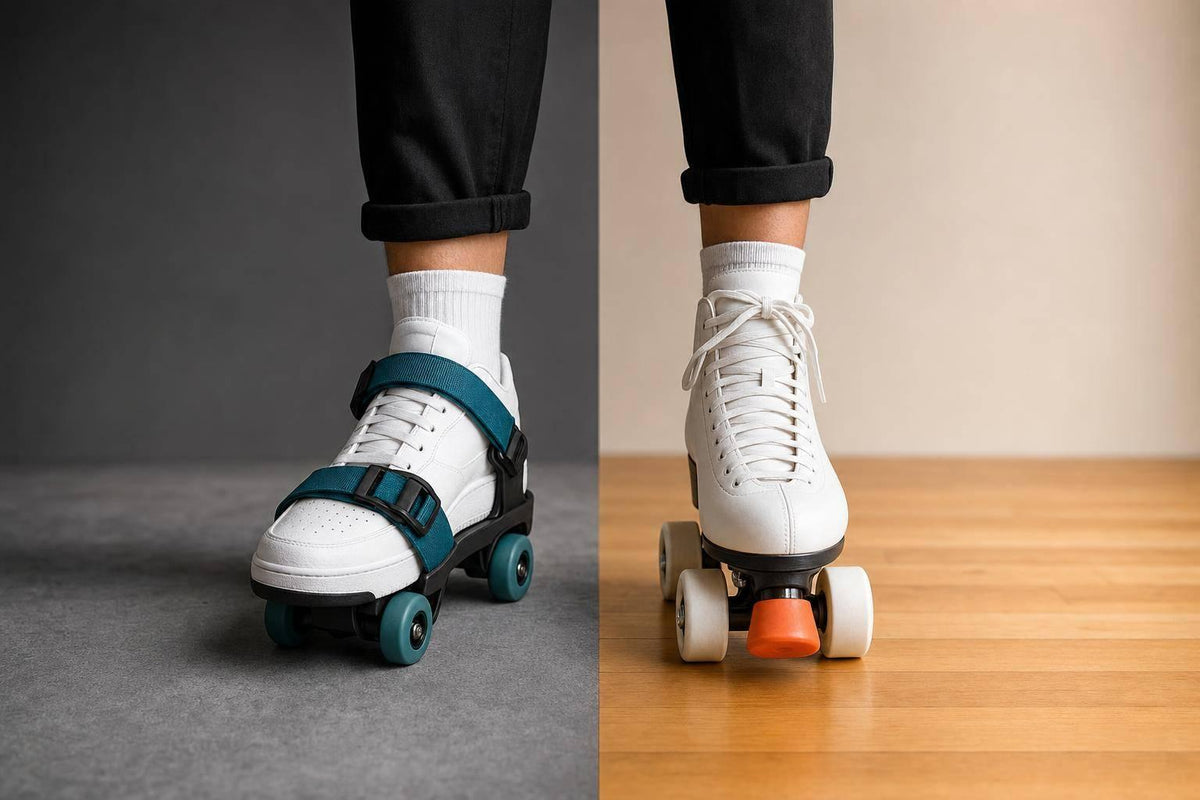
| Boot compatibility | Ski boots (US 4.5–14.5) or snowboard boots (US 6–14.5) | Dedicated ski boots and bindings required | Dedicated ski boots and bindings required |
| Portability | About 1.6 kg total and 44 cm long | Compact, but usually needs a garage rack or corner | Bulky; often needs a wall or ceiling rack |
| Best user type | Kids, beginners, parents on small backyard rinks | Intermediate riders with slightly larger rinks | Traditional skiers practicing technique on larger spaces |
In plain English, skiblades land in the middle. They’re still nimble, but they need more room than skiskates and give you less buffer near the boards. Standard skis feel awkward on a backyard rink fast. Kind of like trying to do a three-point turn with a bus in a short driveway.
Boots, storage, and portability for home use
Control is one part of the story. Home-rink gear also needs to be fast to grab and easy to stash.
For backyard use, skiskates are simpler to wear, faster to grab, and easier to store than full skis. Snowfeet* Skiskates weigh about 1.6 kg total and measure 44 cm long, so you can hang them on a wall hook, slide them under a bench, or toss them into a gear bin. That’s a lot easier than dealing with standard skis, which need a full wall or ceiling rack and take up way more room.
That kind of low-fuss setup matters most for kids, beginners, and casual family sessions. When gear is easy to pull out, people use it more. And on a backyard rink, that’s half the battle :)
Best Pick by Rider Type
On paper, this comparison looks easy. Once you match the gear to the rider, it gets even clearer.
Beginners, kids, and parents running backyard sessions
If you're building a backyard rink for kids or first-timers, short skiskates are usually the better pick. In a small rink, they turn and stop with less fuss.
Short gear is also easier for beginners to balance and control. That’s a big reason skiskates work so well for kids and new riders. Snowfeet* Skiskates (44 cm) keep the foot platform compact, so they’re easier to steady and less likely to catch a tip. That can also help cut down on awkward twists during a fall. When someone is still learning, that compact feel makes a big difference.
For parents, there’s another nice bonus: no separate ski boot purchase and no binding setup. You can get out there faster, which is kind of the whole point of a backyard session :) That simple setup is also why casual skaters and snowboarders tend to get used to skiskates so fast.
Casual riders and skaters who want more fun in less space
If you already skate, ski, or snowboard, you’ll likely get the hang of Snowfeet* Skiskates fast. Their short length supports movements that feel close to ice skating: quick pivots, short strides, and hockey-style direction changes. Snowboarders often notice the edging feel right away. Skiers tend to like that they can pivot each foot on its own.
Long skis are made for open slopes, not a tight backyard ice setup. On a small rink, they can feel clunky. Short skiskates fit the space better, so the whole session feels easier and more fun.
Snowfeet* Product Picks and Final Verdict
Which Snowfeet* model fits your rink and boot setup
If skiskates won the matchup, here’s the simple next step: pick based on your rink size and the boots you already own.
| Rider / Situation | Best Pick | Starting Price |
|---|---|---|
| Adults with ski or snowboard boots, small rink | Skiskates 44 cm | From $460 |
| Casual riders, no ski boots, tight space | Mini Ski Skates 38–50 cm | From $299 |
| Riders who want more glide and ski feel | Skiblades 65 cm | From $590 |
| Kids (shoe size up to about U.S. 6) | MINI KIDS | From $250 |
| Kids ready for a more ski-like feel | Kids Skis | From $199 |
Boot setup matters too. Snowfeet* Skiskates (44 cm) come in both ski-boot and snowboard-boot versions. So if you already own either one, you’re good to go.
Mini Ski Skates (38–50 cm) strap onto winter shoes, which makes them the easiest place to start for families that don’t have ski gear sitting in the garage. Nice and simple.
Skiblades (65 cm) make more sense if you want extra glide and more of that ski feel. They also work better if you like riding small hills. They’re still much shorter than standard skis, but you get more edge grip and a longer glide.
Final takeaway: why skiskates beat skis on backyard ice
Once you match the model to your setup, the answer doesn’t change.
Skiskates and Mini Ski Skates are made for slow, playful backyard sessions. They turn and stop in much less space. And the 44 cm Skiskates fit in a backpack.
Long skis still have their place on mountains.
For backyard ice, Snowfeet is the better fit*.
FAQs
Can you use skiskates on flat backyard ice without a hill?
Yes - skiskates can work on flat backyard ice or packed snow, even if you don’t have a hill.
That’s a big part of the appeal. Their short length - like the 44 cm Snowfeet Skiskates - lets you make quick, side-to-side skating moves in small spaces. So instead of needing a full run, you can squeeze in short, playful laps right in the backyard. Pretty fun, honestly :)
Long skis are a poor fit for this kind of setup. They need more room, more glide, and a lot more forgiveness from the terrain. Snowfeet products make more sense when the space is tight and the goal is just to move around, mess about, and enjoy the snow.
One catch: they do best on packed snow or icy ground. Deep, loose powder is a different story. In soft snow, they won’t feel nearly as smooth or easy to use.
Are skiskates safer than skis for kids and beginners?
Yes - Snowfeet skiskates are often seen as safer than traditional skis for kids and beginners.
The main reason is simple: they’re short and light. That means there’s less chance of the tips crossing, which is a common reason new skiers fall on longer skis.
They’re also easier to turn and control. For a beginner, that matters a lot. If you start to lose balance, you can react faster and get back under control without fighting long, heavy skis.
Their small size also helps people stand in a more natural, skate-like position. For many first-timers, that feels far less awkward than the stance used with regular skis. And yeah, that can make the learning curve much shorter - often minutes instead of days or weeks.
Which skiskates work best with the boots I already own?
For a backyard rink, the best Snowfeet model comes down to one thing: your boots.
If you plan to wear regular waterproof winter boots or hiking boots, go with Snowfeet 38 cm or Snowfeet PRO 50 cm. Those models use universal bindings, so they’re the better match for everyday boots.
If you already own ski boots or snowboard boots, 44 cm Skiskates are the better pick. They give you a sharper, more responsive feel on firm snow.
No matter which one you choose, firm ankle support makes a big difference. It helps with balance, stability, and control.











اترك تعليقًا
This site is protected by hCaptcha and the hCaptcha Privacy Policy and Terms of Service apply.