



















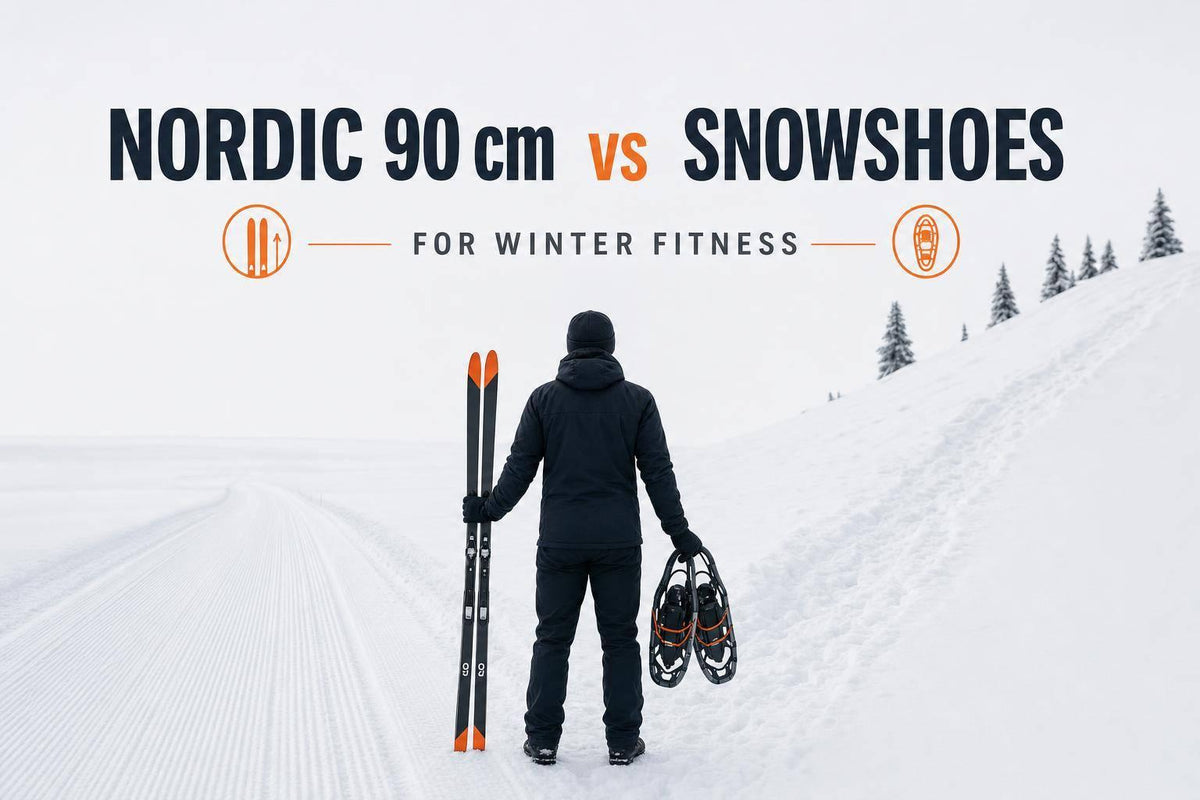
If I want more cardio on packed snow, I’d pick the NORDIC 90 cm. If I plan to walk through deep powder or climb steep hills, I’d grab snowshoes.
Here’s the short version:
- NORDIC 90 cm works best on groomed paths, packed trails, and rolling terrain
- Snowshoes work best in deep, soft, untracked snow
- The NORDIC uses a glide motion, so it feels more like a workout
- Snowshoes use a walking motion, so they feel simpler from the first step
- NORDIC fits regular winter shoes in US sizes 6–13
- Snowshoes usually need insulated winter boots
- NORDIC starts around $450
- Snowshoes often start around $150
- NORDIC weighs about 3.84 lb per pair and measures 35 inches
- Learning the NORDIC usually takes about 1 day based on the source article
If you want the fast answer, it’s this: packed snow = NORDIC 90 cm; deep snow = snowshoes. That’s the whole game, more or less :)
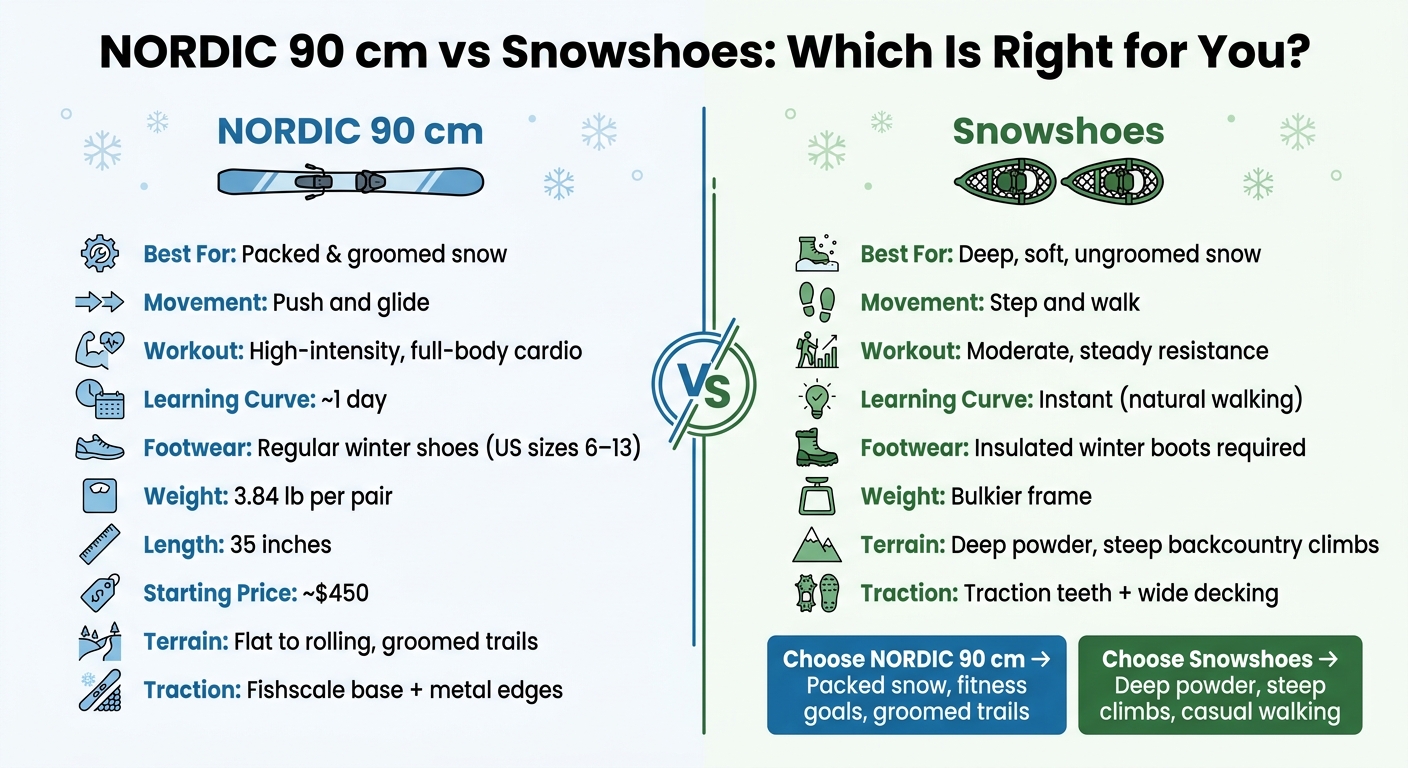
NORDIC 90 cm vs Snowshoes: Side-by-Side Comparison
This Nordic Ski Can Be Attached to Any Winter Shoes | Snowfeet Cross-country Skate Skis | 90 cm
Quick Comparison
| Criteria | NORDIC 90 cm | Snowshoes |
|---|---|---|
| Best use | Packed and groomed snow | Deep ungroomed snow |
| Movement | Glide | Walk |
| Workout feel | More cardio, more full-body | Steady, lower pace |
| Learning curve | About 1 day | Very low |
| Footwear | Winter shoes, US 6–13 | Winter boots |
| Steep climbs | Best on mild grades | Better choice |
| Portability | Lighter and shorter | Bulkier |
| Starting price | About $450 | About $150 |
So, if I’m helping a friend choose, I’d keep it simple: go with the NORDIC for fitness laps and glide; go with snowshoes for powder days and hill climbs.
Helpful videos if you want to see the feel before you buy:
How each option works on snow
Snowfeet* NORDIC 90 cm: short skis built for glide
The NORDIC 90 cm is made for a simple push-and-glide stride. That means more speed and a more cardio-heavy workout. At 35 inches, it stays short, compact, and easy to handle.
The waxless fishscale base grips when you push and glides when you stride. On a groomed park path or a packed rail trail, that motion starts to click fast. Soon, you get a smooth, athletic rhythm. Metal edges help you stay in control on firm or icy spots, and the bindings fit regular winter shoes in US sizes 6–13. So, you don’t need to buy special boots.
Martina MacLean from Bailey, US said it well:
"It didn't take long to get used to these shorter skis, much easier than the original longer XC skis I used to own a long time ago!"
That glide changes how the workout feels. It also changes your speed and how hard you have to work.
Snowshoes: walking traction and flotation in deeper snow
Snowshoes are built for steady walking in deep snow. Their wide frame and decking spread your weight over more snow, which helps you stay on top of soft snow instead of sinking in. Under the shoe, traction teeth grip packed or sloped sections.
The movement feels close to normal walking. There’s no glide and no push-and-slide rhythm. Snowshoes need insulated winter boots for warmth and a secure fit. That adds more bulk than the lighter NORDIC setup. On firm, groomed snow, all that extra surface can slow you down.
This is where the gap becomes pretty clear:
| NORDIC 90 cm | Snowshoes | |
|---|---|---|
| Movement | Push and glide | Step and walk |
| Best snow | Packed, groomed, rolling terrain | Deep, soft, ungroomed snow |
| Traction method | Fishscale base + metal edges | Traction teeth + wide decking |
| Footwear | Regular winter shoes (US 6–13) | Insulated winter boots |
| Main design goal | Speed and glide rhythm | Flotation and stability |
Those differences show up most in workout feel, terrain, comfort, and cost.
sbb-itb-17ade95
Side-by-side comparison: workout, terrain, comfort, and cost
Workout feel and calorie burn
The NORDIC 90 cm gives you a faster, more full-body workout. Snowshoes feel more like slower resistance work.
With the NORDIC stride, your legs and upper body work together. That creates a smooth cardio rhythm once you get the hang of it. On flat or groomed terrain, that faster stride usually leads to a harder workout than easy snowshoe walking.
Snowshoes feel closer to brisk walking. They still make you work, of course. And when the snow gets deep, the effort jumps fast. But on flat or packed ground, the intensity usually stays moderate.
Terrain, stability, and learning curve
That gap in workout feel stands out even more when the trail gets deeper or steeper. Snowshoes are the easiest place to start. The NORDIC 90 cm starts to feel natural after about a day.
The best pick depends a lot on where you plan to go.
The NORDIC 90 cm works best on groomed paths, packed snow, and rolling terrain where speed and efficiency matter. Snowshoes do better in deep, soft, ungroomed snow. On steep climbs, snowshoes with built-in crampons can bite right into the slope. The NORDIC 90 cm is a better match for flatter ground and gentle grades.
| Feature | NORDIC 90 cm | Snowshoes |
|---|---|---|
| Learning curve | Very fast (about 1 day) | Instant (natural walking) |
| Groomed trails | Excellent | Works, but slower |
| Deep ungroomed snow | Limited flotation | Excellent |
| Steep climbs | Best on gentle grades | Excellent (with crampons) |
Footwear, portability, and price in the U.S.
Once you look past workout feel and terrain, cost and convenience start to matter a lot.
The NORDIC 90 cm starts at about $450 and works with standard winter shoes in U.S. sizes 6–13. So, you don't need special boots to get started. Standard winter shoes are enough.
Recreational snowshoes often start around $150, so the upfront price is lower. But there's a catch. If you need insulated, waterproof boots to stay comfortable in deeper snow, that price gap can shrink pretty fast.
The NORDIC 90 cm also wins on portability. At 3.84 lb per pair and just 35 inches long, it's much easier to carry, store, and toss in the car than a bulkier snowshoe frame.
For groomed or packed terrain, NORDIC can give you more performance for the money if you already own winter shoes.
Which option fits your winter fitness goals
Once you stack up workout style and terrain, the call gets pretty simple: speed and glide on packed snow vs. flotation in deep powder.
Choose NORDIC 90 cm for groomed paths, rolling trails, and a more athletic workout
If you want a faster, more athletic workout, NORDIC 90 cm is the better pick. The gliding motion lets you cover more ground, keep your pace up, and work your arms, core, and legs all at once.
Use it on groomed Nordic centers, packed park loops, or golf-course trails after fresh snow. It fits standard winter shoes in U.S. sizes 6–13.
Choose snowshoes for deep snow, steep climbs, and simple winter walking
Snowshoes still win when snow depth matters more than speed. If you're heading into deep, ungroomed snow or steep climbs, snowshoes give you the flotation and crampon grip that short skis just can't match.
They're also a smart pick if you don't want to think much about technique. Snowshoeing is basically walking with a wider stance, so the learning curve is low. For casual outings where the goal is fresh air and light movement, not a hard workout, that simplicity is a big plus.
| Your situation | Better pick |
|---|---|
| Groomed Nordic trails or packed park paths | NORDIC 90 cm |
| Deep, untracked powder or wooded terrain | Snowshoes |
| Higher-intensity full-body workout | NORDIC 90 cm |
| Steep backcountry climbs | Snowshoes |
| Already own winter shoes, want no extra gear | NORDIC 90 cm |
| Minimal learning curve | Snowshoes |
Conclusion: the better pick for most casual riders
After looking at terrain, workout feel, and setup, the call is pretty clear. Snowshoes are the better tool for deep, ungroomed snow and steep climbs, where flotation and traction matter most.
That’s why NORDIC 90 cm comes out ahead on groomed and packed trails. For most casual riders on packed snow, it’s the stronger pick because it’s lighter, simpler, and built more for glide-based fitness. It also gives you a more athletic workout than snowshoeing. So if you want a true cardio session, not just a walk in the snow, this is the better match.
Users often mention a quick learning curve and a smooth glide. That edge matters most when your goal is exercise, not just winter walking.
It does cost more upfront than many snowshoes. Still, its speed, portability, and simple setup make NORDIC 90 cm the better fit for most casual riders on packed trails.
FAQs
Can beginners use NORDIC 90 cm right away?
Yes. Snowfeet NORDIC 90 cm* is much easier to learn on than long skis.
Snowshoes are still the most simple option. You just strap them on and walk.
But for most beginners, NORDIC 90 cm is easy to pick up fast. You can usually learn the basics of gliding, turning, and stopping in a single day. In many cases, people get the hang of it in about five minutes.
The short length helps a lot, too. It’s easier to control, easier to handle, and way less intimidating than a pair of long skis.
Do I need poles with NORDIC 90 cm or snowshoes?
You don’t have to use poles with Snowfeet NORDIC 90 cm. For a first session, it’s often better to skip them and just focus on balance and weight transfer.
Once you feel good with gliding and stopping, poles can help with the V-skate technique and give you a bit more push. If you decide to use them, go with skate-style poles that are about 90% of your height.
Which burns more calories on packed trails?
On packed trails, cross-country skiing burns more calories per hour than snowshoeing. That makes sense when you look at how each one works.
Snowshoeing is mostly a lower-body workout. You lift, step, lift, step. It gets the job done, but the motion can feel a bit like climbing stairs on repeat.
Nordic skiing uses your arms, core, and legs at the same time. With more of your body in play, you put more demand on your heart and lungs too.
With Snowfeet NORDIC 90 cm*, that smooth gliding motion turns the workout into something more active and more fun. You get a stronger cardio push, and it often feels easier on your joints than snowshoeing. That’s a pretty nice trade-off :)











اترك تعليقًا
This site is protected by hCaptcha and the hCaptcha Privacy Policy and Terms of Service apply.