





If you want the short answer: I’d pick the Snowfeet* Skiblades 99 cm for most women over 50. It gives the best mix of easy turning, steadier tracking, and low hassle. The 44 cm is the easiest to pack, the 65 cm is a nice step up for mellow skiing, and the 120 cm feels closest to a regular ski.
Here’s the simple breakdown:
- 44 cm Skiskates: smallest, lightest feel, fastest side-to-side response
- 65 cm Skiblades: easier to settle into than 44 cm, still small and light
- 99 cm Skiblades: best middle ground for comfort and control
- 120 cm Short Skis: most stable in this group, but less easy to carry
A few facts matter right away:
- The 44 cm Skiskates have a 4.9/5 rating from 126 reviews
- The 65 cm Skiblades start at $490
- The 99 cm Skiblades start at $690
- The 120 cm Short Skis cost $950
- These models fit ski boots or snowboard boots, depending on version
- Regular winter boots won’t work
If you’re getting back into skiing, I’d keep it simple: pick based on stability, turning feel, effort, and boot setup. For most casual resort days on green and blue groomers, the 99 cm is the one I’d point you to first.
Best Skis for the Elderly? | Are Short Skis Better for Older Skiers?
Quick Comparison
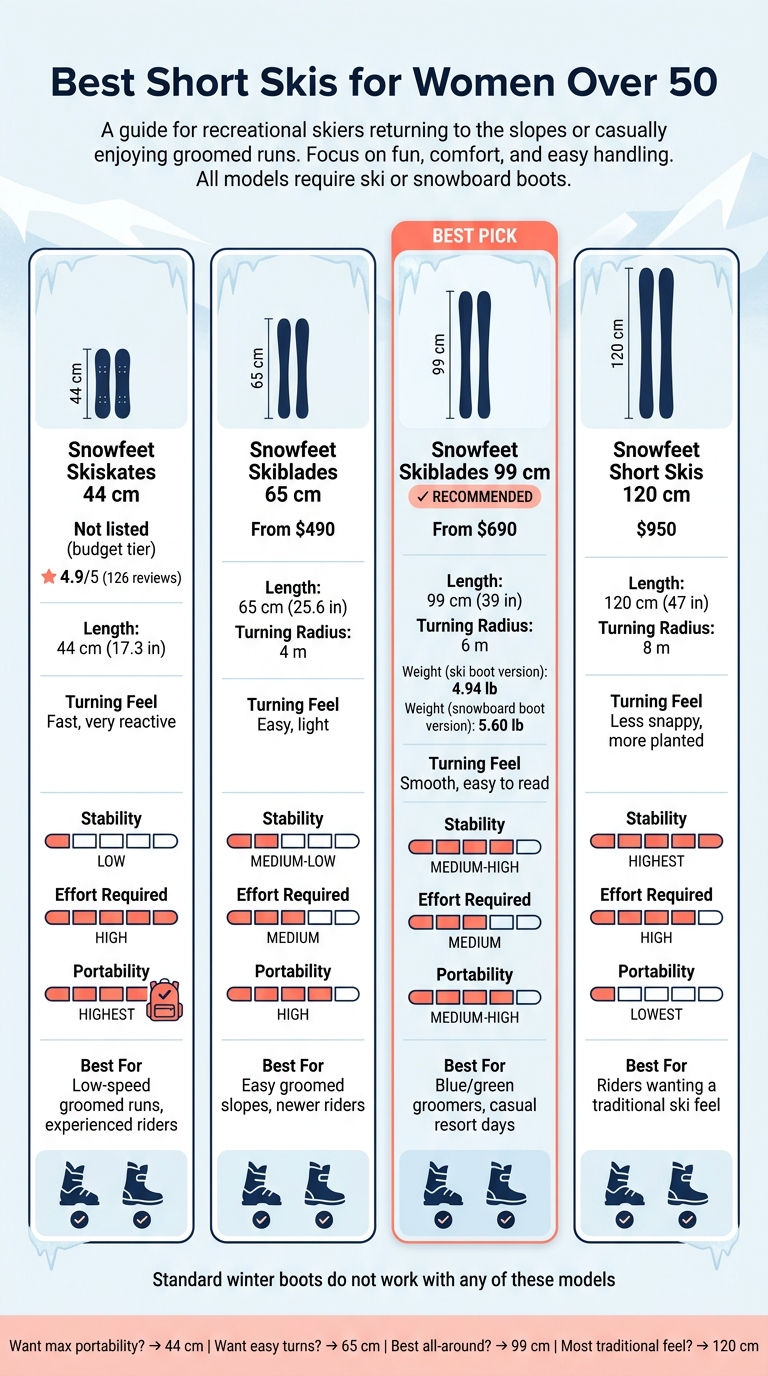
Best Short Skis for Women Over 50: Side-by-Side Comparison
| Model | Turning Feel | Stability | Effort | Portability | Best Use |
|---|---|---|---|---|---|
| 44 cm Skiskates | Fast, very reactive | Low | More ankle and calf work | Highest | Low-speed groomed runs |
| 65 cm Skiblades | Easy, light | Medium-low | Lower than 44 cm for many riders | High | Easy groomed slopes |
| 99 cm Skiblades | Smooth, easy to read | Medium-high | Good balance | Medium-high | Blue/green groomers |
| 120 cm Short Skis | Less snappy, more planted | Highest here | More work than shorter options | Lowest here | Riders who want a more ski-like feel |
So, if you want one clean answer, go with the 99 cm. It skips the twitchy feel of very short skis without dragging you back to the bulk of long skis. Nice and simple :)
1. Snowfeet* Skiskates 44 cm
At 44 cm (17.3 in), the Skiskates are the most portable pick in the lineup. They’re small enough to fit in a backpack, which is pretty wild if you’re used to hauling full-length skis around the parking lot. The product page lists a 4.9/5 rating from 126 reviews.
Turning and Control
For women over 50 who want easier steering, the 44 cm length feels fast to react and easy to read. The Skiskates use a parabolic shape with a narrow waist plus metal edges, which helps with carving and stopping.
Because they’re so short, turns come up fast. That can feel fun and freeing, especially if full-length skis have started to feel like a lot to manage. They’re a strong match for women who want easier steering than standard alpine skis.
If you’re new to skiskating, start on a wide, gentle groomed slope. Keep your speed low at first until that side-to-side balance starts to click.
Stability and Support
Here’s the trade-off: quick handling means less built-in stability. At 44 cm, you don’t get the same edge length or flotation as a standard alpine ski. So, these aren’t the best match for steep runs, deep powder, or fast cruising.
If your main goal is confidence and control at moderate speeds, though, this size makes a lot of sense. It works best as a playful option for groomed beginner and intermediate terrain.
Fatigue and Muscle Use
For women over 50, this trade-off often comes down to one thing: easy handling versus all-day confidence. The small size can cut swing weight, which may help them feel less bulky. But skiskating still asks plenty from your ankles, calves, and stabilizer muscles, especially if you haven’t been on snow in a while.
A smart move is to start with shorter sessions. Let your body get used to the motion before you try to stretch it into a full day.
Terrain and Boot Fit
Skiskates work best on groomed resort runs at controlled speeds. That’s their sweet spot.
Boot fit matters too. The ski-boot model fits US sizes 4.5–14.5, and the snowboard-boot version fits US sizes 6–14.5. Use the right binding version, because standard winter boots do not work.
2. Snowfeet* Skiblades 65 cm
If the 44 cm Skiskates feel a bit too quick, the 65 cm Skiblades slow things down in a good way. You still get that short-ski feel, but with more calm under your feet. At 65 cm (about 26 inches), they give you more stability than the 44 cm Skiskates while staying nice and compact. They also have a 4 m turning radius and a camber shape built for easier carving and better edge control.
Turning and Control
That extra length makes a clear difference. The ski feels steadier and less twitchy than the 44 cm Skiskates, which can be a big plus if you want balance to come a bit easier. Turns still feel quick and light on groomed runs, but the ride is less jumpy.
For women who want more confidence on groomed slopes without giving up easy turning, this is a smart middle ground. It’s the step-up pick for riders who want more steadiness and still want the ski to feel nimble.
Stability and Support
Compared with standard alpine skis, the 65 cm Skiblades are still easy to turn, rotate, and carry around. That said, they give you less fore-aft support and less edge length than a full ski. So, they make the most sense on groomed beginner and intermediate runs at moderate speeds, where easy turns matter more than top-end stability.
Fatigue and Portability
When your legs start to fade, these are easier to handle than full-length skis. That alone can make a ski day feel less like a grind. They’re also more forgiving than the 44 cm option, which helps women getting back into skiing after some time away.
Terrain and Boot Fit
For women returning to skiing, this length hits a nice balance between control, comfort, and ease of use. They come in both ski-boot and snowboard-boot versions, with the same fit ranges as the 44 cm model.
At $490, they fit women who want more stability than the 44 cm Skiskates without stepping up to a longer ski.
sbb-itb-17ade95
3. Snowfeet* Skiblades 99 cm
If the 65 cm Skiblades feel a bit too fast and twitchy, the 99 cm version gives you a calmer ride without going all the way to a full ski. It’s a nice middle ground. You get more stability, but you still keep that short-ski feel that’s easy to handle.
Starting at $690, this model fits women who want more support on groomed runs and prefer something less reactive than the 65 cm option.
Turning and Control
The 99 cm model uses a parabolic shape and has a 6 m turning radius. It also has a camber profile made for easier carving and cleaner edge hold.
What does that mean on snow? Simple: it helps the ski make smooth, steady turns on groomed slopes. Not wild. Not jerky. Just more controlled and predictable.
Stability and Support
The longer platform gives you more edge contact than the shorter Skiblades. That extra contact helps the ski feel steadier on groomed trails at moderate resort speeds.
For women over 50, that extra length can make a big difference. You get easier balance, better control, and less of that “whoa, okay!” feeling that can come with a very short ski. The 99 cm model tones things down in a good way :)
Fatigue and Portability
These are still light and easy to manage. The ski-boot version weighs about 4.94 lb, and the snowboard-boot version comes in at about 5.60 lb.
So, yes, they’re still easy to carry from the parking lot, pack in the car, or stash away without a wrestling match.
Terrain and Boot Fit
This model works best on groomed blue and green runs, especially if you want more stability than the 65 cm version offers. It comes in both ski-boot and snowboard-boot versions, with sizes starting at US women’s 5.5 and US 6.
If you want a feel that’s even steadier and closer to a full ski, the 120 cm model is the next move.
4. Snowfeet* Short Skis 120 cm
At $950, the 120 cm Short Skis are the longest option from Snowfeet*. They also feel the most like a regular ski in this lineup. So if you want more stability but still like the easy, compact feel of short skis, this is the step up to look at.
Turning and Control
At 47 inches (120 cm), this ski has an 8 m turn radius and a camber profile with tip and tail rocker. In plain English, that means it can handle tighter turns and quick direction changes on groomed runs without feeling slow or clunky.
Stability and Support
The added length gives this model a steadier feel than the 65 cm and 99 cm versions. That can be a smart pick for women over 50 who want smoother handling at moderate speeds, but don’t want to jump all the way to a full-length ski.
Terrain and Boot Fit
This model works best on groomed runs and in moderate variable snow. You’ll need to choose either the ski-boot or snowboard-boot version based on the boots you already use. Standard winter boots won’t fit.
It hits a nice middle ground: more control, easy to carry, and a bit more confidence underfoot. The pros and cons are up next.
Pros and Cons
Use this summary to line up each model with how you ride. The table below boils the trade-offs down into one fast comparison.
| Model | Main Advantages | Main Limitations | Best For | Not Best For |
|---|---|---|---|---|
| 44 cm Skiskates | Most portable; backpack-friendly | Least stable at speed; smallest platform; least forgiving on uneven snow | Experienced riders on groomed beginner and intermediate terrain | Nervous beginners, high-speed runs, variable or icy terrain |
| 65 cm Skiblades | More stable than 44 cm; still compact | Less stable than 99 cm or 120 cm; limited in rough snow or at higher speeds | Newer riders and cautious resort skiers on easy groomed slopes | Fast skiing, deep snow, or anyone wanting a conventional long-ski feel |
| 99 cm Skiblades | Best all-around balance of maneuverability, stability, and portability; more planted feel than shorter models | Less nimble than 44 cm or 65 cm in tight spaces; not a deep-powder ski | Casual riders on groomed blue and green runs | Higher speeds, powder, or riders who want maximum compactness |
| 120 cm Short Skis | Closest feel to a traditional ski; smoother tracking and directional stability | More demanding to handle than shorter models; less portable; harder for true beginners | Confident skiers wanting short-ski convenience closer to a standard ski | Very cautious first-timers, tight spaces, or anyone prioritizing maximum portability |
So, the choice is pretty simple: go shorter for ease and go longer for more stability.
From the summary above, the 99 cm stands out as the most balanced option. It’s the strongest all-around pick in this group. Choose 65 cm if control matters most. Choose 120 cm if you want the most traditional feel in this lineup.
Match the ski length to your comfort level, terrain, and boot setup. All four options work best at controlled speeds, with the right boots, and on suitable terrain.
Conclusion
For most women over 50, the Snowfeet* Skiblades 99 cm is the best all-around pick. It’s easier to turn than regular skis, but it also feels more steady than the 44 cm or 65 cm models. That’s why 99 cm stands out as the best fit for most casual riders.
That said, the best length depends on you and where you are right now. Shorter gear is easier to turn and easier to handle. Longer gear gives you more support and smoother tracking as your speed goes up.
Here’s the simple breakdown:
| Your Situation | Best Pick |
|---|---|
| Maximum portability and low-speed practice | Snowfeet* Skiskates 44 cm |
| Easy turning with a bit more support | Snowfeet* Skiblades 65 cm |
| Best balance of control, comfort, and stability | Snowfeet* Skiblades 99 cm ✓ |
| Most traditional feel with added stability | Snowfeet* Short Skis 120 cm |
No matter which length you go with, start on easy groomed runs and make sure your boots fit well. The sweet spot is the setup that matches your balance, strength, confidence, and boots. Simple beats fancy every time :)
FAQs
How do I choose between 65 cm and 99 cm?
Choose 65 cm if you want the easiest learning curve, faster turn initiation, and a ride that feels less intimidating on slow-to-moderate groomers. It’s a smart pick for beginners, park riders, or anyone who spends most of their time on green runs.
Choose 99 cm if you want more stability as speed picks up and conditions change. It feels calmer on mixed groomers and light powder, while still staying compact and easy to turn.
Are short skis easier on aging knees?
Yes. Short skis are often easier on aging knees because their shorter length puts less leverage and twisting force on your legs in turns than long skis. That can mean less strain on the joints.
They’re also lighter, which makes it easier to ski in a more natural, upright stance. And that can take some pressure off the knees, hips, and lower back.
For most older skiers, Snowfeet 99 cm or 120 cm models* hit the sweet spot between stability and a knee-friendlier ride.
Can I use snowboard boots with all Snowfeet* models?
Not all of them.
The 44 cm Skiskates and 65 cm/99 cm Skiblades can be set up for snowboard boots, since they come with snowboard-boot binding options.
The 120 cm models are ski-boot only for the best hold and security.













اترك تعليقًا
This site is protected by hCaptcha and the hCaptcha Privacy Policy and Terms of Service apply.