



















I’d sum it up like this: 44–120 cm snow gear is easier to pack, easier to turn, and often easier to learn than 160–180 cm skis or a full snowboard setup. The trade-off is simple: you give up some calm at high speed, deep-powder float, and steep-terrain power.
Here’s the fast take:
- Best all-around pick for most casual riders: 99 cm skiblades
- Best for max portability: 44 cm skiskates
- Best for beginners and low-key laps: 50 cm Snowfeet PRO
- Best if you want a more ski-like feel: 120 cm short skis
- Best for kids: MINI KIDS
- Best for speed, ice, and bigger terrain: full-length skis
- Best for powder and surf-style riding: snowboard
Snowfeet says its gear runs from about $199 to $950, with many models small enough to fit in a backpack or tight car trunk. That’s a big shift from hauling long skis through the airport and paying $35–$40 each way for a checked bag. Less gear drama, more riding.
If I were helping a friend choose, I’d keep it this simple: pick short gear for groomers, travel, small hills, park laps, and fun; pick long skis or a snowboard for speed, steep runs, and deeper snow.
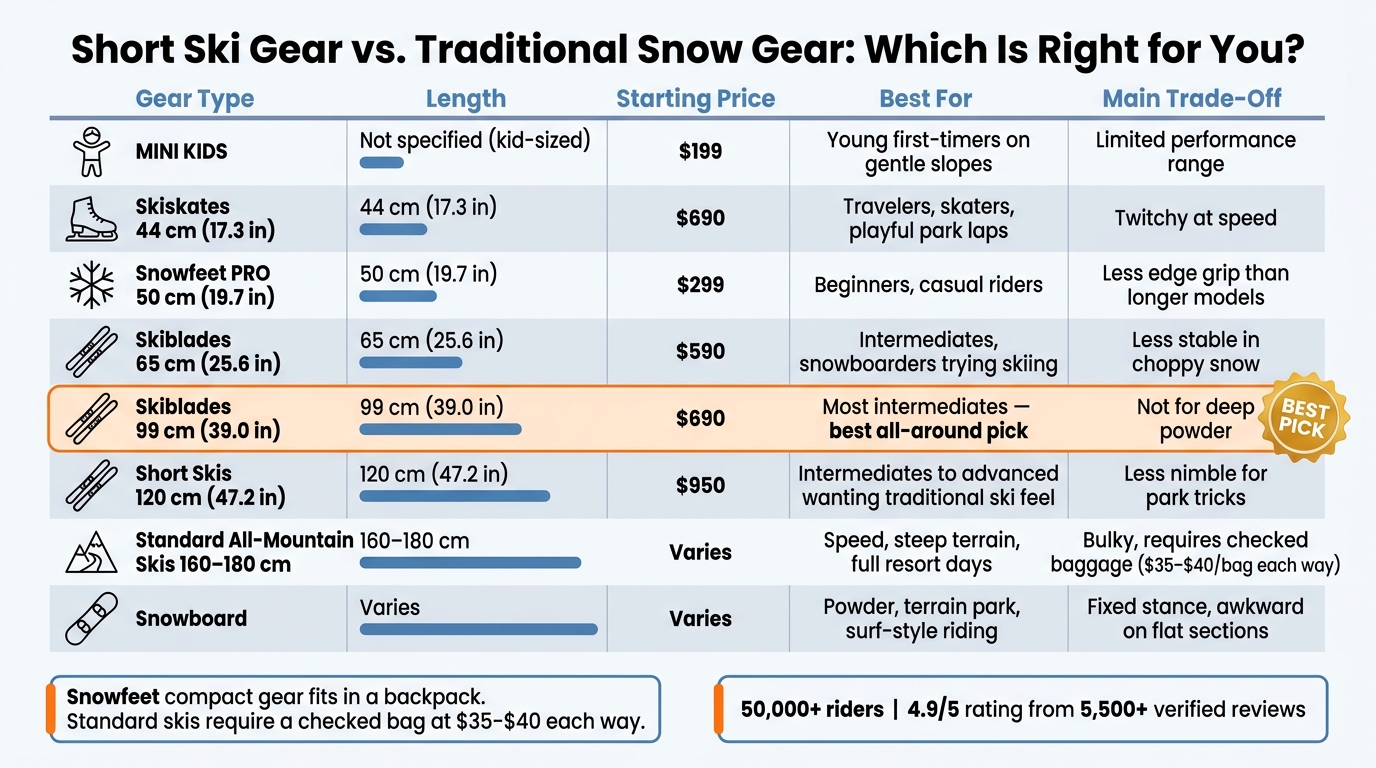
| Gear | Best For | Main Give-Up | Starting Price |
|---|---|---|---|
| Skiskates 44 cm | Travel, playful laps, skaters | Can feel twitchy at speed | $690 |
| PRO 50 cm | Beginners, casual riders | Less edge grip than longer models | $299 |
| Skiblades 65 cm | Easy turning, mellow park use | Less calm in rough snow | $590 |
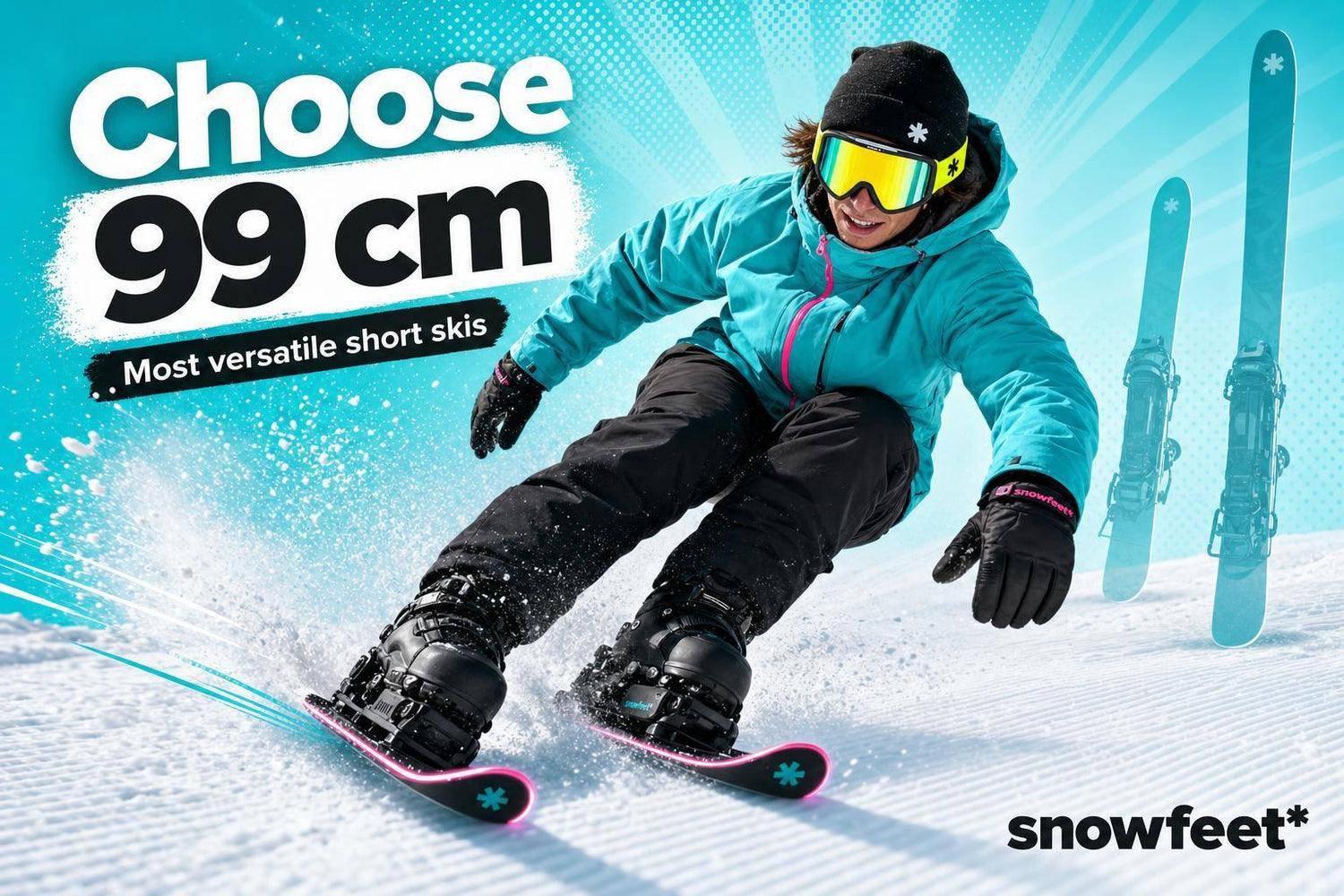
| Skiblades 99 cm | Most riders, best middle ground | Not made for deep powder | $690 |
| Short Skis 120 cm | More ski-like ride | Still not as planted as long skis | $950 |
| MINI KIDS | Young first-timers | Small performance range | $199 |
| All-mountain skis | Speed, edge hold, mixed resort days | Bulk, weight, travel hassle | Varies |
| Snowboard | Powder, park, surf feel | Fixed stance, awkward flats | Varies |
A couple quick facts stood out to me:
- Most standard skis sit around 160–180 cm
- Snowfeet skiskates are as short as 17.3 in
- Some compact models work with ski boots, snowboard boots, or even winter boots
- Snowfeet says it has 50,000+ riders and a 4.9/5 rating from 5,500+ verified reviews
So, if you want snow gear that feels more fun than fussy, this lineup makes a lot of sense. And if you want one short setup that covers the most ground, I’d start with the 99 cm skiblades.
For a quick look at short-ski riding in action, these YouTube searches help:
Short Ski Gear Comparison: Size, Price & Best Use
1. Snowfeet* Skiskates 44 cm (17.3 in)
Maneuverability vs. Stability
At $690 and a 4.95/5 rating from 123 verified reviews, the 44 cm Skiskates are the boldest shift away from long skis in this lineup.
They’re built for tight, fast turns and a feel that’s much closer to skating than standard skiing. That’s the fun part. The trade-off? As speed goes up, stability starts to fade. So if you like to open it up and charge, this model can feel a bit twitchy. For more stability at speed, the 99 cm or 120 cm models make more sense.
Terrain Match
This is the most skate-like Snowfeet option, so it shines on agility, not top-end speed.
They work well on:
- Groomed slopes
- Snow parks
- Sledding hills
They can also handle light powder up to about 4 in (10 cm). But on icy, steep, or rough terrain, they get less stable. That’s where the short length starts to work against you.
Boot and Travel Practicality
One of the best parts here is the boot setup. They fit both ski boots and snowboard boots across a wide size range. If you already snowboard, that’s nice. You can just use the boots you own and skip extra gear.
At 44 cm, they’ll fit in a backpack or carry-on, which is kind of wild if you’re used to hauling full ski gear around. That easy-to-pack size is the main thing that sets this model apart from standard skis and even most short-ski options.
Best Rider Fit
Skaters and hockey players often get the hang of these fast, sometimes in just a few minutes.
Go with these if you want the smallest and most portable Snowfeet option and care more about agility than speed. If you want that same compact feel but with a little more stability, the 65 cm Skiblades are the next move.
2. Snowfeet* Skiblades 65 cm (25.6 in)
Maneuverability vs. Stability
The 65 cm Skiblades land in a sweet middle spot. They feel more stable than the 44 cm Skiskates, but they still turn fast and feel playful.
You get a 4-meter turn radius plus a twin-tip shape, so riding forward or backward feels natural. That makes them fun for quick turns, mellow park laps, and riders who like a loose, easy feel. The downside? On firm snow at higher speeds, they won’t grip as well as a longer model.
That extra length is a big part of why the 65 cm version works better as an all-around option than the 44 cm model.
Terrain Match
These fit best on groomed blue and green runs, moguls, and small terrain park features. Their wood core, metal edges, and sintered bases give them enough structure for packed powder and soft groomers.
They’re less at home in:
- Deep powder
- Steep icy runs
- Fast groomers
That’s where the 99 cm or 120 cm models do better. If you plan to ride steeper slopes or pick up more speed, the 99 cm Skiblades are the smarter move.
Boot and Travel Practicality
One nice thing here: you can choose ski or snowboard bindings, so the 65 cm Skiblades work with either boot type.
- Ski bindings give you more precise edge control for carving
- Snowboard bindings feel more relaxed and can work well for tricks or park riding
At 3.79 lb (1,720 g) per pair with ski bindings, they’re light enough to toss in a backpack. That’s a big win for road trips, flights, or anyone who hates hauling around giant gear bags. Short skis that don’t fight you in the parking lot? Hard to complain about that :)
Best Rider Fit
These are a good match for beginner-to-intermediate riders, snowboarders who want to try skiblades, and people who want easy turns with easy travel.
If you want more speed and a steadier ride, but still like the short-ski vibe, step up to the 99 cm Skiblades.
3. Snowfeet* Skiblades 99 cm (39.0 in)
Maneuverability vs. Stability
The 99 cm Skiblades give you more stability than the 65 cm version, though full-length skis still have the edge once speeds climb. That said, these hit a nice middle ground. The deep sidecut and 6-meter sidecut radius make carving feel quick and natural, so turning doesn’t feel like work.
If you want more control but don’t want to jump straight to long skis, this is the sweet spot.
Terrain Match
These do best on groomed slopes, moguls, snow parks, and narrow trails. The twin tips also make riding backward feel easy, which is a big plus if you like to play around a bit.
Compared with the 65 cm model, the 99 cm length gives you better carving and edge hold on faster groomers. You’ll feel that extra grip. They’re not made for deep powder or hard-charging all-mountain runs. That’s not a flaw. It’s just the lane they’re built for.
If soft snow is your main thing, Snowfeet also makes a Powder 99 version with a wider shape for better float.
Boot and Travel Practicality
You can get this model in ski-boot and snowboard-boot setups. That opens the door for more riders, especially snowboarders who want to try skiing without changing their whole setup.
The compact size is also a big win for travel. They’re short enough to fit in a backpack, which is a pretty nice perk compared with full-length skis, especially for road trips or small apartment storage.
Best Rider Fit
The 99 cm Skiblades are a good match for:
- beginners and intermediate riders
- snowboarders trying skis for the first time
- travelers who want compact gear
They balance control, stability, and portability well, and the wood-core version starts at $690. If you want a bit more calm when the pace picks up, the 120 cm Short Skis are the next move.
4. Snowfeet* Short Skis 120 cm (47.2 in)
Maneuverability vs. Stability
If the 99 cm skiblades feel fun but a bit too twitchy, the 120 cm short skis give you more control. That added length brings a clear bump in stability over the 99 cm Skiblades, which you’ll notice most when your speed climbs or the snow gets rough. They still turn fast, thanks to a strong sidecut and an 8-meter sidecut radius. In the Snowfeet lineup, this is the option that feels most like a regular ski.
Another big difference is the release bindings. They give these short skis a more standard ski feel and add a nice bit of safety when you’re moving faster.
Terrain Match
The 120 cm Short Skis work well on groomers, moguls, and in snow parks. Unlike the shorter models, they’re also made to deal with softer snow and deeper powder. The camber with a tip-and-tail rocker profile helps them hold an edge on hardpack and pivot with less effort in mixed conditions. So, if you ride all sorts of snow, these are the most all-around option in this lineup.
Boot and Travel Practicality
Because of the release bindings and more standard ride feel, these come closest to a normal ski setup in this guide. They won’t disappear into a backpack, of course, but they’re still much easier to pack and carry than 170 cm all-mountain skis.
Best Rider Fit
At $950, these are the priciest option covered here. They’re a strong match for intermediates, returning skiers, and riders who like the feel of short skis but want more stability and a setup that feels familiar. If you already ride in ski boots and want the most stable short ski in this group, this is the one that makes the most sense. It’s the sweet spot before you jump to full-length skis.
5. Snowfeet* PRO 50 cm (19.7 in)
Maneuverability vs. Stability
The PRO 50 cm sits right in the middle of the lineup. It fills the space between the 44 cm Skiskates and the 65 cm Skiblades.
It’s 6 cm longer than the 44 cm Skiskates, and that extra length helps more than you might think. You get better front-to-back balance, especially on softer snow. It still has that skate-like feel, but it’s more steady than the 44 cm model. So if the 44 cm version feels a bit too twitchy, this one smooths things out without losing the fun.
Terrain Match
This model does best on groomed runs, smaller hills, snow parks, and sledding hills. That’s its sweet spot.
It can also handle light powder up to about 4 inches (10 cm) deep, which gives you a bit more room to play when the snow gets soft. But let’s be straight about it: deep powder, steep slopes, and rough ungroomed terrain are asking too much from this setup. The PRO 50 cm is built for quick turns and playful riding, not bombing straight down the hill.
Boot and Travel Practicality
One of the nice parts here is how easy it is to use. The bindings are tool-free and adjustable, with setups for:
- Ski boots
- Snowboard boots
- Winter boots
And yes, it fits in a backpack. That makes it simple to carry, stash in a car, or bring on a trip without dealing with full-size skis. Kind of a grab-and-go option, which is a big part of the appeal.
Best Rider Fit
Compared with the 65 cm Skiblades, the PRO 50 cm leans more toward portability and ease than edge hold. It starts at $299 and has over 1,500 reviews.
This model makes sense for:
- Beginners who want an easier learning curve
- Casual weekend riders
- Travelers
- Snowboarders who want a compact ski-like ride
There’s also a fun crossover here. Many skaters, inline skaters, and hockey players can adapt in about 5 minutes. That quick learning feel is a big draw.
It’s not the pick for steep, fast, or deep-snow skiing. But if your main goals are fun, portability, and ease of use, this one checks those boxes. For riders who want the smallest practical setup without dropping all the way to Skiskates, the PRO 50 cm is a nice middle ground.
6. Snowfeet* MINI KIDS
Maneuverability vs. Stability
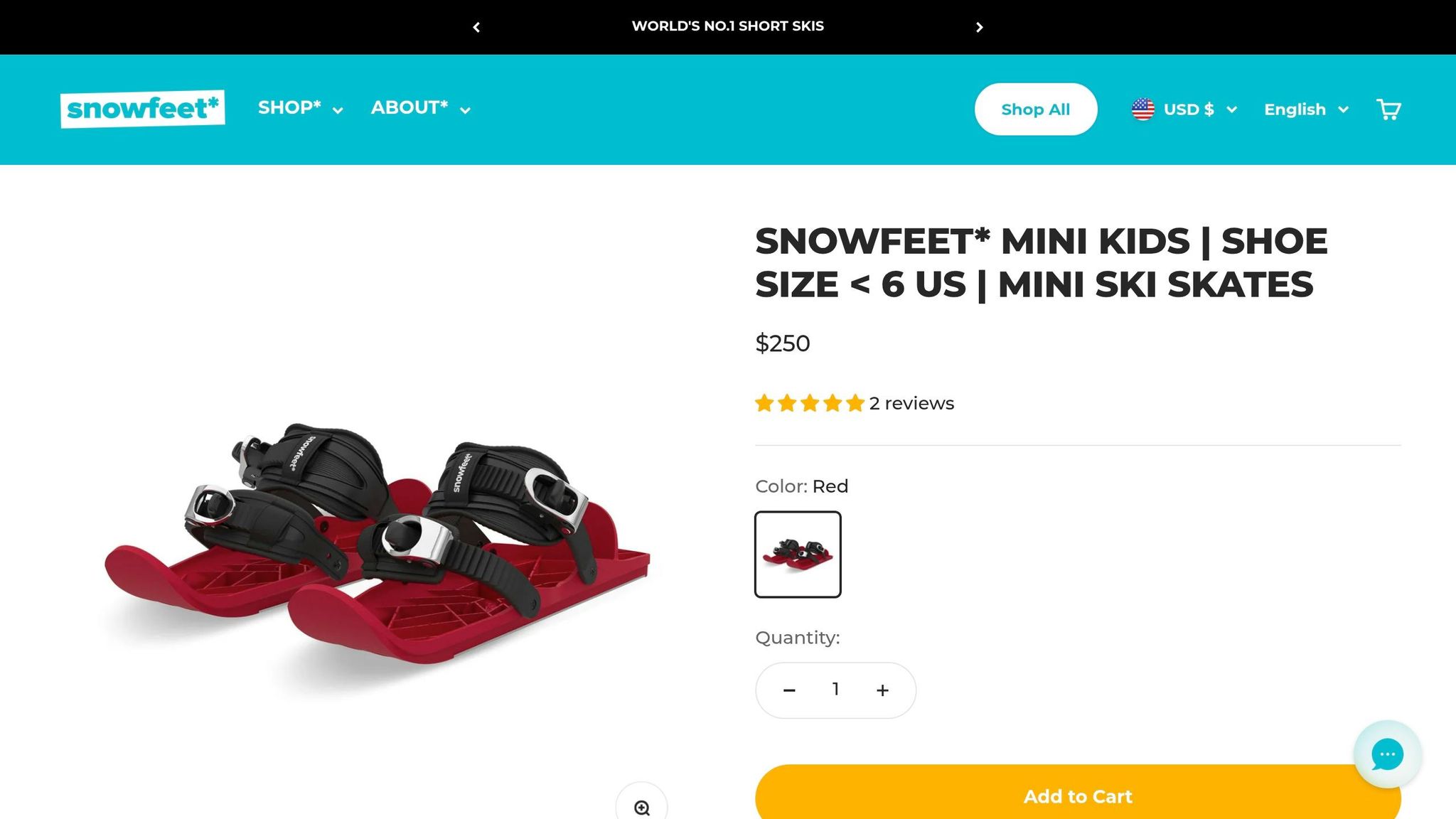
MINI KIDS is the kid-size compact pick. It’s easy to turn, easy to stop, and way less scary than long skis. For families that want compact gear instead of full-length skis, this keeps the learning curve low.
The trade-off is simple: the short length gives kids less front-to-back stability. So, some younger kids may need a little time to find their balance. Still, most kids get the hang of it fast.
Terrain Match
This model does best on groomed slopes, local sledding hills, and snow parks. It can handle light powder up to about 4 inches (10 cm), but more than that is too much. Steep, ungroomed terrain is off the table.
Best fit:
- Gentle hills
- Beginner runs
- Smooth, packed snow
Boot and Travel Practicality
MINI KIDS fits EU 27–38 / US kids' size 10 up to adult size 6. That’s a nice plus for families, because it works with winter boots. No need to deal with a full ski-boot setup.
It also packs small, which makes day trips and family travel a lot easier. Toss it in the car, head to the hill, done :)
At $199, MINI KIDS is a solid starter pick for young kids. It uses fiberglass-reinforced construction, metal edges, and a built-in heel brake for added control.
Next, compare that kid-friendly simplicity with the feel of standard all-mountain skis.
sbb-itb-17ade95
7. Standard All-Mountain Skis (160–180 cm / 63–71 in)
Maneuverability vs. Stability
Standard all-mountain skis are the control-first pick. They stay calm at speed, hold an edge well, and shine on open runs.
The tradeoff is simple: longer skis ask for more deliberate edging and cleaner weight transfer. That means Snowfeet* turns faster and feels easier to handle in tight spots.
Terrain Match
This is the area where full-length skis still come out on top. A modern all-mountain ski with about 90–100 mm underfoot and tip rocker can handle groomers, bumps, trees, and the odd powder day in one setup.
That edge matters most for riders who care more about on-snow performance than easy packing. If your goal is one ski for most resort days, this setup has a lot going for it.
Boot and Travel Practicality
Standard all-mountain skis need alpine boots and a full ski bag. That also means checked-bag fees, which often run about $35–$40 per bag each way if baggage isn’t included.
Snowfeet* skips that baggage headache, and that’s a big reason compact gear makes so much sense for travel. Less gear to drag through the airport is, well, hard to argue with :)
Best Rider Fit
Standard all-mountain skis make the most sense for intermediate to advanced riders who ski often at larger resorts and want one setup for most in-bounds conditions.
Next comes the snowboard comparison, which swaps ski-style edge control for a different kind of freedom and feel.
8. Snowboard
Maneuverability vs. Stability
A snowboard is the main classic alternative to compact ski gear, but there’s a clear trade-off: you get a fixed stance instead of free leg movement. Both feet stay locked onto one board, which gives you that surf-style ride.
Board shape and flex change the feel a lot. Shorter, softer boards are easier to turn and tend to be more forgiving for beginners. Longer, stiffer boards feel more planted when speed picks up, but they take more effort to redirect. Compared with Snowfeet*, a snowboard gives each leg less freedom to move on its own. And that doesn’t just change the feel - it changes how the board deals with powder, speed, and fast direction changes.
Terrain Match
Snowboards do best in deep powder and freeride terrain, especially directional boards. All-mountain and true-twin boards can handle groomers, side hits, switch riding, and park features, but they give up some powder performance and quick maneuverability.
For casual riders who spend most of the day on groomed runs and mixed resort terrain, Snowfeet* is the more practical and agile pick. Snowboards stay at their best when the snow gets deep and the terrain gets steep.
Boot and Travel Practicality
One nice perk: snowboard boots are much more comfortable to walk in than ski boots. That helps in parking lots, lift lines, and around the lodge.
Packing is where things get a bit clunky. A full snowboard setup usually means:
- A padded board bag
- A boot bag
- Extra space for goggles, a helmet, outerwear, and accessories
So, while the boots are easier on your feet, the full kit takes up more space and adds more weight than compact gear.
Best Rider Fit
A snowboard makes sense for riders who love the sideways, surf-style feel and want to charge powder or spend a lot of time in the terrain park. It also fits people who ride often at larger resorts with varied terrain and want a full snowboard setup built for that kind of day.
The next section breaks these differences down by the criteria that matter most: control, portability, learning curve, and terrain.
Snowboarder tries Snowfeet* | Which Snowfeet* Short Ski is the Best? | Snowblades 44, 65, 99 Review
How These Options Compare on the Criteria That Matter
Now that we’ve walked through each setup, let’s line them up side by side.
Agility vs. Stability
This is where length changes the whole feel.
The Snowfeet* Skiskates at 44 cm (17.3 in) and PRO at 50 cm (19.7 in) feel a lot like skating on snow. You get fast pivots, super short turns, and a playful ride, especially at low to mid speeds. They’re quick. Almost too quick if you like bombing hills.
Step up to the 65 cm (25.6 in) and 99 cm (39.0 in) Skiblades, and you get more stability without losing that short-ski feel. They still turn fast, but they calm down a bit when the snow gets choppy or your speed creeps up.
The 120 cm (47.2 in) Short Skis feel closest to normal skis. They give you solid edge hold and clean carving, with a ride that feels more planted.
Full-length skis still feel steadier at high speed. No shock there. But Snowfeet* stands out for quick turn initiation and easy low-speed handling. That’s the trade: less length, faster response, and gear that’s way easier to carry around.
Terrain Match
On groomers and in the park, the shortest Snowfeet* models are the most playful. They’re fun, quick, and easy to throw around.
The 99 cm and 120 cm versions give you more control when the snow gets rougher or the runs get faster. So if your day is less terrain park lap and more mixed resort cruising, those longer options make more sense.
Boot Compatibility and Packing
This part is simple: Snowfeet* is much easier to pack and carry than normal ski gear.
Most models work with winter boots or snowboard boots, which means you may not need a full ski setup. That’s a big deal if you don’t want to haul extra gear or buy ski boots just to get started.
Traditional skis still ask the most from you. More gear. More bulk. More hassle in the parking lot. We’ve all been there :)
Rider Fit at a Glance
| Gear | Best Rider | Key Trade-off |
|---|---|---|
| Skiskates 44 cm | Playful riders, travelers | Twitchy at speed |
| PRO 50 cm | Beginners, casual riders | Less edge hold |
| Skiblades 65 cm | Intermediates, park riders | Less stable in rough snow |
| Skiblades 99 cm | Most intermediates | Not for deep powder |
| Short Skis 120 cm | Intermediates to advanced | Less stable than full skis at speed |
| MINI KIDS | Kids on small hills | Limited performance range |
| Standard Skis 160–180 cm | Advanced, speed-focused skiers | Heavy, harder to pack |
| Snowboard | Powder chasers, park riders | Fixed stance; awkward on flats |
Use the table above to match each setup to your riding style. Next, we’ll break down the pros and cons of each gear type in plain terms.
Pros and Cons by Gear Type
Use this table for the fastest side-by-side read.
| Gear Type | Main Pros | Main Cons | Best For |
|---|---|---|---|
| Skiskates 44 cm (17.3 in) | Most agile, most portable | Least stable at speed | Travelers, park riders, skaters crossing over to snow |
| Snowfeet PRO 50 cm (19.7 in) | Best for quick, casual use; ultra-portable | Less edge hold than longer models | Beginners, casual riders, short local runs |
| Skiblades 65 cm (25.6 in) | Best step-up from Skiskates for riders who want more stability | Less stable in choppy snow; limited in deep powder | Intermediates, snowboarders curious about skiing |
| Skiblades 99 cm (39.0 in) | Best balance of control and portability | Not for deep powder | Most intermediates wanting performance plus portability |
| Short Skis 120 cm (47.2 in) | Closest Snowfeet* option to a traditional ski; solid stability and carving | Less nimble for park spins | Intermediates to advanced riders who prefer shorter gear |
| MINI KIDS | Light and easy to learn; pairs with regular winter boots | Limited speed range | First-time young riders on gentle slopes and beginner zones |
| Standard All-Mountain Skis (160–180 cm / 63–71 in) | Best high-speed stability; superior edge hold on ice; full resort versatility | Bulky for travel; requires checked baggage | Speed-focused skiers, steep terrain, variable conditions |
| Snowboard | Great powder float; comfortable boots; strong park and jump performance | Fixed stance limits independent leg movement | Powder chasers, park-focused riders |
Those trade-offs make it much easier to narrow things down by rider type and terrain. If you want gear that feels light, quick, and easy to toss in the car, the shorter options stand out fast. If your top goal is speed, edge grip, or all-day resort use, longer skis still have the upper hand.
It’s kind of like picking between a nimble hatchback and a long-wheelbase SUV. One feels playful and easy to move around. The other gives you more calm when the trail gets rough or the pace picks up.
Final Verdict: The Best Compact Ski Gear for Most Riders
If you ski just a few days each year, Snowfeet* can be a fun, compact option. It’s not a full stand-in for long skis or a snowboard. But for a lot of casual riders, it makes a ton of sense. Pick the model based on how you like to ride.
Here’s the short version.
| Your Profile | Best Snowfeet* Pick | Starting Price |
|---|---|---|
| Traveler who wants carry-on-friendly gear | Skiskates 44 cm (17.3 in) | $690 |
| Beginner or casual weekend rider | Skiblades 99 cm (39.0 in) | $690 |
| Playful park or trick rider | PRO 50 cm (19.7 in) | $299 |
| Experienced skier who wants the closest thing to a traditional ski feel | Short Skis 120 cm (47.2 in) | $950 |
| Young child on a first-time family trip | MINI KIDS | $199 |
| Intermediate wanting a step up from skiskates | Skiblades 65 cm (25.6 in) | $590 |
If you want the one that does the most for most people, start with the 99 cm Skiblades.
That’s the sweet spot. They give you a nice mix of control, portability, and an easier learning curve. Put simply, the 99 cm Skiblades are the most versatile pick for control, portability, and stability.
If you come from snowboarding, you’ll often adjust fastest to the 99 cm or 120 cm models.
Long skis and snowboards still do better at high speeds, deep powder, and steep terrain. But for most casual U.S. riders, Snowfeet* is the smarter, easier-to-live-with choice.
FAQs
Are short skis harder to control?
No. Short skis are usually easier to control than long, standard skis.
Their smaller size makes it simpler to turn, stop, and keep your balance. For many people, that means a smoother start and less of that "I might eat snow in five seconds" feeling :)
Long skis do have an edge when you're moving fast or riding in deep powder. But Snowfeet models are built for agility, fast response, and precise handling.
Which Snowfeet* model should I start with?
Most beginners should start with the 44 cm Skiskates or 65 cm Skiblades. Both are easy to turn, simple to control, and easier to learn on than regular skis.
Pick the 44 cm Skiskates if you want the most straightforward option. They work with regular winter boots or snowboard boots, which makes things nice and simple.
For young kids ages 3–6, the 38 cm MINI KIDS is the best place to start.
Can I use my regular winter boots?
Yes. One of the main perks of Snowfeet gear is that many models work with regular winter boots.
That means you don’t always need ski boots to get started. Depending on the model and binding style, you may also be able to use snowboard boots or ski boots.
The shorter options - especially Mini Ski Skates - are built to strap onto everyday winter footwear. So, you can skip specialized ski boots and keep things more convenient and affordable.











ฝากความคิดเห็น
เว็บไซต์นี้ได้รับการคุ้มครองโดย hCaptcha และมีการนำนโยบายความเป็นส่วนตัวของ hCaptcha และข้อกำหนดในการใช้บริการมาใช้