



















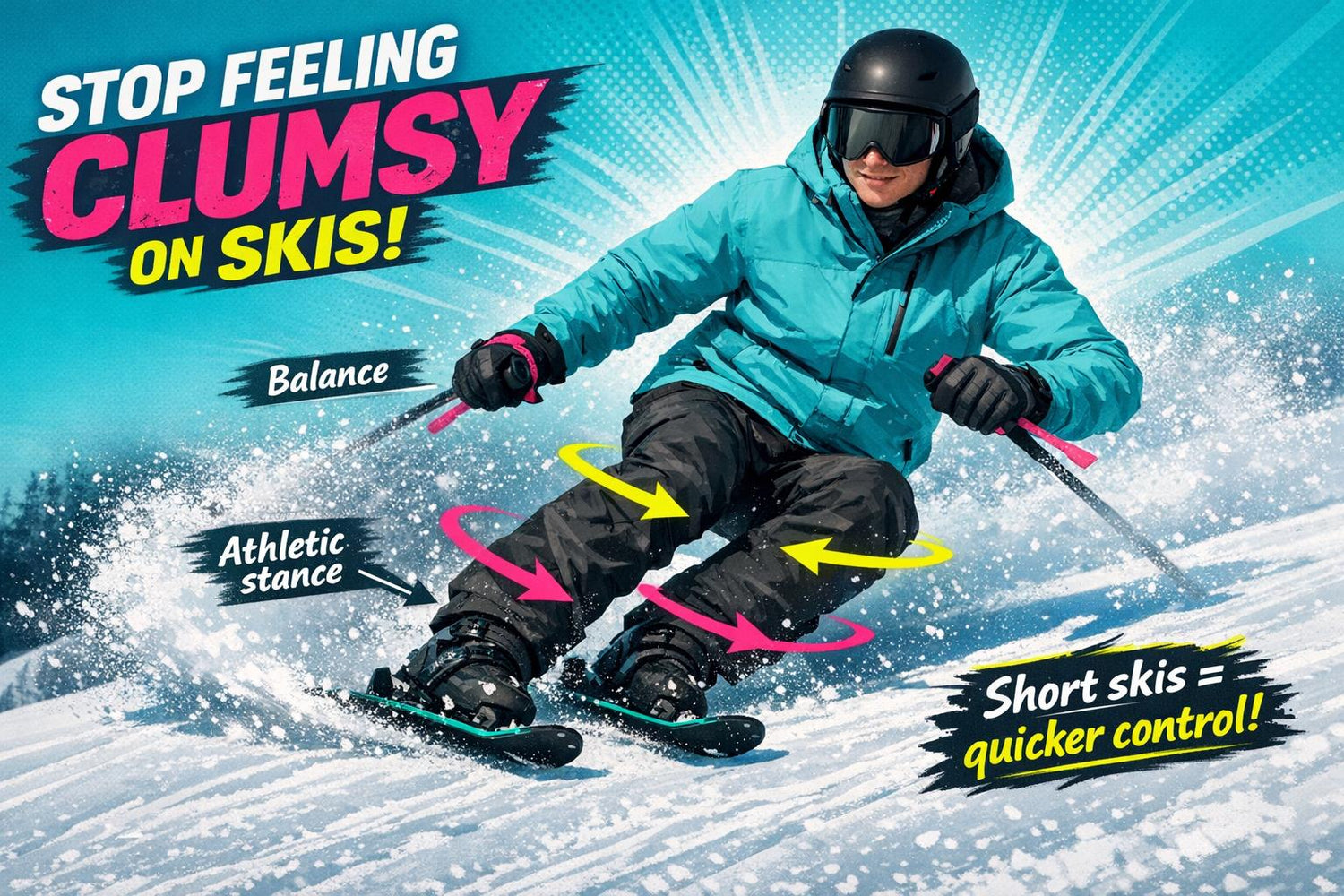
Ever feel like skiing is more about surviving than enjoying? You’re not alone. Many beginners struggle with balance, control, and confidence on the slopes. The good news? A few simple changes can make skiing feel smoother and way more fun. Here’s the gist:
- Fix your stance: Keep your knees bent, weight forward, and shins lightly pressing into your boots.
- Let your legs do the work: Steer with your feet and knees, not your shoulders.
- Start small: Shorter skis, like Snowfeet* Skiblades or Mini Ski Skates, are easier to control and perfect for beginners.
Whether you’re just starting or trying to improve, focus on one skill at a time. Use drills to build balance and practice on easy terrain. And don’t stress - falling is part of the process. With the right stance, movements, and gear, you’ll feel more confident in no time. Let’s dive into the details!
Snowfeet* & Skiskates Tutorial - How to Become a PRO Skiskater
Why You Feel Clumsy on Skis
Feeling awkward on skis? Don’t worry, it’s super common and often comes down to a few fixable habits. Once you know what’s causing the issue, you’ll be carving turns with confidence in no time.
Common Causes of Clumsiness on the Slopes
One of the biggest reasons skiers feel unsteady is leaning back. When you lean back, your ski tips lift off the snow, making it harder to control your movements. To fix this, focus on pressing your shins forward into your boots - this keeps your ski tips engaged and ready to respond.
Another common mistake is using your upper body to steer. If you’re turning with your shoulders instead of letting your legs do the work, you’ll lose control. Keep your upper body stable and let your legs guide the turns.
Other issues, like crossing ski tips or catching an edge, often come from a stance that’s too narrow or uneven weight distribution. Small tweaks - like widening your stance and keeping your weight balanced - can make a big difference.
How Long Skis Make Things Harder
Long skis can be a real challenge, especially for beginners. They’re harder to turn, which can tempt you to overcompensate with your upper body. This only makes things worse, creating a cycle of clumsiness.
Longer skis also amplify mistakes. For instance, a slight lean back on shorter skis might be manageable, but on longer skis, it can cause the tips to lose grip entirely. Plus, with more ski in front of and behind your feet, it takes longer to recover from any imbalance. On busy slopes at places like Park City or Vail, the extra effort to control long skis can lead to fatigue, which makes maintaining good technique even tougher.
If long skis feel overwhelming, consider starting with something shorter and more nimble. Options like Snowfeet* give beginners better control and an easier learning curve.
How to Improve Your Balance and Stance
Balance on skis starts with nailing your stance. Once that's dialed in, a few simple drills can help you lock it down.
The Basic Athletic Ski Stance
Think of it like getting ready to shoot hoops: feet hip-width apart, knees slightly bent, and your weight centered. Keep your skis parallel with your ankles and knees flexed just enough so your hips are stacked over the middle of your feet - not hanging back behind your heels.
A key tip? Keep light shin-to-boot contact. Flex your ankles to press your shins gently into the front of your boots (don’t just hinge at your waist). This helps keep your weight forward, which keeps your ski tips gripping the snow. And don’t forget your hands - hold them out in front of you, somewhere between waist and chest height, like you’re holding a steering wheel. This helps you stay balanced and ready to move.
Here’s a quick self-check: on easy terrain, bounce lightly on your feet. You should feel pressure on the balls of your feet, not your heels. If your heels are bearing the weight, push your shins forward to reset your stance.
Simple Drills to Build Better Balance
Drills paired with the right gear can really lock in your balance. Start on gentle terrain and try these:
- Side-to-side weight shifts: Glide slowly in a straight line and shift your weight gently to your right ski, then your left. Keep your shoulders steady and make the shifts with your legs only.
- Lift-a-ski drill: At low speed, lift the tail of one ski about an inch off the snow, then set it back down and switch sides. If you struggle to balance, it might mean your hips are leaning back - adjust by moving forward and try again.
Focusing on one drill at a time for five to ten runs helps build muscle memory that sticks.
Why Snowfeet* Makes Balance Easier
Snowfeet* gear changes the game for beginners. Unlike traditional long skis, which can be tricky and unforgiving, Snowfeet* gear is compact and precise. Long skis act like levers, amplifying small mistakes. For example, leaning back even slightly on long skis can cause your tips to lose grip, making it harder to stay in control.
Snowfeet* Skiblades (available in 65 cm and 99 cm) or the even smaller Snowfeet* Mini Ski Skates (38 cm) eliminate this issue. Their shorter length makes them much more forgiving. You’re less likely to cross your tips - something that trips up a lot of beginners - and they’re lighter and easier to maneuver. This makes it simpler to keep your hips centered and focus on steering with your legs, which is crucial for building strong balance.
Here’s a quick comparison:
| Balance Factor | Traditional Long Skis | Snowfeet* Short Skis & Skates |
|---|---|---|
| Forgiveness of back-seat posture | Low - tips may wash out quickly | High |
| Tip crossing risk | Higher for beginners | Much lower due to compact length |
| Ease of weight shift drills | Harder at slow speeds | Easier; gear responds quickly to leg movements |
| Overall learning curve | Steeper | Noticeably faster for most beginners |
Snowfeet* gear simplifies the process, making it easier to focus on the fundamentals and gain confidence faster.
Basic Movements for Better Control
Once you’ve nailed your balance and stance, it’s time to refine your movements. A common mistake many beginners make is relying on their upper body to steer instead of using their legs. This can lead to awkward, unpredictable turns and throw off your balance.
Use Your Legs to Turn, Not Your Shoulders
Here’s the golden rule: keep your upper body facing downhill and let your legs do the work. When you try to steer with your shoulders, your skis tend to skid out of control, making it harder to stay balanced.
To fix this, focus on keeping your hands forward and visible, around waist height, like you’re holding a tray. Pick a spot downhill - maybe a lift pole or a sign - and keep your chest pointed toward it. Then, steer by rotating your feet and knees in the direction you want to go. This keeps your torso stable and helps you make smoother, more controlled turns.
Pro tip: If you notice your hands swinging around during turns, it’s a sign you’re using your upper body too much. Refocus on steering with your legs instead.
Beginner Drills to Build Confidence
Here are three drills that can help you master smoother turns and feel more in control on the slopes:
-
Static steering:
On flat ground, stand in a wedge with your skis stationary. Slowly rotate your feet and knees left and right for 10–15 repetitions on each side. Keep your shoulders steady to focus entirely on leg movement. -
Garlands:
Find a gentle slope and traverse across it in a wedge. Gradually steer your skis slightly downhill, then back across the hill - like a garland hanging on a wall. Repeat this 4–6 times per run, alternating directions. The goal isn’t to complete full turns yet; it’s about practicing how to start and stop a turn with control. -
Linked S-turns:
Begin in a wedge and slide straight for a few feet. Then, guide your skis into a wide arc to the left until you’re crossing the hill. Smoothly shift into a right arc, creating a rhythm of linked turns. Aim for round, flowing turns instead of sharp, jerky movements. Control your speed by completing each turn across the slope, not by braking suddenly. Most beginners need a few days on the snow before these linked turns start to feel natural. Short, focused practice sessions (10–15 minutes per drill) are more effective than long, tiring ones.
How to Apply These Techniques with Snowfeet* Gear
Once you’re comfortable with these drills, using them with Snowfeet* gear becomes second nature. The compact design of Snowfeet* gear responds well to small, precise movements. Keep your knees bent and your weight forward, and avoid abrupt steering - short skis like these can feel jerky if you force them.
As mentioned earlier, maintaining a forward stance is key. Snowfeet* gear, like the Snowfeet* Skiblades (65 cm or 99 cm) or the Snowfeet* Mini Ski Skates (38 cm, starting at $250), makes this easier. Their short length allows for quick pivots at lower speeds, so there’s no need to muscle your way through turns.
When it’s time to stop, steer across the hill to naturally reduce your speed. Then, roll your ankles and knees into the slope to set a firm edge. Stick to the same leg-driven steering technique while keeping your upper body steady. With Snowfeet* gear, this kind of precise edging feels natural and effortless - especially compared to managing longer skis on groomed trails.
sbb-itb-17ade95
Choosing Gear That Helps You Ski Better
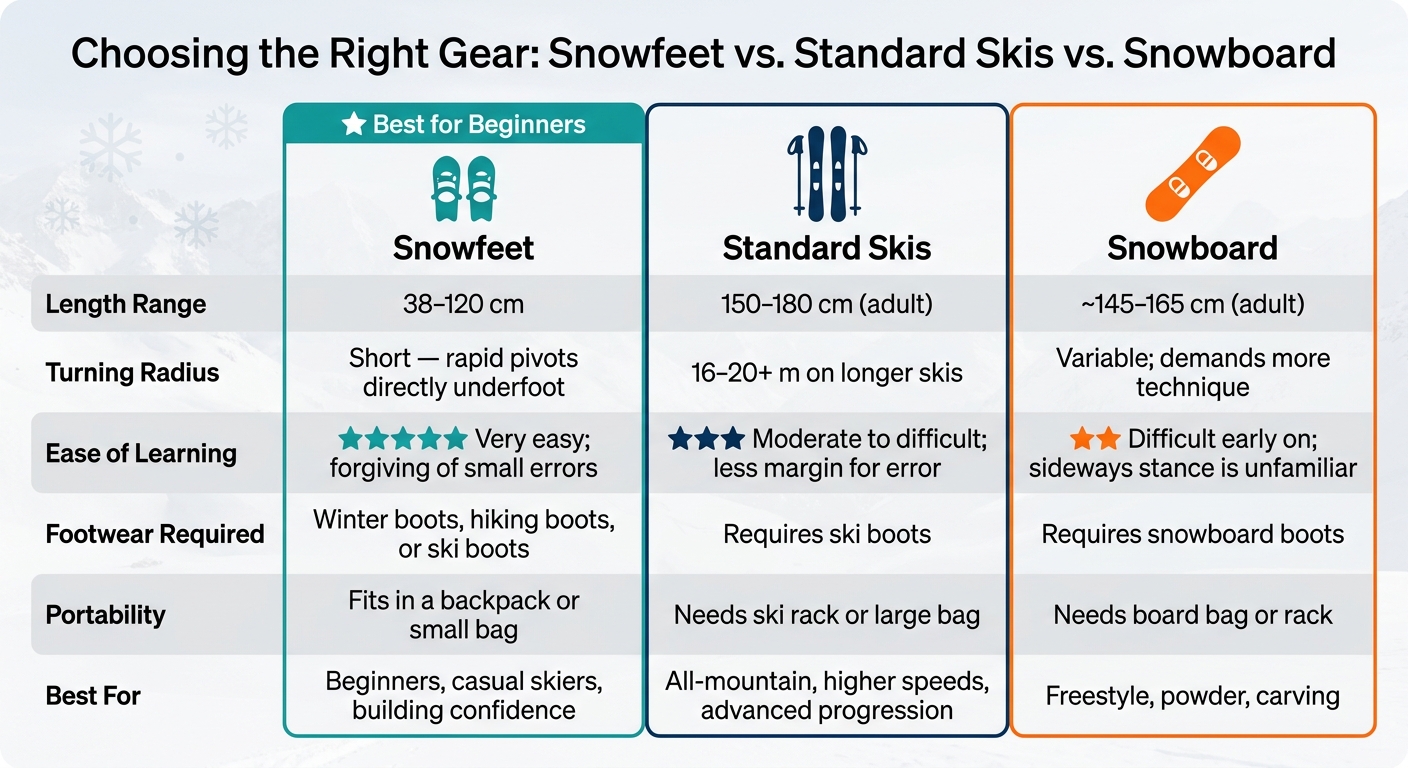
Snowfeet vs. Standard Skis vs. Snowboard: Beginner's Gear Comparison
The right gear can make or break your skiing experience. Even with excellent technique and drills, your equipment needs to work with you - not against you. If your setup feels like a battle, skiing will never feel as smooth as it should.
Why Standard Ski Gear Can Hold You Back
Most rental shops hand beginners all-mountain skis that are way too long. These skis, often between 150–180 cm for adults, are tough to control at slow speeds. A small wobble can send you veering off course, making it harder to stay balanced. The design itself creates these challenges.
Then there are ski boots. Traditional models limit ankle movement, which adds to the discomfort. For beginners, this stiff, unforgiving setup can make learning harder than it needs to be. That’s where Snowfeet* gear changes the game.
Snowfeet*: A Smarter Choice for Beginners
Snowfeet* gear is designed to make skiing easier and more enjoyable, especially if you're just starting out. With shorter lengths and more forgiving designs, Snowfeet* products let you focus on improving your technique instead of wrestling with your equipment.
- The Snowfeet* Mini Ski Skates (38 cm, starting at $250) are the most compact option. Their short length makes steering feel natural and responsive, with turns happening almost directly underfoot. Plus, they work with regular insulated winter boots, so you can skip the stiff, uncomfortable ski boots.
- The Skiblades (65 cm, from $635, or 99 cm, from $675) offer a balance of control and performance. They’re short enough for quick, easy turns but long enough to carve cleanly on groomed trails.
- For those aiming to transition to traditional skiing, the Snowfeet* Short Skis (120 cm, $775) are a great stepping stone. They’re more forgiving than standard all-mountain skis while still offering a taste of traditional skiing.
This gear aligns perfectly with the techniques mentioned earlier, giving you the tools to practice and progress with confidence.
Snowfeet* vs. Standard Ski Gear: Side-by-Side Comparison
| Feature | Snowfeet* Products | Standard Skis | Snowboard |
|---|---|---|---|
| Length range | 38–120 cm | 150–180 cm (adult) | ~145–165 cm (adult) |
| Turning radius | Short, enabling rapid pivots | 16–20+ m on longer skis | Variable; demands more technique |
| Ease of learning | Very easy; forgiving of small errors | Moderate to difficult; less margin for error | Difficult early on; sideways stance is unfamiliar |
| Footwear | Winter boots, hiking boots, or ski boots | Requires ski boots | Requires snowboard boots |
| Portability | Fits in a backpack or small bag | Needs ski rack or large bag | Needs board bag or rack |
| Best for | Beginners, casual skiers, building confidence | All-mountain, higher speeds, advanced progression | Freestyle, powder, carving |
The takeaway? If you’re tired of feeling clumsy on the slopes, shorter gear like Snowfeet* gives you the control and comfort you need to build confidence. You’ll find it easier to stay balanced, avoid crossing your tips, and enjoy the freedom of wearing boots that don’t feel like a chore.
A Simple Plan to Build Confidence on Skis
Good gear sets the stage, but a thoughtful practice plan is what really builds confidence. The aim? To feel steady and in control on every run. Here's a straightforward approach to help you get there, step by step.
Start on Easy Terrain and Build Gradually
Begin on a green (beginner) run with a gentle, wide slope. This type of terrain keeps your speed manageable, giving you fewer decisions to make and more time to focus on the basics. Plus, it’s a lot less intimidating, which helps you stay calm and in control.
Stick to one skill per session. On your first outing, work on sliding in a straight line and coming to a clean stop. Once that feels second nature - meaning you can do it smoothly and confidently several times in a row - move on to gentle wedge turns. The key is to master one thing before tackling the next. Jumping ahead too soon can leave you feeling unsteady and frustrated.
If you’re using Snowfeet* Skiblades or Mini Ski Skates, you’ll notice that their shorter length makes turning easier. Because the turns happen almost directly under your feet, you get quicker feedback, which helps you learn faster on beginner-friendly slopes.
Keep Practice Sessions Short and Focused
When you’ve gotten comfortable on easier slopes, keep building your skills with focused, bite-sized practice sessions. Why short? Fatigue messes with balance and coordination, which can lead to bad habits. To avoid that, stick to sessions of 60–120 minutes, as recommended by ski schools and the PSIA (Professional Ski Instructors of America).
Take breaks when needed, and keep each run purposeful by focusing on a single mental cue, like “relax your shoulders” or “press into your boots.” Always end your session with an easy, successful run. That way, your brain associates skiing with control and confidence - not frustration.
Stay Relaxed and Enjoy the Process
Relaxation is your secret weapon. Tension - whether in your legs, shoulders, or mindset - makes skiing harder than it needs to be. Before each run, take a moment to breathe deeply a couple of times, shake out your arms, and remind yourself that it’s okay to take it slow.
And if you fall? No big deal. Treat it as feedback. Maybe you leaned too far back or rushed a turn - whatever the case, adjust calmly and move on. Sports psychology research shows that positive self-talk and a playful mindset can do wonders for your performance. Try drills like gentle zig-zags to make practice feel more like play. This relaxed approach not only makes skiing more enjoyable but also helps you adapt and learn faster.
Progress in skiing isn’t a straight line, and that’s okay. The skiers who embrace easy terrain and stay patient often improve much faster than those who push too hard, too fast. So, take your time, stay relaxed, and enjoy the ride!
Conclusion: Ski with Confidence Using Snowfeet*
Feeling unsteady on skis doesn’t define you - it’s just where you’re starting. The key to progress boils down to three essentials: a solid stance, regular practice, and gear that suits your skill level.
Focus on keeping your knees bent and your weight centered for a balanced stance. Pair this with consistent practice and the precision of Snowfeet* gear, and you’ll go from shaky to smooth in no time. It’s amazing how quickly confidence grows when you stick with it.
Snowfeet* gear can make a big difference right from the start. Its compact design makes it easier to control your movements, giving you smoother turns and quicker responses. Instead of struggling with bulky equipment, you can focus on improving your technique. Use these tips every time you hit the slopes, and you’ll notice the shift from clumsy to confident.
Learning to balance, steer with your legs, and manage edge control using Snowfeet* gear lays a great foundation for transitioning to longer skis. Stick to easy terrain, work on one drill at a time, and don’t rush yourself. The slopes will always be there, and so will your chance to keep getting better.
FAQs
Should I take a lesson or can I fix clumsiness on my own?
You don’t need formal lessons to stop feeling awkward on skis. Traditional long skis can throw off your balance because of their size and weight. But there’s a simpler option: Snowfeet skiskates or skiblades. These are compact and lightweight, making them much easier to control. Most beginners can pick up the basics in just 15–30 minutes - a huge time saver compared to learning with traditional ski gear.
How do I know if my skis are too long for me?
Skis that are too long can make quick turns harder and tire you out faster because of the extra effort needed to control them. They can also make it tricky to maintain stability at lower speeds or execute precise stops. Instead of traditional long skis (typically over 160 cm), compact alternatives like Snowfeet Skiblades and Skiskates are much easier to handle. They provide better balance and are more forgiving, making them a great choice for a smoother experience.
Are Snowfeet* Skiblades or Mini Ski Skates easier than skis or a snowboard?
Yes, Snowfeet Skiblades and Mini Ski Skates are a breeze compared to traditional skis or snowboards. Thanks to their shorter and lighter design, they’re less bulky, making it easier to balance and turn naturally. Most beginners can get the hang of it in just 1–2 hours - way faster than the days it often takes with standard gear. Plus, their skate-like design means you can use your regular winter boots or snowboard boots, skipping the hassle (and expense) of specialized ski boots.











ฝากความคิดเห็น
เว็บไซต์นี้ได้รับการคุ้มครองโดย hCaptcha และมีการนำนโยบายความเป็นส่วนตัวของ hCaptcha และข้อกำหนดในการใช้บริการมาใช้