



















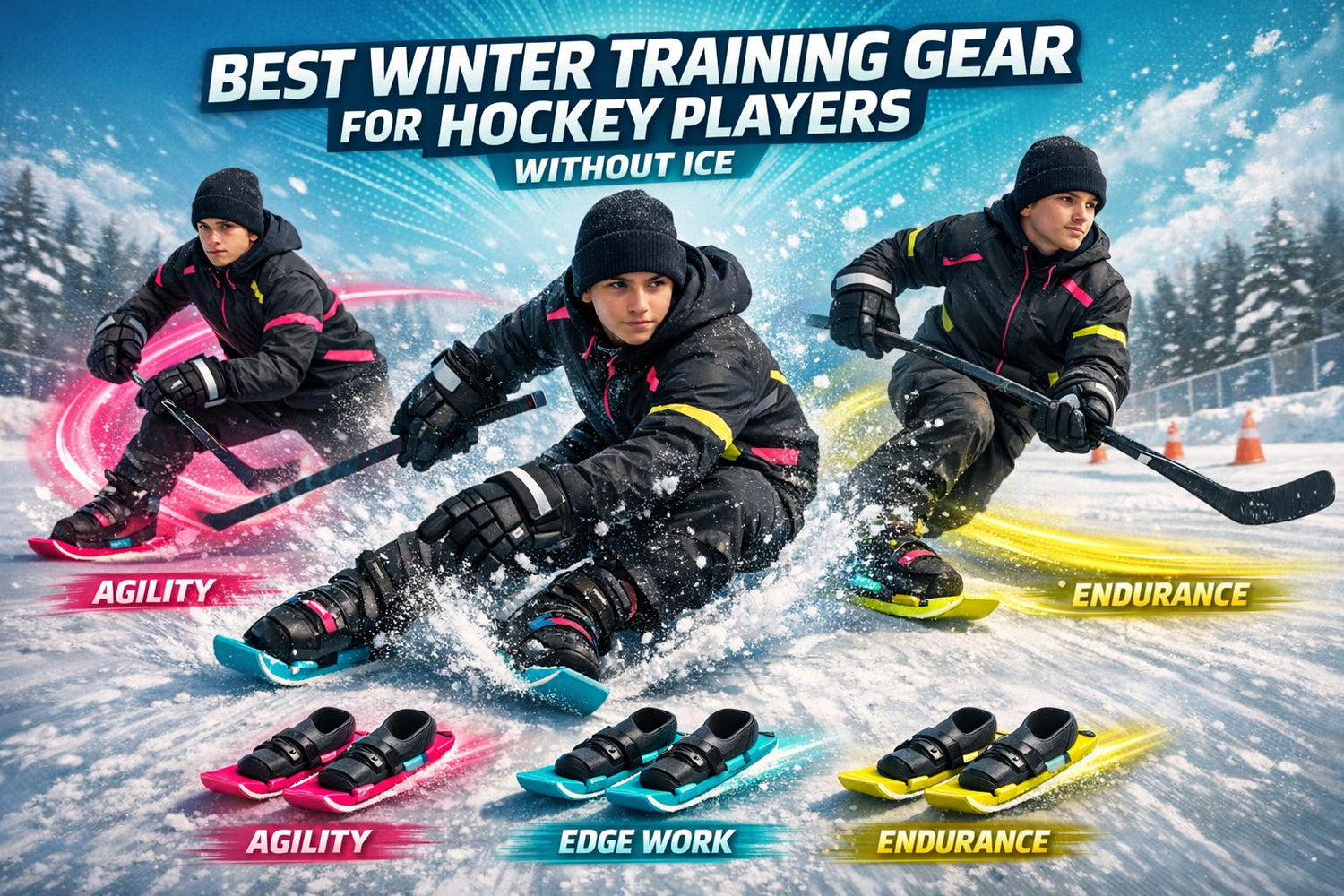
If you’re a hockey player looking to train in winter but don’t have access to ice, Snowfeet* gear offers a great solution. These ski-skate hybrids are designed to mimic skating movements like knee bends, edge control, and weight shifts - all crucial for hockey. Whether you're practicing tight turns, quick stops, or endurance drills, there’s a model for every skill level and budget.
Here’s a quick breakdown of the top options:
- Mini Ski Skates (38 cm): Small, portable, and affordable ($250). Great for agility drills and youth players.
- Skiskates (44 cm): Compact and precise ($575). Ideal for sharp turns, hockey stops, and edge control.
- PRO (50 cm): Balanced performance ($275). Perfect for intermediate players focusing on skating technique.
- Skiblades (65 cm): Longer and stable ($635). Best for refining stride and edge work on moderate slopes.
- Short Skis (120 cm): Longest option ($775). Designed for advanced players building power and endurance.
Key takeaway: Snowfeet* products let you practice skating techniques on snow, making them a practical training tool for hockey players during the off-season. Choose based on your skill level, training focus, and terrain. Always wear protective gear and start slow to get the hang of it.
1. Snowfeet* Skiskates 44 cm
The Snowfeet* Skiskates 44 cm, measuring just 17.3 inches in length, are the most skate-like option in the Snowfeet* lineup. Starting at $575, they feature a wood core, durable metal edges, and a parabolic sidecut - similar to what you'd find in traditional skis - allowing for sharp carving and precise control.
Skating-Movement Similarity
Their short length sets them apart, enabling movements that aren't possible with standard skis. You can pull off tight turns, pivots, and even hockey stops in small spaces. For hockey players, these skates allow for forward and backward C-cuts, lateral pushes, and quick acceleration-deceleration drills that mimic on-ice skating. As Snowfeet* explains:
"If you play hockey, ice skate, or rollerblade, this will feel completely natural."
Balance and Edge Control
Using Snowfeet* Skiskates is all about balance. Their compact design requires constant micro-adjustments in your ankles, knees, and hips to stay centered, much like ice skating. The parabolic sidecut gives you precise edge control, making weight shifts smooth and deliberate - ideal for hockey players working on edge engagement. If you’ve skated before, you’ll likely pick it up in about 5 minutes, though a few tumbles are almost guaranteed at first. Protective gear is a must.
Portability
These skates are incredibly portable. They fit into a regular backpack - no need for a ski bag, boot bag, or roof rack. Just toss them in your trunk with your hockey gear, and you’re ready to practice wherever there’s packed snow. For players who can’t always access ice rinks, this convenience allows for extra training sessions throughout the winter. Anytime there’s snow, you’ve got a practice spot.
Terrain Flexibility
The Skiskates 44 cm perform best on groomed or packed snow, like snow-covered sports fields, gentle slopes, or sledding hills. They can handle light powder up to 4 inches deep, but deeper snow makes gliding and edge control more challenging. Avoid pure ice or areas with hidden obstacles like rocks or roots. A quick test: if you can walk on the snow without sinking more than a couple of inches, it’s good enough for drills. This versatility makes them a great off-ice training tool that closely mimics on-ice performance.
2. Snowfeet* Mini Ski Skates 38 cm
The Snowfeet* Mini Ski Skates are a compact, hockey-inspired tool for winter training. At just 15 inches long (38 cm), these skates are the smallest in the Snowfeet* lineup, making them perfect for agility and hockey movement practice. Starting at $250, they’re also the most budget-friendly option and can be strapped directly onto standard winter boots.
Skating-Like Movement
These mini skates are designed to mimic the feel of skating on ice. Their short length allows for explosive strides, quick lateral movements, and sharp turns - just like on the rink. Snowfeet* explains it best:
"You just need to keep your balance, which is natural for those who play ice hockey, ice skate, or use inline skates."
Stopping is also familiar, with a technique similar to the classic hockey stop. If you’re already comfortable on ice, the transition to these skates feels intuitive.
Balance and Edge Control
The shorter length of these skates demands more active balance, which is great for hockey training. Unlike longer skis, they force you to engage your core and lower body constantly, helping refine your edge control. The metal edges allow for precise inside and outside edge work, tight turns, and single-leg glides. However, their reduced stability might be tricky for beginners or those without skating experience, so protective gear is a must.
Easy to Carry
At just 38 cm, these skates are small enough to fit in a standard backpack. Since they attach directly to winter boots, they’re incredibly portable. You can toss them in your car for impromptu training sessions or pack multiple pairs for team practice - something that’s nearly impossible with traditional skis or hockey skates.
Versatile for Different Terrains
These skates shine on firm, packed snow, like groomed fields, golf courses, or gentle hills often found in northern U.S. winters. They grip and glide best on this type of snow, offering a realistic skating feel. Deep powder, however, isn’t ideal - it bogs down the skates and disrupts the skating-like motion. For training, you can set up cone drills on flat packed snow or simulate short shifts on a gentle slope, focusing on stride, tempo, and quick turns.
3. Snowfeet* PRO 50 cm
The Snowfeet* PRO, priced at $275, is a step up from the Mini Ski Skates (38 cm) and a solid alternative to the Skiskates 44 cm. It strikes a balance between stability and agility, making it perfect for hockey-focused off-ice training. Unlike traditional skis that can feel clunky, the PRO delivers the nimbleness you need while keeping you steady.
Skating-Movement Similarity
With a length of 50 cm (about 19.7 inches), the PRO allows for quick strides, lateral pushes, and C-cuts that mimic the movements of on-ice skating. You can practice edge weight transfer, explosive strides, and those all-important C-cuts on packed snow or gentle slopes. Plus, the glide phase in each stride helps reinforce proper skating posture - knees bent, chest forward, and weight balanced on the balls of your feet. It’s like bringing the rink to the snow.
Balance and Edge Control
The PRO isn’t just about speed - it also challenges your balance and edge control. By tilting your ankles and knees, you can engage the edges effectively, sharpening the movements needed for tight turns and quick pivots. Want to up the intensity? Coaches can add resistance bands or even light shoulder taps during drills to simulate real-game physical contact. It’s a great way to build stability and strengthen your core at the same time.
Portability
At just under 20 inches, the PRO is compact and easy to carry. Toss it in your car trunk or clip it onto your backpack - no need for a bulky roof rack. It straps right onto your regular winter boots, so there’s no need to invest in special ski boots. This makes it super convenient to squeeze in a 30–45 minute training session, whether it’s before work, after school, or during a quick break. The portability means you can train almost anywhere without hassle.
Terrain Flexibility
The PRO shines on packed snow and gentle slopes, making it ideal for places like groomed parks, golf courses, or mild hills - perfect for drills like short sprints, cone zigzags, and pivot transitions. However, it’s best to avoid deep powder, steep slopes, or icy surfaces. Deep snow slows your glide, steep hills turn it into downhill skiing, and icy patches make edge grip tricky, increasing the chance of falls. By sticking to the right terrain, you can focus on refining the skills that translate directly to on-ice performance.
4. Snowfeet* Skiblades 65 cm
The Snowfeet* Skiblades, priced at $635, are the longest "skate-style" option in the Snowfeet* lineup before venturing into short-ski territory. Measuring 65 cm (about 25.6 inches), they strike a balance between stability and agility. While they offer more glide and control than the shorter models, they remain far more maneuverable than traditional skis, which typically range from 150–180 cm. If you're aiming to refine stride technique and edge work rather than focusing solely on quick, sharp movements, these are a solid choice for honing those skills.
Skating-Movement Similarity
True to the Snowfeet* design philosophy, these Skiblades prioritize precision and agility. However, their added length makes them particularly suited for stride refinement. They’re perfect for drills like long-stride acceleration, wide crossover circles, and seamless backward-to-forward transitions, all of which mimic high-speed ice skating movements. The extended edge contact enhances weight transfer, making it feel more deliberate and skating-like, especially during extended crossover sequences or curved edge transitions spanning 50–100 feet on packed snow.
Balance and Edge Control
The 65 cm length demands solid technique. Any slight misalignment quickly reveals itself, offering instant feedback to help fine-tune your form. Drills such as inside-to-outside edge holds, one-foot glides, and quick lateral hops challenge your balance while boosting ankle mobility and knee flexion. These skills translate directly to better gap control on defense and sharper offensive cutbacks. Designed for players aged 13 and up with a strong skating foundation, this model is ideal for those focusing on power and efficiency. Plus, the design is practical, making it easy to transport and store.
Portability
Even at 65 cm, these Skiblades are compact enough to fit across a car's back seat or trunk without the need for a roof rack. While a bit heavier than the shorter 38–50 cm models, they can be easily stored in a dedicated trunk gear bag. At home, they stack neatly alongside your hockey gear in a closet or garage, keeping your setup organized and hassle-free.
Terrain Flexibility
The Skiblades shine on firm, packed snow - think groomed park hills, sledding runs, or snow-covered golf courses. To get the best performance, stick to well-compacted surfaces and avoid conditions that might compromise edge grip. For players in the U.S. dealing with unpredictable winter conditions, finding a reliable spot with consistently packed snow - like a shaded park hill or a closed golf course fairway - can make all the difference for quality practice sessions.
sbb-itb-17ade95
5. Snowfeet* Short Skis 120 cm
At $775, the Snowfeet* Short Skis 120 cm stand out as the most ski-like option in the Snowfeet* lineup. At roughly 47 inches long, these skis offer a significant upgrade over shorter models, thanks to their sustainable wood core, full metal steel edges, and ski boot bindings. This design makes them less about mimicking skates and more about building the lower-body mechanics and conditioning that translate to better on-ice performance.
Skating-Movement Similarity
While these won’t replace traditional skates, they’re excellent for training core skating movements. The longer length doesn’t provide the ultra-tight, skate-like feel of the 44 cm Skiskates, but it does offer a stable platform for practicing lateral weight transfer and stride timing. Drills like alternating C-cuts, slalom turns, and stop-and-go patterns on gentle slopes can help refine your skating mechanics, ensuring smoother on-ice transitions.
Balance and Edge Control
One of the standout features is the full metal steel edges. These allow for precise carving, controlled skids, and even hockey-stop–style braking on packed snow. The 120 cm length strikes a balance - it’s forgiving enough for beginners but still offers a challenge for advanced users. This combination helps improve stability and edge control, which directly benefits skating performance.
Portability
Compared to full-length skis, these short skis are much easier to manage. They fit comfortably in most car trunks and are compatible with standard ski boot bindings, making them welcome at most ski resorts. This portability means you can train on local hills, resort slopes, or even in your backyard. Like other Snowfeet* products, they offer a great mix of convenience and performance, making them a practical tool for transferring off-ice training to on-ice skills.
Terrain Flexibility
Thanks to their extra length and durable metal edges, these skis perform well across various conditions, from powder to groomed runs. This versatility is a big plus for U.S. hockey players who often face unpredictable winter weather. Unlike traditional skis or snowboards, which focus on resort performance, the Snowfeet* Short Skis are tailored for hockey-specific training. Stick to gentle or moderate slopes for drills, and save steeper terrain for when your skills are more advanced. They’re a focused conditioning tool that full-length skis just can’t match.
Pros and Cons
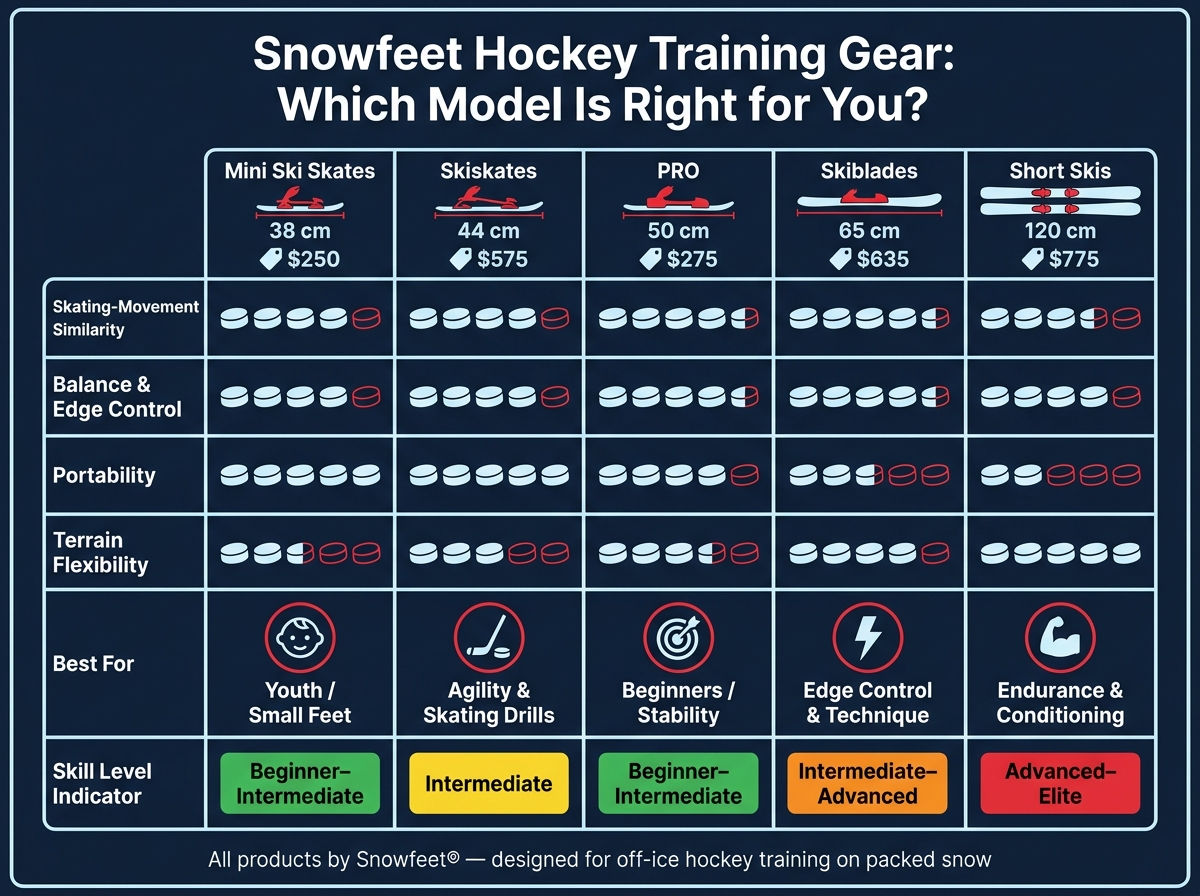
Snowfeet Hockey Training Gear Comparison Chart
Each Snowfeet* product is tailored to enhance hockey training in specific ways. Knowing the strengths and limitations of each model can help you pick the right one for your needs.
| Product | Skating-Movement Similarity | Balance & Edge Control | Portability | Terrain Flexibility |
|---|---|---|---|---|
| Skiskates 44 cm ($575+) | 4/5 | 4/5 | 5/5 | 3/5 |
| Mini Ski Skates 38 cm ($250+) | 4/5 | 4/5 | 5/5 | 3/5 |
| PRO 50 cm ($275) | 4.5/5 | 4.5/5 | 4/5 | 3.5/5 |
| Skiblades 65 cm ($635+) | 4.5/5 | 4.5/5 | 3/5 | 4/5 |
| Short Skis 120 cm ($775) | 3.5/5 | 3.5–5/5 | 2/5 | 5/5 |
Here’s a breakdown of what each model brings to the table:
The 38 cm Mini Ski Skates and 44 cm Skiskates are all about portability and mimicking skating movements. They’re perfect for drills like explosive starts, lateral shuffles, and crossovers. Lightweight and compact, they’re easy to carry around and use on groomed snow. However, they’re less effective on uneven terrain. These models are great for younger players or beginners looking to sharpen their skills.
The PRO 50 cm strikes a good balance between performance and portability. Its added length improves edge control and skating stride realism, while still being agile enough for drills like transitions and C-cuts. Priced at $275, it’s a solid choice for high school players or competitive adults with strong skating fundamentals. It does require better balance, so it’s best for those who are already confident on their skates.
The Skiblades 65 cm stand out for their ability to carve and hold edges during wide turns, making them ideal for practicing deliberate techniques on moderate slopes. Their longer size means they need more space, so they’re not the best choice for tight areas like a small driveway. They’re a great tool for improving on-ice performance when working on controlled, technical drills.
Finally, the Short Skis 120 cm are designed for advanced conditioning. They provide maximum glide and stability, making them highly effective for building power and endurance over longer distances. However, they’re the least portable and come with a steeper learning curve. These skis are best suited for elite players who are comfortable on snow and want to focus on serious conditioning. They’re a specialized training tool rather than a general-use option.
Each model has its niche, so consider your training goals and experience level when choosing.
Conclusion
Picking the right off-ice training gear comes down to your skill level, training goals, and how portable you need the gear to be.
For kids or anyone with smaller feet, the Snowfeet Mini Ski Skates (38 cm) are a great choice. At $250, they’re lightweight and easy to carry around. Beginners who need extra stability should check out the Snowfeet PRO (50 cm). It’s a solid option for learning the basics while still delivering consistent performance. As Snowfeet* puts it:
"Improved version of original Snowfeet* model, longer, more stable"
If you’re an intermediate player looking for sharper edge control and realistic skating strides, the Skiskates (44 cm) or Skiblades (65 cm) will fit the bill. And for elite athletes aiming to condition for endurance and power over longer distances, the Short Skis (120 cm) at $775 are hard to beat.
Here’s a quick guide to help you decide:
| Your Priority | Best Pick |
|---|---|
| Beginner / most stability | Snowfeet PRO 50 cm ($275) |
| Youth / Small feet | Mini Ski Skates 38 cm ($250) |
| Agility & skating drills | Skiskates 44 cm ($575+) |
| Edge control & technique | Skiblades 65 cm ($635+) |
| Endurance & conditioning | Short Skis 120 cm ($775) |
Unlike traditional skis or snowboards, Snowfeet* gear is designed to mimic hockey-specific movements. Standard skis are built for downhill speed, but they don’t offer the lateral agility or quick stops hockey players need. Each Snowfeet* model is crafted to replicate the pivots, stops, and strides of on-ice skating, making it a standout choice for hockey-focused training. Whether you’re working on agility, edge control, or endurance, there’s a Snowfeet* option tailored to your needs.
FAQs
Which Snowfeet* model feels most like hockey skates?
The 44 cm Snowfeet Skiskates* are perfect for capturing the feel of hockey skates on the slopes. With their compact 17.3-inch length, they mimic the dynamics of hockey, allowing for sharp edge control, explosive starts, and lateral push-offs. Unlike traditional skis that push you into a forward stance, these Skiskates encourage a centered, athletic posture. This design gives you the agility needed for quick direction changes - something you just don’t get with standard ski or snowboard gear.
What boots and safety gear do I need to use Snowfeet*?
You don’t need bulky, specialized boots to use Snowfeet*. A good pair of waterproof winter boots or snowboard boots with solid ankle support will do the trick. If you're planning to use them for hockey drills, stiffer boots are the way to go for better performance.
The adjustable bindings are designed to fit U.S. shoe sizes 6–13 and can easily be fine-tuned using a screwdriver. And don’t forget safety gear! Always suit up with a certified snow sports helmet, wrist guards, impact shorts, and knee and elbow pads to stay protected.
Can I train on flat snow, or do I need a hill?
You can practice using Snowfeet* on both flat snow and slopes, giving them a lot more flexibility compared to traditional skis or snowboards. Flat, packed snow - like what you'd find in a backyard or open field - is great for working on balance, skating strides, or even waddle skating. If you're ready to step it up, a gentle slope is ideal for trying out advanced moves like edge control or one-foot glides. Thanks to their compact size, Snowfeet* let you train pretty much anywhere, as long as there’s a few inches of snow.











ฝากความคิดเห็น
เว็บไซต์นี้ได้รับการคุ้มครองโดย hCaptcha และมีการนำนโยบายความเป็นส่วนตัวของ hCaptcha และข้อกำหนดในการใช้บริการมาใช้